
Le secrétaire permanent du ministère de l'Agriculture de la Tanzanie, l'honorable Andrew Massawe, a applaudi IITA’ses réalisations dans l'atteinte d'étapes clés dans le domaine agricole. Il a souligné le partenariat pour l'impact avec les acteurs agricoles nationaux, l'Institut de recherche agricole de Tanzanie (TARI) pour améliorer l'amélioration génétique, les innovations en matière de propagation des semences et la multiplication, ainsi que l'Institut officiel de certification des semences de Tanzanie (TOSCI) pour renforcer les capacités en matière de certification des semences.
Cela a été révélé lors d'une visite officielle de trois jours de la direction du pôle régional pour l'Afrique de l'Est de l'IITA au ministère de l'Agriculture et à la TARI du 15 au 17 mai. L'activité a été organisée et soutenue par le projet Building Economically Sustainable Seed Systems for Cassava, Phase II (BASICS-II), la Coopération Sud-Sud et triangulaire du Fonds international de développement agricole (FIDA-CST), et Initiative pour l'agronomie du manioc en Afrique projets. L'objectif de la visite était de faire le point avec le nouveau Secrétaire permanent, l'honorable Massawe, sur les engagements récents entre l'IITA et le Ministère et sur les domaines potentiels de partenariat. Le Directeur du pôle régional de l'IITA pour l'Afrique de l'Est Leena Tripathi a remercié le ministère de l'Agriculture pour son soutien et a partagé les expériences opérationnelles de l'IITA en Tanzanie concernant les défis administratifs, notamment des environnements propices et robustes pour le travail scientifique et les engagements.
“ J'ai visité un jour les centres TARI Kibaha et Mikocheni ; j'ai vu les affiches de l'IITA et j'étais curieux d'en savoir plus sur vous. Quand je suis arrivé au centre de Mikocheni, on m'a informés que nombre de leurs laboratoires ont été rendus possibles grâce au soutien de l'IITA ”, a déclaré l'Hon. Massawe.
Au cours de la réunion, Tripathi a noté que le travail et les efforts de l'IITA s'alignent généralement sur la stratégie de développement du gouvernement telle qu'elle est définie dans le Plan de développement du secteur agricole II (ASDP II). “ Nos activités de recherche pour les partenariats visent à accroître la sécurité alimentaire et sanitaire, à réduire la pauvreté rurale et la sous-nutrition, et à promouvoir la gestion durable des ressources naturelles ”, a-t-elle déclaré.
Toutefois, l'honorable Massawe a mis en avant les axes prioritaires à suivre pour atteindre un taux de croissance annuel de 10% dans le secteur agricole, qui fait vivre 65% de Tanzaniens.
“ Les domaines d'action prioritaires sont les systèmes semenciers, axés sur la sélection de nouvelles variétés et la multiplication, la recherche, le soutien aux jeunes pour bâtir un avenir meilleur (l'engagement des jeunes dans l'agro-industrie), les développements structurels pour les marchés et la mécanisation, ainsi que l'utilisation du modèle de partenariat public-privé ”, a-t-il souligné.
Le lendemain, l'équipe de l'IITA a rencontré le directeur général de la TARI, Geoffrey Mkamilo, au siège de la TARI à Makutopola, à Dodoma, pour l'informer de la transition vers Un seul CGIAR et discuter des moyens de renforcer le partenariat et d'améliorer la visibilité de l'IITA en Tanzanie. Mkamilo a conseillé une stratégie de plaidoyer pour accroître la visibilité des activités de l'IITA auprès des hautes instances gouvernementales par le biais de réunions et de visites fréquentes. Tripathi a mentionné que la TARI devrait reconnaître les contributions de l'IITA au développement de variétés et d'autres technologies développées conjointement lors de discussions avec les représentants du gouvernement. Il a également été convenu que nous devrions co-développer des propositions et co-mettre en œuvre des projets ou des programmes.
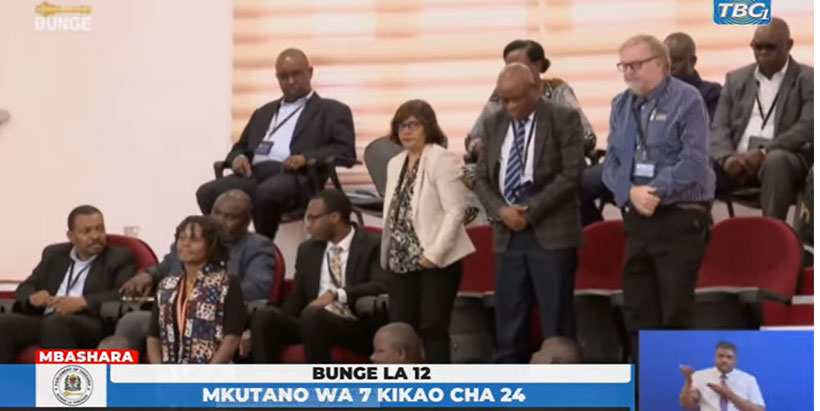
Le dernier jour, l'équipe de l'IITA a assisté à la session budgétaire parlementaire annuelle pour 2022/2023, au cours de laquelle le ministère de l'Agriculture a présenté son budget annuel. Durant cette session, organisée à l'intention des parties prenantes sur l'invitation du ministère de l'Agriculture, la présidente de l'Assemblée nationale de Tanzanie, l'honorable Tulia Ackson, a remercié plusieurs organisations et instituts internationaux, notamment l'IITA et d'autres centres du CGIAR, pour leur immense contribution au secteur du développement agricole du pays.
L'IITA entretient un excellent partenariat avec le ministère de l'Agriculture. L'Institut a soutenu différentes activités, notamment l'édition et l'impression de la Stratégie de développement du manioc de la Tanzanie 2020-2030 et d'autres ouvrages sur l'agriculture intelligente face au climat, ainsi qu'une collaboration pour améliorer les services de vulgarisation par le biais du renforcement des capacités du personnel agricole gouvernemental.
Contribué par Gloriana Ndibalema
Contribué par
Histoires récentes