
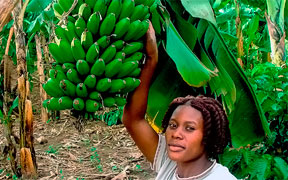
Millions of smallholder banana farmers in Tanzania and Ug anda are set to benefit from a new $13.8 million project to develop and distribute higher-yielding, disease-resistant hybrid banana varieties. The effort is being funded by a grant from the Bill & Melinda Gates Foundation to the International Institute of Tropical Agriculture (IITA). Rony Swennen, a professor at KU Leuven and head of banana breeding at IITA, is leading the project.
Bananas are both a food staple and an economic backbone in East and Central Africa, where over half of all cultivated l and is planted with bananas. Ug anda and Tanzania produce over 50% of all bananas grown in Africa. The region’s yearly banana crop is valued at $4.3 billion.
However, banana production in Ug anda and Tanzania achieves just 9% of its potential yield due to pests and diseases, posing a serious threat to the future sustainability of banana production in the region.
The new five-year project aims to dramatically upscale and speed up existing banana breeding efforts in the two countries. The researchers expect their hybrid banana varieties to have a 30% higher yield and a 50% higher resistance to at least three of the target pests and diseases compared to the current varieties grown by the farmers under the same on-farm conditions. The varieties will also meet over 90% of the quality traits for consumers found in the current cultivars, say the researchers.
“One of the most effective ways to increase production of any crop is to plant high-yielding varieties,” says Professor Rony Swennen. “This new project will exp and the on-going breeding efforts in Ug anda and Tanzania by developing research capacity and bringing expertise from other countries. Hence farmers will get faster access to high-yielding, high-resistance hybrids that are at the same time satisfactory to the consumer.”
The project builds on a very successful collaboration between IITA and Ug anda’s National Agricultural Research Organization (NARO), which culminated in the development of the first 26 high-yielding, and disease-resistant hybrid varieties, called NARITA varieties.
The project will also support the on-farm testing of these hybrids in Ug anda and Tanzania, will improve the technical capacity of the breeding programmes in the region, will strengthen partnerships with farmers, and will develop local human capacity by supporting 8 PhD projects and 5 MSc research projects.
The IITA, Bioversity International and the CGIAR Research Program on Roots, Tubers and Bananas are also providing substantial co-financing.
Pour plus d'informations, veuillez contacter :
Catherine Njuguna, c.njuguna@cgiar.org
À propos de l'IITA, www.iita.org
L'IITA est l'un des principaux partenaires de recherche au monde pour trouver des solutions à la faim, à la malnutrition et à la pauvreté. Son approche primée de recherche pour le développement (R4D) répond aux besoins de développement des pays tropicaux. L'IITA travaille avec des partenaires pour améliorer la qualité et la productivité des cultures, réduire les risques pour les producteurs et les consommateurs, et générer de la richesse à partir de l'agriculture. L'IITA est une organisation à but non lucratif fondée en 1967 et dirigée par un conseil d'administration. L'IITA travaille sur les cultures suivantes : le niébé, le soja, la banane/banane plantain, l'igname, le manioc et le maïs. L'IITA est membre du CGIAR, un partenariat mondial de recherche agricole pour un avenir alimentaire sûr.
Contribué par
Histoires récentes