
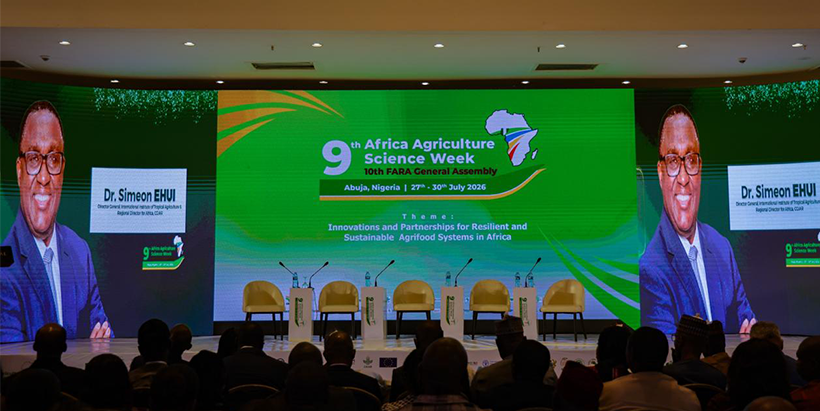
L'Afrique possède les talents scientifiques, les institutions et la capacité d'innovation nécessaires pour transformer ses systèmes agroalimentaires, mais des investissements accrus, des partenariats plus solides et un engagement à mettre à l'échelle les solutions locales sont nécessaires pour libérer tout le potentiel du continent.
C'était le message clé délivré lors du 9th Semaine de la science agricole en Afrique et 10th FARA Assemblée générale, où des dirigeants de tous les secteurs de la recherche agricole, des politiques et du développement en Afrique se sont réunis sous le thème “ Innovation et partenariats pour des systèmes agroalimentaires résilients et durables en Afrique ”.”
S'exprimant lors de son discours d'ouverture prononcé à l'inauguration, IITA Directeur général et CGIAR Directeur régional pour l'Afrique, Dr Siméon Ehui, a contesté la perception ancrée de longue date selon laquelle l'Afrique est simplement un bénéficiaire d'innovations agricoles. Il a soutenu au contraire que le continent génère de plus en plus de solutions de recherche pertinentes à l'échelle mondiale pour relever certains des défis les plus pressants de l'agriculture.
“ L'Afrique n'est pas seulement un bénéficiaire de l'innovation. L'Afrique est également une source de connaissances en matière de recherche, de technologies et de solutions d'intérêt mondial ”, a-t-il déclaré.
En appelant les gouvernements, les partenaires au développement, le secteur privé et les autres parties prenantes à repenser la manière dont le succès de la science agricole est défini, le Dr Ehui a souligné que l'innovation ne peut améliorer les moyens de subsistance, renforcer les systèmes alimentaires et avoir un impact si elle n'est pas accessible ou si elle ne répond pas aux réalités locales.
Soulignant la nécessité urgente de répondre au changement climatique, à la dégradation des terres, à la perte de biodiversité et à l'insécurité alimentaire et nutritionnelle croissante par le biais d'approches scientifiques plaçant les agriculteurs au centre de l'innovation, le Dr Ehui a exhorté les parties prenantes à regarder au-delà des obstacles et à reconnaître les plus grands atouts de l'Afrique : son talent scientifique, sa population jeune, sa riche biodiversité, sa connectivité numérique croissante et ses millions d'agriculteurs innovants.
Rassembler ces atouts grâce à la science, à l'investissement, aux politiques et à des institutions solides, a-t-il affirmé, est essentiel pour bâtir des systèmes agroalimentaires résilients et durables.
“ L'innovation doit commencer par le problème, et non par la technologie ”, a-t-il fait remarquer, en soulignant que les chercheurs, les agents de vulgarisation et les communautés agricoles devraient concevoir conjointement des solutions dès les premiers stades de la recherche.
Il a souligné les scientifiques africains qui développent des variétés de cultures résistantes au climat, des méthodes de lutte biologique contre les ravageurs, des plateformes de conseil numérique et des pratiques de gestion durable des sols, tandis que les agriculteurs continuent d'adapter les connaissances scientifiques avec des générations d'expérience autochtone. La prochaine étape, a-t-il affirmé, est de renforcer les institutions africaines, d'investir dans un leadership scientifique dirigé par l'Afrique et de veiller à ce que le continent contribue stratégiquement au programme mondial de recherche agricole.
S'exprimant sur les approches éprouvées pour relever les défis existants, le Dr Ehui a appelé à un investissement accru dans la gestion intégrée de la fertilité des sols, l'utilisation efficace des engrais, l'agroforesterie et la restauration des paysages dégradés afin d'améliorer à la fois la productivité et la durabilité environnementale.
Pour démontrer que la science fait déjà une différence, il a cité des initiatives telles que le partenariat multiple Technologies pour la Transformation Agricole en Afrique (TAAT), le programme d'amélioration du manioc de l'IITA et le pôle régional pour les engrais et la santé des sols pour l'Afrique de l'Ouest et le Sahel comme preuve que la recherche collaborative produit des résultats à grande échelle.
Ces réussites démontrent que l'Afrique ne manque pas d'innovations avérées ; le plus grand défi est de les déployer à grande échelle grâce à des partenariats efficaces, des systèmes semenciers solides, des politiques favorables et un investissement soutenu, a-t-il fait remarquer.
Il a souligné que les partenariats impliquant les gouvernements, les institutions de recherche nationales, le CGIAR, les universités, les partenaires au développement, le secteur privé et les agriculteurs détermineraient si les avancées scientifiques profitent à des millions de personnes.
“ Aucune institution ne peut transformer à elle seule les systèmes agroalimentaires de l'Afrique. Nous devons travailler ensemble pour co-concevoir des solutions, renforcer les systèmes nationaux et accélérer l'adoption de technologies qui répondent aux réalités des agriculteurs ’, a-t-il déclaré.
Soulignant l'importance de la gestion des connaissances et de l'apprentissage adaptatif, il a fait remarquer que la recherche ne crée de la valeur que lorsqu'elle est accessible, comprise et appliquée.
Tourné vers l'avenir, il a annoncé que le CGIAR élabore une nouvelle stratégie pour l'Afrique, conçue à travers une large consultation avec les parties prenantes africaines afin de garantir que les futurs investissements s'alignent sur les priorités nationales et renforcent le leadership scientifique africain.
Il a invité les délégués à participer au processus de consultation, le décrivant comme une opportunité de façonner une vision menée par l'Afrique pour la recherche et l'innovation agricoles.
En conclusion de son allocution, il a exhorté les participants à dépasser les discussions de la conférence pour passer à des actions mesurables.
“ L’urgence de nos défis exige des actes ”, a-t-il déclaré, en appelant à des engagements concrets pour restaurer les terres dégradées, renforcer les institutions de recherche, améliorer la sécurité alimentaire et créer des opportunités pour la population croissante de l’Afrique.
Le discours du Dr Ehui s'est conclu par un appel au continent à passer “ de solutions importées à des innovations menées par l'Afrique ” et des promesses de transformation à des résultats mesurables.
Contribué par
Anu Oyeleye et Timilehin Osunde