
IITA NEWS

CGIAR Africa director calls for African-led innovation to transform agrifood systems at AASW9
August 4, 2026
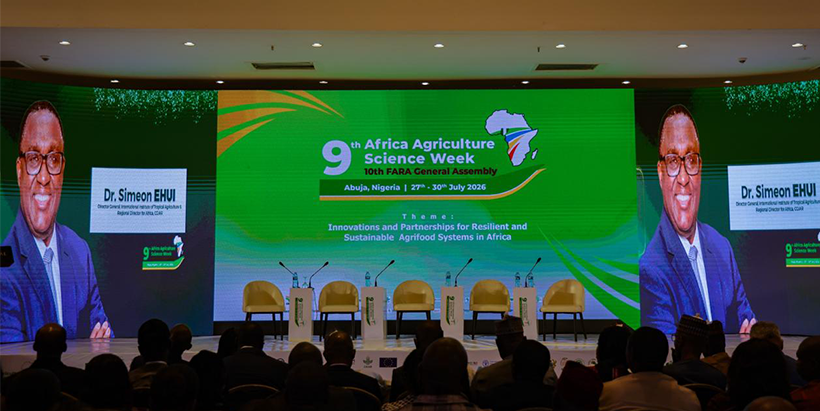
A virtual keynote address by IITA Director General and CGIAR Regional Director for Continental Africa, Dr Simeon Ehui, during the 9th Africa Agriculture Science Week (AASW9) and 10th FARA General Assembly in Abuja, Nigeria.

Africa has the scientific talent, institutions and innovative capacity needed to transform its agrifood systems, but greater investment, stronger partnerships and a commitment to scaling homegrown solutions are needed to unlock the continent’s full potential.

This was the key message delivered during the 9th Africa Agriculture Science Week and 10th FARA General Assembly, where leaders from across Africa’s agricultural research, policy, and development sectors gathered under the theme “Innovation and Partnerships for Resilient and Sustainable Agrifood Systems in Africa.”

Speaking during his keynote address delivered at the opening, IITA Director General and CGIAR Regional Director for Africa, Dr Simeon Ehui, challenged the long-held perception that Africa is merely a recipient of agricultural innovations. He argued instead that the continent is increasingly generating globally relevant research solutions to some of agriculture’s most pressing challenges.

“Africa is not only a beneficiary of innovation. Africa is also a source of globally relevant research knowledge, technologies, and solutions,” he said.

Calling on governments, development partners, the private sector, and other stakeholders to rethink how success in agricultural science is defined, Dr Ehui stressed that innovation cannot improve livelihoods, strengthen food systems, and deliver impact if it is not accessible or if it fails to respond to local realities.

Highlighting the urgent need to respond to climate change, land degradation, biodiversity loss, and rising food and nutrition insecurity through science-driven approaches that place farmers at the center of innovation, Dr Ehui urged stakeholders to look beyond the obstacles and recognize Africa’s greatest strengths: its scientific talent, youthful population, rich biodiversity, growing digital connectivity, and millions of innovative farmers.

Bringing these assets together through science, investment, policy, and strong institutions, he said, is essential to building resilient and sustainable agrifood systems.

“Innovation must begin with the problem, not with the technology,” he noted, emphasizing that researchers, extension workers and farming communities should co-design solutions from the earliest stages of research.

He pointed to African scientists developing climate-resilient crop varieties, biological pest controls, digital advisory platforms, and sustainable soil management practices, while farmers continue adapting scientific knowledge with generations of indigenous experience. The next step, he said, is to strengthen African institutions, invest in Africa-led scientific leadership, and ensure the continent strategically contributes to the global agricultural research agenda.

Speaking on proven approaches in addressing existing challenges, Dr Ehui called for greater investment in integrated soil fertility management, efficient fertilizer use, agroforestry, and restoration of degraded landscapes to improve both productivity and environment sustainability.

To demonstrate that science is already making a difference, he cited initiatives such as the multi-partner Technologies for African Agricultural Transformation (TAAT), IITA’s cassava improvement program, and the Regional Hub for Fertilizer and Soil Health for West Africa and the Sahel as evidence that collaborative research is delivering impact at scale.

These successes demonstrate that Africa does not lack proven innovations; the greater challenge is scaling through effective partnerships, strong seed systems, enabling policies, and sustained investment, he noted.

He emphasized that partnerships involving governments, national research institutions, CGIAR, universities, development partners, the private sector, and farmers would determine whether scientific breakthroughs reach millions of people.

“No single institution can transform Africa’s agrifood systems alone. We must work together to co-design solutions, strengthen national systems, and accelerate the adoption of technologies that respond to farmers’ realities,” he said.

Highlighting the importance of knowledge management and adaptive learning, he noted that research creates value only when it is accessible, understood, and applied.

Looking ahead, he announced that CGIAR is developing a new Africa Strategy designed through broad consultation with African stakeholders to ensure future investments align with national priorities and strengthen African scientific leadership.

He invited delegates to participate in the consultation process, describing it as an opportunity to shape an Africa-led vision for agricultural research and innovation.

Closing the address, he urged participants to move beyond conference discussions toward measurable action.

“The urgency of our challenges demands implementation,” he said, calling for concrete commitments that will restore degraded lands, strengthen research institutions, improve food security, and create opportunities for Africa’s growing population.

Dr Ehui’s speech concluded with a call for the continent to move “from imported solutions to African-led innovations” and from promises of transformation to measurable results.


Scroll to Top
Olaosebikan, Olamide

Olamide Deborah Nwanze is a Senior Research Associate specializing in gender mainstreaming research to inform participatory and inclusive breeding, variety development, and seed systems policies regarding root, tuber, and banana (RTB) crops in the International Institute of Tropical Agriculture Headquarters, Ibadan, Nigeria. She is a PhD candidate at the University of Ibadan and holds an MSc and B. Agric in Agricultural Extension and Rural Development. Olamide is a fellow of the African Women in Agricultural Research and Development – Gender Responsive Agricultural Systems Policy (AWARD-GRASP) and the Gender Responsive Researchers Equipped for Agricultural Transformation (GREAT). She seeks to apply her gender-mainstreaming learnings, gender-responsive research, and policy development, and review expertise to facilitate women, youth, children, and vulnerable social group’s access to and adoption of agricultural Innovations that guarantee food, nutrition, income, and livelihood security in Africa. Her current roles include mentoring research fellows, development of guides and training manuals, implementation and adaptation of gender frameworks and tools, value chain actors’ engagement as citizen science partners, policy review and redesign, data management, and analysis. Her current research explores mixed methods and participatory and interdisciplinary approaches to capture and highlight gender dynamics, needs, preferences, and challenges stakeholders face within the agricultural livelihood value chain to prioritize gender-inclusive strategies in breeding programs, policy design, and implementation.

At IITA, she contributes to the implementation of the CGIAR Accelerated Breeding Initiative and Genetic Innovation Programs; participatory and gender research within the NextGen CassavaHarvestPlusRTBFoods, and Tricot-ClimMob 1000Farms Projects; and gender knowledge communication via the G-LENS webinar series, video documentary, policy briefspublications, and blogs.


Recent publications

de Sousa, K., van Etten, J., Manners, R. Bello, A., Teeken, B., Olaosebikan, O., et al. 2024. The tricot approach: an agile framework for decentralized on-farm testing supported by citizen science. A retrospective. Agron. Sustain. Dev. 44, 8. https://doi.org/10.1007/s13593-023-00937-1

Madu, T., Onwuka, S., Nwafor, S., Onyemauwa, N., Ejechi, M., Ofoeze, M., Ukeje, B., Eluagu, C., Olaosebikan, O., Okoye, B., 2024. Gender-Inclusive Consumer Studies Improve Cassava Breeding in Nigeria in: Frontiers in Sociology, volume 9, number: 1224504, doi: 10.3389/fsoc.2024.1224504

Olaosebikan, O.; Bello, A.; Utoblo, O.; Okoye, B.; Olutegbe, N.; Garner, E.; Teeken, B.; Bryan, E.; Forsythe, L.; Cole, S.; Madu, T. 2023.  Stressors and Resilience within the Cassava Value Chain in Nigeria: Preferred Cassava Variety Traits and Response Strategies of Men and Women to Inform Breeding. Sustainability 15, 7837. https://doi.org/10.3390/su15107837

Okoye, B., Ofoeze, M., Ejechi, M., Onwuka, S., Nwafor, S., Onyemauwa, N., Ukeje, B., Eluagu, C., Obidiegwu, J.*, Olaosebikan, O., Madu, T.* 2023. Prioritizing preferred traits in the yam value chain in Nigeria: a gender situation analysis in: Frontiers in Sociology, volume 8, number: 1232626, pages 1 – 9, ISSN 2297-7775, 2023. https://www.frontiersin.org/articles/10.3389/fsoc.2023.1232626/full

Olaosebikan, O., Bello, A. A., de Sousa, K., Ndjouenkeu, R., Adesokan, M., Alamu, E. O., Agbona, A., van Etten, J., Kegah, F. N.*, Dufour, D., Bouniol, A., Teeken, B. 2023. Consumer acceptability of cassava gari-eba food products across cultural and environmental settings using the triadic comparison of technologies approach (tricot) in: Journal of the Science of Food and Agriculture,

Teeken, B., Olaosebikan, O., Bello, A. A., Madu, T.*, Cole, S. M. 2023. Qualitative assessment on the positionality and preferences of dyads in relation to cassava-related activities: working with tricot trial citizen scientists https://hdl.handle.net/10568/138326 Type: Manual

Bouniol, A., Ceballos, H., Bello, A. A., Teeken, B., Olaosebikan, O., Owoade, D., Agbona, A., Fotso Kuate, A., Madu, T.*, Okoye, B.*, Ofoeze, M.*, Nwafor, S.*, Onyemauwa, N.*, Adinsi, L.*, Forsythe, L., Dufour, D. 2023. Varietal impact on women’s labour, workload and related drudgery in processing root, tuber and banana crops: focus on cassava in sub-Saharan Africa in: Journal of the Science of Food and Agriculture, pages 1 – 25, ISSN 0022-5142,

Bello, A. A., Agbona, A., Olaosebikan, O., Edughaen, G., Dufour, D., Bouniol, A., Iluebbey, P., Ndjouenkeu, R.*, Rabbi, I. Y., Teeken, B. 2023. Genetic and environmental effects on processing productivity and food product yield: drudgery of women’s work in: Journal of the Science of Food and Agriculture, pages 1 – 32, ISSN 0022-5142, 5

Cavicchioli, M., Zimbiti, T., Teeken, B., Nwanze, D.O., Liani, M., Parkes, E. & Bello, A. 2023. IITA-Gender Responsive Breeding Training Report. Genetic Resources Center, IITA-HQ, Ibadan, 21-23 September, 2022. Ibadan, Nigeria: IITA, (34 p.).https://hdl.handle.net/10568/131368

Agbona, A. Peteti P., Teeken B., Olaosebikan O. Bello, A. A., Parkes, E., Rabbi, I. Y., Mueller, L., Egesi, C., Kulakow, P. 2022. Data Management in Multi-disciplinary African RTB Crop Breeding Programs. In: Williamson, H.F., Leonelli, S. (eds) Towards Responsible Plant Data Linkage: Data Challenges for Agricultural Research and Development. Springer, Cham. https://doi.org/10.1007/978-3-031-13276-6_5

Lora Forsythe, Pricilla Marimo, Sarah Mayanja, Olamide D. Olaosebikan, Esme Stuart, Bela Teeken, Benjamin Okoye, Tessy Madu, (2021). Cross-product Gender Analysis of RTBfoods Step 2 Gendered Food Mapping on RTB Products. Understanding the Drivers of Trait Preferences and the Development of Multi-user RTB Product Profiles, WP1. London, UK: RTBfoods Field Scientific Report, 30 p.

Teeken, B., Garner, E., Agbona, A., Balogun, I., Olaosebikan, O., Bello, A., Madu, T., Okoye, B., Egesi, C., Kulakow, P. and Tufan, H.A. 2021. Beyond “Women’s Traits”: Exploring How Gender, Social Difference, and Household Characteristics Influence Trait Preferences. Frontiers Sustainable Food Systems 5:740926. https://doi.org/10.3389/fsufs.2021.740926

Teeken, B., Agbona, A., Bello, A., Olaosebikan, O., Alamu, E., Adesokan, M., Awoyale, W., Madu, T., Okoye, B., Chijioke, U., Owoade, D., Okoro, M., Bouniol, A., Dufour, D., Hershey, C., Rabbi, I., Maziya‐Dixon, B., Egesi, C., Tufan, H. and Kulakow, P. (020. Understanding cassava varietal preferences through pairwise ranking of gari‐eba and fufu prepared by local farmer–processors. Int J Food Sci Technol. https://doi.org/10.1111/ijfs.14862

Bela Teeken, Olamide Olaosebikan, Ireti Balogun, Benjamin Okoye, Tessy Madu, Steven Cole, Abolore Bello, Elizabeth Parkes. (2020). Piloting the G+ customer and product profile tools for gender-responsive cassava breeding in Nigeria. Nigeria: International Institute of Tropical Agriculture (IITA). https://hdl.handle.net/20.500.11766/13000