
IITA NEWS

Africa’s agricultural future hinges on scaling proven innovations, leaders say at AASW9
August 4, 2026
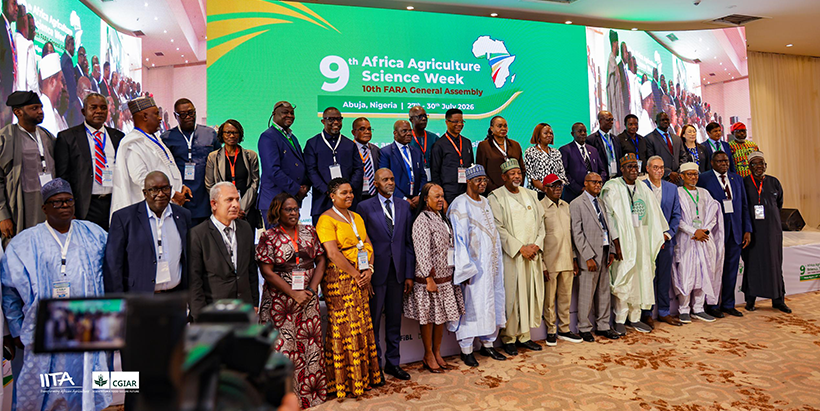
The Honorable Minister of Agriculture and Food Security, Senator Abubakar Kyari, the Honorable Minister of Livestock Development, Idi Mukhtar Maiha; FARA Board Chairperson Ms. Bongiwe Njobe, FARA Board members, and delegates from across Africa at the 9th Africa Agriculture Science Week (AASW9) and the 10th FARA General Assembly in Abuja, Nigeria. 

Africa is not short of agricultural innovations. From climate-smart technologies and improved crop varieties to digital advisory services and livestock innovations, the continent has developed solutions that can transform its food systems at scale. Yet millions of smallholder farmers remain beyond their reach.

Bridging this gap—moving these proven technologies from research to the last mile users— emerged as the defining theme on the opening and first day of the 9th Africa Agriculture Science Week (AASW9) and the 10th FARA General Assembly.

Bringing together heads of government, policymakers, scientists, development partners, private sector actors, and young innovators from across the continent, the event opened with a shared call to shift Africa’s agricultural agenda from developing new technologies to delivering greater impact through stronger partnerships, investment, and implementation.

As host nation, Nigeria set the tone for the week. President Bola Ahmed Tinubu, represented by the Honorable Minister of Livestock Development, Idi Mukhtar Maiha, said that the establishment of the Federal Ministry of Livestock Development demonstrates Nigeria’s commitment to unlocking the livestock sector’s potential to strengthen food security, create jobs, and drive economic growth.

The Honorable Minister of Agriculture and Food Security, Senator Abubakar Kyari welcomed delegated from across Africa, reaffirming Nigeria’s commitment to regional collaboration in advancing agricultural transformation. Senator Adams Oshiomhole also called for sustained political commitment and increased investment, stressing that agriculture must remain central to Africa’s long-term development agenda.

Speaking on behalf of the African Union Commissioner for Agriculture, Rural Development, Blue Economy and Sustainable Environment, Dr Janet Edeme emphasized that achieving the ambitions of Agenda 2063 and the Comprehensive Africa Agriculture Development Programme (CAADP) will require stronger institutions, enabling policies, and sustainable financing. She also highlighted the importance of empowering women and young people—not simply as beneficiaries of development programs, but as leaders driving Africa’s agricultural transformation.

At the opening, the keynote address reinforced the conference’s central message. IITA Director General and CGIAR Regional Director for Africa, Dr Simeon Ehui, argued that Africa already possesses the scientific expertise, biodiversity, research institutions, and farming communities needed to transform its agrifood systems. The continent’s greatest challenge, he noted, is ensuring that scientific breakthroughs are translated into solutions that are accessible, affordable, locally relevant, and adopted at scale.

He called for stronger connections between science, policy, investment, markets, and local knowledge, urging stakeholders to move beyond fragmented projects towards coordinated scaling and delivery systems that can generate measurable impact for farmers and food systems across Africa.

That call for action resonated throughout the opening ceremony. FARA Director General, Dr Aggrey Agumya, described science, innovation, and collaboration as the foundations of resilient agrifood systems, while urging governments, researchers, and development partners to deepen partnerships that accelerate the adoption of proven technologies on the continent.

Similarly, Dr Debisi Araba, Managing Director of, AKADEMIYA2063, reminded participants that Africa’s food sufficiency will ultimately be judged not by the quality of its strategies, but by how effectively they are implemented.

The conversations continued in a series of technical and side events that translated these high-level priorities into practical action. A session on Gender Equality in Food, Land and Water Systems highlighted the importance of evidence-based policies that expand women’s and young people’s access to innovation, finance, leadership opportunities, and productive resources, recognizing inclusion as a prerequisite for resilient and sustainable food systems.

Youth leadership also took center stage during the Youth4Nutrition: Inclusive Science and Innovation from Soil to Plate side event, where young scientists and agripreneurs displayed innovations designed to improve nutrition and strengthen food systems. The launch of the Youth4Nutrition Nigeria Chapter further signaled growing momentum to place young people at the forefront of Africa’s agricultural transformation.

Other discussions explored food safety and the Technologies for African Agricultural Transformation (TAAT) program, demonstrating how strategic partnerships are helping move research beyond experimental trials into practical solutions benefiting millions of farmers. Across the exhibition halls, researchers, policymakers, investors, entrepreneurs, and development partners exchanged ideas, showcased innovations, and forged new collaborations aimed at accelerating agricultural transformation across the continent.

As the first day concluded, one message echoed consistently across plenary sessions, technical discussions, and exhibition spaces: Africa’s agricultural transformation will not be determined by the number of innovations it produces, but by how effectively existing solutions reach the farmers and communities they are designed to serve. Scaling what already works, participants agreed, is now the continent’s most urgent agricultural priority.


Scroll to Top
Olaosebikan, Olamide

Olamide Deborah Nwanze is a Senior Research Associate specializing in gender mainstreaming research to inform participatory and inclusive breeding, variety development, and seed systems policies regarding root, tuber, and banana (RTB) crops in the International Institute of Tropical Agriculture Headquarters, Ibadan, Nigeria. She is a PhD candidate at the University of Ibadan and holds an MSc and B. Agric in Agricultural Extension and Rural Development. Olamide is a fellow of the African Women in Agricultural Research and Development – Gender Responsive Agricultural Systems Policy (AWARD-GRASP) and the Gender Responsive Researchers Equipped for Agricultural Transformation (GREAT). She seeks to apply her gender-mainstreaming learnings, gender-responsive research, and policy development, and review expertise to facilitate women, youth, children, and vulnerable social group’s access to and adoption of agricultural Innovations that guarantee food, nutrition, income, and livelihood security in Africa. Her current roles include mentoring research fellows, development of guides and training manuals, implementation and adaptation of gender frameworks and tools, value chain actors’ engagement as citizen science partners, policy review and redesign, data management, and analysis. Her current research explores mixed methods and participatory and interdisciplinary approaches to capture and highlight gender dynamics, needs, preferences, and challenges stakeholders face within the agricultural livelihood value chain to prioritize gender-inclusive strategies in breeding programs, policy design, and implementation.

At IITA, she contributes to the implementation of the CGIAR Accelerated Breeding Initiative and Genetic Innovation Programs; participatory and gender research within the NextGen CassavaHarvestPlusRTBFoods, and Tricot-ClimMob 1000Farms Projects; and gender knowledge communication via the G-LENS webinar series, video documentary, policy briefspublications, and blogs.


Recent publications

de Sousa, K., van Etten, J., Manners, R. Bello, A., Teeken, B., Olaosebikan, O., et al. 2024. The tricot approach: an agile framework for decentralized on-farm testing supported by citizen science. A retrospective. Agron. Sustain. Dev. 44, 8. https://doi.org/10.1007/s13593-023-00937-1

Madu, T., Onwuka, S., Nwafor, S., Onyemauwa, N., Ejechi, M., Ofoeze, M., Ukeje, B., Eluagu, C., Olaosebikan, O., Okoye, B., 2024. Gender-Inclusive Consumer Studies Improve Cassava Breeding in Nigeria in: Frontiers in Sociology, volume 9, number: 1224504, doi: 10.3389/fsoc.2024.1224504

Olaosebikan, O.; Bello, A.; Utoblo, O.; Okoye, B.; Olutegbe, N.; Garner, E.; Teeken, B.; Bryan, E.; Forsythe, L.; Cole, S.; Madu, T. 2023.  Stressors and Resilience within the Cassava Value Chain in Nigeria: Preferred Cassava Variety Traits and Response Strategies of Men and Women to Inform Breeding. Sustainability 15, 7837. https://doi.org/10.3390/su15107837

Okoye, B., Ofoeze, M., Ejechi, M., Onwuka, S., Nwafor, S., Onyemauwa, N., Ukeje, B., Eluagu, C., Obidiegwu, J.*, Olaosebikan, O., Madu, T.* 2023. Prioritizing preferred traits in the yam value chain in Nigeria: a gender situation analysis in: Frontiers in Sociology, volume 8, number: 1232626, pages 1 – 9, ISSN 2297-7775, 2023. https://www.frontiersin.org/articles/10.3389/fsoc.2023.1232626/full

Olaosebikan, O., Bello, A. A., de Sousa, K., Ndjouenkeu, R., Adesokan, M., Alamu, E. O., Agbona, A., van Etten, J., Kegah, F. N.*, Dufour, D., Bouniol, A., Teeken, B. 2023. Consumer acceptability of cassava gari-eba food products across cultural and environmental settings using the triadic comparison of technologies approach (tricot) in: Journal of the Science of Food and Agriculture,

Teeken, B., Olaosebikan, O., Bello, A. A., Madu, T.*, Cole, S. M. 2023. Qualitative assessment on the positionality and preferences of dyads in relation to cassava-related activities: working with tricot trial citizen scientists https://hdl.handle.net/10568/138326 Type: Manual

Bouniol, A., Ceballos, H., Bello, A. A., Teeken, B., Olaosebikan, O., Owoade, D., Agbona, A., Fotso Kuate, A., Madu, T.*, Okoye, B.*, Ofoeze, M.*, Nwafor, S.*, Onyemauwa, N.*, Adinsi, L.*, Forsythe, L., Dufour, D. 2023. Varietal impact on women’s labour, workload and related drudgery in processing root, tuber and banana crops: focus on cassava in sub-Saharan Africa in: Journal of the Science of Food and Agriculture, pages 1 – 25, ISSN 0022-5142,

Bello, A. A., Agbona, A., Olaosebikan, O., Edughaen, G., Dufour, D., Bouniol, A., Iluebbey, P., Ndjouenkeu, R.*, Rabbi, I. Y., Teeken, B. 2023. Genetic and environmental effects on processing productivity and food product yield: drudgery of women’s work in: Journal of the Science of Food and Agriculture, pages 1 – 32, ISSN 0022-5142, 5

Cavicchioli, M., Zimbiti, T., Teeken, B., Nwanze, D.O., Liani, M., Parkes, E. & Bello, A. 2023. IITA-Gender Responsive Breeding Training Report. Genetic Resources Center, IITA-HQ, Ibadan, 21-23 September, 2022. Ibadan, Nigeria: IITA, (34 p.).https://hdl.handle.net/10568/131368

Agbona, A. Peteti P., Teeken B., Olaosebikan O. Bello, A. A., Parkes, E., Rabbi, I. Y., Mueller, L., Egesi, C., Kulakow, P. 2022. Data Management in Multi-disciplinary African RTB Crop Breeding Programs. In: Williamson, H.F., Leonelli, S. (eds) Towards Responsible Plant Data Linkage: Data Challenges for Agricultural Research and Development. Springer, Cham. https://doi.org/10.1007/978-3-031-13276-6_5

Lora Forsythe, Pricilla Marimo, Sarah Mayanja, Olamide D. Olaosebikan, Esme Stuart, Bela Teeken, Benjamin Okoye, Tessy Madu, (2021). Cross-product Gender Analysis of RTBfoods Step 2 Gendered Food Mapping on RTB Products. Understanding the Drivers of Trait Preferences and the Development of Multi-user RTB Product Profiles, WP1. London, UK: RTBfoods Field Scientific Report, 30 p.

Teeken, B., Garner, E., Agbona, A., Balogun, I., Olaosebikan, O., Bello, A., Madu, T., Okoye, B., Egesi, C., Kulakow, P. and Tufan, H.A. 2021. Beyond “Women’s Traits”: Exploring How Gender, Social Difference, and Household Characteristics Influence Trait Preferences. Frontiers Sustainable Food Systems 5:740926. https://doi.org/10.3389/fsufs.2021.740926

Teeken, B., Agbona, A., Bello, A., Olaosebikan, O., Alamu, E., Adesokan, M., Awoyale, W., Madu, T., Okoye, B., Chijioke, U., Owoade, D., Okoro, M., Bouniol, A., Dufour, D., Hershey, C., Rabbi, I., Maziya‐Dixon, B., Egesi, C., Tufan, H. and Kulakow, P. (020. Understanding cassava varietal preferences through pairwise ranking of gari‐eba and fufu prepared by local farmer–processors. Int J Food Sci Technol. https://doi.org/10.1111/ijfs.14862

Bela Teeken, Olamide Olaosebikan, Ireti Balogun, Benjamin Okoye, Tessy Madu, Steven Cole, Abolore Bello, Elizabeth Parkes. (2020). Piloting the G+ customer and product profile tools for gender-responsive cassava breeding in Nigeria. Nigeria: International Institute of Tropical Agriculture (IITA). https://hdl.handle.net/20.500.11766/13000