
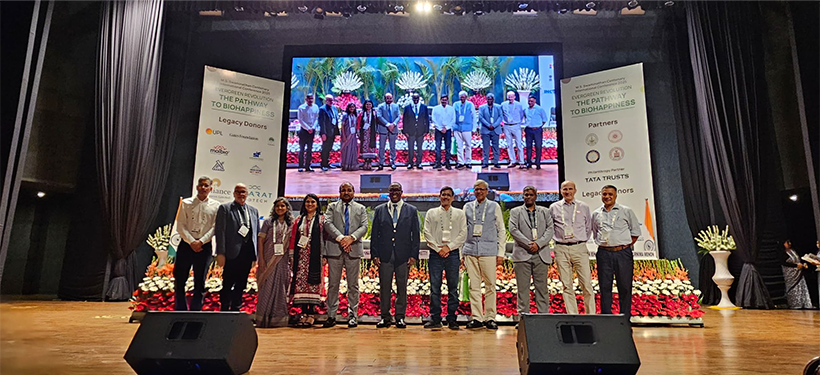
From June 3 to 6, 2025, Dr Siméon Ehui, IITA Directeur général et CGIAR Regional Director for Continental Africa, visited the IITA Station in Cotonou, Benin. The visit provided a platform to interact with staff, assess ongoing research innovations, and explore opportunities to further strengthen IITA’s agricultural research efforts and partnerships in the Republic of Benin.
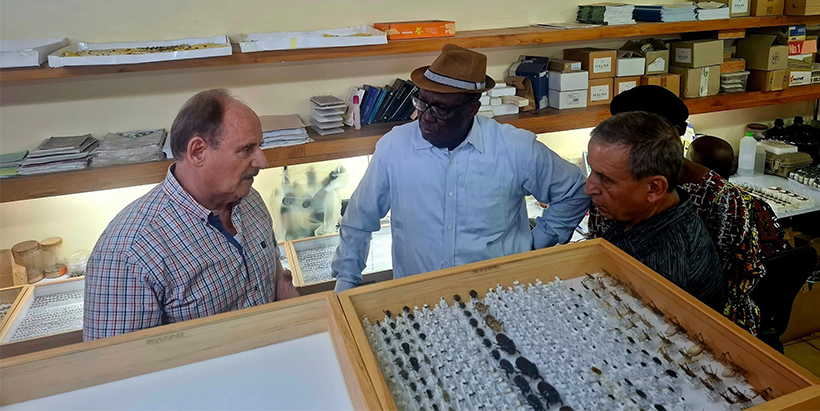
DG Ehui, accompanied by Lahcen Ennahli, Special Advisor to the DG, Toyin Oke, Manager, Resource Mobilization, Protocol and External Liaison (RMPEL), and Sukurate Suleman, Executive Assistant to the DG, toured the Arthropod Biodiversity Research and Conservation Center—the largest insect and mite reference collection in West Africa.
With over 385,000 insect specimens and 30,000 mite slides, the unit is vital in identifying invasive species and supporting the region’s biodiversity efforts. The DG lauded the team’s work and stressed the importance of increasing the visibility of this “hidden jewel” through enhanced communication and completing the DNA fingerprinting of more than 6,000 identified arthropod species.
It is currently estimated that 40-50% of the sub-region’s known arthropod biodiversity is preserved in this collection. IITA’s effort in this area has been instrumental in the interception of major invasive alien species, such as the papaya mealybug and the fall armyworm. It continues to provide an efficient arthropod identification service in West Africa.
He also visited the Agro-Eco-Health platform and lab, where IITA Molecular Entomologist Dr Rousseau Djouaka explained IITA’s work in a circular bio-economy using Black Soldier Flies (BSF). DG Ehui witnessed the full production cycle—from organic waste recycling to the production of high-protein animal feed and compost—highlighting how innovation intersects with sustainability and food systems.
At the Chemical Ecology research and training lab, IITA Benin Country representative Manuele Tamò and Entomologist and Chemical Ecologist Hilaire Kpongbe gave DG Ehui a tour of the facilities, focusing on volatile extraction, GC-MS analysis, and behavioral assays using olfactometers and wind tunnels. These technologies support agricultural and medical entomology solutions, including identifying pheromones of disease vectors like black flies.
During the visit, DG Ehui engaged with the TAAT Clearinghouse team, expressing interest in the TAAT e-catalog and the ENABLE TAAT youth agripreneurship initiative. He applauded the team for their impactful collaborations with the African Development Bank (AfDB) and Islamic Development Bank (IsDB).
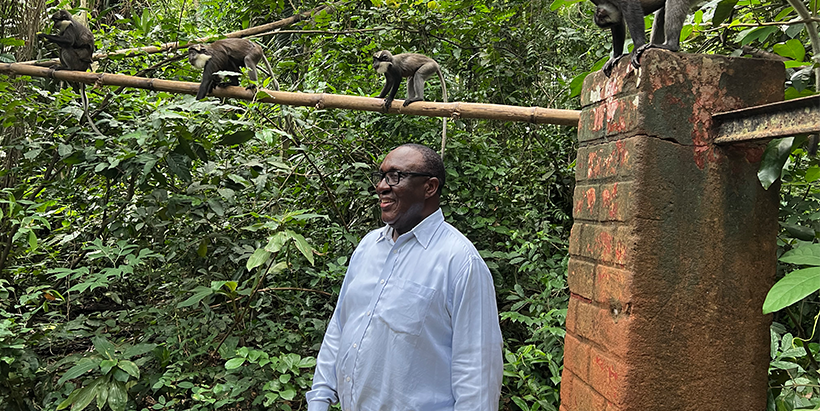
A key highlight of the visit was the trip to the Drabo Gbo forest sanctuary—home to endangered red-bellied monkeys and rare tree species, where IITA Emeritus Scientist Peter Neuenschwander narrated the forest’s journey from fallow land to a 14-hectare conservation zone. Discussions with DG Ehui explored strategies for preserving its ecological, educational, and research value amid climate-related challenges.
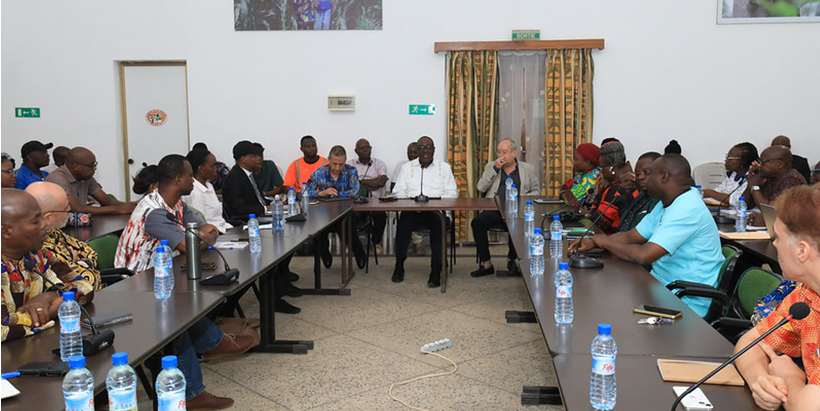
In a town hall with staff, DG Ehui shared updates from IITA and CGIAR, stressing the need for collaboration with other CGIAR centers and strengthening partnerships, especially with national systems and technology adoption in Benin. He emphasized support for youth initiatives, conservation research, and expanding access to technologies such as Semi-Autotrophic Hydroponics (SAH), biofortified crops, and Aflasafe.
Contribué par ‘Timilehin Osunde
Contribué par
Histoires récentes