
The Drabo Forest Reserve (DFR), one of the remaining patches of secondary rainforests in Benin Republic, was the site of a recent bird survey conducted by Centre forestier de l'IITA Manager Adewale Awoyemi. The survey was funded by the A.G. Leventis Foundation.
The DFR is a regenerating secondary rainforest rehabilitated and managed by the IITA emeritus scientist Peter Neuenschwander on behalf of the Institute. Located in Drabo Gbo and Dodja villages near Calavi, the DFR is strictly reserved for biodiversity conservation in the immensely degraded area. Despite its small size and persistent threats from urbanization and unsustainable farming, the DFR supports populations of three monkey species, including the critically endangered Red-bellied Monkey Cercopithecus erythrogaster, the Mona Monkey Cercopithecus mona, and the Green Monkey Chlorocebus sabaeus, and many more mammals, reptiles, and, of course, insects.
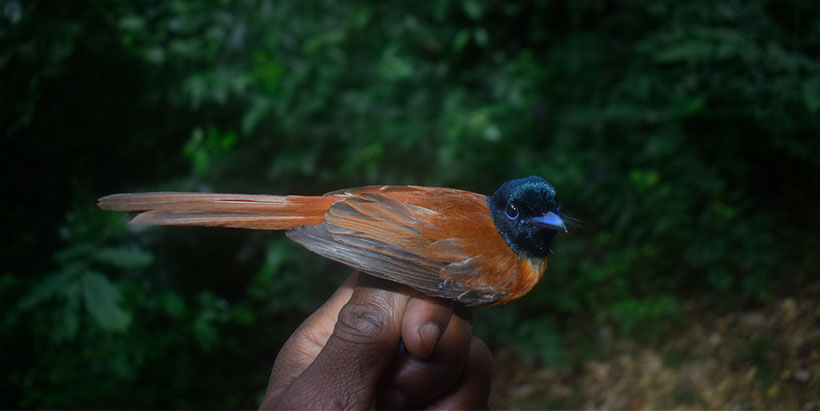
The purpose of the survey was to collect valuable data contributing to the ornithological significance of Benin Republic broadly and the Drabo Forest Reserve in particular. Awoyemi, assisted by DFR forest guides, Godonou Kandji and Louis Hounguè, carried out the bird survey concurrently using non-hazardous line transect and mist-netting. The transect method of surveying birds involves simply walking and counting birds seen or heard within a fixed radius and duration. In contrast, mist-netting involves capturing birds using mist nets made of nylon or polyester mesh suspended between two poles, resembling a volleyball net. After capture, the birds are removed from the nets and ringed with numbered metal or color rings. Data on their morphology (e.g., tarsus and wing length, mass) and breeding (estimated from the swelling around the belly or brood patch) are typically recorded before releasing them safely into the wild.
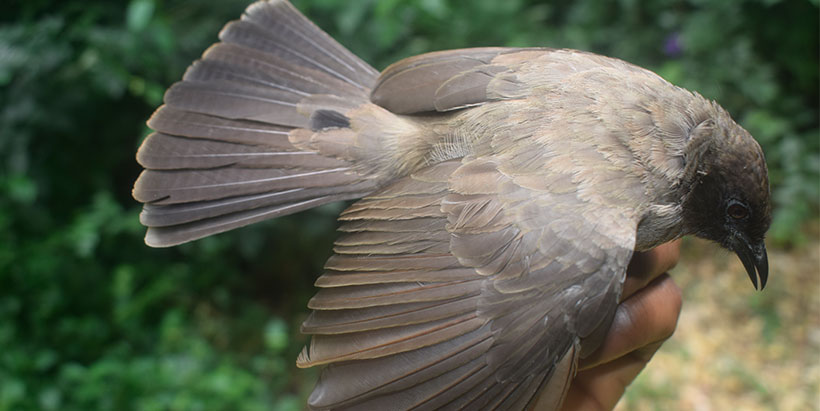
The team recorded 253 birds of 46 different species during the 6-day survey. Nocturnal birds, including the Barn Owl Tyto alba, African Wood Owl Strix woodfordii, Northern White-faced Owl Ptilopsis leucotis, and Black-shouldered Nightjar Caprimulgus nigriscapularis were prominent among the birds recorded during line transect, while the African Pygmy Kingfisher Ispidina picta was conspicuous during mist-netting.
Birds were observed taking cover in the luxuriant tree canopy, suggesting that despite the threats affecting the area, birds find the DFR a haven of refuge and food. This survey is the fourth conducted since 2018, with around 100 species of birds observed in the forest reserve and its surroundings. This encourages us to continue long-term bird monitoring to establish data useful for ecological decisions and biodiversity conservation and recommends the continued protection and regeneration of the DFR.
Proposé par Folake Oduntan
Contribué par
Histoires récentes