
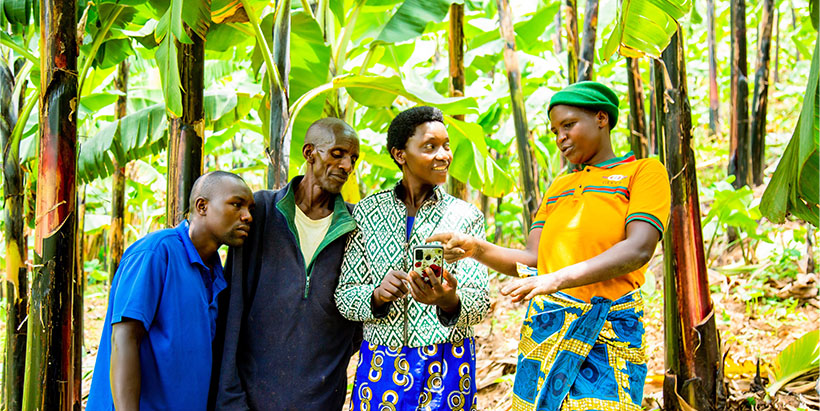
Une observation essentielle ressort du paysage changeant du développement agricole, en particulier des interactions avec les agriculteurs : ces derniers comprennent souvent leur contexte agricole mieux que quiconque. Cependant, de nombreux projets de développement et de recherche sont mis en œuvre en partant du principe que les innovations conçues par les scientifiques et les développeurs de haut niveau sont intrinsèquement adaptées et peuvent être facilement adoptées par les agriculteurs. La réalité est plus complexe, caractérisée par des décalages entre les attentes et les réalités, ce qui entraîne souvent une faible adoption et une durabilité limitée des innovations.
Le Projet ICT4BXW illustre l'importance d'aligner la conception des projets sur les réalités contextuelles des agriculteurs. Sur une période de six ans (2018-2023), le projet a été mis en œuvre pour déployer l'innovation numérique dans le but de surveiller et de contrôler la flétrissure bactérienne du bananier (BXW) au Rwanda.
En tant que maladie dévastatrice du bananier, le BXW a eu un impact significatif sur les moyens de subsistance des petits exploitants agricoles. Bien que le projet ait initialement envisagé de fournir des outils numériques sur smartphone pour lutter contre la maladie, l'engagement auprès des agriculteurs et du système national de vulgarisation a révélé la nécessité d'une approche plus nuancée.
Le projet ICT4BXW a commencé par la création et la diffusion d'outils numériques pour aider les agriculteurs et les agents de vulgarisation à lutter contre la BXW. Cependant, les premières consultations ont mis en évidence des obstacles importants à l'adoption, notamment la faible connectivité Internet dans les zones rurales, l'alphabétisation numérique limitée et la faible possession de smartphones parmi les agriculteurs.
Conscient de ces défis, le projet a réorienté et développé une suite d'outils adaptés aux réalités des agriculteurs. Ceux-ci comprenaient l'USSD (Unstructured Supplementary Service Data), un système textuel accessible sur les téléphones mobiles de base ; le SVI (Serveur Vocal Interactif), qui fournissait des messages audio dans les langues locales pour guider les agriculteurs ; des chatbots pour ceux dont les compétences numériques étaient limitées ; et des canaux de communication traditionnels tels que des programmes radio, des réunions communautaires et des bulletins d'information pour toucher un public plus large. Cette approche diversifiée a garanti que, quelles que soient leurs capacités technologiques, les agriculteurs pouvaient accéder aux outils dont ils avaient besoin pour protéger leurs cultures.
L'équipe du projet ICT4BXW a surmonté les hauts et les bas de la conception, du développement, des tests et de la mise à l'échelle des outils numériques co-imaginés, et a pris des mesures supplémentaires pour synthétiser et publier les leçons essentielles apprises qui pourront guider les futures initiatives d'innovation numérique dans l'agriculture. Au cœur de ces leçons se trouve l'importance de valoriser la contribution des agriculteurs à chaque étape du projet. Les solutions développées doivent répondre aux défis et aux contraintes spécifiques de la communauté cible. S'appuyer sur des leaders communautaires, tels que les promoteurs agricoles, qui sont des relais d'opinion de confiance, s'est avéré déterminant pour diffuser les outils et les connaissances. La formation de ces influenceurs a garanti une plus grande adoption au sein des communautés. Les incitations ont également joué un rôle important en encourageant les agriculteurs à tester et à utiliser les outils numériques. Cependant, lorsque les incitations ont pris fin, on a assisté à une baisse notable de l'utilisation des outils, ce qui souligne la nécessité de stratégies de motivation durables.
L'équipe de projet a souligné un point critique : “ La quatrième révolution agricole, caractérisée par des avancées numériques et technologiques, redessine les systèmes alimentaires mondiaux. ” Les agriculteurs africains doivent participer à cette transformation pour garantir une sécurité alimentaire durable. Cependant, l'engagement et l'autonomisation des petits exploitants agricoles sont essentiels pour concrétiser la vision de la transformation. Les projets peuvent obtenir une plus grande pertinence, une meilleure adoption et un impact accru en associant les agriculteurs au processus de développement et en concevant des solutions qui reflètent leurs réalités.
Bien que le projet ICT4BXW ait fait des progrès significatifs dans la lutte contre la BXW, il a également mis en lumière les défis liés à la pérennisation de l'innovation numérique dans les systèmes agricoles familiaux. Le déclin progressif (sans incitation) puis la résurgence (par la réintroduction d'incitations) de l'utilisation de l'outil numérique principal après la fin du projet soulignent l'importance d'un engagement et d'un soutien constants. Les initiatives futures doivent explorer des moyens de garantir une adoption à long terme en intégrant les outils numériques dans des systèmes d'appui agricole plus larges.
Contribué par Ritha Bumwe
Lisez la publication complète ici : L'adoption de l'innovation numérique par les agriculteurs au Rwanda pour plus d'informations.
Contribué par
Histoires récentes