
NOUVELLES DE L'IITA

Enhancing access to quality seed for farmers in Burundi
décembre 13, 2024

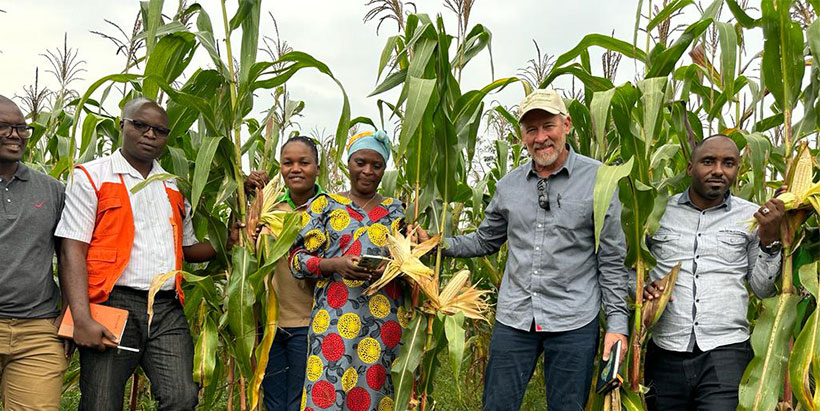
January 2024: Excellent performance of ‘bazooka’ hybrid maize variety performance in a farmer’s field in Kirundo District, Burundi. World Vision International Burundi, SSG, and ISABU were on the ground to assess the results.

Le manque de semences de qualité et les difficultés d'approvisionnement en intrants agricoles essentiels ont constitué des défis majeurs pour les agriculteurs burundais. IITACGIAR led Projet AID-I GLR – known as the Kugwiza Project in Burundi – is addressing this critical need by not only equipping farmers with the knowledge to acquire high-quality seeds but also forging strong connections between farmers and local input suppliers so that quality seeds are available to farmers.  

Consistent access to high-quality seeds and related inputs improves both productivity and profitability. By facilitating partnerships with local input suppliers, the project has created a reliable network to enhance timely access to essential agricultural inputs, going beyond quality seeds to cover other essential inputs such as fertilizer and lime.  

In Kayanza Province, World Vision Burundi leads a consortium of scaling partners whose goal is to empower small-scale farmers through good agronomic practices and better crop varieties. Triphonie Hakizimana is one such farmer.  At 43 and a mother of four, her livelihood has been positively transformed by the project.  

World Vision Burundi has trained farmers on good agricultural practices to improve smallholder farming and livelihoods, including field preparation, fertilization with organic and mineral manure, line sowing, weeding, disease control, and seed preservation. This was coupled with access to certified, clean, high-yield seeds for common food crops such as beans, hybrid maize (bazooka), orange-fleshed sweet potatoes, livestock-improvement practices, and advisory services, including brochures explaining the inputs.    

“This knowledge has been very beneficial because, in the past, we planted using disorganized methods,” says Triphonie.  
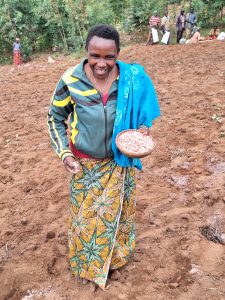
Triphonie initially thought the 100-gram pack of bazooka hybrid maize seeds was a joke. But she couldn’t believe her eyes after the harvest—the yield had increased significantly. She went to an agro-dealer and bought more seeds (eight kilos) to plant on a larger plot for the next season.

She lives in Muhanga Commune, Kayanza Province, where families typically rely on farming and livestock-keeping as their economic mainstays. Initially skeptical when the project distributed only a small pack of hybrid maize seeds, she quickly recognized the benefits of certified, high-yielding seeds and the improved farming techniques accompanying the dissemination of the small-pack approach.  

“When I received the 100 grams of seeds, I thought it was a joke. But after the harvest, I was truly surprised. It was a learning experience because I planted these seeds near my old plots and prepared both fields similarly, yet the yields were completely different,” Triphonie said. 

L'impact a été significatif en une seule saison (2024 A, octobre 2023 - janvier 2024). Les graines de maïs hybride bazooka de 100 grammes sur une parcelle de 5 x 10 mètres ont produit 23 kilos, une différence notable par rapport à ses rendements précédents de moins de 150 kilos sur une parcelle de 50 x 50 mètres. Sa surprise initiale s'est muée en confiance alors qu'elle observait la croissance luxuriante de la culture et sa résilience climatique, résistant aux maladies et au vent.  

“ Tous ceux qui sont passés par mon champ posaient des questions sur la parcelle plantée avec des semences certifiées ”, se souvient-elle fièrement. “ Nous demandons au projet Kugwiza de rendre plus de semences disponibles, car il y aura une forte demande mais pas assez d'approvisionnement de la part des multiplieurs de semences ”, avertit-elle.  

For the following cropping season, 2025 A (October 2024–January 2025), and inspired by her positive small-pack experience, Triphonie confidently purchased about eight kilos from an agro-dealer to plant on a larger 50 x 50-meter plot.  

“We purchased the seeds from a seed shop in our commune,” Triphonie added.  

To streamline, standardize, and systematize the availability of high-quality certified seeds and other inputs for smallholder farmers, the Kugwiza Project collaborated with agro-dealers. The project strengthened the capacity of the agro-dealers by connecting them with seed companies to ensure a steadfast and stable seed supply.   

The connections have caught and now have traction.  A local hybrid maize seed entrepreneur, Yvette Akimana, has seen a sharp rise in demand for certified and clean maize seeds, which not only yield more but also resist diseases and adverse climate effects.  
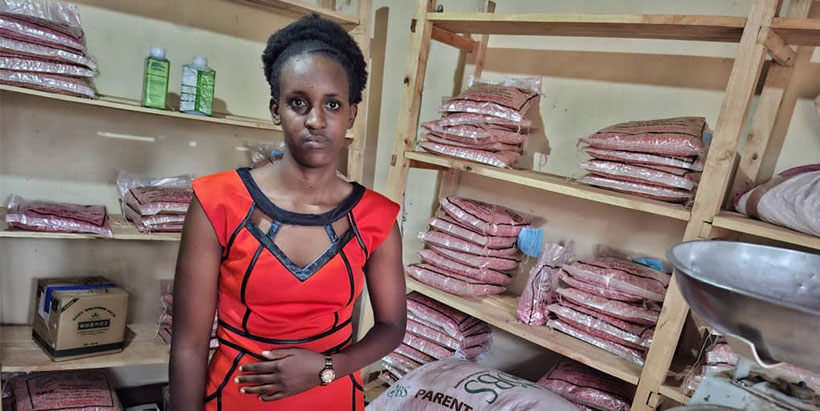
An agro-dealer since 2022, Yvette notes that “before the Kugwiza Project, seed demand was low. Now, farmers know the value of high-quality hybrid maize seeds, and our sales have grown season after season.”

Her efforts have steadily increased the bazooka seed supply and corresponding acreage. With growing interest from local farmers, she’s expanding her stock to meet demand. Efforts like hers significantly contribute to improving the country’s agriculture and seed systems. These steadfast and expanding agro-dealer promote-and-supply efforts of hybrid maize seed, and the need-driven demonstrable farmer interest are both reflected in the quantities sold countrywide in three consecutive years (2022–2024) and seasons standing at 1.5, 3.2, and 5.6 tons, respectively. 

For the upcoming 2025 A cropping season, farmers nationwide have already pre-ordered 8.6 tons of hybrid maize seeds, outstripping supply, “The quantities imported from NASECO were insufficient to meet the demand,” observed Yvette, the agro-dealer.  

According to NASECO, demand has more than doubled this year, rising from 156 tons in 2023 to 377 tons in 2024. Yields increased from less than one ton per hectare to more than four tons in Burundi.  

Currently, Burundi’s seed system still heavily relies on seed import, leaving supply and affordability susceptible to external forces. For example, Yvette imports seeds from Uganda’s NASECO company.  

But the seed-supply future is promising. Local seed multipliers like Larissa Igiraneza are key in supplying high-quality seeds locally. Based in Muyinga, Larissa has worked with Institut des Sciences Agronomiques du Burundi (ISABU) since 2014 to produce certified seeds. With the Kugwiza Project’s support, she has doubled her fields to keep pace with local demand, recognizing that “certified seeds are strong, productive, and resistant.” Kugwiza has amplified her capacity through training and the small-pack approach, fostering the adoption of improved seed and agricultural growth in the community.   

 Larissa Igiraneza said; 

“I will build greenhouses as soon as I get the bags to cover the nursery. Currently, I cannot meet the demand, so I am working to increase the harvest by cultivating on a larger scale. After the project explained to the community the importance of consuming orange-fleshed sweet potatoes, for example, and with the emergence of processing units that produce various products from sweet potatoes such as bread, chapatis, and cakes, many farmers are now requesting them. As a result, I had to expand my fields and have already purchased two hectares on another hill.    

I have also already opened stores for certified seeds – especially hybrid maize and beans – in Gashoho and Gasorwe. There are model farmers [Village-Based Advisors] who are under the guidance of the Kugwiza Project and help us promote certified seeds in the Gashoho commune. I have just opened three seed shops in the Gasorwe commune to expand my market, whereas I have only worked in the Gashoho commune before.   

Another strategy is to diversify the types of crop varieties in collaboration with certified seed producers, possibly with support from BPEAE [Bureau Provincial de l’Environnement, de l’Agriculture et de l’Elevage], responsible for providing agricultural technical assistance in Burundi]. I also plan to work with local microfinance institutions and have just applied for a loan to increase my working capital. 

This project taught me how to raise community awareness of certified seeds by setting up small demonstration plots and sowing 100 grams of beans and maize in high-traffic areas. This made it much easier to promote these seeds [as farmers could see the results for themselves]. This is the approach I plan to use to compete with other seed multipliers. 

The seed multiplication and sales sectors are very beneficial. I have registered at the national level, and ISABU has listed me as a certified seed multiplier recognized by ONCCS, Burundi’s national agency responsible for controlling and certifying seeds.  

When the planting season arrives, farmers come to me for certified seeds. We have observed that these farmers are now a growing part of our client base: previously, we only had corporate customers, with organizations – especially NGOs – buying seeds to distribute to their target beneficiaries.  

Farmers’ demand for bazooka hybrid maize was around 732 kilos during the planting season 2023B. After the Kugwiza intervention, the demand rose exponentially in seasons 2024A and B. More than 4,000 customers ordered nearly 5 tons, up from 2.6 tons previously sold to individual farmers.  

I am very grateful to this project and its partners for providing the knowledge to help us now and in the future.” 

The collaboration above exemplifies the Kugwiza Project’s model of bringing together farmers, distributors, and multipliers to create a self-sustaining ecosystem to distribute high-quality seeds.  

With continued education and community outreach, AID-I GLR provides resources and empowers local businesses to carry these gains forward, creating enduring benefits for the region. 

Contributed by Bumwe Ritha, Patrick Mutuo and Christophe Gahungu 


Contribué par

Recent stories

Aucun article trouvé

Laisser un commentaire

Votre adresse e-mail ne sera pas publiée. Les champs obligatoires sont indiqués avec *

Retour en haut
Olaosebikan, Olamide

Olamide Deborah Nwanze est une chercheuse principale spécialisée dans la recherche sur l'approche "genre" afin d'éclairer les politiques de sélection participative et inclusive, de développement de variétés et de systèmes semenciers concernant les cultures de racines, tubercules et bananes (RTB) au siège de l'Institut International d'Agriculture Tropicale, à Ibadan, au Nigeria. Elle est candidate au doctorat à l'Université d'Ibadan et titulaire d'un master et d'un diplôme d'ingénieur agronome en vulgarisation agricole et développement rural. Olamide est membre du programme African Women in Agricultural Research and Development – Gender Responsive Agricultural Systems Policy (SAISIE DE RÉCOMPENSEet les Chercheuses Sensibles au Genre Équipées pour la Transformation Agricole (SUPER. Elle cherche à appliquer ses apprentissages en matière d’approche genre, recherche sensible au genre, et expertise en développement et examen de politiques pour faciliter l’accès et l’adoption par les femmes, les jeunes, les enfants et les groupes sociaux vulnérables aux innovations agricoles qui garantissent la sécurité alimentaire, nutritionnelle, des revenus et des moyens de subsistance en Afrique. Ses rôles actuels comprennent le mentorat de chercheurs stagiaires, le développement de guides et manuels de formation, la mise en œuvre et l'adaptation de cadres et d'outils genre, l'engagement des acteurs de la chaîne de valeur en tant que partenaires de la science citoyenne, l'examen et la refonte des politiques, la gestion et l'analyse des données. Ses recherches actuelles portent sur les méthodes mixtes ainsi que sur les approches participatives et interdisciplinaires pour saisir et mettre en évidence les dynamiques de genre, les besoins, les préférences et les défis rencontrés par les parties prenantes au sein de la chaîne de valeur des moyens de subsistance agricoles afin de prioriser des stratégies axées sur le genre dans les programmes de sélection, la conception et la mise en œuvre des politiques.

À l'IITA, elle contribue à la mise en œuvre du CGIAR Initiative d'Élevage Accéléré et Innovation génétique Programmes ; recherche participative et genre au sein des Prochaine Génération ManiocHarvestPlusRTBAliments, et Tricot-ClimMob 1000Fermes Projets ; et la communication des connaissances sur le genre via le Série de webinaires G-LENS, vidéo documentaire, notes de politiquepublications, et blogs.


Publications récentes

de Sousa, K., van Etten, J., Manners, R. Bello, A., Teeken, B., Olaosebikan, O., et al. 2024. L'approche tricot : un cadre agile pour les essais décentralisés à la ferme soutenus par la science citoyenne. Une rétrospective. Agron. Sustain. Dev. 44, 8. https://doi.org/10.1007/s13593-023-00937-1

Madu, T., Onwuka, S., Nwafor, S., Onyemauwa, N., Ejechi, M., Ofoeze, M., Ukeje, B., Eluagu, C., Olaosebikan, O., Okoye, B., 2024. Les études sur les consommateurs inclusifs en matière de genre améliorent l'amélioration du manioc au Nigeria dans : Frontiers in Sociology, volume 9, numéro : 1224504, doi : 10.3389/fsoc.2024.1224504

Olaosebikan, O. ; Bello, A. ; Utoblo, O. ; Okoye, B. ; Olutegbe, N. ; Garner, E. ; Teeken, B. ; Bryan, E. ; Forsythe, L. ; Cole, S. ; Madu, T. 2023. Facteurs de stress et résilience au sein de la chaîne de valeur du manioc au Nigeria : Caractéristiques préférées des variétés de manioc et stratégies de réponse des hommes et des femmes pour informer l'amélioration variétale. Sustainability 15, 7837. https://doi.org/10.3390/su15107837

Okoye, B., Ofoeze, M., Ejechi, M., Onwuka, S., Nwafor, S., Onyemauwa, N., Ukeje, B., Eluagu, C., Obidiegwu, J.*, Olaosebikan, O., Madu, T.* 2023. Priorisation des traits préférés dans la chaîne de valeur de l'igname au Nigeria : une analyse de la situation en matière de genre in: Frontiers in Sociology, volume 8, numéro : 1232626, pages 1 – 9, ISSN 2297-7775, 2023. https://www.frontiersin.org/articles/10.3389/fsoc.2023.1232626/full

Olaosebikan, O., Bello, A. A., de Sousa, K., Ndjouenkeu, R., Adesokan, M., Alamu, E. O., Agbona, A., van Etten, J., Kegah, F. N.*, Dufour, D., Bouniol, A., Teeken, B. 2023. Acceptabilité par les consommateurs des produits alimentaires à base de gari-eba de manioc dans des contextes culturels et environnementaux variés en utilisant l'approche triade de comparaison des technologies (tricot) dans : Journal of the Science of Food and Agriculture,

Teeken, B., Olaosebikan, O., Bello, A. A., Madu, T.*, Cole, S. M. 2023. Évaluation qualitative de la positionnalité et des préférences des dyades en relation avec les activités liées au manioc : travailler avec des scientifiques citoyens du procès tricot https://hdl.handle.net/10568/138326 Type : Manuel

Bouniol, A., Ceballos, H., Bello, A. A., Teeken, B., Olaosebikan, O., Owoade, D., Agbona, A., Fotso Kuate, A., Madu, T.*, Okoye, B.*, Ofoeze, M.*, Nwafor, S.*, Onyemauwa, N.*, Adinsi, L.*, Forsythe, L., Dufour, D. 2023. Impact variétal sur le travail des femmes, la charge de travail et la pénibilité associée dans le traitement des plantes à racines, tubercules et bananes : focus sur le manioc en Afrique subsaharienne dans : Journal of the Science of Food and Agriculture, pages 1 – 25, ISSN 0022-5142,

Bello, A. A., Agbona, A., Olaosebikan, O., Edughaen, G., Dufour, D., Bouniol, A., Iluebbey, P., Ndjouenkeu, R.*, Rabbi, I. Y., Teeken, B. 2023. Effets génétiques et environnementaux sur la productivité de la transformation et le rendement des produits alimentaires : la pénibilité du travail des femmes dans : Journal of the Science of Food and Agriculture, pages 1 – 32, ISSN 0022-5142, 5

Cavicchioli, M., Zimbiti, T., Teeken, B., Nwanze, D.O., Liani, M., Parkes, E. & Bello, A. 2023. Rapport sur la formation en sélection génétique sensible au genre à l'IITA. Genetic Resources Center, IITA-HQ, Ibadan, 21-23 septembre 2022. Ibadan, Nigéria : IITA, (34 p.).https://hdl.handle.net/10568/131368

Agbona, A. Peteti P., Teeken B., Olaosebikan O. Bello, A. A., Parkes, E., Rabbi, I. Y., Mueller, L., Egesi, C., Kulakow, P. 2022. Gestion des données dans les programmes d'amélioration des cultures RTB africaines multidisciplinaires. In : Williamson, H.F., Leonelli, S. (eds) Towards Responsible Plant Data Linkage: Data Challenges for Agricultural Research and Development. Springer, Cham. https://doi.org/10.1007/978-3-031-13276-6_5

Lora Forsythe, Pricilla Marimo, Sarah Mayanja, Olamide D. Olaosebikan, Esme Stuart, Bela Teeken, Benjamin Okoye, Tessy Madu, (2021). Analyse transversale du genre dans RTBfoods Étape 2 Cartographie des genres sur les produits RTB. Comprendre les moteurs des préférences en matière de traits et le développement de profils de produits RTB multi-utilisateurs, WP1. Londres, Royaume-Uni : Rapport scientifique de terrain RTBfoods, 30 p.

Teeken, B., Garner, E., Agbona, A., Balogun, I., Olaosebikan, O., Bello, A., Madu, T., Okoye, B., Egesi, C., Kulakow, P. et Tufan, H.A. 2021. Au-delà des “ traits des femmes ” : explorer comment le genre, les différences sociales et les caractéristiques des ménages influencent les préférences pour les traits. Frontiers Systèmes alimentaires durables 5:740926. https://doi.org/10.3389/fsufs.2021.740926

Teeken, B., Agbona, A., Bello, A., Olaosebikan, O., Alamu, E., Adesokan, M., Awoyale, W., Madu, T., Okoye, B., Chijioke, U., Owoade, D., Okoro, M., Bouniol, A., Dufour, D., Hershey, C., Rabbi, I., Maziya‐Dixon, B., Egesi, C., Tufan, H. et Kulakow, P. (020. Comprendre les préférences variétales du manioc par le classement par paires du gari-eba et du fufu préparés par des agriculteurs-transformateurs locaux. Int J Food Sci Technol. https://doi.org/10.1111/ijfs.14862

Bela Teeken, Olamide Olaosebikan, Ireti Balogun, Benjamin Okoye, Tessy Madu, Steven Cole, Abolore Bello, Elizabeth Parkes. (2020). Pilotage des outils de profil client et produit G+ pour l'amélioration sensible au genre du manioc au Nigeria. Nigeria : Institut international d'agriculture tropicale (IIAT). https://hdl.handle.net/20.500.11766/13000