
Nine extension agents (five male, four female), including two youths, have been trained by IITA–CGIAR as part of its efforts to strengthen the capacity of extension agents in knowledge and technology transfer in orange-fleshed sweet potato (OFSP) vines and root multiplication in Oyo State. The three-day intensive training was held from 10 to 12 May under the Strengthening Nutrition in Priority Staples (SNiPS) project funded by the Global Alliance for Improved Nutrition (GAIN). The training was held at the IITA Ibadan campus, and practical demonstrations on one of the project farmer’s farms in Ido Local Government Area (LGA).
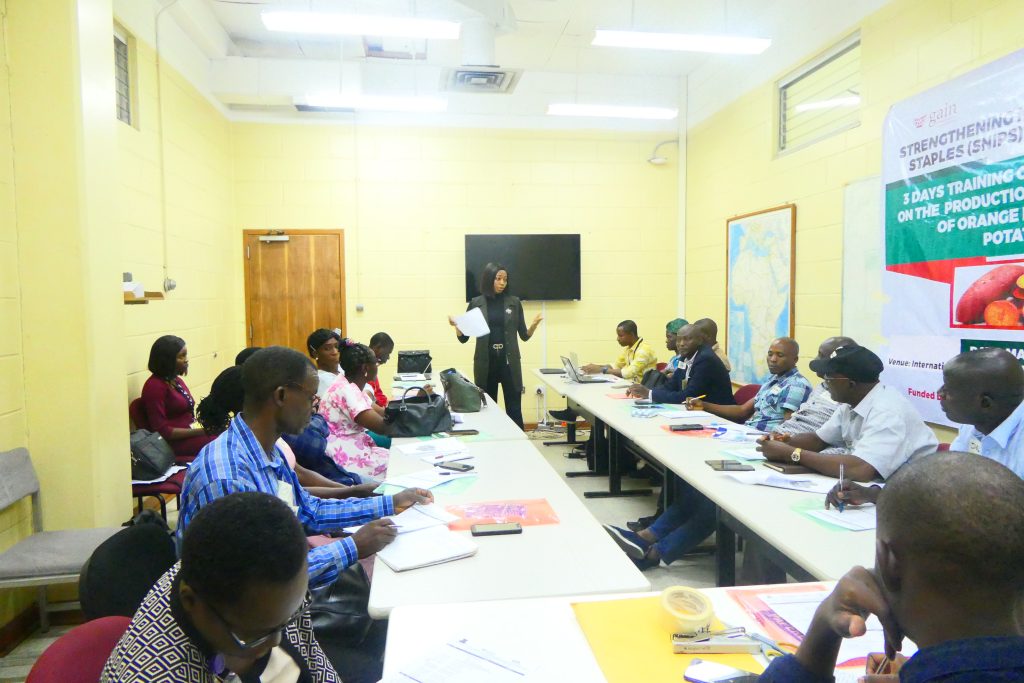
The SNiPS initiative aims to increase the production and consumption of OFSP among smallholder farmers. Its main goals are to reduce malnutrition and improve farmers’ livelihoods.
While declaring the training open, the Director-General of the Oyo State Agribusiness Development Agency (OYSADA), Director and Program Lead IITA Mechanisation, Adebowale Akande, commended GAIN for ensuring that the SNiPS initiative covered nutrition as well as business, processing, and marketing.
“I am particularly glad that SNiPS has not been limited to nutrition alone,” he said. “It is engaging youth, women, and the private sector and covering business, processing, and marketing. This is highly commendable, and I hail the sponsors for this.”
Akande, also the Chief Executive Officer of the IITA Business Incubation Platform (BIP), charged the extension agents to help change the negative mindsets of farmers they would be encountering and be ready for more work as there are many agricultural innovations to be scaled out.
GAIN Biofortification Project Lead Faden Lachang, represented by Rasaq Moruff, the Director of Agricultural Extension Services, Ministry of Agriculture and Rural Development, Oyo State, in his address, disclosed that the project is focusing on maize, rice, cassava, and orange-fleshed sweet potatoes in four pilot states—Benue, Kaduna, Nasarawa, and Oyo. Razaq, also the Desk Officer of GAIN in the state, stressed the need to monitor the farmers receiving the orange-fleshed sweet potato to avoid diversion of the planting materials or fields not being established.
The training program consisted of class sessions, practical experience on the field, and regular feedback and evaluation.
Training Facilitator Dr Bunmi Olasanmi used class and field demonstrations to showcase specific techniques in the rapid multiplication of quality vines with specified requirements in the production of sweet potato storage root using five varieties of the crop—King J, Mothers Delight, Igbariam local, Igbariam improved and SPV White.
While addressing the participants’ concerns about conveying the superiority of the improved varieties over the traditional varieties to farmers, Olasanmi explained that OFSP is naturally biofortified with beta-carotene, and its consumption has been reported to improve vitamin A and is rich in carbohydrates.
At the end of the training, the Extension Agents were given the criteria for selecting farmers for step-down training in each LGA of the state. The LGAs are Ido, Afijio, Oyo West and Iseyin. After the selection, a farmer-led demonstration plot will be set up in each LGA to train farmers and identify vine producers.
Contribué par
Histoires récentes