
Le FMARD et l'IITA signent un protocole d'accord pour renforcer la santé des sols et la sécurité alimentaire au Nigéria
16 janvier 2026
Partnership advances fertilizer efficiency through the Regional Hub for Fertilizer and Soil Health for West Africa and the Sahel
Abuja, Nigéria — January 15, 2026 — In a major step toward strengthening sustainable agriculture and national food security, the Federal Ministry of Agriculture and Food Security (FMAFS) and the International Institute of Tropical Agriculture (IITA) have signed a Memorandum of Understanding (MoU) to enhance soil health, improve fertilizer efficiency, and boost farm productivity in Nigeria.
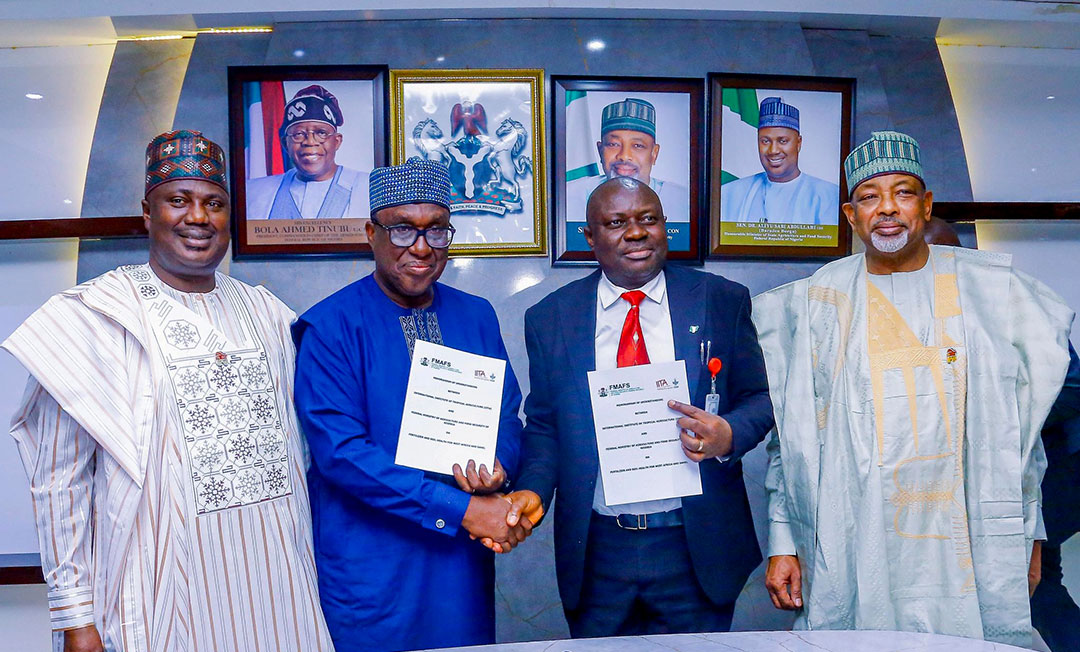 The MoU was signed by IITA Director General, Dr Simeon Ehui, and His Excellency, the Minister of State for Agriculture and Food Security, Senator Dr Aliyu Sabi Abdullahi (CON), in support of the Nigeria Farmers Soil Health Scheme (NFSHS) and national soil information system development initiatives. All activities under the agreement will be implemented through the Regional Hub for Fertilizer and Soil Health for West Africa and the Sahel, hosted by IITA.
“The Regional Hub is designed to be the technical backbone of soil health and fertilizer use for West Africa and the Sahel. With the Soil Health Initiative in Nigeria, the Hub gains a visible champion that elevates soil health from a technical agenda to a political one,” said IITA Director General, Simeon Ehui. “It creates demand and urgency for the Hub’s outputs—from digital soil maps and fertilizer recommendations to laboratory standards. Nigeria’s example helps the Hub catalyze momentum across West Africa and the Sahel region, showing that regional cooperation can deliver tangible national benefits.”
The partnership deepens collaboration between IITA, a leading research-for-development institution addressing hunger, poverty, and land degradation, and FMAFS, Nigeria’s lead agency for agricultural productivity and food security policy. Together, the institutions will address persistent soil fertility challenges and fertilizer inefficiencies through the use of data-driven tools, advanced technologies, and regional expertise.
The MoU builds on the Nigeria Farmers Soil Health Scheme, which promotes precise soil testing and crop-specific recommendations to support sustainable intensification and climate-resilient farming systems across the country.
It addresses soil fertility challenges, fertilizer inefficiencies, and sustainable farming through data-driven tools, technology, and regional expertise, expanding the Nigeria Farmers Soil Health Scheme (NFSHS), which was launched on October 14, 2025, for precise soil testing and crop recommendations.
Launched in 2024 as a sub-program of the Economic Community of West African States (ECOWAS) and hosted by IITA in Ibadan, it brings together a strong consortium of partners, including the IITA, the International Fertilizer Development Center (IFDC), OCP Africa, the African Plant Nutrition Institute
(APNI), University Mohammed VI Polytechnic (UM6P), and ISRIC – World Soil Information. The Hub receives financial support from the World Bank through the CGIAR Accelerating Impacts of CGIAR Climate Research for Africa (AICCRA) project, as well as from OCP Africa.
Key deliverables of the partnership include:
The MoU was signed by IITA Director General, Dr Simeon Ehui, and His Excellency, the Minister of State for Agriculture and Food Security, Senator Dr Aliyu Sabi Abdullahi (CON), in support of the Nigeria Farmers Soil Health Scheme (NFSHS) and national soil information system development initiatives. All activities under the agreement will be implemented through the Regional Hub for Fertilizer and Soil Health for West Africa and the Sahel, hosted by IITA.
“The Regional Hub is designed to be the technical backbone of soil health and fertilizer use for West Africa and the Sahel. With the Soil Health Initiative in Nigeria, the Hub gains a visible champion that elevates soil health from a technical agenda to a political one,” said IITA Director General, Simeon Ehui. “It creates demand and urgency for the Hub’s outputs—from digital soil maps and fertilizer recommendations to laboratory standards. Nigeria’s example helps the Hub catalyze momentum across West Africa and the Sahel region, showing that regional cooperation can deliver tangible national benefits.”
The partnership deepens collaboration between IITA, a leading research-for-development institution addressing hunger, poverty, and land degradation, and FMAFS, Nigeria’s lead agency for agricultural productivity and food security policy. Together, the institutions will address persistent soil fertility challenges and fertilizer inefficiencies through the use of data-driven tools, advanced technologies, and regional expertise.
The MoU builds on the Nigeria Farmers Soil Health Scheme, which promotes precise soil testing and crop-specific recommendations to support sustainable intensification and climate-resilient farming systems across the country.
It addresses soil fertility challenges, fertilizer inefficiencies, and sustainable farming through data-driven tools, technology, and regional expertise, expanding the Nigeria Farmers Soil Health Scheme (NFSHS), which was launched on October 14, 2025, for precise soil testing and crop recommendations.
Launched in 2024 as a sub-program of the Economic Community of West African States (ECOWAS) and hosted by IITA in Ibadan, it brings together a strong consortium of partners, including the IITA, the International Fertilizer Development Center (IFDC), OCP Africa, the African Plant Nutrition Institute
(APNI), University Mohammed VI Polytechnic (UM6P), and ISRIC – World Soil Information. The Hub receives financial support from the World Bank through the CGIAR Accelerating Impacts of CGIAR Climate Research for Africa (AICCRA) project, as well as from OCP Africa.
Key deliverables of the partnership include:
The MoU was signed by IITA Director General, Dr Simeon Ehui, and His Excellency, the Minister of State for Agriculture and Food Security, Senator Dr Aliyu Sabi Abdullahi (CON), in support of the Nigeria Farmers Soil Health Scheme (NFSHS) and national soil information system development initiatives. All activities under the agreement will be implemented through the Regional Hub for Fertilizer and Soil Health for West Africa and the Sahel, hosted by IITA.
“The Regional Hub is designed to be the technical backbone of soil health and fertilizer use for West Africa and the Sahel. With the Soil Health Initiative in Nigeria, the Hub gains a visible champion that elevates soil health from a technical agenda to a political one,” said IITA Director General, Simeon Ehui. “It creates demand and urgency for the Hub’s outputs—from digital soil maps and fertilizer recommendations to laboratory standards. Nigeria’s example helps the Hub catalyze momentum across West Africa and the Sahel region, showing that regional cooperation can deliver tangible national benefits.”
The partnership deepens collaboration between IITA, a leading research-for-development institution addressing hunger, poverty, and land degradation, and FMAFS, Nigeria’s lead agency for agricultural productivity and food security policy. Together, the institutions will address persistent soil fertility challenges and fertilizer inefficiencies through the use of data-driven tools, advanced technologies, and regional expertise.
The MoU builds on the Nigeria Farmers Soil Health Scheme, which promotes precise soil testing and crop-specific recommendations to support sustainable intensification and climate-resilient farming systems across the country.
It addresses soil fertility challenges, fertilizer inefficiencies, and sustainable farming through data-driven tools, technology, and regional expertise, expanding the Nigeria Farmers Soil Health Scheme (NFSHS), which was launched on October 14, 2025, for precise soil testing and crop recommendations.
Launched in 2024 as a sub-program of the Economic Community of West African States (ECOWAS) and hosted by IITA in Ibadan, it brings together a strong consortium of partners, including the IITA, the International Fertilizer Development Center (IFDC), OCP Africa, the African Plant Nutrition Institute
(APNI), University Mohammed VI Polytechnic (UM6P), and ISRIC – World Soil Information. The Hub receives financial support from the World Bank through the CGIAR Accelerating Impacts of CGIAR Climate Research for Africa (AICCRA) project, as well as from OCP Africa.
Key deliverables of the partnership include:
- Crop- and location-specific fertilizer recommendations for staples such as maize and rice
- Application of Gestion intégrée de la fertilité des sols (GIFS) et le 4Rs of nutrient stewardship—right source, right rate, right time, and right place
- Development of digital soil information systems, laboratory standards, and capacity building
- Scalable models to support sustainable agriculture across West Africa and the Sahel
Contribué par
Histoires récentes
Aucun article trouvé