Government of Ghana launches landmark Aflatoxin Policy calling for Aflasafe adoption to mitigate food and feed contamination
octobre 21, 2022
Ghana is on the path to overcoming issues related to aflatoxin contamination in food and feed—maize, groundnut, sorghum, and derived products—by launching a landmark National Policy for Aflatoxin Control in Food and Feed. The Aflatoxin Policy, launched in Accra on 12 October, provides a coordinated approach among institutions and stakeholders to control aflatoxin in foods and feeds to reduce foodborne diseases. A successful implementation would also increase the income of farmers and agricultural stakeholders and promote food security and food safety in keeping with Goal 2 of the Sustainable Development Goals (SDGs)—Achieve Zero Hunger by 2030.
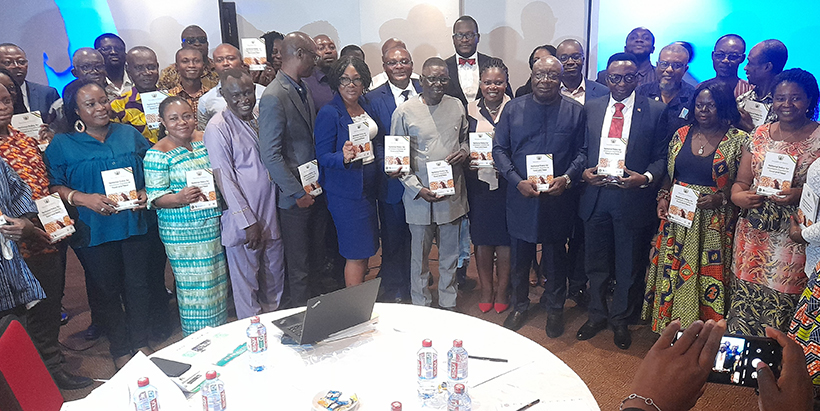
The Minister for Environment, Science, Technology and Innovation, Dr Kwaku Afriyie (front row, sixth from right), with other public and private sector stakeholders showcasing the National Aflatoxin Policy document at the launch event in Accra.
Ghana’s Minister for Environment, Science, Technology and Innovation (MESTI), Dr Kwaku Afriyie, lauded the effort of the Science and Technology Policy Research Institute of Ghana’s Council for Scientific and Industrial Research (CSIR-STEPRI) for their leading role in developing the policy. Afriyie emphasized that aflatoxin contamination in crops has serious implications for food security, health, trade, and livelihoods. He noted how aflatoxin might be linked to increased liver cancer cases in Ghana (21% of all recorded cancer cases in Ghana).
Afriyie elaborated on how aflatoxins pose a barrier to trade and market development due to the rejection of contaminated products by local and international buyers. In the early 2000s, the European Union (EU) was the main destination for Ghana’s groundnut and maize products; however, only 10% of the exported peanut butter met the stringent EU standards in 2019. The Minister, therefore, acknowledged that the policy aligns with the Government’s Coordinated Programme of Economic and Social Development Policies (2017-2024), which recognizes challenges in agriculture, nutrition, and health and makes provisions for addressing them. When implemented, he said, it would boost the success of the government’s flagship programs, including Planting for Food and Jobs, Planting for Exports and Rural Development, Rearing for Food and Jobs, and One District One Factory.
In his speech, the Minister of Food and Agriculture (MoFA), Dr Owusu Afriyie Akoto, also recognized the immense adverse effects of aflatoxin contamination. He indicated that MoFA, through the Plant Protection and Regulatory Services Directorate (PPRSD), has developed codes of practice for preventing, reducing, and eliminating aflatoxin contamination in maize and groundnut in the country.
Long-time IITA collaborator and Chairman of the National Steering Committee for Aflatoxin Control, Professor Richard T. Awuah, appealed to the Government of Ghana through MoFA to adopt Aflasafe GH01 and Aflasafe GH02. These aflatoxin biocontrol products were developed specifically for Ghana through painstaking research by IITA, in collaboration with the Kwame Nkrumah University of Science and Technology (KNUST) and the US Department of Agriculture-Agricultural Research Service (USDA-ARS). He said studies have shown that, apart from its high effectiveness in maize and groundnut, farmers who used Aflasafe to cultivate sorghum in the Northern Region produced aflatoxin-safe sorghum.
“This is probably the most important way we can minimize aflatoxin contamination of our feed and food in Ghana. We have tried drying, early planting, early harvesting, and proper storage. These are good, but they don’t amount to much. It is the Aflasafe, which is going to do the trick,” Prof. Awuah said. He added: “If the Government helps make Aflasafe available to farmers, it will help a lot in mitigating aflatoxin contamination of our foods.” Aflasafe distribution rights in Ghana have been licensed to CalliGhana, a UPL subsidiary.
A significant aspect of the policy is that CSIR-STEPRI used the Prioritizing Investments for Market Access (P-IMA) framework in collaboration with AGRA and the support of the Standards and Trade Development Facility (STDF) to harness the power of strong public‒private dialogue, economic data, and evidence for prioritizing investments related to aflatoxin control. Further, various activities identified were ranked into five main investment options in the Aflatoxin Policy’s implementation plan to bring the policy’s vision to life:
Consolidating institutional capacity to ensure successful implementation of the policy
Increasing public awareness, advocacy, communication, and demand for aflatoxin-safe food and feed
Strengthening research and technology transfer on aflatoxin
Enhancing surveillance systems for the detection of aflatoxin-related diseases in humans, livestock, and fish
Strengthening the capacity of value chain actors in pre- and post-harvest aflatoxin management for market access.
The goal for implementing activities under these investment options is to strengthen consumer protection while increasing market access for domestic and international trade in aflatoxin-safe food products for increased income of value chain actors. MoFA, MESTI, the Ministry of Health (MoH), and the Ministry of Trade and Industry (MoTI) have been tasked to lead the implementation of activities within their respective mandates.
Contributed by Daniel Agbetiameh
Olamide Deborah Nwanze est une chercheuse principale spécialisée dans la recherche sur l'approche "genre" afin d'éclairer les politiques de sélection participative et inclusive, de développement de variétés et de systèmes semenciers concernant les cultures de racines, tubercules et bananes (RTB) au siège de l'Institut International d'Agriculture Tropicale, à Ibadan, au Nigeria. Elle est candidate au doctorat à l'Université d'Ibadan et titulaire d'un master et d'un diplôme d'ingénieur agronome en vulgarisation agricole et développement rural. Olamide est membre du programme African Women in Agricultural Research and Development – Gender Responsive Agricultural Systems Policy (SAISIE DE RÉCOMPENSEet les Chercheuses Sensibles au Genre Équipées pour la Transformation Agricole (SUPER. Elle cherche à appliquer ses apprentissages en matière d’approche genre, recherche sensible au genre, et expertise en développement et examen de politiques pour faciliter l’accès et l’adoption par les femmes, les jeunes, les enfants et les groupes sociaux vulnérables aux innovations agricoles qui garantissent la sécurité alimentaire, nutritionnelle, des revenus et des moyens de subsistance en Afrique. Ses rôles actuels comprennent le mentorat de chercheurs stagiaires, le développement de guides et manuels de formation, la mise en œuvre et l'adaptation de cadres et d'outils genre, l'engagement des acteurs de la chaîne de valeur en tant que partenaires de la science citoyenne, l'examen et la refonte des politiques, la gestion et l'analyse des données. Ses recherches actuelles portent sur les méthodes mixtes ainsi que sur les approches participatives et interdisciplinaires pour saisir et mettre en évidence les dynamiques de genre, les besoins, les préférences et les défis rencontrés par les parties prenantes au sein de la chaîne de valeur des moyens de subsistance agricoles afin de prioriser des stratégies axées sur le genre dans les programmes de sélection, la conception et la mise en œuvre des politiques.
de Sousa, K., van Etten, J., Manners, R. Bello, A., Teeken, B., Olaosebikan, O., et al. 2024. L'approche tricot : un cadre agile pour les essais décentralisés à la ferme soutenus par la science citoyenne. Une rétrospective. Agron. Sustain. Dev. 44, 8. https://doi.org/10.1007/s13593-023-00937-1
Madu, T., Onwuka, S., Nwafor, S., Onyemauwa, N., Ejechi, M., Ofoeze, M., Ukeje, B., Eluagu, C., Olaosebikan, O., Okoye, B., 2024. Les études sur les consommateurs inclusifs en matière de genre améliorent l'amélioration du manioc au Nigeria dans : Frontiers in Sociology, volume 9, numéro : 1224504, doi : 10.3389/fsoc.2024.1224504
Olaosebikan, O. ; Bello, A. ; Utoblo, O. ; Okoye, B. ; Olutegbe, N. ; Garner, E. ; Teeken, B. ; Bryan, E. ; Forsythe, L. ; Cole, S. ; Madu, T. 2023. Facteurs de stress et résilience au sein de la chaîne de valeur du manioc au Nigeria : Caractéristiques préférées des variétés de manioc et stratégies de réponse des hommes et des femmes pour informer l'amélioration variétale. Sustainability 15, 7837. https://doi.org/10.3390/su15107837
Okoye, B., Ofoeze, M., Ejechi, M., Onwuka, S., Nwafor, S., Onyemauwa, N., Ukeje, B., Eluagu, C., Obidiegwu, J.*, Olaosebikan, O., Madu, T.* 2023. Priorisation des traits préférés dans la chaîne de valeur de l'igname au Nigeria : une analyse de la situation en matière de genre in: Frontiers in Sociology, volume 8, numéro : 1232626, pages 1 – 9, ISSN 2297-7775, 2023. https://www.frontiersin.org/articles/10.3389/fsoc.2023.1232626/full
Olaosebikan, O., Bello, A. A., de Sousa, K., Ndjouenkeu, R., Adesokan, M., Alamu, E. O., Agbona, A., van Etten, J., Kegah, F. N.*, Dufour, D., Bouniol, A., Teeken, B. 2023. Acceptabilité par les consommateurs des produits alimentaires à base de gari-eba de manioc dans des contextes culturels et environnementaux variés en utilisant l'approche triade de comparaison des technologies (tricot) dans : Journal of the Science of Food and Agriculture,
Teeken, B., Olaosebikan, O., Bello, A. A., Madu, T.*, Cole, S. M. 2023. Évaluation qualitative de la positionnalité et des préférences des dyades en relation avec les activités liées au manioc : travailler avec des scientifiques citoyens du procès tricot https://hdl.handle.net/10568/138326 Type : Manuel
Bouniol, A., Ceballos, H., Bello, A. A., Teeken, B., Olaosebikan, O., Owoade, D., Agbona, A., Fotso Kuate, A., Madu, T.*, Okoye, B.*, Ofoeze, M.*, Nwafor, S.*, Onyemauwa, N.*, Adinsi, L.*, Forsythe, L., Dufour, D. 2023. Impact variétal sur le travail des femmes, la charge de travail et la pénibilité associée dans le traitement des plantes à racines, tubercules et bananes : focus sur le manioc en Afrique subsaharienne dans : Journal of the Science of Food and Agriculture, pages 1 – 25, ISSN 0022-5142,
Bello, A. A., Agbona, A., Olaosebikan, O., Edughaen, G., Dufour, D., Bouniol, A., Iluebbey, P., Ndjouenkeu, R.*, Rabbi, I. Y., Teeken, B. 2023. Effets génétiques et environnementaux sur la productivité de la transformation et le rendement des produits alimentaires : la pénibilité du travail des femmes dans : Journal of the Science of Food and Agriculture, pages 1 – 32, ISSN 0022-5142, 5
Cavicchioli, M., Zimbiti, T., Teeken, B., Nwanze, D.O., Liani, M., Parkes, E. & Bello, A. 2023. Rapport sur la formation en sélection génétique sensible au genre à l'IITA. Genetic Resources Center, IITA-HQ, Ibadan, 21-23 septembre 2022. Ibadan, Nigéria : IITA, (34 p.).https://hdl.handle.net/10568/131368
Agbona, A. Peteti P., Teeken B., Olaosebikan O. Bello, A. A., Parkes, E., Rabbi, I. Y., Mueller, L., Egesi, C., Kulakow, P. 2022. Gestion des données dans les programmes d'amélioration des cultures RTB africaines multidisciplinaires. In : Williamson, H.F., Leonelli, S. (eds) Towards Responsible Plant Data Linkage: Data Challenges for Agricultural Research and Development. Springer, Cham. https://doi.org/10.1007/978-3-031-13276-6_5
Lora Forsythe, Pricilla Marimo, Sarah Mayanja, Olamide D. Olaosebikan, Esme Stuart, Bela Teeken, Benjamin Okoye, Tessy Madu, (2021). Analyse transversale du genre dans RTBfoods Étape 2 Cartographie des genres sur les produits RTB. Comprendre les moteurs des préférences en matière de traits et le développement de profils de produits RTB multi-utilisateurs, WP1. Londres, Royaume-Uni : Rapport scientifique de terrain RTBfoods, 30 p.
Teeken, B., Garner, E., Agbona, A., Balogun, I., Olaosebikan, O., Bello, A., Madu, T., Okoye, B., Egesi, C., Kulakow, P. et Tufan, H.A. 2021. Au-delà des “ traits des femmes ” : explorer comment le genre, les différences sociales et les caractéristiques des ménages influencent les préférences pour les traits. Frontiers Systèmes alimentaires durables 5:740926. https://doi.org/10.3389/fsufs.2021.740926
Teeken, B., Agbona, A., Bello, A., Olaosebikan, O., Alamu, E., Adesokan, M., Awoyale, W., Madu, T., Okoye, B., Chijioke, U., Owoade, D., Okoro, M., Bouniol, A., Dufour, D., Hershey, C., Rabbi, I., Maziya‐Dixon, B., Egesi, C., Tufan, H. et Kulakow, P. (020. Comprendre les préférences variétales du manioc par le classement par paires du gari-eba et du fufu préparés par des agriculteurs-transformateurs locaux. Int J Food Sci Technol.https://doi.org/10.1111/ijfs.14862
Bela Teeken, Olamide Olaosebikan, Ireti Balogun, Benjamin Okoye, Tessy Madu, Steven Cole, Abolore Bello, Elizabeth Parkes. (2020). Pilotage des outils de profil client et produit G+ pour l'amélioration sensible au genre du manioc au Nigeria. Nigeria : Institut international d'agriculture tropicale (IIAT). https://hdl.handle.net/20.500.11766/13000