
NEWS

How I-Youth, Agrihub Nigeria projects are supporting youths to modernize dairy farming in Adamawa State
février 14, 2025

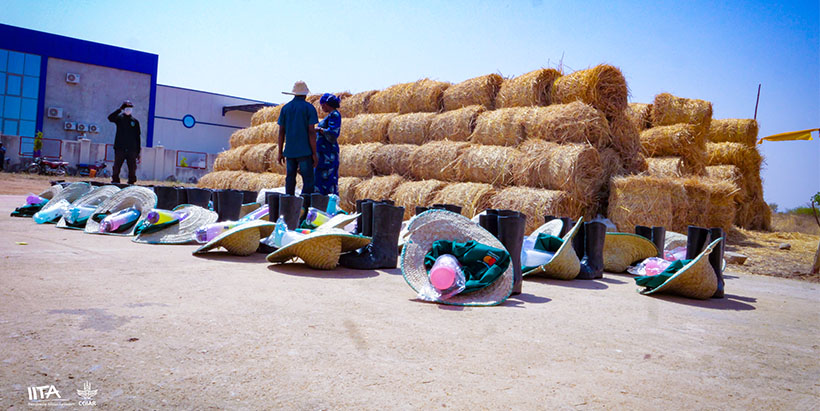
Bales of high-quality grasses, along with farm boots, hats, and overalls provided to the participants.

The youth in the agribusiness unit of IITA has provided employment opportunities for 500 youths along the dairy value chain in Adamawa State. The initiative, which was birth from the collaboration with Sebore International Farms, is targeted at unemployed young people in the state and aims to equip them with the technical and business skills required to thrive in the dairy sector.

The participants, who are the second cohorts of the initiative, will operate in various capacities in the communities. About 100 participants were trained as veterinary service providers who will render basic health services to dairy farmers and assist them with timely responses and first aid treatment for their cattle’s health-related challenges. Also, 300 youths were trained in dairy production and will supply milk to an established market in the state. The third category of youth who received training on feed and fodder production are expected to produce nutritious food for the cattle to improve their milk production.

While speaking during the participants’ graduation and input distribution ceremony, a representative of the Youth in Agribusiness unit, Adetola Adenmosun, mentioned that the initiative and collaboration with Sebore International Farms was to address some of the challenges faced by dairy farmers. According to her, the challenges include, but are not limited to, access to healthy cattle for quality milk and increased productivity, securing quality feed for optimal milk yield, and access to reliable veterinary services for health emergencies. While commending the youths for their resilience, she encouraged them to utilize the training and other resources provided to them to improve their businesses, livelihoods, and communities.
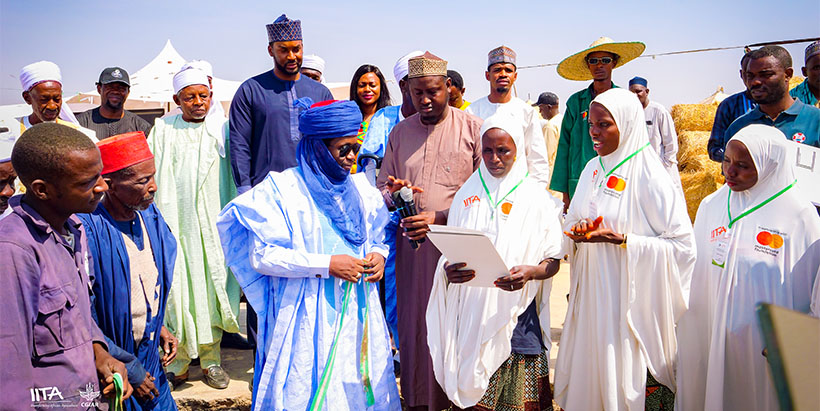
A women’s cooperative group receiving their certificate of registration and input from Mr. Ardo Bamanga Dalil, District Head of Mayo-Belwa, Adamawa State.

Also speaking at the event, the Managing Director of Sebore International Farm, Aminu Nyako, said it had become expedient to invest in the youth early enough to maximize their contributions to food security now and in the future.

“The future is the youths, and we must invest heavily right now to ensure that the youth have a place in dairy farming and agriculture in Adamawa State and the whole of Nigeria. For this reason, we ensured that the training and intervention by Sebore Farms in partnership with IITA are all-encompassing.”

“We have trained you, we have organized you into cooperatives, we have taught you how to take care of the cows, we have given you access to veterinary services, we have given you access to feed and fodder, how to cultivate the feed and fodder and access to market to sell your milk. This kind of intervention is completely end-to-end to integrate you into the dairy sector,” he added.
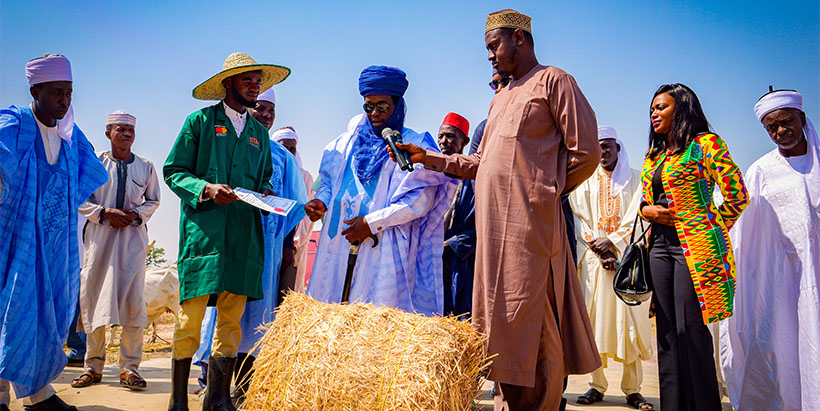
Ardo Bamanga Dalil presenting some high-quality feed to a participant in the feed and fodder unit.

The District Head of Mayo-Belwa Community, Ardo Bamanga Dalil, congratulated the farmers, and commended the partners for their contribution to providing jobs for young people.   “To our partners, your visionary leadership and unwavering support have created opportunities and instilled hope in the hearts of these young farmers and countless others who will benefit from their success. Like Oliver Twist, we humbly ask you to do more,” he said.

The event featured various sessions, including sensitization on financial inclusion and its crucial role in modern dairy agribusiness. Participants were also reminded of the best practices in modern dairy practices and veterinary care.

While applauding the intervention, one of the participants, Husseini Zakariyau, said, “Sebore Farms, in partnership with IITA, have invested their money, energy, and resources to provide training opportunities for us. The training was comprehensive; I learned how to identify illnesses in cattle, administer the proper medications, and apply treatments orally or through intravenous push (IV). This program gave us veterinary tool kits, enabling us to return to our communities and provide qualitative care for our cattle. I chose veterinary service to control common illnesses among our cattle, thereby helping my people and myself.”

Part of the input distributed to support the 500 farmers included the input of high-yielding cattle breeds, improved fodder varieties rich in nutrients, and essential veterinary care tool kits. The farmers were also organized into cooperatives based on their respective activities: 30 cooperatives for dairy producers, 10 for feed and fodder producers, and 10 for veterinary service providers. This structure ensures the businesses’ sustainability while strengthening members’ production capacity and profitability.

With improved cattle breeds, nutrient-rich fodder varieties, and essential veterinary tool kits now in their hands, these young farmers have been supported to significantly impact the dairy sector within Adamawa and the neighboring states.

Also, last year, about 300 farmers were trained in dairy production and supported with improved cattle breeds that can enhance milk production and supply.

For many of these young farmers, this initiative is a pathway to accessing dignified and fulfilling work, stability, and financial independence. With guaranteed access to the market through Sebore International Farms and strengthened production practices, these young dairy farmers are no longer at the mercy of fluctuating market conditions or outdated practices. Rather, they are becoming leaders in a growing dairy sector, contributing to food security, job creation, and economic development in Adamawa State. Their stories prove that with the right support, young people can redefine the future of agriculture.

Proposé par Jesutofunmi Robinson


Contribué par

Histoires récentes

Aucun article trouvé

Laisser un commentaire

Votre adresse e-mail ne sera pas publiée. Les champs obligatoires sont indiqués avec *

Retour en haut
Olaosebikan, Olamide

Olamide Deborah Nwanze est une chercheuse principale spécialisée dans la recherche sur l'approche "genre" afin d'éclairer les politiques de sélection participative et inclusive, de développement de variétés et de systèmes semenciers concernant les cultures de racines, tubercules et bananes (RTB) au siège de l'Institut International d'Agriculture Tropicale, à Ibadan, au Nigeria. Elle est candidate au doctorat à l'Université d'Ibadan et titulaire d'un master et d'un diplôme d'ingénieur agronome en vulgarisation agricole et développement rural. Olamide est membre du programme African Women in Agricultural Research and Development – Gender Responsive Agricultural Systems Policy (SAISIE DE RÉCOMPENSEet les Chercheuses Sensibles au Genre Équipées pour la Transformation Agricole (SUPER. Elle cherche à appliquer ses apprentissages en matière d’approche genre, recherche sensible au genre, et expertise en développement et examen de politiques pour faciliter l’accès et l’adoption par les femmes, les jeunes, les enfants et les groupes sociaux vulnérables aux innovations agricoles qui garantissent la sécurité alimentaire, nutritionnelle, des revenus et des moyens de subsistance en Afrique. Ses rôles actuels comprennent le mentorat de chercheurs stagiaires, le développement de guides et manuels de formation, la mise en œuvre et l'adaptation de cadres et d'outils genre, l'engagement des acteurs de la chaîne de valeur en tant que partenaires de la science citoyenne, l'examen et la refonte des politiques, la gestion et l'analyse des données. Ses recherches actuelles portent sur les méthodes mixtes ainsi que sur les approches participatives et interdisciplinaires pour saisir et mettre en évidence les dynamiques de genre, les besoins, les préférences et les défis rencontrés par les parties prenantes au sein de la chaîne de valeur des moyens de subsistance agricoles afin de prioriser des stratégies axées sur le genre dans les programmes de sélection, la conception et la mise en œuvre des politiques.

À l'IITA, elle contribue à la mise en œuvre du CGIAR Initiative d'Élevage Accéléré et Innovation génétique Programmes ; recherche participative et genre au sein des Prochaine Génération ManiocHarvestPlusRTBAliments, et Tricot-ClimMob 1000Fermes Projets ; et la communication des connaissances sur le genre via le Série de webinaires G-LENS, vidéo documentaire, notes de politiquepublications, et blogs.


Publications récentes

de Sousa, K., van Etten, J., Manners, R. Bello, A., Teeken, B., Olaosebikan, O., et al. 2024. L'approche tricot : un cadre agile pour les essais décentralisés à la ferme soutenus par la science citoyenne. Une rétrospective. Agron. Sustain. Dev. 44, 8. https://doi.org/10.1007/s13593-023-00937-1

Madu, T., Onwuka, S., Nwafor, S., Onyemauwa, N., Ejechi, M., Ofoeze, M., Ukeje, B., Eluagu, C., Olaosebikan, O., Okoye, B., 2024. Les études sur les consommateurs inclusifs en matière de genre améliorent l'amélioration du manioc au Nigeria dans : Frontiers in Sociology, volume 9, numéro : 1224504, doi : 10.3389/fsoc.2024.1224504

Olaosebikan, O. ; Bello, A. ; Utoblo, O. ; Okoye, B. ; Olutegbe, N. ; Garner, E. ; Teeken, B. ; Bryan, E. ; Forsythe, L. ; Cole, S. ; Madu, T. 2023. Facteurs de stress et résilience au sein de la chaîne de valeur du manioc au Nigeria : Caractéristiques préférées des variétés de manioc et stratégies de réponse des hommes et des femmes pour informer l'amélioration variétale. Sustainability 15, 7837. https://doi.org/10.3390/su15107837

Okoye, B., Ofoeze, M., Ejechi, M., Onwuka, S., Nwafor, S., Onyemauwa, N., Ukeje, B., Eluagu, C., Obidiegwu, J.*, Olaosebikan, O., Madu, T.* 2023. Priorisation des traits préférés dans la chaîne de valeur de l'igname au Nigeria : une analyse de la situation en matière de genre in: Frontiers in Sociology, volume 8, numéro : 1232626, pages 1 – 9, ISSN 2297-7775, 2023. https://www.frontiersin.org/articles/10.3389/fsoc.2023.1232626/full

Olaosebikan, O., Bello, A. A., de Sousa, K., Ndjouenkeu, R., Adesokan, M., Alamu, E. O., Agbona, A., van Etten, J., Kegah, F. N.*, Dufour, D., Bouniol, A., Teeken, B. 2023. Acceptabilité par les consommateurs des produits alimentaires à base de gari-eba de manioc dans des contextes culturels et environnementaux variés en utilisant l'approche triade de comparaison des technologies (tricot) dans : Journal of the Science of Food and Agriculture,

Teeken, B., Olaosebikan, O., Bello, A. A., Madu, T.*, Cole, S. M. 2023. Évaluation qualitative de la positionnalité et des préférences des dyades en relation avec les activités liées au manioc : travailler avec des scientifiques citoyens du procès tricot https://hdl.handle.net/10568/138326 Type : Manuel

Bouniol, A., Ceballos, H., Bello, A. A., Teeken, B., Olaosebikan, O., Owoade, D., Agbona, A., Fotso Kuate, A., Madu, T.*, Okoye, B.*, Ofoeze, M.*, Nwafor, S.*, Onyemauwa, N.*, Adinsi, L.*, Forsythe, L., Dufour, D. 2023. Impact variétal sur le travail des femmes, la charge de travail et la pénibilité associée dans le traitement des plantes à racines, tubercules et bananes : focus sur le manioc en Afrique subsaharienne dans : Journal of the Science of Food and Agriculture, pages 1 – 25, ISSN 0022-5142,

Bello, A. A., Agbona, A., Olaosebikan, O., Edughaen, G., Dufour, D., Bouniol, A., Iluebbey, P., Ndjouenkeu, R.*, Rabbi, I. Y., Teeken, B. 2023. Effets génétiques et environnementaux sur la productivité de la transformation et le rendement des produits alimentaires : la pénibilité du travail des femmes dans : Journal of the Science of Food and Agriculture, pages 1 – 32, ISSN 0022-5142, 5

Cavicchioli, M., Zimbiti, T., Teeken, B., Nwanze, D.O., Liani, M., Parkes, E. & Bello, A. 2023. Rapport sur la formation en sélection génétique sensible au genre à l'IITA. Genetic Resources Center, IITA-HQ, Ibadan, 21-23 septembre 2022. Ibadan, Nigéria : IITA, (34 p.).https://hdl.handle.net/10568/131368

Agbona, A. Peteti P., Teeken B., Olaosebikan O. Bello, A. A., Parkes, E., Rabbi, I. Y., Mueller, L., Egesi, C., Kulakow, P. 2022. Gestion des données dans les programmes d'amélioration des cultures RTB africaines multidisciplinaires. In : Williamson, H.F., Leonelli, S. (eds) Towards Responsible Plant Data Linkage: Data Challenges for Agricultural Research and Development. Springer, Cham. https://doi.org/10.1007/978-3-031-13276-6_5

Lora Forsythe, Pricilla Marimo, Sarah Mayanja, Olamide D. Olaosebikan, Esme Stuart, Bela Teeken, Benjamin Okoye, Tessy Madu, (2021). Analyse transversale du genre dans RTBfoods Étape 2 Cartographie des genres sur les produits RTB. Comprendre les moteurs des préférences en matière de traits et le développement de profils de produits RTB multi-utilisateurs, WP1. Londres, Royaume-Uni : Rapport scientifique de terrain RTBfoods, 30 p.

Teeken, B., Garner, E., Agbona, A., Balogun, I., Olaosebikan, O., Bello, A., Madu, T., Okoye, B., Egesi, C., Kulakow, P. et Tufan, H.A. 2021. Au-delà des “ traits des femmes ” : explorer comment le genre, les différences sociales et les caractéristiques des ménages influencent les préférences pour les traits. Frontiers Systèmes alimentaires durables 5:740926. https://doi.org/10.3389/fsufs.2021.740926

Teeken, B., Agbona, A., Bello, A., Olaosebikan, O., Alamu, E., Adesokan, M., Awoyale, W., Madu, T., Okoye, B., Chijioke, U., Owoade, D., Okoro, M., Bouniol, A., Dufour, D., Hershey, C., Rabbi, I., Maziya‐Dixon, B., Egesi, C., Tufan, H. et Kulakow, P. (020. Comprendre les préférences variétales du manioc par le classement par paires du gari-eba et du fufu préparés par des agriculteurs-transformateurs locaux. Int J Food Sci Technol. https://doi.org/10.1111/ijfs.14862

Bela Teeken, Olamide Olaosebikan, Ireti Balogun, Benjamin Okoye, Tessy Madu, Steven Cole, Abolore Bello, Elizabeth Parkes. (2020). Pilotage des outils de profil client et produit G+ pour l'amélioration sensible au genre du manioc au Nigeria. Nigeria : Institut international d'agriculture tropicale (IIAT). https://hdl.handle.net/20.500.11766/13000