
NOUVELLES DE L'IITA

IFAD Agrihub project holds a job fair, and experts advise youths to embrace careers in the agricultural sector
octobre 11, 2024

The IFAD Agrihub project, a key initiative implemented by IITA, played a pivotal role in hosting a job fair in Ibadan, Oyo State. This project, which focuses on employment and entrepreneurship tracks, was instrumental in facilitating job linkages and reducing youth unemployment in the agricultural sector. It underscores the importance of youth empowerment in driving the growth and sustainability of the agribusiness sector.
The Keynote Speaker at the Agrihub Job Fair 2024, Executive Director of Greenport Nigeria, Ms. Edobong Akpabio; the Coordinator TAAT Program Management Unit, Dr. Chrysantus Akem; and the Project Coordinator for Agrihub Nigeria, Mr. 'Tomiwa Adesanya, at the event.
The Keynote Speaker at the Agrihub Job Fair 2024, Executive Director of Greenport Nigeria, Ms. Edobong Akpabio; the Coordinator TAAT Program Management Unit, Dr. Chrysantus Akem; and the Project Coordinator for Agrihub Nigeria, Mr. ‘Tomiwa Adesanya, at the event.

With substantial funding from the International Fund for Agricultural Development (IFAD), Visa Foundation, and BMZ, the IFAD Agrihub project has been a resounding success. Its employment and entrepreneurship tracks have created sustainable employment and profitable enterprises for over 4,800 youths in agriculture-related activities. This success story is a beacon of hope, signaling a promising future for youth employment in the agricultural sector.

The fair, held on 26 September at the University of Ibadan International Conference Center, was significant. About 300 youths, several business owners in the agro-sector, and other stakeholders attended. The fair’s theme, “Empowering Youth for Sustainable Agri-food Careers: Skills and Opportunities,” underscored the urgency and relevance of the event in the context of youth employment in the agricultural sector.

At the fair, employers from the agro-sector engaged with the participants, who were trained in the value chain of different commodities by the IFAD Agrihub project. The available positions ranged from farm managers and accountants to data analysts and supply chain supervisors, among several others. The fair also featured workshops on agribusiness management, entrepreneurship, and the future of agriculture, providing a comprehensive view of the sector and its opportunities. These workshops covered topics such as financial management, market analysis, and the use of technology in agriculture, equipping the participants with the necessary skills for a successful career in the agro-sector.

The keynote speaker, Executive Director of Greenport Nigeria Edobong Akpabio, advised young people to choose a career over a job in the agricultural sector. She emphasized that a career in agriculture, whether in farming, agribusiness, or agricultural technology, would provide them with a sense of purpose, financial stability, and personal fulfillment in the long term.

Akpabio, who spoke on “Creating a career, not just taking up roles in the agricultural sector,” described agriculture as the most sustainable sector, noting that being a player in the sector is not limited to farming.

She added, “We are encouraging young people looking for sustainable careers to look at the agro-sector, and they should look beyond getting jobs. A job makes you focus on salary; the world has moved beyond that. You can be more useful to yourselves, other people, and your country. Many of the career opportunities employers need in 2024 have less than 20 percent to do with production. There is a lot outside of production, and those gaps must be filled.

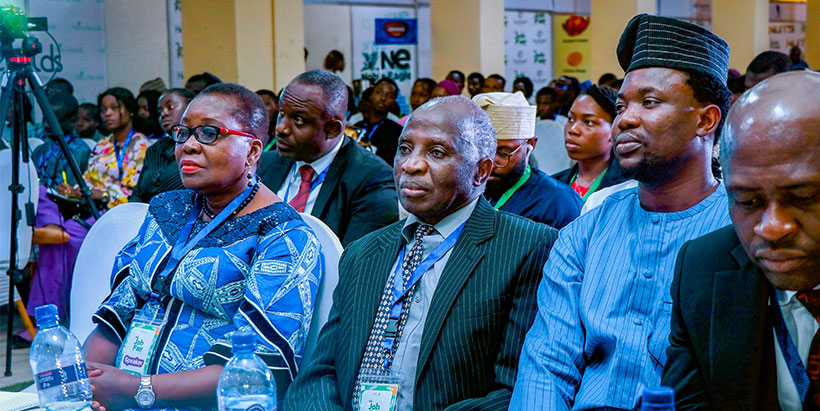
A section of participants at the Agrihub Job Fair, held at the International Conference Centre, University of Ibadan, Ibadan.

“Based on findings, top careers in the agro-sector in 2024 include agriculture finance professionals, animal scientists, veterinary professionals, soil scientists, renewable energy specialists, water resources experts, robotics experts, marketing professionals, agro-extension professionals, agro-insurance professionals, beekeepers, supply chain professionals, farm safety experts. The careers in the agro-sector are many.

“However, to succeed in this sector, people must be accountable, spiritual and passionate, have integrity, know how to cultivate relationships, and excel at what they do. Even if they didn’t study agriculture in school, there are platforms in the agricultural sector where their education will be useful. There are gaps they can fill, and they can be happy doing it, and they can earn money and lead a good life.”

She said further that young people going into agriculture shouldn’t be discouraged by capital, noting that they could start small and grow their enterprises with time.

While highlighting the motivation for the fair, the Coordinator of Technologies for African Agricultural Transformation (TAAT) at IITA, Chrysantus Akem, said that in recognition of the importance of youth, the IITA Youth in Agribusiness Office was established to link young people to opportunities, build their capacity across the different value chains and support them in their respective enterprises.

He added, “IITA is known as a leading research institute, but in addition to that, we try to deliver what comes out of the research to the end users, including young farmers. The unit (IYA) was created primarily to bring youths into agriculture and change their mindset so they can see agriculture as a business and not a chore. I believe the youths are the future of agriculture.”

Meanwhile, IFAD said it was delighted that the project had surpassed expectations.

A representative from its headquarters in Rome, Hisham Zehni, said: “This is just one example of how our collective efforts are empowering young people and communities, particularly women. The job fair is a critical step in continuing this mission. The potential is vast, and with the support of private sector partners, government agencies, and the youth, we can continue to unlock new opportunities and drive new growth.”

He also described the recent launch of the IFAD Agrihub Job Portal as a powerful tool that would bridge the gap between young talents and opportunities within Nigeria’s growing agro sector.

Similarly, Ekoue Dede, IFAD Country Director in Nigeria, said the job fair was a unique opportunity to form partnerships between potential employers and youths interested in getting jobs and business opportunities in the agribusiness sector.

She added, “We want to say that IFAD’s commitment to promoting youth in agriculture is firm. IFAD Agrihub was born out of this commitment, and we have been privileged to witness some of the key results achieved by the IFAD Agrihub project. We think this is a moment to celebrate that IFAD Agrihub achieved more than 100 percent of the original program targets.

“We believe in the transformational power of the youth in agribusiness. This is our plea as IFAD: Let us harness the potential of the youth.”

A group photograph of some of the panellists (L-R): Business Development Officers at the IITA Youth in Agribusiness Office (IYA), Mr. Oyelekan Oyeniyi and Mr. Idowu Osun; COO of Ashdam Solar Company, Ms. Damilola Asalaye; and Lead of Soiless Farm Lab, Mr. Samson Ogbole, following a panel discussion.

Speaking on the impact of the IFAD Agrihub project so far, the project coordinator, Omotomiwa Adesanya, said 3,946 youths across 19 states had been trained, out of which 908 had established their businesses. The youth-led agribusinesses also created an additional 1,352 jobs. He added that the project had facilitated the employment of 2,570 youths, with 54 percent female participation.

Adesanya added, “Over the years, we have trained youths and connected them with companies in the agricultural value chain for employment, while we have supported some to start their businesses. However, this job fair benefitted other youths, so we opened it to all youths. Also, by interacting with the employers, they will become familiar with the skills that are in demand. We brought some of our partners so they could interact and ultimately employ the participants with the required skills.”

The program also featured two-panel sessions. The first topic, “Sustainable agri-food careers: Making a difference through Green Innovations,” had Samson Ogbole, a renowned agripreneur, Damilola Asaleye, an agribusiness consultant, and Idowu Osun, a sustainable agriculture advocate, as members. They expatiated the potential of green innovations in the agri-food sector and how they can create sustainable careers. The second session, with the topic, “Essential skills to build for career opportunities in the agri-food sector,” had Olawale Ojo, a human resource expert, Chidinma Mary Ezeh, a successful agribusiness owner, and Tajudeen Yahaya, a career coach as members. They shed light on the skills needed to excel in the agri-food sector and how to build them.

Contributed by Babatunde Ajaja


Contribué par

Nouvelles connexes

Aucun article trouvé

Laisser un commentaire

Votre adresse e-mail ne sera pas publiée. Les champs obligatoires sont indiqués avec *

Retour en haut
Olaosebikan, Olamide

Olamide Deborah Nwanze est une chercheuse principale spécialisée dans la recherche sur l'approche "genre" afin d'éclairer les politiques de sélection participative et inclusive, de développement de variétés et de systèmes semenciers concernant les cultures de racines, tubercules et bananes (RTB) au siège de l'Institut International d'Agriculture Tropicale, à Ibadan, au Nigeria. Elle est candidate au doctorat à l'Université d'Ibadan et titulaire d'un master et d'un diplôme d'ingénieur agronome en vulgarisation agricole et développement rural. Olamide est membre du programme African Women in Agricultural Research and Development – Gender Responsive Agricultural Systems Policy (SAISIE DE RÉCOMPENSEet les Chercheuses Sensibles au Genre Équipées pour la Transformation Agricole (SUPER. Elle cherche à appliquer ses apprentissages en matière d’approche genre, recherche sensible au genre, et expertise en développement et examen de politiques pour faciliter l’accès et l’adoption par les femmes, les jeunes, les enfants et les groupes sociaux vulnérables aux innovations agricoles qui garantissent la sécurité alimentaire, nutritionnelle, des revenus et des moyens de subsistance en Afrique. Ses rôles actuels comprennent le mentorat de chercheurs stagiaires, le développement de guides et manuels de formation, la mise en œuvre et l'adaptation de cadres et d'outils genre, l'engagement des acteurs de la chaîne de valeur en tant que partenaires de la science citoyenne, l'examen et la refonte des politiques, la gestion et l'analyse des données. Ses recherches actuelles portent sur les méthodes mixtes ainsi que sur les approches participatives et interdisciplinaires pour saisir et mettre en évidence les dynamiques de genre, les besoins, les préférences et les défis rencontrés par les parties prenantes au sein de la chaîne de valeur des moyens de subsistance agricoles afin de prioriser des stratégies axées sur le genre dans les programmes de sélection, la conception et la mise en œuvre des politiques.

À l'IITA, elle contribue à la mise en œuvre du CGIAR Initiative d'Élevage Accéléré et Innovation génétique Programmes ; recherche participative et genre au sein des Prochaine Génération ManiocHarvestPlusRTBAliments, et Tricot-ClimMob 1000Fermes Projets ; et la communication des connaissances sur le genre via le Série de webinaires G-LENS, vidéo documentaire, notes de politiquepublications, et blogs.


Publications récentes

de Sousa, K., van Etten, J., Manners, R. Bello, A., Teeken, B., Olaosebikan, O., et al. 2024. L'approche tricot : un cadre agile pour les essais décentralisés à la ferme soutenus par la science citoyenne. Une rétrospective. Agron. Sustain. Dev. 44, 8. https://doi.org/10.1007/s13593-023-00937-1

Madu, T., Onwuka, S., Nwafor, S., Onyemauwa, N., Ejechi, M., Ofoeze, M., Ukeje, B., Eluagu, C., Olaosebikan, O., Okoye, B., 2024. Les études sur les consommateurs inclusifs en matière de genre améliorent l'amélioration du manioc au Nigeria dans : Frontiers in Sociology, volume 9, numéro : 1224504, doi : 10.3389/fsoc.2024.1224504

Olaosebikan, O. ; Bello, A. ; Utoblo, O. ; Okoye, B. ; Olutegbe, N. ; Garner, E. ; Teeken, B. ; Bryan, E. ; Forsythe, L. ; Cole, S. ; Madu, T. 2023. Facteurs de stress et résilience au sein de la chaîne de valeur du manioc au Nigeria : Caractéristiques préférées des variétés de manioc et stratégies de réponse des hommes et des femmes pour informer l'amélioration variétale. Sustainability 15, 7837. https://doi.org/10.3390/su15107837

Okoye, B., Ofoeze, M., Ejechi, M., Onwuka, S., Nwafor, S., Onyemauwa, N., Ukeje, B., Eluagu, C., Obidiegwu, J.*, Olaosebikan, O., Madu, T.* 2023. Priorisation des traits préférés dans la chaîne de valeur de l'igname au Nigeria : une analyse de la situation en matière de genre in: Frontiers in Sociology, volume 8, numéro : 1232626, pages 1 – 9, ISSN 2297-7775, 2023. https://www.frontiersin.org/articles/10.3389/fsoc.2023.1232626/full

Olaosebikan, O., Bello, A. A., de Sousa, K., Ndjouenkeu, R., Adesokan, M., Alamu, E. O., Agbona, A., van Etten, J., Kegah, F. N.*, Dufour, D., Bouniol, A., Teeken, B. 2023. Acceptabilité par les consommateurs des produits alimentaires à base de gari-eba de manioc dans des contextes culturels et environnementaux variés en utilisant l'approche triade de comparaison des technologies (tricot) dans : Journal of the Science of Food and Agriculture,

Teeken, B., Olaosebikan, O., Bello, A. A., Madu, T.*, Cole, S. M. 2023. Évaluation qualitative de la positionnalité et des préférences des dyades en relation avec les activités liées au manioc : travailler avec des scientifiques citoyens du procès tricot https://hdl.handle.net/10568/138326 Type : Manuel

Bouniol, A., Ceballos, H., Bello, A. A., Teeken, B., Olaosebikan, O., Owoade, D., Agbona, A., Fotso Kuate, A., Madu, T.*, Okoye, B.*, Ofoeze, M.*, Nwafor, S.*, Onyemauwa, N.*, Adinsi, L.*, Forsythe, L., Dufour, D. 2023. Impact variétal sur le travail des femmes, la charge de travail et la pénibilité associée dans le traitement des plantes à racines, tubercules et bananes : focus sur le manioc en Afrique subsaharienne dans : Journal of the Science of Food and Agriculture, pages 1 – 25, ISSN 0022-5142,

Bello, A. A., Agbona, A., Olaosebikan, O., Edughaen, G., Dufour, D., Bouniol, A., Iluebbey, P., Ndjouenkeu, R.*, Rabbi, I. Y., Teeken, B. 2023. Effets génétiques et environnementaux sur la productivité de la transformation et le rendement des produits alimentaires : la pénibilité du travail des femmes dans : Journal of the Science of Food and Agriculture, pages 1 – 32, ISSN 0022-5142, 5

Cavicchioli, M., Zimbiti, T., Teeken, B., Nwanze, D.O., Liani, M., Parkes, E. & Bello, A. 2023. Rapport sur la formation en sélection génétique sensible au genre à l'IITA. Genetic Resources Center, IITA-HQ, Ibadan, 21-23 septembre 2022. Ibadan, Nigéria : IITA, (34 p.).https://hdl.handle.net/10568/131368

Agbona, A. Peteti P., Teeken B., Olaosebikan O. Bello, A. A., Parkes, E., Rabbi, I. Y., Mueller, L., Egesi, C., Kulakow, P. 2022. Gestion des données dans les programmes d'amélioration des cultures RTB africaines multidisciplinaires. In : Williamson, H.F., Leonelli, S. (eds) Towards Responsible Plant Data Linkage: Data Challenges for Agricultural Research and Development. Springer, Cham. https://doi.org/10.1007/978-3-031-13276-6_5

Lora Forsythe, Pricilla Marimo, Sarah Mayanja, Olamide D. Olaosebikan, Esme Stuart, Bela Teeken, Benjamin Okoye, Tessy Madu, (2021). Analyse transversale du genre dans RTBfoods Étape 2 Cartographie des genres sur les produits RTB. Comprendre les moteurs des préférences en matière de traits et le développement de profils de produits RTB multi-utilisateurs, WP1. Londres, Royaume-Uni : Rapport scientifique de terrain RTBfoods, 30 p.

Teeken, B., Garner, E., Agbona, A., Balogun, I., Olaosebikan, O., Bello, A., Madu, T., Okoye, B., Egesi, C., Kulakow, P. et Tufan, H.A. 2021. Au-delà des “ traits des femmes ” : explorer comment le genre, les différences sociales et les caractéristiques des ménages influencent les préférences pour les traits. Frontiers Systèmes alimentaires durables 5:740926. https://doi.org/10.3389/fsufs.2021.740926

Teeken, B., Agbona, A., Bello, A., Olaosebikan, O., Alamu, E., Adesokan, M., Awoyale, W., Madu, T., Okoye, B., Chijioke, U., Owoade, D., Okoro, M., Bouniol, A., Dufour, D., Hershey, C., Rabbi, I., Maziya‐Dixon, B., Egesi, C., Tufan, H. et Kulakow, P. (020. Comprendre les préférences variétales du manioc par le classement par paires du gari-eba et du fufu préparés par des agriculteurs-transformateurs locaux. Int J Food Sci Technol. https://doi.org/10.1111/ijfs.14862

Bela Teeken, Olamide Olaosebikan, Ireti Balogun, Benjamin Okoye, Tessy Madu, Steven Cole, Abolore Bello, Elizabeth Parkes. (2020). Pilotage des outils de profil client et produit G+ pour l'amélioration sensible au genre du manioc au Nigeria. Nigeria : Institut international d'agriculture tropicale (IIAT). https://hdl.handle.net/20.500.11766/13000