
With the start of the year, plans are underway to develop pathways to address critical issues in the research and food systems exchange, focusing on innovation scaling.
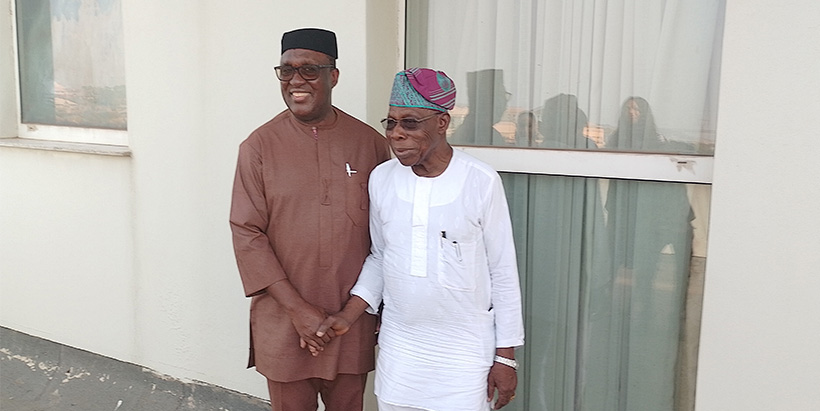
Speaking during a courtesy visit to IITA Ambassador and former President of Nigeria, Chief Olusegun Obasanjo, IITA Director General and CGIAR Regional Director for Continental Africa, Dr Siméon Ehui, said the work to ensure Africa becomes food secure continues and identifying the roles of key stakeholders is strategic to the success of the food security agenda on the continent.
While receiving the IITA team in his Abeokuta home, Chief Obasanjo said there is a need to create viable and functional approaches for stakeholders to adopt across various levels, adding that this is vital to providing solutions to food insecurity in Africa.
Proposing a strategic meeting of key stakeholders and policymakers in Nigeria and on the continent, Chief Obasanjo said the meeting would cut across three levels of policymakers and would look at critical issues like food and nutrition insecurity, climate-smart agriculture, and the existing gap between research, food systems, and innovation scaling and adoption.
According to Chief Obasanjo, discussions will focus on strategies for implementing the identified agriculture transformation agenda and how IITA and CGIAR can collaborate with state, national, and continental policymakers to produce sustainable solutions for transforming food systems.
“There is a need to explore ways to bridge existing gaps on the path to aligning research with food and nutrition security on the continent, as research seems to be struggling. And if efforts are not strategically driven, we will be doing so much and impact will be minimal,” Chief Obasanjo said.
Dr Ehui highlighted feedback from recent meetings with policymakers in West Africa, indicating a positive outlook on future collaborative efforts. “I am optimistic that some of the governments on the continent will be open to working with IITA and the CGIAR to scale innovations that will address food insecurity,” he said.
The proposed multi-level approach to address existing gaps in research, food systems, and innovation adoption exchange will support and drive the food security agenda at state, national, and continental levels. This approach will also position Nigeria and the rest of the continent for a food and nutrition secure future.
Proposé par Timilehin OsundeContribué par
Histoires récentes