
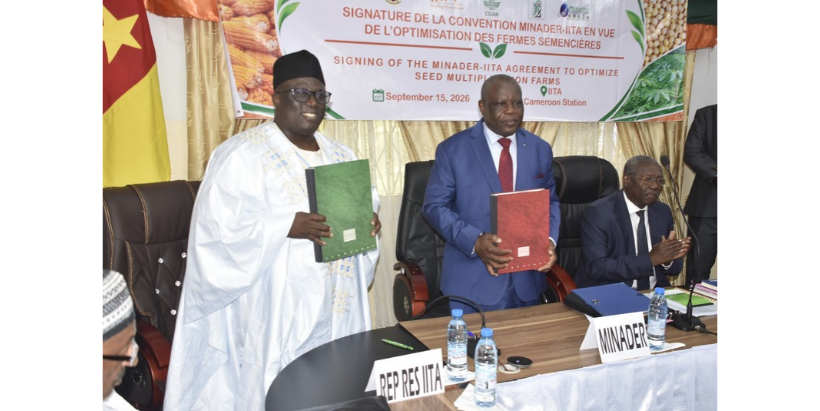
IITA–CGIAR and Cameroon’s Ministry of Agriculture and Rural Development (MINADER) have signed a landmark agreement to strengthen the country’s seed system through the optimization of two strategic seed multiplication sites in Sabally, in the South Region, and Nachtigal, in the Center Region.
The two facilities, covering a combined 88 hectares, are expected to strengthen the production of quality seed for key crops, including banana and plantain, cassava, cowpea, maize, soybean, and yam, and support the development of Cameroon’s national seed systems. The partnership brings together IITA’s research expertise and MINADER’s agricultural development mandate to improve the production and dissemination of improved planting materials and contribute to more productive and resilient agricultural value chains.
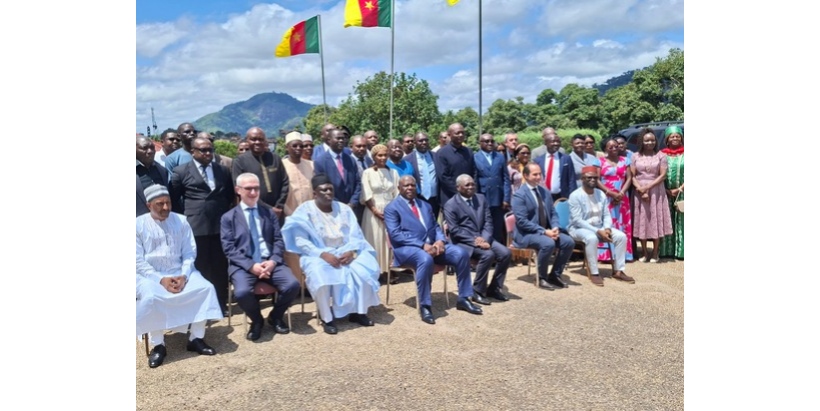
The agreement was signed during a high-level visit to IITA in Yaoundé, which brought together senior government officials, development partners, and agricultural stakeholders as part of the consolidation workshop of Cameroon’s AgriConnect Pact.
AgriConnect is Cameroon’s 2026–2030 national compact aimed at accelerating food security, agricultural transformation, and job creation. Its priorities include strengthening agri-food systems, advancing policy reforms, and expanding agricultural financing through public-private partnerships.
The agreement between IITA and MINADER represents a concrete contribution to these ambitions by focusing on one of the foundations of agricultural productivity: access to quality seed and improved planting materials.
The Minister of Agriculture and Rural Development, Gabriel Mbaïrobe, emphasized that AgriConnect is designed to accelerate transformation by bringing existing policies and interventions into greater coherence and increasing their impact across production, processing, financing, and value-chain competitiveness.
MINADER and IITA are two of the important instruments for translating the objectives of the AgriConnect Pact into concrete action. By optimizing seed farms, strengthening agricultural research, and making improved planting materials more accessible, this collaboration will contribute to increasing national production, strengthening value chains, and accelerating the transformation of Cameroon’s agricultural sector,” said Minister Gabriel Mbaïrobe (MINADER).
By combining research, innovation, and dedicated seed multiplication facilities, the collaboration is expected to strengthen the pathway from the development of improved planting materials to their production and dissemination for use by farmers.
“This agreement builds on decades of collaboration between IITA and MINADER and reflects a shared commitment to moving from research to action. IITA has contributed its scientific expertise and experience to help shape this collaboration, working with MINADER to identify practical areas where research, improved planting materials, and innovation can support national agricultural priorities. By formalizing this partnership, we are creating a stronger platform for scaling solutions and translating science into impact for farmers, while supporting the objectives of Cameroon’s agri-food systems even beyond the AgriConnect Pact,” said Dr Fotso Apollin, IITA Country Representative in Cameroon.
The agreement also reinforces IITA’s broader contribution to Cameroon’s agricultural transformation agenda. During the visit, the delegation toured IITA’s research facilities, including the soil laboratory where soil health assessments and fertilizer recommendations are conducted, and the tissue culture laboratory where micropropagation technologies are used to produce disease-free, high-yield planting materials for major crops across the region.
The visit concluded with the planting of symbolic trees by the Ministers and the World Bank representative, reflecting a shared commitment to environmental sustainability, resilient agriculture, and a greener future for Cameroon.
Contribué par
Chichi Melanie Nyako and Ritha Bumwe
Histoires récentes