IITA and partners meet with Togo president and officials to discuss joint projects
janvier 28, 2018
Le Directeur Général de l'IITA, Nteranya Sanginga, in a joint delegation with the CEO of the Nigeria Incentive-Based Risk Sharing System for Agricultural Lending (NIRSAL), visited Togo on 24-26 January at the request of the Banque africaine de développement (AfDB) President and the President of Togo.
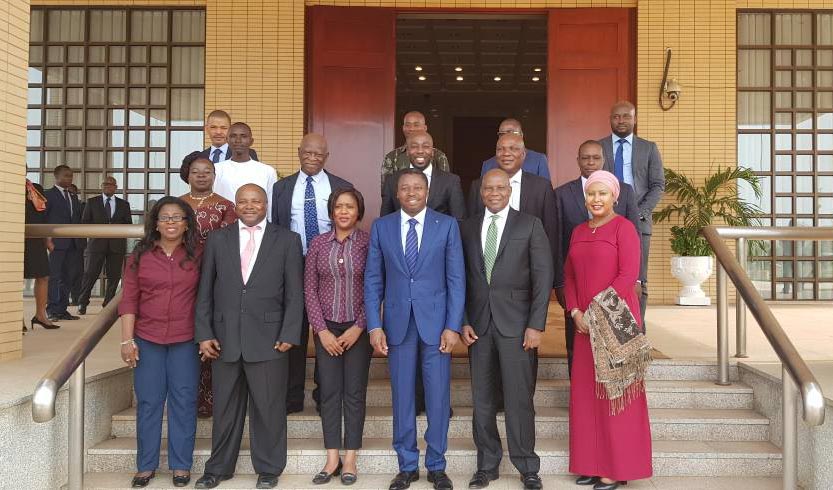
DG Nteranya Sanginga (front row, 2nd from left) with other delegates.
The joint mission met high level officials of Togo, including the Chief of Staff of the President of Togo, the Secretary General of the Presidency, the Ministers of Agriculture, the Minister of Trade and Private Sector Promotion, Advisers to the President, Advisers to the Prime Minister, the Central Bank Governor, several commercial bank directors, the CEO of Grans Moulins du Togo, the CEO of Brasseries du Togo, the DG of the Togo Agricultural Research Institute, and directors in various ministries and technical agencies of the Government of Togo (GoT). The mission was facilitated by the AfDB Country Manager who also participated in all the sessions.
The two principals of the joint delegation (IITA and NIRSAL) and the AfDB Country Manager met with the President of Togo on day 2 of the mission with the Chief of Staff and the Minister of Special Projects to the President.
Sanginga summarized the outcome of the meeting with the large group and briefed the President about the opportunity or potential support from the Fonds international de développement agricole (IFAD), whose Togo portfolio is about $15 million.
The President agreed to contact the IFAD President who incidentally had served on his cabinet as Premier Minister in the recent past. The President also indicated that he will meet and brief the AfDB President about this mission when they meet during the AU summit in Addis.
The delegation met in plenary on Day 1 with all the Togolese counterparts. The Minister of Agriculture described the challenges that Togo was facing in agriculture and particularly with the cassava value chain. The IITA DG presented on IITA and described how it is helping other African countries such as Liberia and Sierra Leone which faced similar challenges. He also explained about the IITA Youth Agripreneur model that is focused on bringing African youth to become active players and build careers in agribusiness. The NIRSAL CEO presented its model of enabling access to finance throughout the agricultural value chain.
On day 2, the meeting broke into two separate groups, one to discuss in detail potential technical interventions, and the other to address financial interventions to support the development of agriculture in Togo, particularly the cassava value chain. A plenary meeting was then convened to integrate the outcomes of the breakaway discussions and agree on a roadmap for action. This plenary meeting was further attended by commercial bank directors, directors of insurance companies, and an administrator of the insurance sector regulatory commission, the head of the Togo federation of agricultural producers, and the head of the food processors association, who were asked to provide their comments and opinions on the proposed actions.
At the end of the meeting, the group agreed on several action points:
Compile existing data on cassava in Togo, particularly the status of market supply and dem and, challenges and opportunities of the subsector, and to set development targets. This work could be led by IITA and the Institut Togolaise de Recherche Agronomique (ITRA). The outcome would be a plan of action for the development of the cassava subsector to increase food security in Togo, increase employment and wealth creation opportunities, particularly for women and youth, and in the long run contribute to GoT’s import substitution strategy and supply raw materials for agro-based industries.
The GoT to coordinate all efforts for developing the cassava subsector by establishing a Special Initiative on Cassava, preferably coordinated at the highest level of government with the President of Togo as its champion.
The GoT and the AfDB Country Office to seek resources in ongoing projects that could be reoriented towards the take-off of a cassava development initiative, especially the formulation of the action plan. In the absence of such resources, the GoT could approach other donors.
NIRSAL to continue consultations with relevant institutions of the GoT to propose the setting up of a program or institution that could play the same role that NIRSAL has played in Nigeria, or the Ghana Incentive-Based Risk-Sharing System for Agricultural Lending (GIRSAL) in Ghana.
The GoT to consider establishing a legal framework with clear indices to be used by insurers and bankers to facilitate the provision of agricultural financing and insurance.
IITA to address the challenge of institutional capacity building very early in the implementation of a cassava development program.
The President of Togo to brief the AfDB President about the outcome and the way forward to effectively start this initiative as quickly as possible.
The joint mission noted that the political will for transforming agriculture and creating wealth and employment opportunities for women and youth was very high in Togo. Mobilizing at short notice government agencies, the private sector (particularly commercial banks), and producer organizations, together with the relatively small size of the country, and the strong political will to produce results are indications that a program to transform agriculture with technologies to boost productivity and remove constraints, and with facilitated access to agricultural finance would have a high probability for success. There are therefore excellent opportunities for the Technologies for African Agricultural Transformation (TAAT), RSF, Affirmative Finance Action for Women in Africa (AFAWA), and Empowering Novel Agri-Business-Led Employment (ENABLE) Youth flagship programs in Togo.
The presence of Gr ands Moulins du Togo and Brasseries du Togo at the meeting is an indication that there is interest in cassava as an industrial raw material for bakery products and for use in brewing beer.
Considering that there is already surplus production of cassava in Togo, establishing a Special Cassava Processing Zone (SCPZ) in the southern part of Togo could be a possibility in the future. With the relative abundance of infrastructure (energy, port, airport, West Africa highway, ICT) in the South, a cassava-based ICT could even be promoted as a completely private venture.
Olamide Deborah Nwanze est une chercheuse principale spécialisée dans la recherche sur l'approche "genre" afin d'éclairer les politiques de sélection participative et inclusive, de développement de variétés et de systèmes semenciers concernant les cultures de racines, tubercules et bananes (RTB) au siège de l'Institut International d'Agriculture Tropicale, à Ibadan, au Nigeria. Elle est candidate au doctorat à l'Université d'Ibadan et titulaire d'un master et d'un diplôme d'ingénieur agronome en vulgarisation agricole et développement rural. Olamide est membre du programme African Women in Agricultural Research and Development – Gender Responsive Agricultural Systems Policy (SAISIE DE RÉCOMPENSEet les Chercheuses Sensibles au Genre Équipées pour la Transformation Agricole (SUPER. Elle cherche à appliquer ses apprentissages en matière d’approche genre, recherche sensible au genre, et expertise en développement et examen de politiques pour faciliter l’accès et l’adoption par les femmes, les jeunes, les enfants et les groupes sociaux vulnérables aux innovations agricoles qui garantissent la sécurité alimentaire, nutritionnelle, des revenus et des moyens de subsistance en Afrique. Ses rôles actuels comprennent le mentorat de chercheurs stagiaires, le développement de guides et manuels de formation, la mise en œuvre et l'adaptation de cadres et d'outils genre, l'engagement des acteurs de la chaîne de valeur en tant que partenaires de la science citoyenne, l'examen et la refonte des politiques, la gestion et l'analyse des données. Ses recherches actuelles portent sur les méthodes mixtes ainsi que sur les approches participatives et interdisciplinaires pour saisir et mettre en évidence les dynamiques de genre, les besoins, les préférences et les défis rencontrés par les parties prenantes au sein de la chaîne de valeur des moyens de subsistance agricoles afin de prioriser des stratégies axées sur le genre dans les programmes de sélection, la conception et la mise en œuvre des politiques.
de Sousa, K., van Etten, J., Manners, R. Bello, A., Teeken, B., Olaosebikan, O., et al. 2024. L'approche tricot : un cadre agile pour les essais décentralisés à la ferme soutenus par la science citoyenne. Une rétrospective. Agron. Sustain. Dev. 44, 8. https://doi.org/10.1007/s13593-023-00937-1
Madu, T., Onwuka, S., Nwafor, S., Onyemauwa, N., Ejechi, M., Ofoeze, M., Ukeje, B., Eluagu, C., Olaosebikan, O., Okoye, B., 2024. Les études sur les consommateurs inclusifs en matière de genre améliorent l'amélioration du manioc au Nigeria dans : Frontiers in Sociology, volume 9, numéro : 1224504, doi : 10.3389/fsoc.2024.1224504
Olaosebikan, O. ; Bello, A. ; Utoblo, O. ; Okoye, B. ; Olutegbe, N. ; Garner, E. ; Teeken, B. ; Bryan, E. ; Forsythe, L. ; Cole, S. ; Madu, T. 2023. Facteurs de stress et résilience au sein de la chaîne de valeur du manioc au Nigeria : Caractéristiques préférées des variétés de manioc et stratégies de réponse des hommes et des femmes pour informer l'amélioration variétale. Sustainability 15, 7837. https://doi.org/10.3390/su15107837
Okoye, B., Ofoeze, M., Ejechi, M., Onwuka, S., Nwafor, S., Onyemauwa, N., Ukeje, B., Eluagu, C., Obidiegwu, J.*, Olaosebikan, O., Madu, T.* 2023. Priorisation des traits préférés dans la chaîne de valeur de l'igname au Nigeria : une analyse de la situation en matière de genre in: Frontiers in Sociology, volume 8, numéro : 1232626, pages 1 – 9, ISSN 2297-7775, 2023. https://www.frontiersin.org/articles/10.3389/fsoc.2023.1232626/full
Olaosebikan, O., Bello, A. A., de Sousa, K., Ndjouenkeu, R., Adesokan, M., Alamu, E. O., Agbona, A., van Etten, J., Kegah, F. N.*, Dufour, D., Bouniol, A., Teeken, B. 2023. Acceptabilité par les consommateurs des produits alimentaires à base de gari-eba de manioc dans des contextes culturels et environnementaux variés en utilisant l'approche triade de comparaison des technologies (tricot) dans : Journal of the Science of Food and Agriculture,
Teeken, B., Olaosebikan, O., Bello, A. A., Madu, T.*, Cole, S. M. 2023. Évaluation qualitative de la positionnalité et des préférences des dyades en relation avec les activités liées au manioc : travailler avec des scientifiques citoyens du procès tricot https://hdl.handle.net/10568/138326 Type : Manuel
Bouniol, A., Ceballos, H., Bello, A. A., Teeken, B., Olaosebikan, O., Owoade, D., Agbona, A., Fotso Kuate, A., Madu, T.*, Okoye, B.*, Ofoeze, M.*, Nwafor, S.*, Onyemauwa, N.*, Adinsi, L.*, Forsythe, L., Dufour, D. 2023. Impact variétal sur le travail des femmes, la charge de travail et la pénibilité associée dans le traitement des plantes à racines, tubercules et bananes : focus sur le manioc en Afrique subsaharienne dans : Journal of the Science of Food and Agriculture, pages 1 – 25, ISSN 0022-5142,
Bello, A. A., Agbona, A., Olaosebikan, O., Edughaen, G., Dufour, D., Bouniol, A., Iluebbey, P., Ndjouenkeu, R.*, Rabbi, I. Y., Teeken, B. 2023. Effets génétiques et environnementaux sur la productivité de la transformation et le rendement des produits alimentaires : la pénibilité du travail des femmes dans : Journal of the Science of Food and Agriculture, pages 1 – 32, ISSN 0022-5142, 5
Cavicchioli, M., Zimbiti, T., Teeken, B., Nwanze, D.O., Liani, M., Parkes, E. & Bello, A. 2023. Rapport sur la formation en sélection génétique sensible au genre à l'IITA. Genetic Resources Center, IITA-HQ, Ibadan, 21-23 septembre 2022. Ibadan, Nigéria : IITA, (34 p.).https://hdl.handle.net/10568/131368
Agbona, A. Peteti P., Teeken B., Olaosebikan O. Bello, A. A., Parkes, E., Rabbi, I. Y., Mueller, L., Egesi, C., Kulakow, P. 2022. Gestion des données dans les programmes d'amélioration des cultures RTB africaines multidisciplinaires. In : Williamson, H.F., Leonelli, S. (eds) Towards Responsible Plant Data Linkage: Data Challenges for Agricultural Research and Development. Springer, Cham. https://doi.org/10.1007/978-3-031-13276-6_5
Lora Forsythe, Pricilla Marimo, Sarah Mayanja, Olamide D. Olaosebikan, Esme Stuart, Bela Teeken, Benjamin Okoye, Tessy Madu, (2021). Analyse transversale du genre dans RTBfoods Étape 2 Cartographie des genres sur les produits RTB. Comprendre les moteurs des préférences en matière de traits et le développement de profils de produits RTB multi-utilisateurs, WP1. Londres, Royaume-Uni : Rapport scientifique de terrain RTBfoods, 30 p.
Teeken, B., Garner, E., Agbona, A., Balogun, I., Olaosebikan, O., Bello, A., Madu, T., Okoye, B., Egesi, C., Kulakow, P. et Tufan, H.A. 2021. Au-delà des “ traits des femmes ” : explorer comment le genre, les différences sociales et les caractéristiques des ménages influencent les préférences pour les traits. Frontiers Systèmes alimentaires durables 5:740926. https://doi.org/10.3389/fsufs.2021.740926
Teeken, B., Agbona, A., Bello, A., Olaosebikan, O., Alamu, E., Adesokan, M., Awoyale, W., Madu, T., Okoye, B., Chijioke, U., Owoade, D., Okoro, M., Bouniol, A., Dufour, D., Hershey, C., Rabbi, I., Maziya‐Dixon, B., Egesi, C., Tufan, H. et Kulakow, P. (020. Comprendre les préférences variétales du manioc par le classement par paires du gari-eba et du fufu préparés par des agriculteurs-transformateurs locaux. Int J Food Sci Technol.https://doi.org/10.1111/ijfs.14862
Bela Teeken, Olamide Olaosebikan, Ireti Balogun, Benjamin Okoye, Tessy Madu, Steven Cole, Abolore Bello, Elizabeth Parkes. (2020). Pilotage des outils de profil client et produit G+ pour l'amélioration sensible au genre du manioc au Nigeria. Nigeria : Institut international d'agriculture tropicale (IIAT). https://hdl.handle.net/20.500.11766/13000