
NEWS

IITA boss receives prestigious award for championing youth in agriculture programs
septembre 3, 2021

The Association of Deans of Agriculture in Nigeria Universities (ADAN) has honored the Director-General of the International Institute of Tropical Agriculture (IITA), Dr Nteranya Sanginga, with an Award of Excellence for successfully pioneering the IITA Youth in Agribusiness program.

The award was presented to the IITA boss during the 64th annual general meeting of ADAN held recently in Nasarawa State, north-central Nigeria.
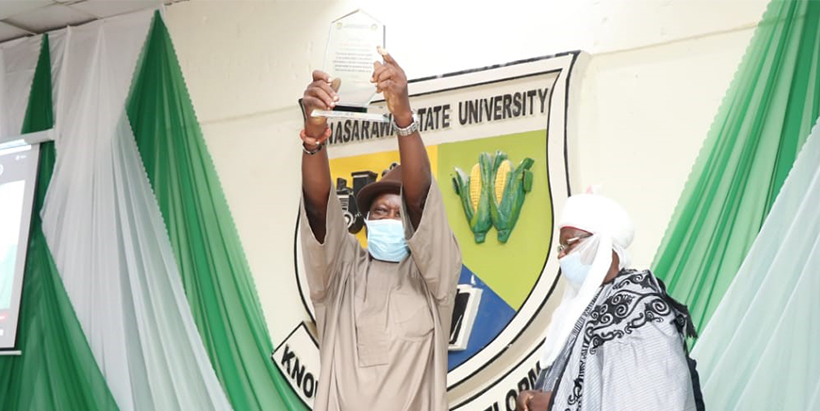
IITA boss receives prestigious award for championing youth in agriculture programs
Dr Alfred Dixon receiving the award on behalf of DG Sanginga.

“We are proud of the impact of the work that IITA has been doing, particularly among the youth, and it is worthy of recognition,” Chair of the Local Organizing Committee of ADAN, Prof. Olumuyiwa James Jayeoba, said.

The IITA youth program, which initially started with less than 50 youths on IITA Campus, Ibadan, has blossomed with hundreds of young people across Africa benefiting from the program. Most of the program’s beneficiaries are now managers of their own farms, while others have picked up other vocations within the agriculture space.

“ADAN intends to emulate the IITA Youth program and replicate the model across Nigerian universities,” Prof. Jayeoba disclosed.

Receiving the award on behalf of Dr Sanginga, Dr Alfred Dixon, the Director of the Development and Delivery Office of IITA, said the recognition was an encouragement for IITA and the DG to do more for the growth of youth in Africa.

“The youth program in IITA has demonstrated that the rising youth population is a huge capital that we need to harness for wealth creation and the prosperity of Africa,” Dr Dixon added.

Widely referred to as the “father of youth in agripreneurship”, Dr Sanginga successfully pioneered the youth-in-agriculture initiative that has been adopted in many African countries.

Prior to becoming the Director-General of IITA, Dr Sanginga served as the Director of the Nairobi-based Tropical Soil Biology and Fertility Institute (TBSF) of the Centro Internacional de Agricultura Tropical (CIAT-TBSF). Before transferring to CIAT-TBSF, Dr Sanginga served for 14 years in IITA in various capacities, including Principal Scientist and Head of the Soil Microbiology Unit. Other positions he held include Assistant Coordinator of the Alley Farming Network for Tropical Africa (AFNETA); Project Coordinator of Improvement of High-Intensity Food and Forage Crop Systems and Short Fallow Systems to Arrest Land Degradation due to Land Use Intensification; Leader of the multidisciplinary program Improving and Intensifying Cereal-Legume Systems in the Moist and Dry Savannas of West and Central Africa, and collaborating with many scientists in national and international institutions.

Dr Sanginga has more than 30 years of experience with the University of Zimbabwe, International Atomic Energy Agency (IAEA) in Austria, CIAT-TSBF, and IITA in agricultural research and development, particularly in the fields of applied microbial ecology, plant nutrition, and integrated natural resources management in Africa, Latin America, and Southeast Asia.

Born and bred in the Democratic Republic of Congo (DRC), Dr Sanginga did most of his postgraduate training at IITA and his PhD in Agronomy/Soil Microbiology under a joint program between IITA and the Institut Facultaire des Sciences Agronomiques, Yangambi, DRC.

He has extensive skills in research management, developing partnerships and institutional linkages, and institution building. Under his leadership, the CIAT-TSBF portfolio rose from $1.2 million in 2003 to over $14.5 million in 2010. Its research-for-development agenda expanded from focusing on Western Kenya to covering the major agroecosystems of East, Central, and Southern Africa. In IITA, he has more than tripled the institute’s budget since assumption into office.

Dr Sanginga played a major role in the creation of the Consortium for Improving Agriculture-based Livelihood in Central Africa (CIALCA) that included three international research centers (IITA, CIAT-TSBF, and Bioversity), university partners in Belgium, national research and development partners in DRC, Burundi, and Rwanda.

His career has also focused on building the capacity of young scientists in Africa. He has trained more than 30 PhD candidates at the National University of Congo, School of Agriculture and the University of Zimbabwe, who now hold leadership positions in their countries.

Dr Sanginga has to his credit more than 150 publications in international journals and book chapters.

Under his leadership, IITA received the Al-Sumait Award for Food Security in 2016 and the Africa Food Prize in 2018.

At the award ceremony were: Dr Chrys Akem, Technologies for TAAT Coordinator: Prof. Lateef Sanni, Project Leader for BASICS-II; Ezinne Igbokwe Ibe , Project Administrator, BASICS-II: Godwin Atser, Advocacy, Promotion & Outreach Lead, BASICS-II and the youth agriprenuers in IITA.


Contribué par

Histoires récentes

Aucun article trouvé

Laisser un commentaire

Votre adresse e-mail ne sera pas publiée. Les champs obligatoires sont indiqués avec *

Retour en haut
Olaosebikan, Olamide

Olamide Deborah Nwanze est une chercheuse principale spécialisée dans la recherche sur l'approche "genre" afin d'éclairer les politiques de sélection participative et inclusive, de développement de variétés et de systèmes semenciers concernant les cultures de racines, tubercules et bananes (RTB) au siège de l'Institut International d'Agriculture Tropicale, à Ibadan, au Nigeria. Elle est candidate au doctorat à l'Université d'Ibadan et titulaire d'un master et d'un diplôme d'ingénieur agronome en vulgarisation agricole et développement rural. Olamide est membre du programme African Women in Agricultural Research and Development – Gender Responsive Agricultural Systems Policy (SAISIE DE RÉCOMPENSEet les Chercheuses Sensibles au Genre Équipées pour la Transformation Agricole (SUPER. Elle cherche à appliquer ses apprentissages en matière d’approche genre, recherche sensible au genre, et expertise en développement et examen de politiques pour faciliter l’accès et l’adoption par les femmes, les jeunes, les enfants et les groupes sociaux vulnérables aux innovations agricoles qui garantissent la sécurité alimentaire, nutritionnelle, des revenus et des moyens de subsistance en Afrique. Ses rôles actuels comprennent le mentorat de chercheurs stagiaires, le développement de guides et manuels de formation, la mise en œuvre et l'adaptation de cadres et d'outils genre, l'engagement des acteurs de la chaîne de valeur en tant que partenaires de la science citoyenne, l'examen et la refonte des politiques, la gestion et l'analyse des données. Ses recherches actuelles portent sur les méthodes mixtes ainsi que sur les approches participatives et interdisciplinaires pour saisir et mettre en évidence les dynamiques de genre, les besoins, les préférences et les défis rencontrés par les parties prenantes au sein de la chaîne de valeur des moyens de subsistance agricoles afin de prioriser des stratégies axées sur le genre dans les programmes de sélection, la conception et la mise en œuvre des politiques.

À l'IITA, elle contribue à la mise en œuvre du CGIAR Initiative d'Élevage Accéléré et Innovation génétique Programmes ; recherche participative et genre au sein des Prochaine Génération ManiocHarvestPlusRTBAliments, et Tricot-ClimMob 1000Fermes Projets ; et la communication des connaissances sur le genre via le Série de webinaires G-LENS, vidéo documentaire, notes de politiquepublications, et blogs.


Publications récentes

de Sousa, K., van Etten, J., Manners, R. Bello, A., Teeken, B., Olaosebikan, O., et al. 2024. L'approche tricot : un cadre agile pour les essais décentralisés à la ferme soutenus par la science citoyenne. Une rétrospective. Agron. Sustain. Dev. 44, 8. https://doi.org/10.1007/s13593-023-00937-1

Madu, T., Onwuka, S., Nwafor, S., Onyemauwa, N., Ejechi, M., Ofoeze, M., Ukeje, B., Eluagu, C., Olaosebikan, O., Okoye, B., 2024. Les études sur les consommateurs inclusifs en matière de genre améliorent l'amélioration du manioc au Nigeria dans : Frontiers in Sociology, volume 9, numéro : 1224504, doi : 10.3389/fsoc.2024.1224504

Olaosebikan, O. ; Bello, A. ; Utoblo, O. ; Okoye, B. ; Olutegbe, N. ; Garner, E. ; Teeken, B. ; Bryan, E. ; Forsythe, L. ; Cole, S. ; Madu, T. 2023. Facteurs de stress et résilience au sein de la chaîne de valeur du manioc au Nigeria : Caractéristiques préférées des variétés de manioc et stratégies de réponse des hommes et des femmes pour informer l'amélioration variétale. Sustainability 15, 7837. https://doi.org/10.3390/su15107837

Okoye, B., Ofoeze, M., Ejechi, M., Onwuka, S., Nwafor, S., Onyemauwa, N., Ukeje, B., Eluagu, C., Obidiegwu, J.*, Olaosebikan, O., Madu, T.* 2023. Priorisation des traits préférés dans la chaîne de valeur de l'igname au Nigeria : une analyse de la situation en matière de genre in: Frontiers in Sociology, volume 8, numéro : 1232626, pages 1 – 9, ISSN 2297-7775, 2023. https://www.frontiersin.org/articles/10.3389/fsoc.2023.1232626/full

Olaosebikan, O., Bello, A. A., de Sousa, K., Ndjouenkeu, R., Adesokan, M., Alamu, E. O., Agbona, A., van Etten, J., Kegah, F. N.*, Dufour, D., Bouniol, A., Teeken, B. 2023. Acceptabilité par les consommateurs des produits alimentaires à base de gari-eba de manioc dans des contextes culturels et environnementaux variés en utilisant l'approche triade de comparaison des technologies (tricot) dans : Journal of the Science of Food and Agriculture,

Teeken, B., Olaosebikan, O., Bello, A. A., Madu, T.*, Cole, S. M. 2023. Évaluation qualitative de la positionnalité et des préférences des dyades en relation avec les activités liées au manioc : travailler avec des scientifiques citoyens du procès tricot https://hdl.handle.net/10568/138326 Type : Manuel

Bouniol, A., Ceballos, H., Bello, A. A., Teeken, B., Olaosebikan, O., Owoade, D., Agbona, A., Fotso Kuate, A., Madu, T.*, Okoye, B.*, Ofoeze, M.*, Nwafor, S.*, Onyemauwa, N.*, Adinsi, L.*, Forsythe, L., Dufour, D. 2023. Impact variétal sur le travail des femmes, la charge de travail et la pénibilité associée dans le traitement des plantes à racines, tubercules et bananes : focus sur le manioc en Afrique subsaharienne dans : Journal of the Science of Food and Agriculture, pages 1 – 25, ISSN 0022-5142,

Bello, A. A., Agbona, A., Olaosebikan, O., Edughaen, G., Dufour, D., Bouniol, A., Iluebbey, P., Ndjouenkeu, R.*, Rabbi, I. Y., Teeken, B. 2023. Effets génétiques et environnementaux sur la productivité de la transformation et le rendement des produits alimentaires : la pénibilité du travail des femmes dans : Journal of the Science of Food and Agriculture, pages 1 – 32, ISSN 0022-5142, 5

Cavicchioli, M., Zimbiti, T., Teeken, B., Nwanze, D.O., Liani, M., Parkes, E. & Bello, A. 2023. Rapport sur la formation en sélection génétique sensible au genre à l'IITA. Genetic Resources Center, IITA-HQ, Ibadan, 21-23 septembre 2022. Ibadan, Nigéria : IITA, (34 p.).https://hdl.handle.net/10568/131368

Agbona, A. Peteti P., Teeken B., Olaosebikan O. Bello, A. A., Parkes, E., Rabbi, I. Y., Mueller, L., Egesi, C., Kulakow, P. 2022. Gestion des données dans les programmes d'amélioration des cultures RTB africaines multidisciplinaires. In : Williamson, H.F., Leonelli, S. (eds) Towards Responsible Plant Data Linkage: Data Challenges for Agricultural Research and Development. Springer, Cham. https://doi.org/10.1007/978-3-031-13276-6_5

Lora Forsythe, Pricilla Marimo, Sarah Mayanja, Olamide D. Olaosebikan, Esme Stuart, Bela Teeken, Benjamin Okoye, Tessy Madu, (2021). Analyse transversale du genre dans RTBfoods Étape 2 Cartographie des genres sur les produits RTB. Comprendre les moteurs des préférences en matière de traits et le développement de profils de produits RTB multi-utilisateurs, WP1. Londres, Royaume-Uni : Rapport scientifique de terrain RTBfoods, 30 p.

Teeken, B., Garner, E., Agbona, A., Balogun, I., Olaosebikan, O., Bello, A., Madu, T., Okoye, B., Egesi, C., Kulakow, P. et Tufan, H.A. 2021. Au-delà des “ traits des femmes ” : explorer comment le genre, les différences sociales et les caractéristiques des ménages influencent les préférences pour les traits. Frontiers Systèmes alimentaires durables 5:740926. https://doi.org/10.3389/fsufs.2021.740926

Teeken, B., Agbona, A., Bello, A., Olaosebikan, O., Alamu, E., Adesokan, M., Awoyale, W., Madu, T., Okoye, B., Chijioke, U., Owoade, D., Okoro, M., Bouniol, A., Dufour, D., Hershey, C., Rabbi, I., Maziya‐Dixon, B., Egesi, C., Tufan, H. et Kulakow, P. (020. Comprendre les préférences variétales du manioc par le classement par paires du gari-eba et du fufu préparés par des agriculteurs-transformateurs locaux. Int J Food Sci Technol. https://doi.org/10.1111/ijfs.14862

Bela Teeken, Olamide Olaosebikan, Ireti Balogun, Benjamin Okoye, Tessy Madu, Steven Cole, Abolore Bello, Elizabeth Parkes. (2020). Pilotage des outils de profil client et produit G+ pour l'amélioration sensible au genre du manioc au Nigeria. Nigeria : Institut international d'agriculture tropicale (IIAT). https://hdl.handle.net/20.500.11766/13000