IITA chief recognized for achievements by traditional king of Yoruba in Nigeria
novembre 15, 2021
Ibadan, Nigeria — The Ooni of Ife, His Imperial Majesty, Oba Enitan Adeyeye, Ojaja II, will confer the title of Aare Afurugbin Ola de la Source (Lead Sower of Wealth and Prosperity of the House Oduduwa) on the Director General of the International Institute of Tropical Agriculture (IITA), Dr Nteranya Sanginga. Dr Sanginga is also the Regional Director of CGIAR, a global partnership that unites international organizations engaged in research about food security.
The conferment, which will take place at Ile Oodua, Ooni’s palace, Ile-Ife, Osun State, Nigeria, is in recognition of Dr Sanginga’s achievements as one of the illustrious sons of Africa who has contributed immensely to the development and promotion of the financial and economic stability and growth of the continent.
The Ooni (king), who is one of the most powerful and influential traditional rulers in Africa, sits in Ile-Ife, the cradle of the Yoruba people—the largest ethnic group in West Africa.
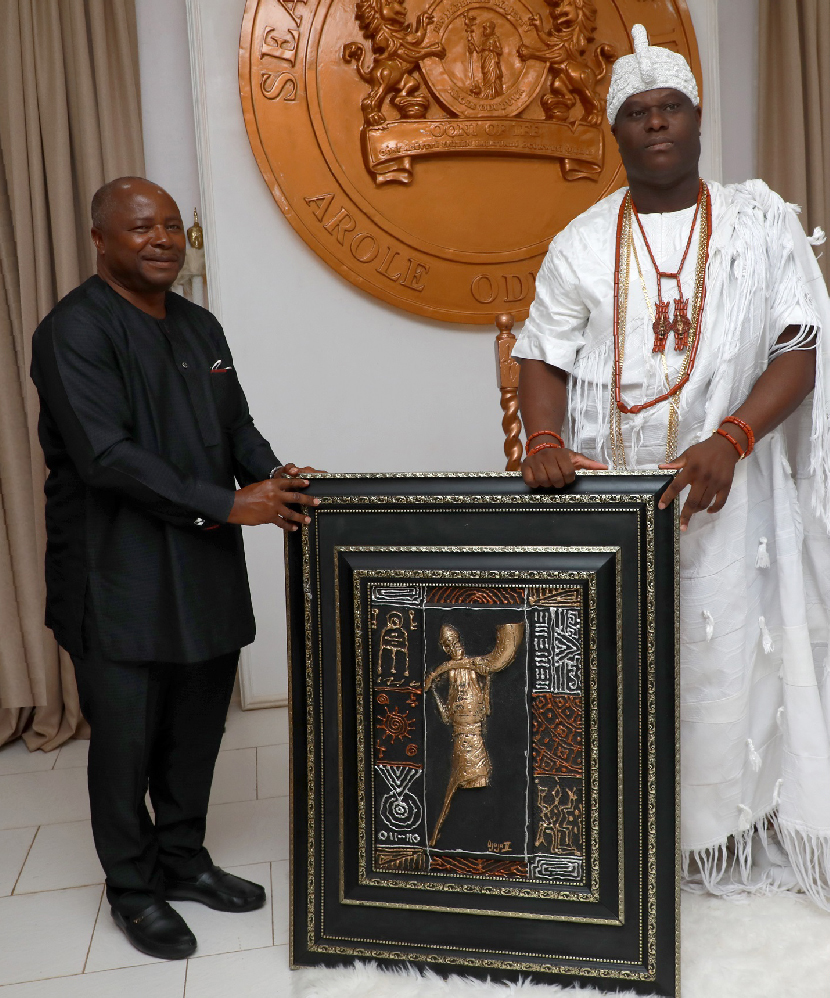
The Ooni (king) of Ife (right), Oba Enitan Adeyeye, Ojaja II, will confer the Aare Afurugbin-Ola of ‘The Source’, Oduduwa land (Lead Sower of Wealth and Prosperity, of the House of Oduduwa) on Dr Nteranya Sanginga, Director General of the International Institute of Tropical Agriculture (IITA) on 11 December 2021 in recognition of his achievements that have contributed immensely to the development and promotion of the financial and economic stability and growth of the African continent. Photo by Olusegun Adebayo, IITA.
Dr Sanginga is a citizen of the Democratic Republic of the Congo (DRC) and had spent a large part of his career in Nigeria and is the first African to head IITA.
In 2018, Dr Sanginga, on behalf of IITA, received the Africa Food Prize for the trailblazing research leadership of the institute in Nigeria and the continent which has impacted positively on the lives and livelihoods of millions of smallholder farmers.
The Institute was cited for“generating solutions on and off the farm that have improved the lives of millions in the face of climate change, a surge of crop pests and diseases, and an urgent need for youth employment.”
In 2016, IITA also received the Al-Sumait Award for Food Security for its sustained efforts in undertaking groundbreaking research and development that continues to positively affect the lives of millions on the African continent.
The Ooni of Ife, Arole Oduduwa Olofin Adimula, Ooni Adeyeye Enitan Ogunwusi, Ojaja II, the natural head of the entire Oodua Race worldwide, will confer the title of Aare Afurugbin Ola of the Source (Lead Sower of Wealth and Prosperity of the House Oduduwa) on Dr Sanginga on 11 December at a conferment ceremony to be held at Ile Oodua (Ooni’s palace), Ile-Ife, Osun State, Nigeria.
The conferment of the title is indeed an honor that is well respected and regarded, not only in Yorubaland, but also in Africa.
Since he assumed office in 2011, Dr Sanginga has displayed exceptional commitment to initiatives which have placed the African continent on the global stage, especially in the agricultural arena.
Over the past 50 years, IITA, through its various programs, provided farmers on the continent with innovations that promoted food and nutritional security and safety, increased food production, raised yield of major food crops, reduced poverty levels, decreased postharvest losses, promoted mechanization of agriculture, and generated jobs and wealth creation for young people and women in the agricultural sector, among others.
IITA is known for its world-class innovative research that has lifted millions of African farmers out of peasant farming and given them the opportunity to practice agriculture on a more profitable scale through agribusiness. It is one of 13 research centers under CGIAR, which aims to reduce rural poverty, increase food security, improve human health and nutrition, and sustainable management of natural resources.
To develop the next generation of farmers, agribusiness entrepreneurs, and science leaders, IITA under Sanginga built the research capacity of national agricultural systems in sub-Saharan Africa, provided opportunities for young scientists and entrepreneurs to adopt and introduce various agricultural technologies while also developing the skills of young people to become self-employed and employers of labor in the agricultural sector.
The conferment event, which is the first of international honorary chieftaincy in the reign of the current king—the 51st Oonirisa of Ile-Ife—will host captains of industries from all over Africa, Heads of state, former Heads of state, diplomats from within and outside Africa, politicians of repute, members of the development community, and other stakeholders in the diaspora.
This event is also expected to promote the socioeconomic and cultural ties between Nigeria and Dr Sanginga’s country—the Democratic Republic of Congo, two of Africa’s most endowed countries in terms of human and natural resources.
END
À propos de l'IITA, iita.org
The International Institute of Tropical Agriculture (IITA) is a not-for-profit institution that generates agricultural innovations to meet Africa’s most pressing challenges of hunger, malnutrition, poverty, and natural resource degradation. Working with various partners across sub-Saharan Africa, we improve livelihoods, enhance food and nutrition security, increase employment, and preserve natural resource integrity. IITA is a member of CGIAR, a global agriculture research partnership for a food secure future.
About Oonirisa
“Oònirìsà” means caretaker of the “Orisa” (Oracle, deity, the Almighty). The Ooni of Ife is the traditional ruler of Ile-Ife, whose dynasty goes back hundreds of years. Ifè is also known as Ilé-Ifè̀, an ancient Yoruba city in south-western Nigeria. Ooni Adeyeye Enitan Ogunwusi is the 51st Ooni of Ife.
Contacts presse
Katherine Lopez, Head of Communication, IITA
Email: k.lopez@cgiar.org, Tel. +234 8039784454
Moses Olafare, Director Public Affairs, Ile Oodua, Ile Ife
Email: myvisionsocial@gmail.com, Tel. +234 8033588148
Olamide Deborah Nwanze est une chercheuse principale spécialisée dans la recherche sur l'approche "genre" afin d'éclairer les politiques de sélection participative et inclusive, de développement de variétés et de systèmes semenciers concernant les cultures de racines, tubercules et bananes (RTB) au siège de l'Institut International d'Agriculture Tropicale, à Ibadan, au Nigeria. Elle est candidate au doctorat à l'Université d'Ibadan et titulaire d'un master et d'un diplôme d'ingénieur agronome en vulgarisation agricole et développement rural. Olamide est membre du programme African Women in Agricultural Research and Development – Gender Responsive Agricultural Systems Policy (SAISIE DE RÉCOMPENSEet les Chercheuses Sensibles au Genre Équipées pour la Transformation Agricole (SUPER. Elle cherche à appliquer ses apprentissages en matière d’approche genre, recherche sensible au genre, et expertise en développement et examen de politiques pour faciliter l’accès et l’adoption par les femmes, les jeunes, les enfants et les groupes sociaux vulnérables aux innovations agricoles qui garantissent la sécurité alimentaire, nutritionnelle, des revenus et des moyens de subsistance en Afrique. Ses rôles actuels comprennent le mentorat de chercheurs stagiaires, le développement de guides et manuels de formation, la mise en œuvre et l'adaptation de cadres et d'outils genre, l'engagement des acteurs de la chaîne de valeur en tant que partenaires de la science citoyenne, l'examen et la refonte des politiques, la gestion et l'analyse des données. Ses recherches actuelles portent sur les méthodes mixtes ainsi que sur les approches participatives et interdisciplinaires pour saisir et mettre en évidence les dynamiques de genre, les besoins, les préférences et les défis rencontrés par les parties prenantes au sein de la chaîne de valeur des moyens de subsistance agricoles afin de prioriser des stratégies axées sur le genre dans les programmes de sélection, la conception et la mise en œuvre des politiques.
de Sousa, K., van Etten, J., Manners, R. Bello, A., Teeken, B., Olaosebikan, O., et al. 2024. L'approche tricot : un cadre agile pour les essais décentralisés à la ferme soutenus par la science citoyenne. Une rétrospective. Agron. Sustain. Dev. 44, 8. https://doi.org/10.1007/s13593-023-00937-1
Madu, T., Onwuka, S., Nwafor, S., Onyemauwa, N., Ejechi, M., Ofoeze, M., Ukeje, B., Eluagu, C., Olaosebikan, O., Okoye, B., 2024. Les études sur les consommateurs inclusifs en matière de genre améliorent l'amélioration du manioc au Nigeria dans : Frontiers in Sociology, volume 9, numéro : 1224504, doi : 10.3389/fsoc.2024.1224504
Olaosebikan, O. ; Bello, A. ; Utoblo, O. ; Okoye, B. ; Olutegbe, N. ; Garner, E. ; Teeken, B. ; Bryan, E. ; Forsythe, L. ; Cole, S. ; Madu, T. 2023. Facteurs de stress et résilience au sein de la chaîne de valeur du manioc au Nigeria : Caractéristiques préférées des variétés de manioc et stratégies de réponse des hommes et des femmes pour informer l'amélioration variétale. Sustainability 15, 7837. https://doi.org/10.3390/su15107837
Okoye, B., Ofoeze, M., Ejechi, M., Onwuka, S., Nwafor, S., Onyemauwa, N., Ukeje, B., Eluagu, C., Obidiegwu, J.*, Olaosebikan, O., Madu, T.* 2023. Priorisation des traits préférés dans la chaîne de valeur de l'igname au Nigeria : une analyse de la situation en matière de genre in: Frontiers in Sociology, volume 8, numéro : 1232626, pages 1 – 9, ISSN 2297-7775, 2023. https://www.frontiersin.org/articles/10.3389/fsoc.2023.1232626/full
Olaosebikan, O., Bello, A. A., de Sousa, K., Ndjouenkeu, R., Adesokan, M., Alamu, E. O., Agbona, A., van Etten, J., Kegah, F. N.*, Dufour, D., Bouniol, A., Teeken, B. 2023. Acceptabilité par les consommateurs des produits alimentaires à base de gari-eba de manioc dans des contextes culturels et environnementaux variés en utilisant l'approche triade de comparaison des technologies (tricot) dans : Journal of the Science of Food and Agriculture,
Teeken, B., Olaosebikan, O., Bello, A. A., Madu, T.*, Cole, S. M. 2023. Évaluation qualitative de la positionnalité et des préférences des dyades en relation avec les activités liées au manioc : travailler avec des scientifiques citoyens du procès tricot https://hdl.handle.net/10568/138326 Type : Manuel
Bouniol, A., Ceballos, H., Bello, A. A., Teeken, B., Olaosebikan, O., Owoade, D., Agbona, A., Fotso Kuate, A., Madu, T.*, Okoye, B.*, Ofoeze, M.*, Nwafor, S.*, Onyemauwa, N.*, Adinsi, L.*, Forsythe, L., Dufour, D. 2023. Impact variétal sur le travail des femmes, la charge de travail et la pénibilité associée dans le traitement des plantes à racines, tubercules et bananes : focus sur le manioc en Afrique subsaharienne dans : Journal of the Science of Food and Agriculture, pages 1 – 25, ISSN 0022-5142,
Bello, A. A., Agbona, A., Olaosebikan, O., Edughaen, G., Dufour, D., Bouniol, A., Iluebbey, P., Ndjouenkeu, R.*, Rabbi, I. Y., Teeken, B. 2023. Effets génétiques et environnementaux sur la productivité de la transformation et le rendement des produits alimentaires : la pénibilité du travail des femmes dans : Journal of the Science of Food and Agriculture, pages 1 – 32, ISSN 0022-5142, 5
Cavicchioli, M., Zimbiti, T., Teeken, B., Nwanze, D.O., Liani, M., Parkes, E. & Bello, A. 2023. Rapport sur la formation en sélection génétique sensible au genre à l'IITA. Genetic Resources Center, IITA-HQ, Ibadan, 21-23 septembre 2022. Ibadan, Nigéria : IITA, (34 p.).https://hdl.handle.net/10568/131368
Agbona, A. Peteti P., Teeken B., Olaosebikan O. Bello, A. A., Parkes, E., Rabbi, I. Y., Mueller, L., Egesi, C., Kulakow, P. 2022. Gestion des données dans les programmes d'amélioration des cultures RTB africaines multidisciplinaires. In : Williamson, H.F., Leonelli, S. (eds) Towards Responsible Plant Data Linkage: Data Challenges for Agricultural Research and Development. Springer, Cham. https://doi.org/10.1007/978-3-031-13276-6_5
Lora Forsythe, Pricilla Marimo, Sarah Mayanja, Olamide D. Olaosebikan, Esme Stuart, Bela Teeken, Benjamin Okoye, Tessy Madu, (2021). Analyse transversale du genre dans RTBfoods Étape 2 Cartographie des genres sur les produits RTB. Comprendre les moteurs des préférences en matière de traits et le développement de profils de produits RTB multi-utilisateurs, WP1. Londres, Royaume-Uni : Rapport scientifique de terrain RTBfoods, 30 p.
Teeken, B., Garner, E., Agbona, A., Balogun, I., Olaosebikan, O., Bello, A., Madu, T., Okoye, B., Egesi, C., Kulakow, P. et Tufan, H.A. 2021. Au-delà des “ traits des femmes ” : explorer comment le genre, les différences sociales et les caractéristiques des ménages influencent les préférences pour les traits. Frontiers Systèmes alimentaires durables 5:740926. https://doi.org/10.3389/fsufs.2021.740926
Teeken, B., Agbona, A., Bello, A., Olaosebikan, O., Alamu, E., Adesokan, M., Awoyale, W., Madu, T., Okoye, B., Chijioke, U., Owoade, D., Okoro, M., Bouniol, A., Dufour, D., Hershey, C., Rabbi, I., Maziya‐Dixon, B., Egesi, C., Tufan, H. et Kulakow, P. (020. Comprendre les préférences variétales du manioc par le classement par paires du gari-eba et du fufu préparés par des agriculteurs-transformateurs locaux. Int J Food Sci Technol.https://doi.org/10.1111/ijfs.14862
Bela Teeken, Olamide Olaosebikan, Ireti Balogun, Benjamin Okoye, Tessy Madu, Steven Cole, Abolore Bello, Elizabeth Parkes. (2020). Pilotage des outils de profil client et produit G+ pour l'amélioration sensible au genre du manioc au Nigeria. Nigeria : Institut international d'agriculture tropicale (IIAT). https://hdl.handle.net/20.500.11766/13000