IITA donates ‘Seeds of Renaissance’ to Nigeria to address humanitarian crisis
mai 21, 2017
IITA donated about 35,930 kilograms of seeds to the Borno state government as part of efforts to cushion the humanitarian crisis in the northeastern part of Nigeria.
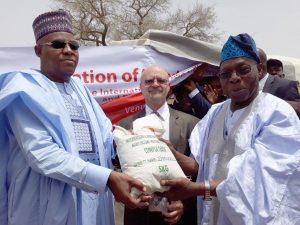
The Governor of Borno State, Alhaji Kashim Shettima; Deputy Director General, Partnerships for Delivery at IITA, Dr Kenton Dashiell; and IITA Ambassador and Former President of Nigeria, Chief Olusegun Obasanjo during the donation of 35,930 kilograms of seeds and 2640 kilograms of rice to Borno State government today (22 May 2017) in Maiduguri.
The donation, which took place on 22 May, is perhaps the largest quantity of seeds offered to Nigeria in recent times. This IITA initiative addresses the humanitarian crisis in the region—a region once referred to as the bread basket of Nigeria.
Delivering the seeds to the Governor of Borno State, Kenton Dashiell, IITA Deputy Director General, Partnerships for Delivery, representing Director General Nteranya Sanginga, said the donation is aimed at helping Nigeria to rebuild Borno in particular and the northeast in general.
Donated seeds include improved varieties of cowpea, soybean, maize, millet, sorghum, and rice that are adapted to the climate of the region. “They are also high yielding and resistant to the major pests and diseases, and other biotic and abiotic constraints in the region,” Dashiell explained, adding that another 3000 bundles of cassava planting materials will be delivered to the state once the rains stabilize.
IITA Ambassador and former Nigerian President, Chief Olusegun Obasanjo described the donation as the “most meaningful gift“ ever given to the people of Borno state.
The IITA Ambassador pledged IITA’s commitment to support Borno state and Nigeria at large during this challenging period.
“IITA and partners including the World Food Program (WFP), the Zero Hunger Forum, and Banque africaine de développement will continue to give priority attention to Borno state in particular and the northeast in general,” Chief Obasanjo said.
Located about 850 kilometers northeast of Abuja, Borno state became the epicenter of attacks from Boko Haram—an Islamic extremist group that had killed more than 20,000 since 2009, and displaced more than 2.3 million, majority of them farmers. The group has become the world’s deadliest organization according to the Global Terrorism Index in 2015.
In February 2017, the United Nations listed northeastern Nigeria as one of the regions in the world facing hunger and devastating levels of food insecurity.
Dashiell says: “The donation is being given because IITA is concerned about the plight of the people of the Northeast who, by many accounts, are very food insecure, malnourished, and need assistance to get back to normal life. We are committed to working with the Federal Government and the State governments in northeastern Nigeria to transform agriculture. We also plan to partner with WFP and the Food and Agriculture Organization (FAO) of the United Nations during this 2017 growing season. It is also an opportunity for IITA as an international agricultural research-for-development institution to implement its mission to transform agriculture in Nigeria and Africa at large.”
The seeds are intended for planting by farmers of Borno State in the upcoming cropping season. The IITA seed collection is a product of joint efforts by IITA breeders and agronomists, special project managers, and scientists, the Business Incubation Platform (BIP)-GoSeed producers, and Jeunes agripreneurs de l'IITA. Sister centers CIRDI et AfricaRice also provided seeds to support this initiative.
The Governor of Borno State, Alhaji Kashim Shettima, noted with appreciation that agriculture remains the highest employer on earth and that “IITA plays a pivotal role in sustaining the sector in Africa.”
“Words cannot adequately convey the depth of our gratitude to IITA and to President Obasanjo who is an Ambassador of IITA, for the choice of Borno as beneficiary of this remarkable intervention. Seeds, particularly at this time, are life saving for us in Borno State. In a typical conflict situation, majority of farmers end up eating up their seeds because they can’t plant them. These seeds will be of immediate use to our farmers in the southern part of Borno State which has been less affected by the Boko Haram insurgency. Farmers there are still carrying out their activities as against areas like Northern Borno,” Governor Shettima said.
END
For media enquiries, please contact Ken Dashiell, k.dashiell@cgiar.org, or Godwin Atser, g.atser@cgiar.orgAbout IITA, www.iita.org
The International Institute of Tropical Agriculture (IITA) is a not-for-profit institution that generates agricultural innovations to meet Africa’s most pressing challenges of hunger, malnutrition, poverty, and natural resource degradation. Working with various partners across sub-Saharan Africa, we improve livelihoods, enhance food and nutrition security, increase employment, and preserve natural resource integrity. IITA is a member of CGIAR, a global agriculture research partnership for a food secure future.
IITA is guided by an ambitious strategy–to lift 11.5 million people out of poverty and revitalize 7.5 million hectares of farml and–by 2020. IITA has delivered more than 70% of the CGIAR’s impact in sub-Saharan Africa and remains committed to science-driven improvement of agriculture and related food value chains.
Olamide Deborah Nwanze est une chercheuse principale spécialisée dans la recherche sur l'approche "genre" afin d'éclairer les politiques de sélection participative et inclusive, de développement de variétés et de systèmes semenciers concernant les cultures de racines, tubercules et bananes (RTB) au siège de l'Institut International d'Agriculture Tropicale, à Ibadan, au Nigeria. Elle est candidate au doctorat à l'Université d'Ibadan et titulaire d'un master et d'un diplôme d'ingénieur agronome en vulgarisation agricole et développement rural. Olamide est membre du programme African Women in Agricultural Research and Development – Gender Responsive Agricultural Systems Policy (SAISIE DE RÉCOMPENSEet les Chercheuses Sensibles au Genre Équipées pour la Transformation Agricole (SUPER. Elle cherche à appliquer ses apprentissages en matière d’approche genre, recherche sensible au genre, et expertise en développement et examen de politiques pour faciliter l’accès et l’adoption par les femmes, les jeunes, les enfants et les groupes sociaux vulnérables aux innovations agricoles qui garantissent la sécurité alimentaire, nutritionnelle, des revenus et des moyens de subsistance en Afrique. Ses rôles actuels comprennent le mentorat de chercheurs stagiaires, le développement de guides et manuels de formation, la mise en œuvre et l'adaptation de cadres et d'outils genre, l'engagement des acteurs de la chaîne de valeur en tant que partenaires de la science citoyenne, l'examen et la refonte des politiques, la gestion et l'analyse des données. Ses recherches actuelles portent sur les méthodes mixtes ainsi que sur les approches participatives et interdisciplinaires pour saisir et mettre en évidence les dynamiques de genre, les besoins, les préférences et les défis rencontrés par les parties prenantes au sein de la chaîne de valeur des moyens de subsistance agricoles afin de prioriser des stratégies axées sur le genre dans les programmes de sélection, la conception et la mise en œuvre des politiques.
de Sousa, K., van Etten, J., Manners, R. Bello, A., Teeken, B., Olaosebikan, O., et al. 2024. L'approche tricot : un cadre agile pour les essais décentralisés à la ferme soutenus par la science citoyenne. Une rétrospective. Agron. Sustain. Dev. 44, 8. https://doi.org/10.1007/s13593-023-00937-1
Madu, T., Onwuka, S., Nwafor, S., Onyemauwa, N., Ejechi, M., Ofoeze, M., Ukeje, B., Eluagu, C., Olaosebikan, O., Okoye, B., 2024. Les études sur les consommateurs inclusifs en matière de genre améliorent l'amélioration du manioc au Nigeria dans : Frontiers in Sociology, volume 9, numéro : 1224504, doi : 10.3389/fsoc.2024.1224504
Olaosebikan, O. ; Bello, A. ; Utoblo, O. ; Okoye, B. ; Olutegbe, N. ; Garner, E. ; Teeken, B. ; Bryan, E. ; Forsythe, L. ; Cole, S. ; Madu, T. 2023. Facteurs de stress et résilience au sein de la chaîne de valeur du manioc au Nigeria : Caractéristiques préférées des variétés de manioc et stratégies de réponse des hommes et des femmes pour informer l'amélioration variétale. Sustainability 15, 7837. https://doi.org/10.3390/su15107837
Okoye, B., Ofoeze, M., Ejechi, M., Onwuka, S., Nwafor, S., Onyemauwa, N., Ukeje, B., Eluagu, C., Obidiegwu, J.*, Olaosebikan, O., Madu, T.* 2023. Priorisation des traits préférés dans la chaîne de valeur de l'igname au Nigeria : une analyse de la situation en matière de genre in: Frontiers in Sociology, volume 8, numéro : 1232626, pages 1 – 9, ISSN 2297-7775, 2023. https://www.frontiersin.org/articles/10.3389/fsoc.2023.1232626/full
Olaosebikan, O., Bello, A. A., de Sousa, K., Ndjouenkeu, R., Adesokan, M., Alamu, E. O., Agbona, A., van Etten, J., Kegah, F. N.*, Dufour, D., Bouniol, A., Teeken, B. 2023. Acceptabilité par les consommateurs des produits alimentaires à base de gari-eba de manioc dans des contextes culturels et environnementaux variés en utilisant l'approche triade de comparaison des technologies (tricot) dans : Journal of the Science of Food and Agriculture,
Teeken, B., Olaosebikan, O., Bello, A. A., Madu, T.*, Cole, S. M. 2023. Évaluation qualitative de la positionnalité et des préférences des dyades en relation avec les activités liées au manioc : travailler avec des scientifiques citoyens du procès tricot https://hdl.handle.net/10568/138326 Type : Manuel
Bouniol, A., Ceballos, H., Bello, A. A., Teeken, B., Olaosebikan, O., Owoade, D., Agbona, A., Fotso Kuate, A., Madu, T.*, Okoye, B.*, Ofoeze, M.*, Nwafor, S.*, Onyemauwa, N.*, Adinsi, L.*, Forsythe, L., Dufour, D. 2023. Impact variétal sur le travail des femmes, la charge de travail et la pénibilité associée dans le traitement des plantes à racines, tubercules et bananes : focus sur le manioc en Afrique subsaharienne dans : Journal of the Science of Food and Agriculture, pages 1 – 25, ISSN 0022-5142,
Bello, A. A., Agbona, A., Olaosebikan, O., Edughaen, G., Dufour, D., Bouniol, A., Iluebbey, P., Ndjouenkeu, R.*, Rabbi, I. Y., Teeken, B. 2023. Effets génétiques et environnementaux sur la productivité de la transformation et le rendement des produits alimentaires : la pénibilité du travail des femmes dans : Journal of the Science of Food and Agriculture, pages 1 – 32, ISSN 0022-5142, 5
Cavicchioli, M., Zimbiti, T., Teeken, B., Nwanze, D.O., Liani, M., Parkes, E. & Bello, A. 2023. Rapport sur la formation en sélection génétique sensible au genre à l'IITA. Genetic Resources Center, IITA-HQ, Ibadan, 21-23 septembre 2022. Ibadan, Nigéria : IITA, (34 p.).https://hdl.handle.net/10568/131368
Agbona, A. Peteti P., Teeken B., Olaosebikan O. Bello, A. A., Parkes, E., Rabbi, I. Y., Mueller, L., Egesi, C., Kulakow, P. 2022. Gestion des données dans les programmes d'amélioration des cultures RTB africaines multidisciplinaires. In : Williamson, H.F., Leonelli, S. (eds) Towards Responsible Plant Data Linkage: Data Challenges for Agricultural Research and Development. Springer, Cham. https://doi.org/10.1007/978-3-031-13276-6_5
Lora Forsythe, Pricilla Marimo, Sarah Mayanja, Olamide D. Olaosebikan, Esme Stuart, Bela Teeken, Benjamin Okoye, Tessy Madu, (2021). Analyse transversale du genre dans RTBfoods Étape 2 Cartographie des genres sur les produits RTB. Comprendre les moteurs des préférences en matière de traits et le développement de profils de produits RTB multi-utilisateurs, WP1. Londres, Royaume-Uni : Rapport scientifique de terrain RTBfoods, 30 p.
Teeken, B., Garner, E., Agbona, A., Balogun, I., Olaosebikan, O., Bello, A., Madu, T., Okoye, B., Egesi, C., Kulakow, P. et Tufan, H.A. 2021. Au-delà des “ traits des femmes ” : explorer comment le genre, les différences sociales et les caractéristiques des ménages influencent les préférences pour les traits. Frontiers Systèmes alimentaires durables 5:740926. https://doi.org/10.3389/fsufs.2021.740926
Teeken, B., Agbona, A., Bello, A., Olaosebikan, O., Alamu, E., Adesokan, M., Awoyale, W., Madu, T., Okoye, B., Chijioke, U., Owoade, D., Okoro, M., Bouniol, A., Dufour, D., Hershey, C., Rabbi, I., Maziya‐Dixon, B., Egesi, C., Tufan, H. et Kulakow, P. (020. Comprendre les préférences variétales du manioc par le classement par paires du gari-eba et du fufu préparés par des agriculteurs-transformateurs locaux. Int J Food Sci Technol.https://doi.org/10.1111/ijfs.14862
Bela Teeken, Olamide Olaosebikan, Ireti Balogun, Benjamin Okoye, Tessy Madu, Steven Cole, Abolore Bello, Elizabeth Parkes. (2020). Pilotage des outils de profil client et produit G+ pour l'amélioration sensible au genre du manioc au Nigeria. Nigeria : Institut international d'agriculture tropicale (IIAT). https://hdl.handle.net/20.500.11766/13000