
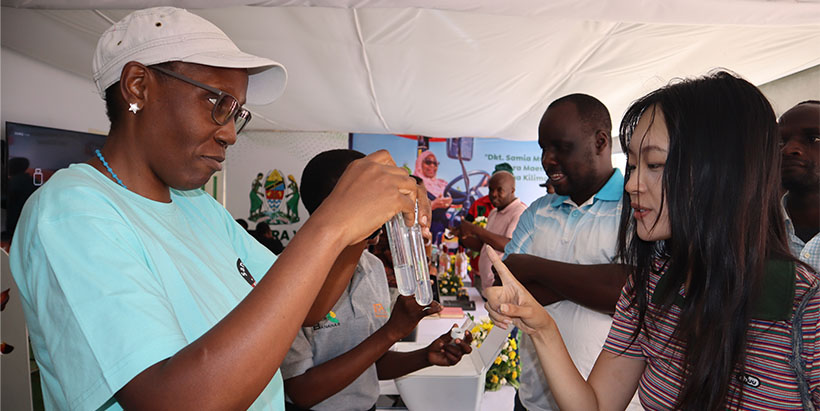
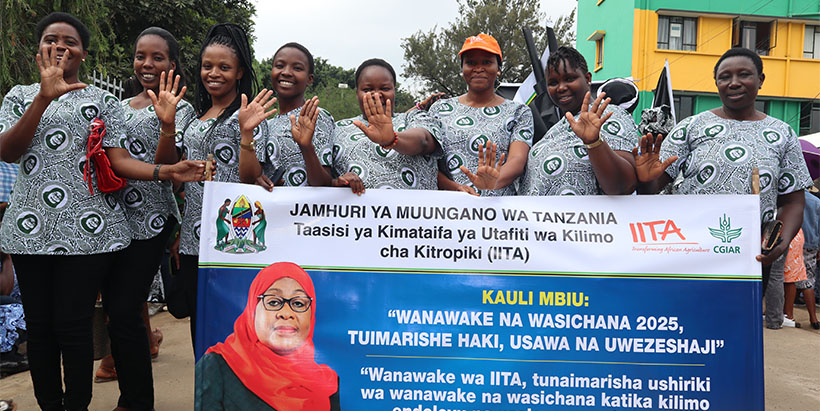
Following a week-long exhibition from 1 to 8 March, IITA–CGIAR participated in the national celebration of International Women’s Day (IWD) held on 8 March 2025 in Arusha, Tanzania. This year’s national theme, “Wanawake na wasichana 2025: Tuimarishe haki, usawa na uwezeshaji,” translates to “Women and girls 2025: Strengthening justice, equality, and empowerment.”
The exhibitions were organized by the Ministry of Community Development, Gender, and Children in collaboration with the Regional Commissioner’s Office in Arusha, providing a platform for women from different sectors to showcase their impactful contributions.
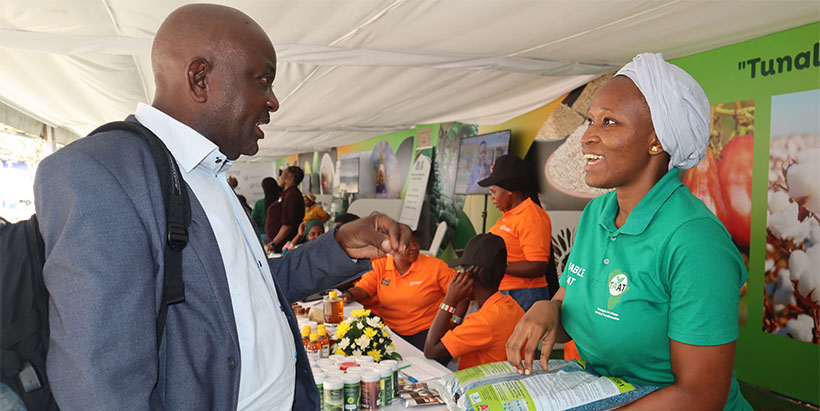
On the invitation of the Tanzania Ministry of Agriculture, IITA showcased agricultural technologies researched and co-developed by women and men scientists. The technologies showcased include banana breeding, Aflasafe, the PlantVillage Nuru digital tool and controlling and managing the banana bunchy top disease, all contribute to transforming Tanzania’s food systems.
During the celebration, Her Excellency Dr Samia Suluhu Hassan, the president of Tanzania, expressed her gratitude to government institutions and non-governmental organizations for their commitment and contributions to women and girls’ development across sectors, echoing the global theme “For all women and girls: Rights, equality, empowerment.”
“Coming together is important in driving the necessary changes the government strives for. Today, I want to highlight that significant policy and legal measures have been, and continue to be, implemented to eliminate oppressive traditions and discrimination against women and girls.”
Dr Suluhu noted that gender equality has progressed significantly, with positive changes occurring. Reflecting on previous years, she noted an increase in women’s participation in both government and private institutions, with a substantial increase in leadership positions such as members of parliament, ministers, and even councilors – far more than in the past. “The private sector has also played a key role in promoting and supporting women to reach higher positions,” she added.
The young women researchers at the event engaged with visitors and shared research-driven solutions, many of which are ready to be scaled and adopted by farming communities. This impressed the visitors with the good work IITA is doing in the country.
“Women’s Day has been a remarkable learning opportunity for us. After visiting the IITA booth, we gained valuable insights into the scientific methods of banana production. We learned that banana plants have seeds, something we never knew before as students,” Devotha Kalakinandosi, a student at Kisonga Foundation College in Moshi, expressed.
“Additionally, we learned about aflatoxin and using Aflasafe to improve maize productivity. This knowledge is crucial for ensuring food security. I pledge to use what I have learned to raise awareness in my community about Aflasafe and its role in reducing the health risks and food waste,” she said.
Moreover, Emma Edward, a resident of Moriet, expressed her excitement about visiting the IITA booth, where she learned about banana diseases and breeding processes, including the role of tissue culture technology in improving banana plants to enhance food security.
“I thank the Ministry of Agriculture for facilitating IITA’s participation at the event; the team is providing valuable agricultural knowledge to help farmers improve their productivity,” Edward said.
As the year’s women’s global campaign is advocating for action in promoting gender equality, fostering empowerment and advancing women’s and girls’ rights, IITA continues to commit to engaging women and youth in agricultural development by increasing decent jobs in targeted services and markets, fostering their entrepreneurial competence and agribusiness skills in ways that generate opportunities that grow with time through its strategic objective in the new IITA 2024-2030 Strategy.
Contributed by Hadi Rashid
Contribué par
Histoires récentes