
NOUVELLES DE L'IITA

IITA-Rwanda releases a digital application in the fight against bacterial wilt disease in bananas
octobre 17, 2019

IITA-Rwanda, together with partners, has launched a digital Application which will serve more than 5,000 farmers across the country to diagnose, control and prevent Banana Xanthomonas Wilt (BXW) in banana plantations.
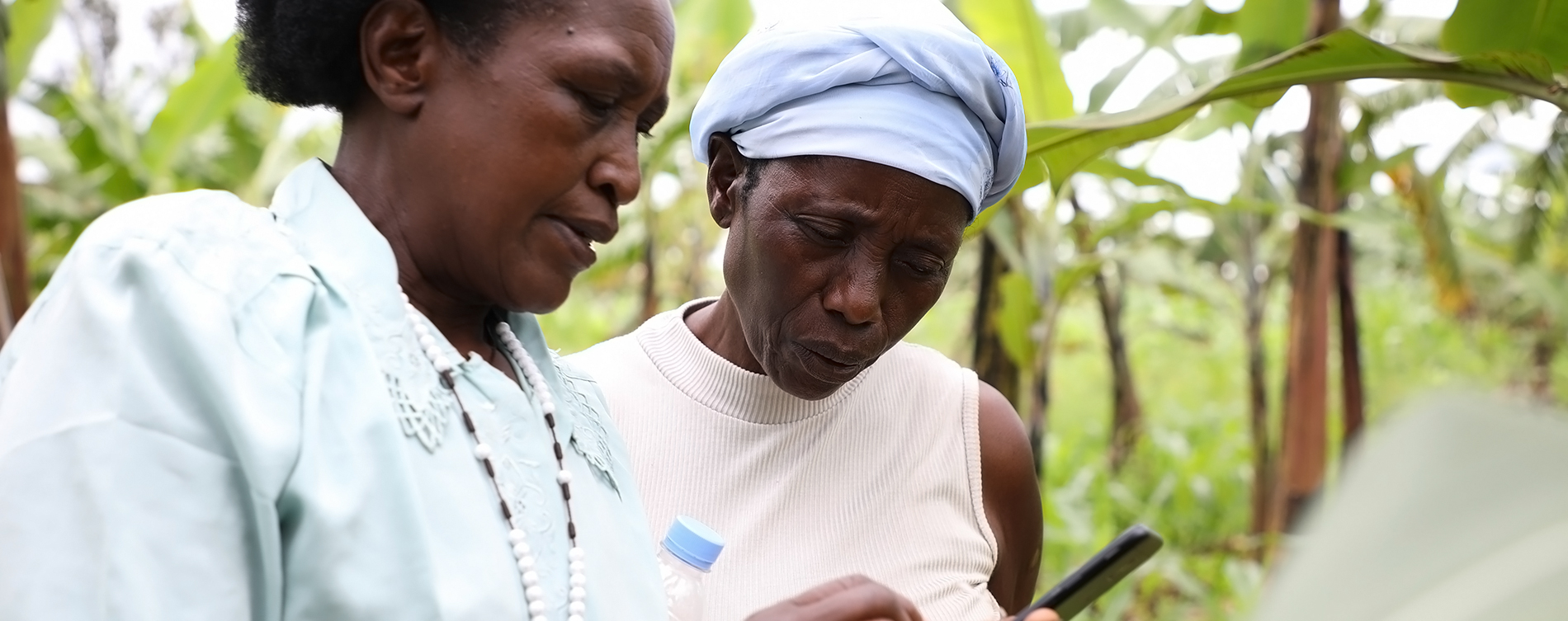
IITA-Rwanda releases a digital application in the fight against bacterial wilt disease in bananas

BXW Application (also BXW-App; Pronounced “Box-Up”) provides a stepwise digital approach that empowers farmers to diagnose BXW in their fields and take immediate control action, as part of an early warning system to combat the disease and prevent its spread to neighboring plants/farmland.

BXW-App is now available on google play store, and any compatible android smartphone user can access, download, and use it to systematically diagnose BXW in banana farm, and do much more! The BXW App is being tested in 8 districts of Rwanda, including Gatsibo, Kayonza, Muhanga, Gisagara, Rulindo, Burera, Karongi and Rubavu with 69 Rwandan Farmer Promoters. However, any interest user across the Country can now access and use the application, which is configured to optimize user-experience in the national Kinyarwanda language.

“We think you cannot control what you cannot monitor. So we are convinced the first step in controlling BXW is to develop a functioning and automated system that enables real-time reporting and monitoring of the disease incidences, and empowers observers (farmers or any citizen) on the field to deploy relevant control measures,” says Dr. Julius Adewopo, who is leading the project – “Citizen science and ICT for advancing the prevention and control of Banana Xanthomonas Wilt (ICT4BXW)” at IITA-Rwanda.

The project is being implemented in collaboration with several partners, including Rwanda Agriculture and Animal Resource Development Board (RAB), Bioversity International and Leibniz Institute of Agricultural Development in Transition Economies (IAMO) with financial support of Deutsche Gesellschaft für Internationale Zusammenarbeit (GIZ). The project aligns with the ICT for Rwanda in Agriculture (ICT4Rag) Strategy 2016-2020 by the Ministry of Agriculture and Animal Resources.

IITA-Rwanda releases a digital application in the fight against bacterial wilt disease in bananas

By 2020, the project aims to have fully piloted the decision-support digital tool, reaching at least 5,000 banana farmers. After that, the project partners aim to secure a second phase during which the tool will be actively promoted for use at larger scale in Rwanda and elsewhere in the African Great Lakes region.

During a field visit to one of the focal districts for the testing of BXW-App, farmer promoters noted that the App has greatly facilitated their role, and improved their engagement with farmers to provide credible advisory support for banana production.

“Before this App for BXW was introduced to us, we were using papers, and walked long distance to report. Now we diagnose and report BXW incidence through the App (and phone) immediately. Moreover, when we are training farmers using the ICT4BXW Application, they are easily convinced, as they see that the information we are giving them are sourced from a credible source by going through all the steps together, seeing pictures that are displaying in the phone, showing various steps that are followed until it tells that the banana stem does not have BXW or it does,” Umutoni Mathilde, Farmer Promotor in Kayonza District said.
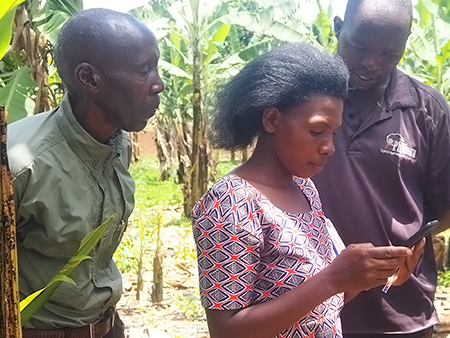
IITA-Rwanda releases a digital application in the fight against bacterial wilt disease in bananas
Farmer promotor explaining to farmers how the BXW App works

69 farmer promotors have been trained under this project in partnership with the Rwanda Agriculture and Animal Resource Development Board (RAB), to use BXW-App for diagnosis and control of BXW in farmers’ fields. They have been also equipped with smartphones to facilitate their implementation of this pilot exercise.

“This application is helping to eyewitness the real signs of BXW in banana field. Before the BXW App, one would confuse BXW signs in a banana stem. For example, the plant sap that comes when you cut a banana stem, you would be confused whether it has BXW or not. But with BXW Application, it shows photos of how the infected plant sap looks like, in order for a farmer also to compare the signs in the App and what is on cut banana stem, then decide of BXW appearance in the field.” Emphasized Murenzi Vianney, Officer in charge of Agriculture in Kayonza District.

BXW Application was developed through an inclusive and participatory design process. It has now four modules. The first module introduces why it is important to control BXW, and the second module enables users to diagnose the disease by step-wisely observing the banana field/stands and answering questions as prompted by the app. The third module provides on-site recommendation for control of BXW, while the fourth module offers general agronomic information for banana management, as an add-on incentive to facilitate healthy and productive banana. The BXW Application may be extended to other African countries in the near future if piloting and scaling are successfully implemented in Rwanda.


Contribué par

Nouvelles connexes

Aucun article trouvé

Laisser un commentaire

Votre adresse e-mail ne sera pas publiée. Les champs obligatoires sont indiqués avec *

Retour en haut
Olaosebikan, Olamide

Olamide Deborah Nwanze est une chercheuse principale spécialisée dans la recherche sur l'approche "genre" afin d'éclairer les politiques de sélection participative et inclusive, de développement de variétés et de systèmes semenciers concernant les cultures de racines, tubercules et bananes (RTB) au siège de l'Institut International d'Agriculture Tropicale, à Ibadan, au Nigeria. Elle est candidate au doctorat à l'Université d'Ibadan et titulaire d'un master et d'un diplôme d'ingénieur agronome en vulgarisation agricole et développement rural. Olamide est membre du programme African Women in Agricultural Research and Development – Gender Responsive Agricultural Systems Policy (SAISIE DE RÉCOMPENSEet les Chercheuses Sensibles au Genre Équipées pour la Transformation Agricole (SUPER. Elle cherche à appliquer ses apprentissages en matière d’approche genre, recherche sensible au genre, et expertise en développement et examen de politiques pour faciliter l’accès et l’adoption par les femmes, les jeunes, les enfants et les groupes sociaux vulnérables aux innovations agricoles qui garantissent la sécurité alimentaire, nutritionnelle, des revenus et des moyens de subsistance en Afrique. Ses rôles actuels comprennent le mentorat de chercheurs stagiaires, le développement de guides et manuels de formation, la mise en œuvre et l'adaptation de cadres et d'outils genre, l'engagement des acteurs de la chaîne de valeur en tant que partenaires de la science citoyenne, l'examen et la refonte des politiques, la gestion et l'analyse des données. Ses recherches actuelles portent sur les méthodes mixtes ainsi que sur les approches participatives et interdisciplinaires pour saisir et mettre en évidence les dynamiques de genre, les besoins, les préférences et les défis rencontrés par les parties prenantes au sein de la chaîne de valeur des moyens de subsistance agricoles afin de prioriser des stratégies axées sur le genre dans les programmes de sélection, la conception et la mise en œuvre des politiques.

À l'IITA, elle contribue à la mise en œuvre du CGIAR Initiative d'Élevage Accéléré et Innovation génétique Programmes ; recherche participative et genre au sein des Prochaine Génération ManiocHarvestPlusRTBAliments, et Tricot-ClimMob 1000Fermes Projets ; et la communication des connaissances sur le genre via le Série de webinaires G-LENS, vidéo documentaire, notes de politiquepublications, et blogs.


Publications récentes

de Sousa, K., van Etten, J., Manners, R. Bello, A., Teeken, B., Olaosebikan, O., et al. 2024. L'approche tricot : un cadre agile pour les essais décentralisés à la ferme soutenus par la science citoyenne. Une rétrospective. Agron. Sustain. Dev. 44, 8. https://doi.org/10.1007/s13593-023-00937-1

Madu, T., Onwuka, S., Nwafor, S., Onyemauwa, N., Ejechi, M., Ofoeze, M., Ukeje, B., Eluagu, C., Olaosebikan, O., Okoye, B., 2024. Les études sur les consommateurs inclusifs en matière de genre améliorent l'amélioration du manioc au Nigeria dans : Frontiers in Sociology, volume 9, numéro : 1224504, doi : 10.3389/fsoc.2024.1224504

Olaosebikan, O. ; Bello, A. ; Utoblo, O. ; Okoye, B. ; Olutegbe, N. ; Garner, E. ; Teeken, B. ; Bryan, E. ; Forsythe, L. ; Cole, S. ; Madu, T. 2023. Facteurs de stress et résilience au sein de la chaîne de valeur du manioc au Nigeria : Caractéristiques préférées des variétés de manioc et stratégies de réponse des hommes et des femmes pour informer l'amélioration variétale. Sustainability 15, 7837. https://doi.org/10.3390/su15107837

Okoye, B., Ofoeze, M., Ejechi, M., Onwuka, S., Nwafor, S., Onyemauwa, N., Ukeje, B., Eluagu, C., Obidiegwu, J.*, Olaosebikan, O., Madu, T.* 2023. Priorisation des traits préférés dans la chaîne de valeur de l'igname au Nigeria : une analyse de la situation en matière de genre in: Frontiers in Sociology, volume 8, numéro : 1232626, pages 1 – 9, ISSN 2297-7775, 2023. https://www.frontiersin.org/articles/10.3389/fsoc.2023.1232626/full

Olaosebikan, O., Bello, A. A., de Sousa, K., Ndjouenkeu, R., Adesokan, M., Alamu, E. O., Agbona, A., van Etten, J., Kegah, F. N.*, Dufour, D., Bouniol, A., Teeken, B. 2023. Acceptabilité par les consommateurs des produits alimentaires à base de gari-eba de manioc dans des contextes culturels et environnementaux variés en utilisant l'approche triade de comparaison des technologies (tricot) dans : Journal of the Science of Food and Agriculture,

Teeken, B., Olaosebikan, O., Bello, A. A., Madu, T.*, Cole, S. M. 2023. Évaluation qualitative de la positionnalité et des préférences des dyades en relation avec les activités liées au manioc : travailler avec des scientifiques citoyens du procès tricot https://hdl.handle.net/10568/138326 Type : Manuel

Bouniol, A., Ceballos, H., Bello, A. A., Teeken, B., Olaosebikan, O., Owoade, D., Agbona, A., Fotso Kuate, A., Madu, T.*, Okoye, B.*, Ofoeze, M.*, Nwafor, S.*, Onyemauwa, N.*, Adinsi, L.*, Forsythe, L., Dufour, D. 2023. Impact variétal sur le travail des femmes, la charge de travail et la pénibilité associée dans le traitement des plantes à racines, tubercules et bananes : focus sur le manioc en Afrique subsaharienne dans : Journal of the Science of Food and Agriculture, pages 1 – 25, ISSN 0022-5142,

Bello, A. A., Agbona, A., Olaosebikan, O., Edughaen, G., Dufour, D., Bouniol, A., Iluebbey, P., Ndjouenkeu, R.*, Rabbi, I. Y., Teeken, B. 2023. Effets génétiques et environnementaux sur la productivité de la transformation et le rendement des produits alimentaires : la pénibilité du travail des femmes dans : Journal of the Science of Food and Agriculture, pages 1 – 32, ISSN 0022-5142, 5

Cavicchioli, M., Zimbiti, T., Teeken, B., Nwanze, D.O., Liani, M., Parkes, E. & Bello, A. 2023. Rapport sur la formation en sélection génétique sensible au genre à l'IITA. Genetic Resources Center, IITA-HQ, Ibadan, 21-23 septembre 2022. Ibadan, Nigéria : IITA, (34 p.).https://hdl.handle.net/10568/131368

Agbona, A. Peteti P., Teeken B., Olaosebikan O. Bello, A. A., Parkes, E., Rabbi, I. Y., Mueller, L., Egesi, C., Kulakow, P. 2022. Gestion des données dans les programmes d'amélioration des cultures RTB africaines multidisciplinaires. In : Williamson, H.F., Leonelli, S. (eds) Towards Responsible Plant Data Linkage: Data Challenges for Agricultural Research and Development. Springer, Cham. https://doi.org/10.1007/978-3-031-13276-6_5

Lora Forsythe, Pricilla Marimo, Sarah Mayanja, Olamide D. Olaosebikan, Esme Stuart, Bela Teeken, Benjamin Okoye, Tessy Madu, (2021). Analyse transversale du genre dans RTBfoods Étape 2 Cartographie des genres sur les produits RTB. Comprendre les moteurs des préférences en matière de traits et le développement de profils de produits RTB multi-utilisateurs, WP1. Londres, Royaume-Uni : Rapport scientifique de terrain RTBfoods, 30 p.

Teeken, B., Garner, E., Agbona, A., Balogun, I., Olaosebikan, O., Bello, A., Madu, T., Okoye, B., Egesi, C., Kulakow, P. et Tufan, H.A. 2021. Au-delà des “ traits des femmes ” : explorer comment le genre, les différences sociales et les caractéristiques des ménages influencent les préférences pour les traits. Frontiers Systèmes alimentaires durables 5:740926. https://doi.org/10.3389/fsufs.2021.740926

Teeken, B., Agbona, A., Bello, A., Olaosebikan, O., Alamu, E., Adesokan, M., Awoyale, W., Madu, T., Okoye, B., Chijioke, U., Owoade, D., Okoro, M., Bouniol, A., Dufour, D., Hershey, C., Rabbi, I., Maziya‐Dixon, B., Egesi, C., Tufan, H. et Kulakow, P. (020. Comprendre les préférences variétales du manioc par le classement par paires du gari-eba et du fufu préparés par des agriculteurs-transformateurs locaux. Int J Food Sci Technol. https://doi.org/10.1111/ijfs.14862

Bela Teeken, Olamide Olaosebikan, Ireti Balogun, Benjamin Okoye, Tessy Madu, Steven Cole, Abolore Bello, Elizabeth Parkes. (2020). Pilotage des outils de profil client et produit G+ pour l'amélioration sensible au genre du manioc au Nigeria. Nigeria : Institut international d'agriculture tropicale (IIAT). https://hdl.handle.net/20.500.11766/13000