
IITA Youth Agripreneurs shine at the 2016 Africa Economic Conference
janvier 13, 2017
Le Jeunes agripreneurs de l'IITA (IYA) in Nigeria wowed participants and other stakeholders present during the session dedicated to youth entrepreneurship in agriculture at the 2016 African Economic Conference(AEC) held in Abuja last December.
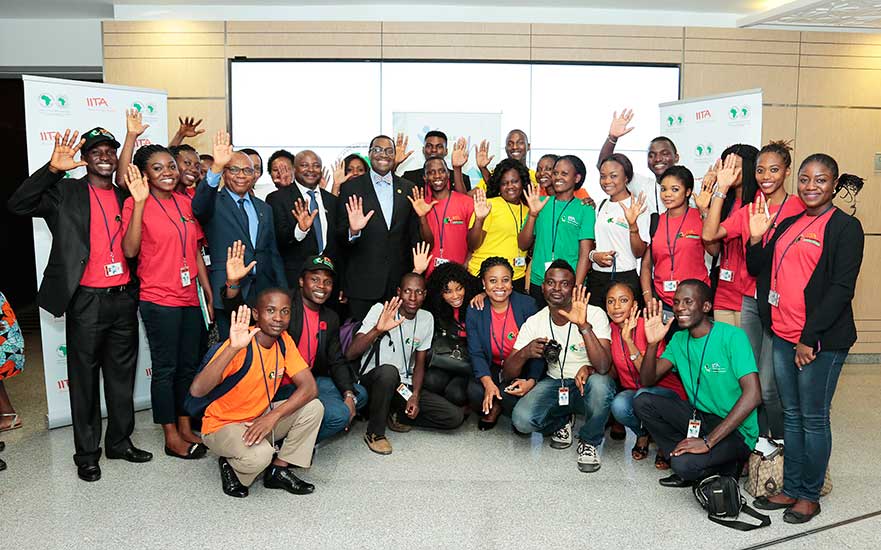 The AEC theme was Feed Africa; Towards Agro-Allied Industrialization for Inclusive Growth, and featured a session on youth agripreneurship where IYA members, representing African youth, made their voices heard by providing testimonials on the impact of IYA on their entrepreneurial skills and also defended their positions on selected topics during the debate sessions.
African Development Bank President Akinwumi Adesina was the keynote speaker during the AEC. He reiterated his support for Africa’s youth, saying that if given the chance to participate effectively in agro-allied industries, they will rejuvenate the agriculture sector, create wealth, and become gainfully employed.
Making a reference to the IYA model in Africa, Adesina stated that the youth through the opportunities given by IITA, are diversifying, innovating, and re-branding the agriculture sector. “The steps taken by these youth and many of their colleagues spread across the continent are part of the contribution needed to change agro-industrialization.”
During the debates, Dorcas Ogunwole, strongly defended her position for the topic Agriculture is a sector of economic opportunity for youth in Africa. She pointed out that the ability of the sector to absorb large numbers of youth irrespective of their academic background or qualification can provoke youth’s innovative nature and bring wide-scale development to the sector.
Waheed Oni, opposing the motion, said the risk involved in the sector, vis-a-vis the fact that the sector does not provide quick investment returns, is not encouraging the youth to venture into the sector.
At the end of the session, participants led by Chiji Ojukwu, Director at the Banque africaine de développement voted in support of the topic affirming that agriculture is indeed a sector of economic opportunity for youth in Africa.
Speaking on the second topic It is better to invest in loans than grants, Olaniyi Tosin and Bajulaiye Tolu cheered the atmosphere in the conference center with their expositions.
While Tosin proposed that loans should be given to youth to establish and expand their businesses, Tolu defended the opposition by saying that interest rates and collateral on loans requested by banks discourage youth from approaching banks for loans, but that they are expected to do well if they have the opportunity to get grants to start their businesses.
Votes at the end of the session were in favor of loans as most participants stated that youth become more credible when given loans.
The personal experiences and testimony session created a spark in the conference hall. Starting with the story of Oyindamola Asaaju, who related her story about not being able to get a job although she graduated with good honors and opted instead to be a bar attendant.
“I would like to thank the African Development Bank for the support. Like many other youths, when I graduated from the university, I couldn’t find an ideal job, so I took on the job of a waitress. I was learning some skills. More than anything else, I wanted to engage in something more challenging. The job wasn’t giving me that. I learned about the youth Agripreneur program when I had to serve food and drinks to a group of young people at a party at IITA. I had the opportunity of joining the group. These young people happen to be the notable IITA Youth Agripreneurs that you see in the hall today, who today are my colleagues,” she said.
Another Agripreneur, Ibironke Ifedayo, said his sojourn into agriculture was borne out of his inability to secure admission to study clinical microbiology. Obtaining a change of course form from 100 level to 400 level, Ifedayo was bent on changing his course but as fate would have it, he was denied that a couple of times. He said the opportunity and exposure given to him by IYA and IITA has changed his mind set and he is now an agricultural evangelist ready to take the “gospel” of agribusiness to other youth in Africa.
Mercy Wakawa is now the CEO of Confiando Global Resources. Disqualified from a million Nigerian youth who applied for the Nigerian Immigration Service job, Mercy was trained by IYA under the N2Africa Borno Project. She stated that the training, internship, and seed capital provided to her after the 2-week intensive training facilitated by IYA exposed her to the business opportunities in agriculture. Through that she was able to establish a groundnut oil processing cottage business. She said the business has employed six other youth.
Isuwa Zacchaeus, on sharing his experiences, said the continent is about to experience a positive shake-up and “insurgency” as IITA has bred a new set of billionaires who will compete on the Forbes list of billionaires in Africa.
More photos of the event are available at https://drive.google.com/open?id=0B2e6gH5nWZNSWG93ZkQ5SmswSG8.
The AEC theme was Feed Africa; Towards Agro-Allied Industrialization for Inclusive Growth, and featured a session on youth agripreneurship where IYA members, representing African youth, made their voices heard by providing testimonials on the impact of IYA on their entrepreneurial skills and also defended their positions on selected topics during the debate sessions.
African Development Bank President Akinwumi Adesina was the keynote speaker during the AEC. He reiterated his support for Africa’s youth, saying that if given the chance to participate effectively in agro-allied industries, they will rejuvenate the agriculture sector, create wealth, and become gainfully employed.
Making a reference to the IYA model in Africa, Adesina stated that the youth through the opportunities given by IITA, are diversifying, innovating, and re-branding the agriculture sector. “The steps taken by these youth and many of their colleagues spread across the continent are part of the contribution needed to change agro-industrialization.”
During the debates, Dorcas Ogunwole, strongly defended her position for the topic Agriculture is a sector of economic opportunity for youth in Africa. She pointed out that the ability of the sector to absorb large numbers of youth irrespective of their academic background or qualification can provoke youth’s innovative nature and bring wide-scale development to the sector.
Waheed Oni, opposing the motion, said the risk involved in the sector, vis-a-vis the fact that the sector does not provide quick investment returns, is not encouraging the youth to venture into the sector.
At the end of the session, participants led by Chiji Ojukwu, Director at the Banque africaine de développement voted in support of the topic affirming that agriculture is indeed a sector of economic opportunity for youth in Africa.
Speaking on the second topic It is better to invest in loans than grants, Olaniyi Tosin and Bajulaiye Tolu cheered the atmosphere in the conference center with their expositions.
While Tosin proposed that loans should be given to youth to establish and expand their businesses, Tolu defended the opposition by saying that interest rates and collateral on loans requested by banks discourage youth from approaching banks for loans, but that they are expected to do well if they have the opportunity to get grants to start their businesses.
Votes at the end of the session were in favor of loans as most participants stated that youth become more credible when given loans.
The personal experiences and testimony session created a spark in the conference hall. Starting with the story of Oyindamola Asaaju, who related her story about not being able to get a job although she graduated with good honors and opted instead to be a bar attendant.
“I would like to thank the African Development Bank for the support. Like many other youths, when I graduated from the university, I couldn’t find an ideal job, so I took on the job of a waitress. I was learning some skills. More than anything else, I wanted to engage in something more challenging. The job wasn’t giving me that. I learned about the youth Agripreneur program when I had to serve food and drinks to a group of young people at a party at IITA. I had the opportunity of joining the group. These young people happen to be the notable IITA Youth Agripreneurs that you see in the hall today, who today are my colleagues,” she said.
Another Agripreneur, Ibironke Ifedayo, said his sojourn into agriculture was borne out of his inability to secure admission to study clinical microbiology. Obtaining a change of course form from 100 level to 400 level, Ifedayo was bent on changing his course but as fate would have it, he was denied that a couple of times. He said the opportunity and exposure given to him by IYA and IITA has changed his mind set and he is now an agricultural evangelist ready to take the “gospel” of agribusiness to other youth in Africa.
Mercy Wakawa is now the CEO of Confiando Global Resources. Disqualified from a million Nigerian youth who applied for the Nigerian Immigration Service job, Mercy was trained by IYA under the N2Africa Borno Project. She stated that the training, internship, and seed capital provided to her after the 2-week intensive training facilitated by IYA exposed her to the business opportunities in agriculture. Through that she was able to establish a groundnut oil processing cottage business. She said the business has employed six other youth.
Isuwa Zacchaeus, on sharing his experiences, said the continent is about to experience a positive shake-up and “insurgency” as IITA has bred a new set of billionaires who will compete on the Forbes list of billionaires in Africa.
More photos of the event are available at https://drive.google.com/open?id=0B2e6gH5nWZNSWG93ZkQ5SmswSG8.
Drs Adesina, Sanginga, and Ojukwu with IITA Youth Agripreneurs during their visit to the AfDB headquarters in Abidjan.
Contribué par
Histoires récentes
Aucun article trouvé