
NOUVELLES DE L'IITA

IITA…Enabling Youth in Agriculture
juillet 20, 2018

For six years, IITA has been supporting the dreams and aspirations of many African youth by creating a platform that encourages them to choose a career in agriculture. The IITA Youth Agripreneurs (IYA) initiative, which started at the IITA Headquarters, Ibadan, Nigeria in August 2012 has grown; spreading tentacles across Africa and guiding vibrant, energetic, young people to become owners and co-owners of independent agribusiness enterprises.
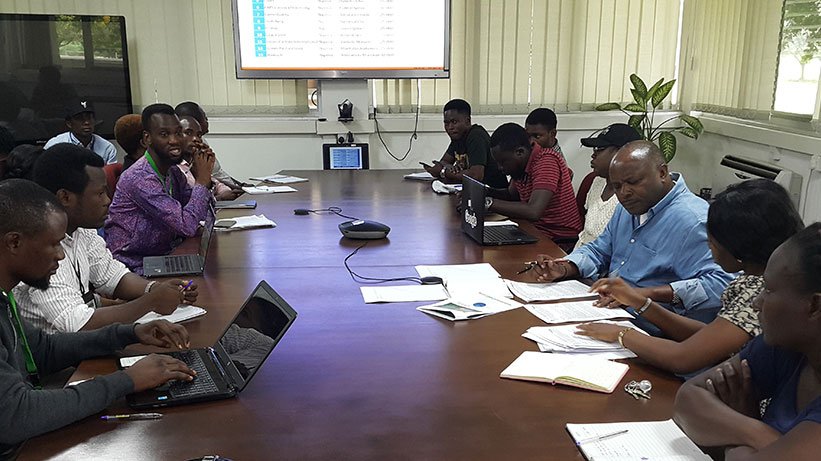
The Director General of IITA, Dr Sanginga screening some of the plans submitted by the youth.
The Director General, Dr Sanginga screening some of the plans submitted by the youth.

Many of these young people who were unemployed and underemployed before their encounter with the IYA initiative did not see themselves creating a career path along the agricultural value chains or embracing agriculture as a real business, but IITA availed them the opportunity to unveil their potentials in agriculture.

Initially, many of them had a negative perception about agriculture, but IITA devised a means of changing their mindset by organizing trainings on agricultural commodities, business management, and leadership skills, and providing mentoring and facilities to explore available opportunities.

Within a short period of time, the initiative recorded successes and became an adoptable model used by organizations and corporate bodies to execute youth in agribusiness projects. One of such projects is the ENABLE-TAAT project.

The ENABLE-TAAT project, which is funded by the Banque africaine de développement, is one of 15 Compacts comprising the Technologies for African Agricultural Transformation Program (TAAT) and led by Youth in Agribusiness Unit of the International Institute of Tropical Agriculture (IITA).

Implementing one of the objectives of the project by providing support for agribusiness establishment and expansion, IITA is screening the business plans and ideas of the applications from agripreneurs seeking for funds to establish and exp and their agribusiness enterprises.

The exercise is being done in partnership with business experts from EKIMIKS Nigeria Limited and to date has selected 34 businesses out of the 51 applications received from Agripreneurs in DR Congo, Kenya, Nigeria, Tanzania, and Ug anda.

The enterprises were selected after review, grading, and recommendations based on key business elements and perceived viability.

These young people will be provided with a certain amount of money, which will be used to start and exp and their businesses. The funds earmarked for each enterprise will be disbursed to their business accounts in four tranches as loans and grants.

Gathering on Thursday, 19 July at the office of the Director General of IITA, Dr Nteranya Sanginga, some of the youth who spoke to the DG about their businesses stated their willingness and readiness to do great exploits in agribusiness.

A co-owner of F-Step Cassava enterprise, Seun Ogidan, while giving an update on the business, stated that the company has acquired 15 hectares of l and at Ago-Owu in Osun State to establish a cassava farm. The business, which is registered by the Corporate Affairs Commission, will be operated in partnership with another Agripreneur, Funmi Lamidi. She added that a sum of 600,000 Naira, which she borrowed from an uncle, has so far been invested in the business. She stressed that the partners are willing to exp and their production to 25 hectares if they have access to funds.

Taking a step ahead, the CEO of Gracevine Ventures, Abosede Idowu explained that she requires some funds for expansion and penetration of her business into a larger market in Lagos. Abosede who started her business in 2016 requires money to upgrade her packaging to meet up with international st andards. She is also planning to invest some funds in cultivating cowpea to produce cowpea flour, a major raw material used in the production of her commodities. Gracevine Ventures located at Moniya in Ibadan, Nigeria produces Yam flour, Plantain flour, packaged stone less beans etc.

Frotchery Farms, which is another spin-off from IITA Youth Agripreneurs, has been progressing well within a short time, venturing into the business of catfish smoking. The business is owned by three young graduates—Ngozi Chituru, Babatunde Ismail, and Oni Hammed and is planning to acquire about 17 ponds to enable them to have access to raw materials. The business has existing markets, but is facing challenges in meeting dem and due to the non-availability of the required sizes of catfish. Since inception a year ago, the business has realized a revenue of $18,000, penetrated 12 states in Nigeria, and three countries. It has also launched a website to enhance the visibility of the company. The business has provided direct employment opportunity for 3 youths indirect employment for 26 others through retail, distribution and sales.

Others in the category also expressed their intentions along the value chain of various crops and livestock that include bread production, Snailery (production, processing, and packaging), cowpea grain and seed production, rice production, maize aggregation, plantain flour production, plantain chip production, and maize seed and grain production.
Addressing them at the meeting, the DG Nteranya Sanginga enjoined the young people to be humble and work as a team. He encouraged them to always support each other as they all need one another to grow in the business.

Similar opportunities are being given to the Agripreneurs in East, West, and Central Africa to pitch their business ideas before a panel at an agribusiness workshop slated to take place in Nairobi in August.

Adequate monitoring and evaluation will be carried out for further checks and balances, backstopping to monitor the growth of the businesses.

For more information, please contact: Adenmosun Adetola, A.Adenmosun@cgiar.org or Yvonne Olatunbosun, y.olatunbosun@cgiar.org or Kathy Lopez, k.lopez@cgiar.org


Contribué par

Nouvelles connexes

Aucun article trouvé

Laisser un commentaire

Votre adresse e-mail ne sera pas publiée. Les champs obligatoires sont indiqués avec *

Retour en haut
Olaosebikan, Olamide

Olamide Deborah Nwanze est une chercheuse principale spécialisée dans la recherche sur l'approche "genre" afin d'éclairer les politiques de sélection participative et inclusive, de développement de variétés et de systèmes semenciers concernant les cultures de racines, tubercules et bananes (RTB) au siège de l'Institut International d'Agriculture Tropicale, à Ibadan, au Nigeria. Elle est candidate au doctorat à l'Université d'Ibadan et titulaire d'un master et d'un diplôme d'ingénieur agronome en vulgarisation agricole et développement rural. Olamide est membre du programme African Women in Agricultural Research and Development – Gender Responsive Agricultural Systems Policy (SAISIE DE RÉCOMPENSEet les Chercheuses Sensibles au Genre Équipées pour la Transformation Agricole (SUPER. Elle cherche à appliquer ses apprentissages en matière d’approche genre, recherche sensible au genre, et expertise en développement et examen de politiques pour faciliter l’accès et l’adoption par les femmes, les jeunes, les enfants et les groupes sociaux vulnérables aux innovations agricoles qui garantissent la sécurité alimentaire, nutritionnelle, des revenus et des moyens de subsistance en Afrique. Ses rôles actuels comprennent le mentorat de chercheurs stagiaires, le développement de guides et manuels de formation, la mise en œuvre et l'adaptation de cadres et d'outils genre, l'engagement des acteurs de la chaîne de valeur en tant que partenaires de la science citoyenne, l'examen et la refonte des politiques, la gestion et l'analyse des données. Ses recherches actuelles portent sur les méthodes mixtes ainsi que sur les approches participatives et interdisciplinaires pour saisir et mettre en évidence les dynamiques de genre, les besoins, les préférences et les défis rencontrés par les parties prenantes au sein de la chaîne de valeur des moyens de subsistance agricoles afin de prioriser des stratégies axées sur le genre dans les programmes de sélection, la conception et la mise en œuvre des politiques.

À l'IITA, elle contribue à la mise en œuvre du CGIAR Initiative d'Élevage Accéléré et Innovation génétique Programmes ; recherche participative et genre au sein des Prochaine Génération ManiocHarvestPlusRTBAliments, et Tricot-ClimMob 1000Fermes Projets ; et la communication des connaissances sur le genre via le Série de webinaires G-LENS, vidéo documentaire, notes de politiquepublications, et blogs.


Publications récentes

de Sousa, K., van Etten, J., Manners, R. Bello, A., Teeken, B., Olaosebikan, O., et al. 2024. L'approche tricot : un cadre agile pour les essais décentralisés à la ferme soutenus par la science citoyenne. Une rétrospective. Agron. Sustain. Dev. 44, 8. https://doi.org/10.1007/s13593-023-00937-1

Madu, T., Onwuka, S., Nwafor, S., Onyemauwa, N., Ejechi, M., Ofoeze, M., Ukeje, B., Eluagu, C., Olaosebikan, O., Okoye, B., 2024. Les études sur les consommateurs inclusifs en matière de genre améliorent l'amélioration du manioc au Nigeria dans : Frontiers in Sociology, volume 9, numéro : 1224504, doi : 10.3389/fsoc.2024.1224504

Olaosebikan, O. ; Bello, A. ; Utoblo, O. ; Okoye, B. ; Olutegbe, N. ; Garner, E. ; Teeken, B. ; Bryan, E. ; Forsythe, L. ; Cole, S. ; Madu, T. 2023. Facteurs de stress et résilience au sein de la chaîne de valeur du manioc au Nigeria : Caractéristiques préférées des variétés de manioc et stratégies de réponse des hommes et des femmes pour informer l'amélioration variétale. Sustainability 15, 7837. https://doi.org/10.3390/su15107837

Okoye, B., Ofoeze, M., Ejechi, M., Onwuka, S., Nwafor, S., Onyemauwa, N., Ukeje, B., Eluagu, C., Obidiegwu, J.*, Olaosebikan, O., Madu, T.* 2023. Priorisation des traits préférés dans la chaîne de valeur de l'igname au Nigeria : une analyse de la situation en matière de genre in: Frontiers in Sociology, volume 8, numéro : 1232626, pages 1 – 9, ISSN 2297-7775, 2023. https://www.frontiersin.org/articles/10.3389/fsoc.2023.1232626/full

Olaosebikan, O., Bello, A. A., de Sousa, K., Ndjouenkeu, R., Adesokan, M., Alamu, E. O., Agbona, A., van Etten, J., Kegah, F. N.*, Dufour, D., Bouniol, A., Teeken, B. 2023. Acceptabilité par les consommateurs des produits alimentaires à base de gari-eba de manioc dans des contextes culturels et environnementaux variés en utilisant l'approche triade de comparaison des technologies (tricot) dans : Journal of the Science of Food and Agriculture,

Teeken, B., Olaosebikan, O., Bello, A. A., Madu, T.*, Cole, S. M. 2023. Évaluation qualitative de la positionnalité et des préférences des dyades en relation avec les activités liées au manioc : travailler avec des scientifiques citoyens du procès tricot https://hdl.handle.net/10568/138326 Type : Manuel

Bouniol, A., Ceballos, H., Bello, A. A., Teeken, B., Olaosebikan, O., Owoade, D., Agbona, A., Fotso Kuate, A., Madu, T.*, Okoye, B.*, Ofoeze, M.*, Nwafor, S.*, Onyemauwa, N.*, Adinsi, L.*, Forsythe, L., Dufour, D. 2023. Impact variétal sur le travail des femmes, la charge de travail et la pénibilité associée dans le traitement des plantes à racines, tubercules et bananes : focus sur le manioc en Afrique subsaharienne dans : Journal of the Science of Food and Agriculture, pages 1 – 25, ISSN 0022-5142,

Bello, A. A., Agbona, A., Olaosebikan, O., Edughaen, G., Dufour, D., Bouniol, A., Iluebbey, P., Ndjouenkeu, R.*, Rabbi, I. Y., Teeken, B. 2023. Effets génétiques et environnementaux sur la productivité de la transformation et le rendement des produits alimentaires : la pénibilité du travail des femmes dans : Journal of the Science of Food and Agriculture, pages 1 – 32, ISSN 0022-5142, 5

Cavicchioli, M., Zimbiti, T., Teeken, B., Nwanze, D.O., Liani, M., Parkes, E. & Bello, A. 2023. Rapport sur la formation en sélection génétique sensible au genre à l'IITA. Genetic Resources Center, IITA-HQ, Ibadan, 21-23 septembre 2022. Ibadan, Nigéria : IITA, (34 p.).https://hdl.handle.net/10568/131368

Agbona, A. Peteti P., Teeken B., Olaosebikan O. Bello, A. A., Parkes, E., Rabbi, I. Y., Mueller, L., Egesi, C., Kulakow, P. 2022. Gestion des données dans les programmes d'amélioration des cultures RTB africaines multidisciplinaires. In : Williamson, H.F., Leonelli, S. (eds) Towards Responsible Plant Data Linkage: Data Challenges for Agricultural Research and Development. Springer, Cham. https://doi.org/10.1007/978-3-031-13276-6_5

Lora Forsythe, Pricilla Marimo, Sarah Mayanja, Olamide D. Olaosebikan, Esme Stuart, Bela Teeken, Benjamin Okoye, Tessy Madu, (2021). Analyse transversale du genre dans RTBfoods Étape 2 Cartographie des genres sur les produits RTB. Comprendre les moteurs des préférences en matière de traits et le développement de profils de produits RTB multi-utilisateurs, WP1. Londres, Royaume-Uni : Rapport scientifique de terrain RTBfoods, 30 p.

Teeken, B., Garner, E., Agbona, A., Balogun, I., Olaosebikan, O., Bello, A., Madu, T., Okoye, B., Egesi, C., Kulakow, P. et Tufan, H.A. 2021. Au-delà des “ traits des femmes ” : explorer comment le genre, les différences sociales et les caractéristiques des ménages influencent les préférences pour les traits. Frontiers Systèmes alimentaires durables 5:740926. https://doi.org/10.3389/fsufs.2021.740926

Teeken, B., Agbona, A., Bello, A., Olaosebikan, O., Alamu, E., Adesokan, M., Awoyale, W., Madu, T., Okoye, B., Chijioke, U., Owoade, D., Okoro, M., Bouniol, A., Dufour, D., Hershey, C., Rabbi, I., Maziya‐Dixon, B., Egesi, C., Tufan, H. et Kulakow, P. (020. Comprendre les préférences variétales du manioc par le classement par paires du gari-eba et du fufu préparés par des agriculteurs-transformateurs locaux. Int J Food Sci Technol. https://doi.org/10.1111/ijfs.14862

Bela Teeken, Olamide Olaosebikan, Ireti Balogun, Benjamin Okoye, Tessy Madu, Steven Cole, Abolore Bello, Elizabeth Parkes. (2020). Pilotage des outils de profil client et produit G+ pour l'amélioration sensible au genre du manioc au Nigeria. Nigeria : Institut international d'agriculture tropicale (IIAT). https://hdl.handle.net/20.500.11766/13000