
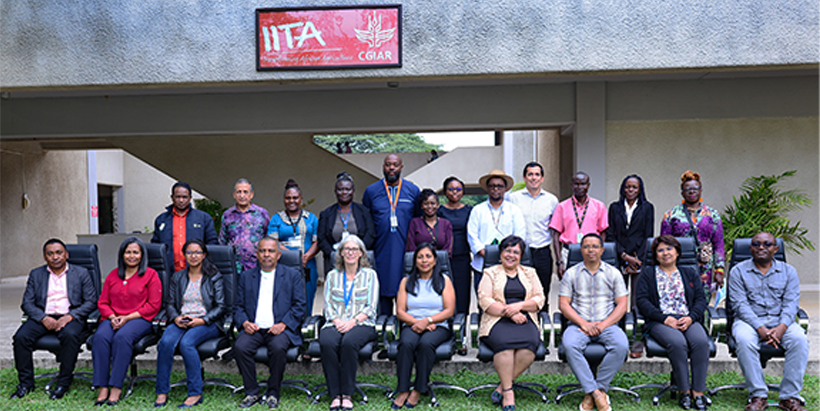
Une délégation de haut niveau de Madagascar s'est rendue IITA–CGIAR du 8 au 12 septembre, lors d'une mission d'immersion visant à explorer les technologies agricoles de pointe, les programmes de recherche et les innovations de l'Institut. La délégation a identifié des technologies innovantes adaptées pour soutenir le programme de transformation agricole du pays. Cette mission reflète la vision du pays de transformer ses systèmes agricoles pour devenir le “ grenier de l'océan Indien ”.”
La délégation de 9 membres comprenait des hauts responsables techniques et politiques du ministère de l'Agriculture et de l'Élevage de Madagascar ainsi que de ses instituts nationaux (FOFIFA, DPV, SOC), du Programme de résilience des systèmes alimentaires (FSRP) et de la Banque mondiale. Parmi les hauts fonctionnaires figuraient Rakotomalala Ny Riana, conseiller technique du ministre de l'Agriculture et de l'Élevage ; Leong Pock Tsy Jean Michel, directeur général du FOFIFA, l'Institut national de recherche agricole ; et Rafalimanana Oliva, coordinateur national du FSRP. Leur mission était d'identifier les technologies et les partenariats susceptibles de renforcer l'actuel projet de sécurité alimentaire de Madagascar, les systèmes semenciers, la gestion de la fertilité des sols et la résilience face aux ravageurs, aux maladies et aux défis aggravés par le climat.
La visite s'est alignée sur la vision du Président de Madagascar d'atteindre l'autosuffisance alimentaire et la prospérité nationale. Les délégués ont examiné les opportunités de lier les neuf programmes de transformation agricole de Madagascar aux innovations de l'IITA. Les discussions ont porté sur les systèmes d'amélioration de la qualité des semences, le renforcement des capacités de laboratoire, la protection phytosanitaire et l'incubation de start-up agricoles dans le cadre d'une collaboration potentielle entre l'Académie FOFIFA et la plateforme d'incubation d'entreprises (BIP) de l'IITA.
Alors qu'un projet Aflasafe financé par le FSRP est déjà en cours à Madagascar, la visite de la délégation a mis un accent particulier sur l'examen des progrès réalisés et la planification des prochains essais de lutte biologique ainsi que de la construction d'un laboratoire et d'une unité de fabrication de produits de lutte biologique à petite échelle. Un élément central des discussions a porté sur la manière de renforcer la collaboration durable entre les secteurs public et privé. À cette fin, les délégués ont visité HarvestField Industries Limited, le partenaire agréé de l'IITA au Nigéria qui fabrique et commercialise l'Aflasafe. Cette visite a offert un aperçu pratique du processus de production, des modèles de distribution et des voies réglementaires qui soutiennent le déploiement à grande échelle de solutions de lutte contre les aflatoxines — des enseignements qui peuvent nourrir les efforts en cours à Madagascar.
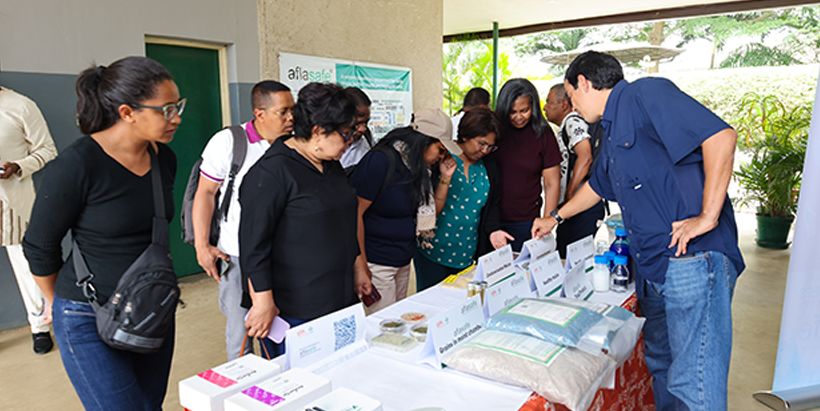
Les délégués se sont également entretenus avec le Directeur général adjoint des services institutionnels de l'IITA, Hilde Koper-Limbourg, qui a présenté un aperçu des opérations institutionnelles de l'IITA. Elle a mis en lumière les systèmes de gestion de projets de l'Institut, les processus de budgétisation et de calcul des coûts, le financement de la main-d'œuvre et la collaboration avec les partenaires nationaux, offrant ainsi aux participants une compréhension approfondie des structures de soutien qui sous-tendent la recherche et la mise en œuvre de l'IITA.
Pendant la visite, la technologie Seed Tracker de l'IITA a suscité un vif intérêt. Cette plateforme numérique améliore la transparence, la traçabilité et le contrôle de la qualité dans l'ensemble des systèmes semenciers, en fournissant des données en temps réel accessibles aux agriculteurs, aux transformateurs, aux régulateurs, aux donateurs et aux autres parties prenantes. Selon Lava Kumar, virologue à l'IITA et responsable de l'Unité de santé du germoplasme : “ L'outil Seed Tracker possède des fonctionnalités pertinentes pour tous les acteurs de la chaîne de valeur. Son intégration pourrait doter Madagascar d'un système de distribution de semences plus transparent et efficace. ”
Au cours de l'une des sessions d'apprentissage, la délégation a examiné comment le pôle régional pour les engrais et la santé des sols pour l'Afrique de l'Ouest et le Sahel exploite la science des données, la modélisation avancée et les techniques de gestion intégrée de la fertilité des sols pour formuler des recommandations d'engrais adaptées aux agriculteurs. Ces approches visent à améliorer la santé des sols, à stimuler la productivité agricole, à renforcer la résilience des agriculteurs face au changement climatique et à maintenir la rentabilité. Les délégués ont également découvert la technologie de culture hydroponique semi-autotrophe (SAH) de l'IITA, qui permet la multiplication rapide de matériel de plantation de manioc et d'igname exempt de maladies, essentiel pour la sécurité alimentaire dans les régions dépendantes des cultures racines.
La sécurité sanitaire des aliments et la nutrition ont été des thèmes centraux tout au long de la mission. Mercy Lung’aho, responsable du programme Sécurité alimentaire, Nutrition et Santé de l'IITA, a engagé l'équipe dans des discussions autour des stratégies d'optimisation de la nutrition. Titilayo Falade, scientifique de la sécurité des aliments à l'IITA, a engagé l'équipe dans des délibérations sur l'atténuation de l'aflatoxine et d'autres études et interventions sur la sécurité des aliments pertinentes pour le contexte de Madagascar.
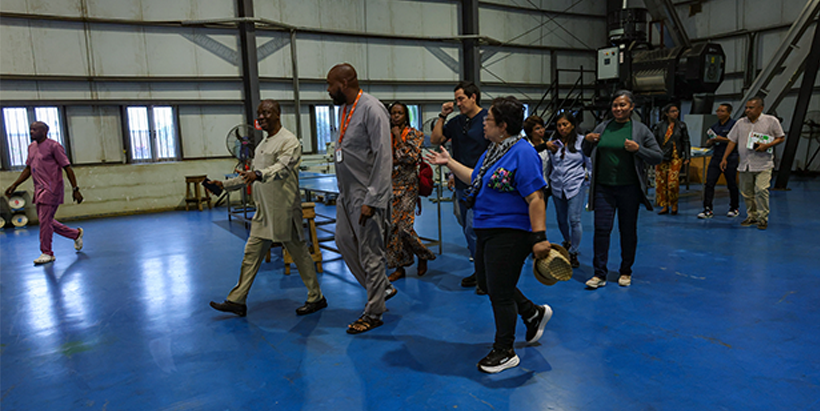
Au siège de l'IITA à Ibadan, la délégation a visité les stations de recherche sur le terrain et les laboratoires, s'entretenant avec des chercheurs et des experts techniques des programmes de recherche de l'IITA sur le maïs, le soja, le niébé, le manioc et le plantain/banane. Ils ont également échangé avec AfricaRice représentants sur les technologies rizicoles avancées adaptées aux systèmes de production de Madagascar.
Un autre point fort a été la visite de l'unité de transformation du manioc de l'IITA, où l'équipe a goûté une variété de produits à base de manioc allant des gâteaux et petits pains aux chips, au shawarma et à la glace. Cela a mis en valeur les opportunités économiques de la transformation post-récolte et de la valorisation.
En réfléchissant à cette visite, Andriampeno Tanteliniaina, coordinateur adjoint du FSRP, a souligné : “ chaque technologie que nous avons observée répond directement aux priorités de Madagascar en matière de sécurité alimentaire, d'amélioration de la nutrition, de moyens de subsistance durables et de renforcement des capacités. ” Leong Jean Michel, directeur général du FOFIFA, a ajouté : “ les échanges que nous avons eus avec les chercheurs et les experts nous permettront de progresser dans la recherche directe et, en fin de compte, d'améliorer la production alimentaire à Madagascar. ”
La mission s'est conclue par la rédaction d'une note conceptuelle décrivant les domaines d'intervention prioritaires, notamment le renforcement du projet Aflasafe en cours à Madagascar et de nouveaux domaines de collaboration avec l'IITA tels que les systèmes semenciers, la gestion de la fertilité des sols et le renforcement des capacités de recherche malgaches. Cela marque une étape importante dans la collaboration entre l'IITA et Madagascar, s'appuyant sur des engagements antérieurs et des partenariats de travail existants avec l'IITA.
Dans ses remarques de clôture, le Directeur général adjoint par intérim de l'IITA, Partenariats pour la mise en œuvre, Abdoulaye Tahirou, a félicité le personnel et les scientifiques de l'IITA d'avoir offert à la délégation une expérience enrichissante et immersive. Il a souligné que les domaines de collaboration identifiés ont le potentiel de transformer l'agriculture africaine — non seulement pour Madagascar, mais aussi pour l'humanité tout entière.
Pour l'IITA, cette visite réaffirme son rôle en tant qu'institut d'innovation agricole et partenaire de confiance pour les gouvernements et les bailleurs de fonds à la recherche de solutions transformatrices pour les systèmes alimentaires. Pour Madagascar, elle témoigne d'une étape concrète vers la mise à l'échelle de technologies qui autonomiseront les agriculteurs, renforceront les chaînes de valeur et garantiront la position du pays en tant que leader de la production alimentaire dans l'océan Indien.
Contribué par Folake Oduntan et Alejandro Ortega-Beltran
Contribué par
Histoires récentes