
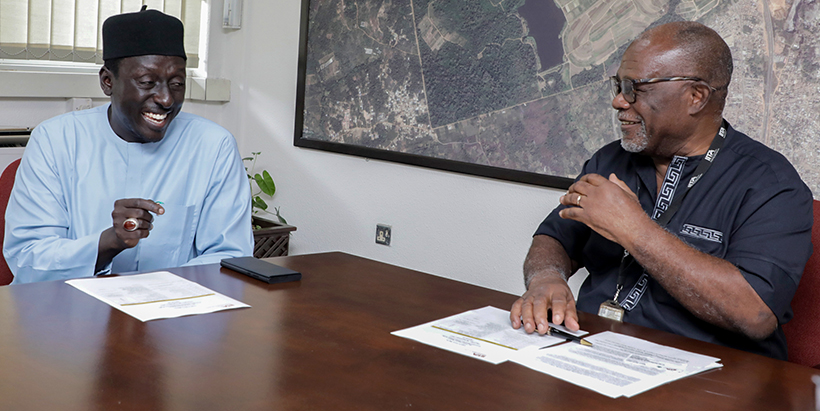
The Executive Director, National Agency for the Great Green Walls (NAGGW), Dr Yusuf Bukar, visited IITA headquarters on 8 September accompanied by his team. The visit aimed to explore various areas to collaborate with IITA.
Kwame Akuffo-Akoto, IITA Deputy Director General, Special Duties, welcomed and introduced the team to the activities and different hubs of the Institute in sub-Saharan Africa. He said that IITA is ready to provide help in terms of linkages with scientists and is open to collaborating with NAGGW.
NAGGW was established to combat desertification and land degradation and improve food security and human livelihood. It also provides essential support for communities to adapt to climate change in the Sahel and Sahara region of Africa.
Bukar commended IITA for its boundless work in improving the agricultural sector across Africa. “GGW has a lot of potentials, and we look forward to the collaboration between both organizations,” he said. In addition, the Executive Director mentioned that NAGGW is particularly interested in agroforestry in IITA and mandate crops such as cassava, cowpea, plantain and banana, and rice. He showed interest in these crops because they would benefit vulnerable communities, and the drought-resistant varieties can be planted with trees in the Northern areas. He also mentioned that they have a special interest in trees and grasses.
Alice Kano, NAGGW Senior Forest Officer, added that NAGGW would also want to collaborate with the Jeunes agripreneurs de l'IITA (IYA) in the youth empowerment program, focusing on value addition.
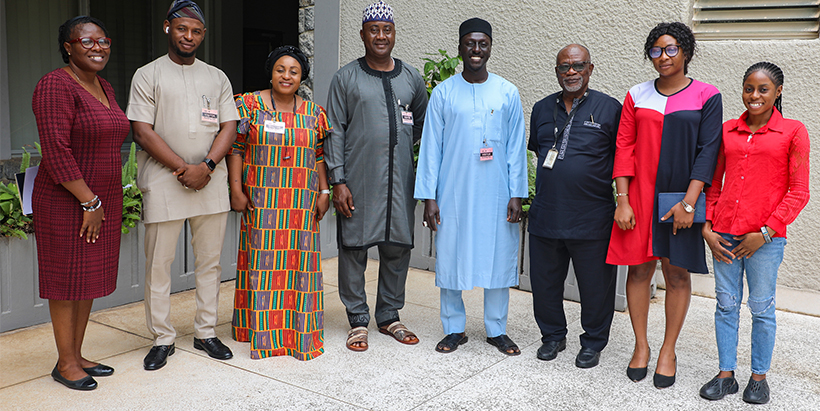
In response, Akuffo-Akoto said the team would be linked with the scientists responsible for the crops. He added that both organizations share the same mission, which is the sustainability of the environment. However, before collaborative work can begin, IITA and NAGGW would need to have an official agreement for partnership, which would serve as a framework for working together.
The team visited the Germplasm Health and Virology Unit, cowpea, plantain and banana, and Forest Center to explore some indigenous trees that can be adapted to the NAGGW program.
Contribué par Anita Akinyomade
Contribué par
Histoires récentes