
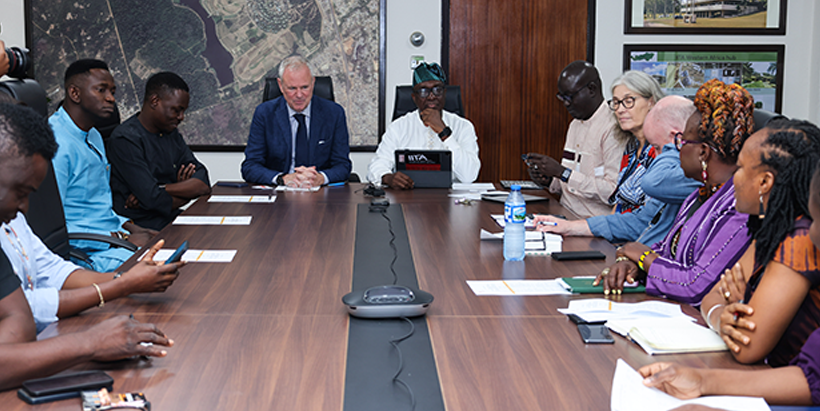
The Ambassador of the Kingdom of the Netherlands to Nigeria, His Excellency Bengt van Loosdrecht, recently visited the IITA–CGIAR headquarters in Ibadan on a courtesy visit aimed at deepening collaborations between IITA and the Netherlands government.
IITA Director General and CGIAR Regional Director for Continental Africa, Dr Siméon Ehui, alongside IITA’s Senior Management team and scientists received the Ambassador and his team, comprising the Policy Advisor, Food Security and Climate at the Embassy, Foluso Adejoro, and Senior Agricultural Policy Advisor, Oluwaseun Ojambati.
In his welcome remarks, Dr Ehui highlighted the long-standing partnership between IITA and the Dutch government, which had spanned over two decades. He applauded Netherlands’ critical role in supporting agricultural research and development in Africa, describing the collaboration as a strong foundation for present and future joint efforts.
With focus on strengthening existing partnerships and Netherlands-funded programs at IITA to deliver increased impact, discussions explored youth engagement and technology scaling for food systems transformation across Africa.
Dr Ehui expressed appreciation for the Netherlands government’s continued investment in agricultural research and development, underscoring how the partnership has enabled IITA to deliver cutting-edge innovations across the continent. He emphasized that enhancing youth engagement and funding support for youth programs like the YAS Project (Youth in Agribusiness: Enabling Scaling of Innovative Technologies for Sustainable Food Solutions) through agribusiness and technology adoption is central to achieving sustainable food systems.
Adding that the support has enabled the project to train over 9,000 Accelerators and Incubators, resulting in 1,400 new youth-led agribusiness enterprises and more than 2,900 young farmers (including 1,300 women), who now earn decent income.
“Not less than 12 agribusiness hubs have been established to aid experiential learning in poultry, aquaculture, horticulture, and staple crops. These successes show that fruitful partnerships create increased impact and greater sustainability. There is also the prospect of replicating this success, especially the aquaculture value chain, in Uganda, based on partnership with WorldFish and Uganda’s National Agricultural Research Organization (NARO),” Dr Ehui said.
Speaking during the meeting, Head of IITA Genetic Resources Centre, Professor Michael Abberton, highlighted IITA’s work on plant health, biotechnology, market systems, policy engagement, post-harvest solutions, climate adaptation, and nutrition – with a focus on addressing micronutrient deficiency.
The Partnership and Stakeholder Engagement Manager, Youth in Agribusiness Unit (IYA), Adetola Adenmosun, in her presentation, highlighted how YAS is tackling youth unemployment and improving the livelihoods of young farmers as part of ITA’s mandate.
She explained that YAS was designed to train and support new entrants into agriculture (Incubators) to create viable agribusinesses and also introduce existing agribusiness owners to modern practices and support them to scale up their enterprises. She noted further that the model has proven to be effective and is being adopted by other projects. She added that with extended support, YAS could scale up its impact even further.
Representing IITA’s Project Development and Administration Unit (PDAU), Bukola Latinwo, noted that IITA had collaborated with the Kingdom of the Netherlands for over 20 years on more than 35 projects, ranging from agricultural research to sector transformation efforts across Africa. Adding that the Netherlands had supported multiple initiatives, including plant-parasitic nematode research, reflecting a broad and productive partnership history.
In his remarks, the Ambassador commended IITA for its extensive work in research and scaling of technologies that improve agricultural productivity. He said it is commendable that young Nigerians have taken ownership of the YAS project, with “the Netherlands playing an advisory, not directive, role”.
While pointing out the need to keep strengthening value chains, he said Dutch development cooperation is evolving to focus on partnerships that also create opportunities for private sector collaboration. He stressed the importance of making agriculture appealing to the youth through innovation and communication.
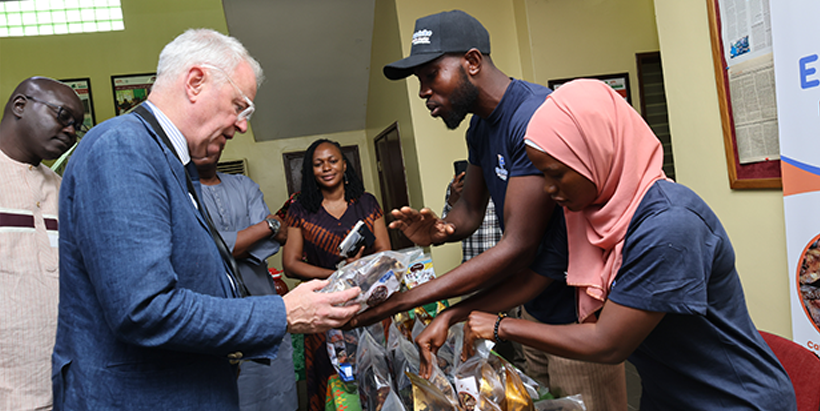
During an exhibition by YAS participants, one of the exhibitors, Timilehin Olowoyo, said before she participated in the YAS training, she had little direction in agribusiness, particularly aquaculture. After the training, she said her team started exporting catfish to Canada, noting that the project taught them self-reliance and gave them the skills to compete even in the international market.
David Ojebola said he began his poultry business with limited resources and faced several challenges, but after the training and mentorship provided by the project, he has expanded his farm, created jobs, and has been able to sustain his operations. “This has shown me the value of persistence and capacity building,” he added.
In his remarks, the Ambassador commended the resilience, energy, and creativity of the participants, saying their stories reflect the potential of Nigerian youth when given the right training and support. He added that the creativity displayed through the products was inspiring. He expressed confidence that the skills gained by the participants would enable them to continue scaling their businesses.
The Ambassador, who also visited the fish feed production, nursery and processing facilities as well as fishpond and screenhouses operated by young agripreneurs, noted, “these success stories go beyond individual growth; they contribute to employment and improved food systems. The future of agribusiness in Nigeria is bright, especially with the youth at the forefront.”
He applauded the young agripreneurs for their eloquence, self-awareness and understanding of both the opportunities and challenges in their businesses, including certification, value chain integration, and logistics.
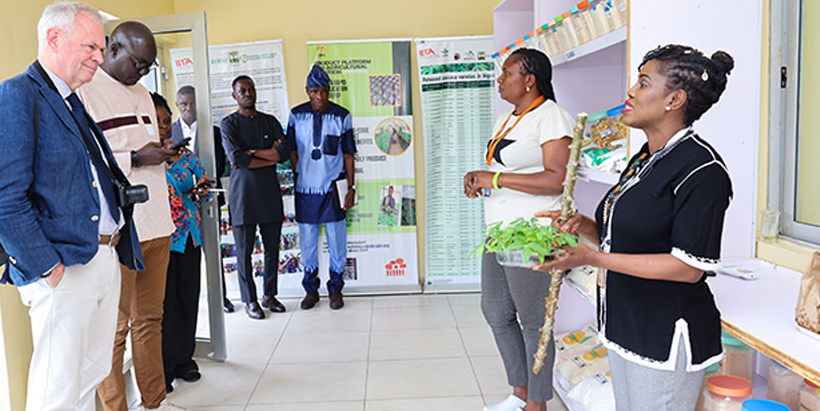
To explore IITA’s research and impact, the Ambassador and his team toured some of IITA’s research facilities – cassava breeding program, semi-autotrophic hydroponics and forest nursery. At the Cassava Breeding Unit, Head of the program and Cassava breeder, Dr Ismail Rabbi, highlighted the various innovations by the unit, while at the Forest Center, the Forest Center lead and Conservation Biologist, Dr Adewale Awoyemi, presented IITA’s forest conservation and climate change mitigation efforts.
The Ambassador and his team, visibly impressed by the tour and innovations, commended IITA’s work and reaffirmed his government’s commitment to supporting collaborative initiatives that empower Africa’s youth, enhance research innovations, and contribute to agricultural transformation.
In his closing remarks, the Dr Ehui expressed his appreciation for the Ambassador’s visit, even as he called for deeper collaboration with the Dutch Government. He stressed that agriculture remained the future, and that IITA is proud of its research innovations and the Youth in Agribusiness Unit for driving innovation and creating opportunities for the next generation.
Also present at the meeting were the Deputy Director-General, Corporate Services, Hilde Koper-Limbourg; Director of Strategic Planning and Chief of Staff to the Director General, Dr Dieng Ibnou; and YAS Project Coordinator, Adebayo Awotodunbo.
The visit further strengthens the long-standing relationship between IITA and the Netherlands, paving the way for expanded cooperation to scale innovations that address food security, climate change, and employment opportunities for Africa’s growing youth population.
Contributed by Babatunde Ajaja and ’Timilehin Osunde
Contribué par
Histoires récentes