Nigeria Integrated Agriculture Activity donates certified seeds to Borno State
juillet 15, 2024
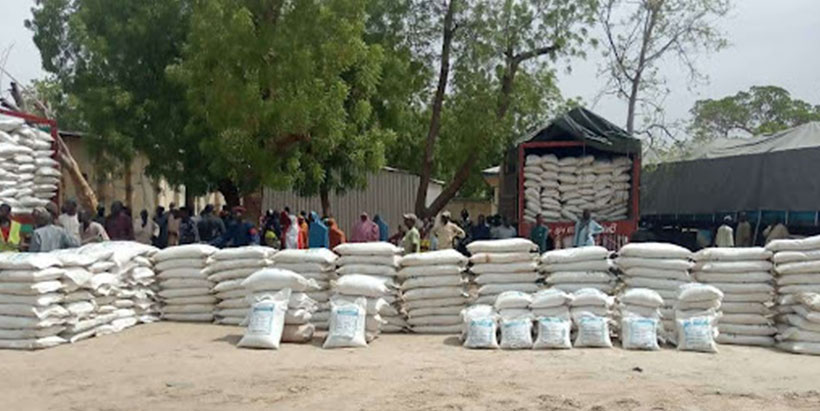
In a collaborative effort to boost agricultural productivity and support sustainable farming practices, the Nigeria Integrated Agriculture Activity (NIAA) donated 17 tons of certified seeds to the Borno State Government recently. The Activity is a five-and-half-year program being implemented by the IITA-CGIAR and its partner, the International Crops Research Institute for the Semi-Arid Tropics (ICRISAT) as part of the United States Agency for International Development (USAID)’s contribution to the economic recovery in Northeast Nigeria, in the wake of the devastation caused by insurgency in the region.
The 17 tons of certified seeds donation on display at Maiduguri, Borno State.The certified seeds donated by the Activity, including rice, soybean, and maize varieties, were recovered from the Community-Based Seed Entrepreneurs (CBSEs) after the successful 2023 wet season seed production. Initially loaned to the CBSEs as foundation seeds, the seeds were meticulously cultivated and harvested, bolstering the effectiveness of the community-based seed production model. The donation aims to support Internally Displaced Persons (IDPs) and vulnerable populations in Borno State, ensuring they have access to high-quality seeds for the upcoming planting seasons.
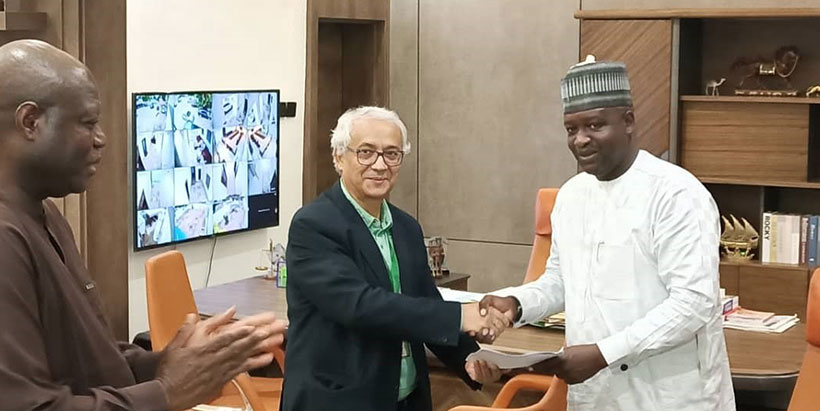
Following the seed donation, a Memorandum of Understanding (MoU) was signed between IITA and the Borno State Government. This MoU is a step forward in collaborative efforts to further strengthen agricultural development in the region. The signing ceremony was attended by key officials, including NIAA Chief of Party, Prakash Kant Silwal, and the Deputy Chief of Party, Kayode Faleti. The Deputy Governor of Borno State, His Excellency Hon. Umar Usman Kadafur, received the donation on behalf of the state government.
The MoU outlined a comprehensive framework for cooperation, focusing on several critical areas such as the establishment of the Agriculture Technology and Business Incubation Centre, and scaling up the CBSE Model to enhance agricultural productivity and sustainability in the Northeast.
The Deputy Governor, Borno State, His Excellency Hon. Umar Usman Kadafur (middle), meeting with the NIAA team after the donation. Also in attendance are the Secretary to Borno State Government, Alhaji Bukar Tijani (second right) and the Permanent Secretary, Borno State Ministry of Agriculture and Natural Resources, Alhaji Bulama (first right).The agreement will help in strengthening the extension services, thereby providing effective support to farmers in Borno state.
During the event, Philemon Fada, a member of the Kam-Lau Community-Based Seed Entrepreneurs, highlighted the profound impact of NIAA’s initiatives on their agricultural practices.
“In just one year, we have seen significant growth and development,” he said. “The introduction of modern farming techniques and high-quality seeds has revolutionized our approach to agriculture. We are grateful to USAID and IITA for their support and look forward to continued collaboration.”
The Borno State Government has assured commitment to mobilizing the resources needed to fully achieve the objectives outlined in the MoU. They are working closely with FAO and other donors to develop a comprehensive framework for cooperation, ensuring that the necessary support and partnerships are in place.
The Deputy Governor, Borno State, His Excellency Hon. Umar Usman Kadafur (Right) during the signing of the Memorandum of Understanding (MoU) in Maiduguri, Borno State.As part of this collaboration, other key areas will be improving market systems, enhancing youth and women’s engagement in agri-entrepreneurship, and diversifying livelihoods to strengthen community resilience. The initiative also aims to build a robust monitoring and evaluation system to track progress and ensure that the targeted outcomes and results are achieved. By leveraging modern techniques, high-quality seeds, and community-based models, the collaboration has the promise of a lasting impact on the livelihoods of farmers in Borno State.
As the Activity draws to a close in Northeast Nigeria, this commitment is a sustainability measure in ensuring that the farming community continues to enjoy offerings of the five-and-half-year engagement that has now culminated in the Seed System Development for Northeast Nigeria, a model that has a potential for nationwide scaling and benefits.
Olamide Deborah Nwanze est une chercheuse principale spécialisée dans la recherche sur l'approche "genre" afin d'éclairer les politiques de sélection participative et inclusive, de développement de variétés et de systèmes semenciers concernant les cultures de racines, tubercules et bananes (RTB) au siège de l'Institut International d'Agriculture Tropicale, à Ibadan, au Nigeria. Elle est candidate au doctorat à l'Université d'Ibadan et titulaire d'un master et d'un diplôme d'ingénieur agronome en vulgarisation agricole et développement rural. Olamide est membre du programme African Women in Agricultural Research and Development – Gender Responsive Agricultural Systems Policy (SAISIE DE RÉCOMPENSEet les Chercheuses Sensibles au Genre Équipées pour la Transformation Agricole (SUPER. Elle cherche à appliquer ses apprentissages en matière d’approche genre, recherche sensible au genre, et expertise en développement et examen de politiques pour faciliter l’accès et l’adoption par les femmes, les jeunes, les enfants et les groupes sociaux vulnérables aux innovations agricoles qui garantissent la sécurité alimentaire, nutritionnelle, des revenus et des moyens de subsistance en Afrique. Ses rôles actuels comprennent le mentorat de chercheurs stagiaires, le développement de guides et manuels de formation, la mise en œuvre et l'adaptation de cadres et d'outils genre, l'engagement des acteurs de la chaîne de valeur en tant que partenaires de la science citoyenne, l'examen et la refonte des politiques, la gestion et l'analyse des données. Ses recherches actuelles portent sur les méthodes mixtes ainsi que sur les approches participatives et interdisciplinaires pour saisir et mettre en évidence les dynamiques de genre, les besoins, les préférences et les défis rencontrés par les parties prenantes au sein de la chaîne de valeur des moyens de subsistance agricoles afin de prioriser des stratégies axées sur le genre dans les programmes de sélection, la conception et la mise en œuvre des politiques.
de Sousa, K., van Etten, J., Manners, R. Bello, A., Teeken, B., Olaosebikan, O., et al. 2024. L'approche tricot : un cadre agile pour les essais décentralisés à la ferme soutenus par la science citoyenne. Une rétrospective. Agron. Sustain. Dev. 44, 8. https://doi.org/10.1007/s13593-023-00937-1
Madu, T., Onwuka, S., Nwafor, S., Onyemauwa, N., Ejechi, M., Ofoeze, M., Ukeje, B., Eluagu, C., Olaosebikan, O., Okoye, B., 2024. Les études sur les consommateurs inclusifs en matière de genre améliorent l'amélioration du manioc au Nigeria dans : Frontiers in Sociology, volume 9, numéro : 1224504, doi : 10.3389/fsoc.2024.1224504
Olaosebikan, O. ; Bello, A. ; Utoblo, O. ; Okoye, B. ; Olutegbe, N. ; Garner, E. ; Teeken, B. ; Bryan, E. ; Forsythe, L. ; Cole, S. ; Madu, T. 2023. Facteurs de stress et résilience au sein de la chaîne de valeur du manioc au Nigeria : Caractéristiques préférées des variétés de manioc et stratégies de réponse des hommes et des femmes pour informer l'amélioration variétale. Sustainability 15, 7837. https://doi.org/10.3390/su15107837
Okoye, B., Ofoeze, M., Ejechi, M., Onwuka, S., Nwafor, S., Onyemauwa, N., Ukeje, B., Eluagu, C., Obidiegwu, J.*, Olaosebikan, O., Madu, T.* 2023. Priorisation des traits préférés dans la chaîne de valeur de l'igname au Nigeria : une analyse de la situation en matière de genre in: Frontiers in Sociology, volume 8, numéro : 1232626, pages 1 – 9, ISSN 2297-7775, 2023. https://www.frontiersin.org/articles/10.3389/fsoc.2023.1232626/full
Olaosebikan, O., Bello, A. A., de Sousa, K., Ndjouenkeu, R., Adesokan, M., Alamu, E. O., Agbona, A., van Etten, J., Kegah, F. N.*, Dufour, D., Bouniol, A., Teeken, B. 2023. Acceptabilité par les consommateurs des produits alimentaires à base de gari-eba de manioc dans des contextes culturels et environnementaux variés en utilisant l'approche triade de comparaison des technologies (tricot) dans : Journal of the Science of Food and Agriculture,
Teeken, B., Olaosebikan, O., Bello, A. A., Madu, T.*, Cole, S. M. 2023. Évaluation qualitative de la positionnalité et des préférences des dyades en relation avec les activités liées au manioc : travailler avec des scientifiques citoyens du procès tricot https://hdl.handle.net/10568/138326 Type : Manuel
Bouniol, A., Ceballos, H., Bello, A. A., Teeken, B., Olaosebikan, O., Owoade, D., Agbona, A., Fotso Kuate, A., Madu, T.*, Okoye, B.*, Ofoeze, M.*, Nwafor, S.*, Onyemauwa, N.*, Adinsi, L.*, Forsythe, L., Dufour, D. 2023. Impact variétal sur le travail des femmes, la charge de travail et la pénibilité associée dans le traitement des plantes à racines, tubercules et bananes : focus sur le manioc en Afrique subsaharienne dans : Journal of the Science of Food and Agriculture, pages 1 – 25, ISSN 0022-5142,
Bello, A. A., Agbona, A., Olaosebikan, O., Edughaen, G., Dufour, D., Bouniol, A., Iluebbey, P., Ndjouenkeu, R.*, Rabbi, I. Y., Teeken, B. 2023. Effets génétiques et environnementaux sur la productivité de la transformation et le rendement des produits alimentaires : la pénibilité du travail des femmes dans : Journal of the Science of Food and Agriculture, pages 1 – 32, ISSN 0022-5142, 5
Cavicchioli, M., Zimbiti, T., Teeken, B., Nwanze, D.O., Liani, M., Parkes, E. & Bello, A. 2023. Rapport sur la formation en sélection génétique sensible au genre à l'IITA. Genetic Resources Center, IITA-HQ, Ibadan, 21-23 septembre 2022. Ibadan, Nigéria : IITA, (34 p.).https://hdl.handle.net/10568/131368
Agbona, A. Peteti P., Teeken B., Olaosebikan O. Bello, A. A., Parkes, E., Rabbi, I. Y., Mueller, L., Egesi, C., Kulakow, P. 2022. Gestion des données dans les programmes d'amélioration des cultures RTB africaines multidisciplinaires. In : Williamson, H.F., Leonelli, S. (eds) Towards Responsible Plant Data Linkage: Data Challenges for Agricultural Research and Development. Springer, Cham. https://doi.org/10.1007/978-3-031-13276-6_5
Lora Forsythe, Pricilla Marimo, Sarah Mayanja, Olamide D. Olaosebikan, Esme Stuart, Bela Teeken, Benjamin Okoye, Tessy Madu, (2021). Analyse transversale du genre dans RTBfoods Étape 2 Cartographie des genres sur les produits RTB. Comprendre les moteurs des préférences en matière de traits et le développement de profils de produits RTB multi-utilisateurs, WP1. Londres, Royaume-Uni : Rapport scientifique de terrain RTBfoods, 30 p.
Teeken, B., Garner, E., Agbona, A., Balogun, I., Olaosebikan, O., Bello, A., Madu, T., Okoye, B., Egesi, C., Kulakow, P. et Tufan, H.A. 2021. Au-delà des “ traits des femmes ” : explorer comment le genre, les différences sociales et les caractéristiques des ménages influencent les préférences pour les traits. Frontiers Systèmes alimentaires durables 5:740926. https://doi.org/10.3389/fsufs.2021.740926
Teeken, B., Agbona, A., Bello, A., Olaosebikan, O., Alamu, E., Adesokan, M., Awoyale, W., Madu, T., Okoye, B., Chijioke, U., Owoade, D., Okoro, M., Bouniol, A., Dufour, D., Hershey, C., Rabbi, I., Maziya‐Dixon, B., Egesi, C., Tufan, H. et Kulakow, P. (020. Comprendre les préférences variétales du manioc par le classement par paires du gari-eba et du fufu préparés par des agriculteurs-transformateurs locaux. Int J Food Sci Technol.https://doi.org/10.1111/ijfs.14862
Bela Teeken, Olamide Olaosebikan, Ireti Balogun, Benjamin Okoye, Tessy Madu, Steven Cole, Abolore Bello, Elizabeth Parkes. (2020). Pilotage des outils de profil client et produit G+ pour l'amélioration sensible au genre du manioc au Nigeria. Nigeria : Institut international d'agriculture tropicale (IIAT). https://hdl.handle.net/20.500.11766/13000