
NEWS

Nigeria releases first generation of herbicide-resistant hybrids
juin 29, 2014

first-generation-of-hybicide-resistant-hybrids

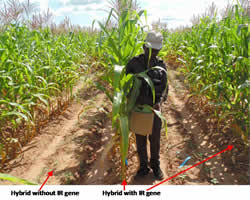
The Nigerian National Variety Release Committee (NVRC) has released the first generation of maize hybrids, resistant to metsulfuron methyl herbicide, that are also endowed with resistance to the noxious parasitic weed Striga hermonthica. The hybrids were developed by the International Institute of Tropical Agriculture (IITA) in partnership with DuPont Pioneer Seeds using conventional breeding with funding from IITA and the Integrated Striga Management in Africa (ISMA) project as part of strategies to control S. hermonthica in maize.
The hybrids were released as P48W01 and P48W02 and are recognized as IITA IR-Maize Hybrid 2 and IR-Maize Hybrid 4. The hybrids have a yield potential of up to 5 t/ha under Striga infestation in comparison with local varieties that produce less than 1 t/ha in such conditions.
“These hybrids are the product of introducing a single nuclear gene that confers resistance to imidazolinone herbicides, including metsulfuron methyl (MSM), into inbred lines with known field resistance to S. hermonthica,” Dr Abebe Menkir, IITA Maize Breeder, said. These inbred lines were developed in the 1980s, with germplasm that is currently in the genebank managed by CIMMYT pursuant to Article 15 of the Plant Treaty. The herbicide resistant gene (IR) was not selected from a genetically modified maize but was identified as a mutant by Pioneer while screening maize for resistance to ALS inhibiting herbicides in tissue culture.

Recent baseline studies conducted under the ISMA project showed that farmers ranked Striga as the number one constraint to maize production in northern Nigeria, with 50 to 100% of the households reporting Striga incidence in their farms. The parasitic weed infests more than 9 million ha planted to millet, maize, and sorghum in Nigeria and severely lowers the production capacity of these crops.
Dr Menkir said yield losses in maize from damage by S. hermonthica varied from 20 to 80% among subsistence farmers, but 100% loss could occur in susceptible cultivars under severe infestation in marginal production conditions.
The released herbicide-resistant hybrids allow seeds to be planted that have been treated with low doses of metsulfuron methyl herbicide. This targets S. hermonthica before or at the time of its attachment to the maize root, killing the parasite underground before it inflicts damage on the crop. These hybrids can thus be used to deplete the Striga seed bank in the soil and minimize yield losses in subsequent cereal crops. MSM-reated seeds of these hybrids can be integrated into the diverse farming systems in Nigeria because the herbicide effectively controls the parasite at a low rate of application.

The ISMA project works with the private sector to catalyze the process of producing and marketing treated seeds of herbicide-resistant maize hybrids to smallholder farmers in Nigeria to control S. hermonthica. Other collaborating partners engaged in extensive testing of these hybrids include the Institute for Agricultural Research (IAR) and Agricultural Development Programs in Bauchi and Kano States.
The collaboration between IITA and Dupont Pioneer started in 2013 and was articulated through a license agreement between both organizations. IITA (the licensor) provided Pioneer Overseas Corporation (the licensee) an exclusive license to evaluate the potential commercial viability of the ‘STRIGA tolerant MSM resistant corn/maize hybrids namely IRHybrid-3 and IRHybrid-4’, to commence commercialization of the product if the result of evaluation was successful,. This license was a limited exclusive license that sought to enhance the level of impact of these hybrids on poor farmers in target countries of West and Central Africa, North Africa and the Middle East. According to the License, Pioneer could sub-license the product to its affiliate companies operating in these countries in order to properly reach a large number of target beneficiaries. Pioneer Overseas Corp committed to make all reasonable efforts to make the stated products available for sale in the countries mentioned above and most especially in the Striga infested areas of Northern Nigeria and the districts of Ghana. The duration of this exclusive license was five years, commencing 01/07/2013 and ending 30/06/2018, subject to renewal. The exclusivity was limited to the two hybrids. IITA retained the ownership over the parents of these hybrids and the right to make them available to any other user without restriction.
Although they ultimately did not do so, the license allowed Pioneer to submit applications for breeders’ rights, government registration and other applications for the two hybrids, in order to protect their market opportunities in the target geographies, and in this way facilitate the inflow of funds necessary for covering the expenditures involved in producing the hybrids and making them available and accessible to smallholder farmers. . The license also considered that Pioneer Overseas Corporation would pay royalty fees to IITA from direct sales of the hybrids in the countries mentioned above, whenever they were sold by itself and its affiliate companies. The products would remain available to small-holder farmers residing in a nation where a national food security related occurrence has occurred that poses imminent threat of a significant loss of human life and which is declared an “emergency” by a national government or a multilateral and internationally recognized institution.
By mid-2019 gains had been made in respect of initial characterization and genotyping of parent lines, pilot hybrid production and ramping up volumes for commercial seed production. For this, IITA provided seeds of parents of the hybrids to support the pilot hybrid seed production and increasing volumes of seed for certified seed production and commercialization. Ultimately, commercialization did not start, and Pioneer had not sought plant breeders’ right protections by the end of the license period. At the end of the license period, in July 2019, IITA and Pioneer planned to renew their license agreements based on the projected impact of Pioneer’s business plan for the period. Commercial sales are expected to commence in 2020 after the licensing agreement is finalized.
IITA and Pioneer are in the process of negotiating a new license. This new agreement will comply with the CGIAR Principles for the Management of Intellectual Assets including ensuring that the materials are available for non-commercial research by public sector research organizations and under emergency circumstances. It will also comply with obligations for monetary benefit sharing under the International Treaty on Plant Genetic Resources for Food and Agriculture
For more details, please contact: Abebe Menkir, a.menkir@cgiar.org


Contribué par

Histoires récentes

Aucun article trouvé

Laisser un commentaire

Votre adresse e-mail ne sera pas publiée. Les champs obligatoires sont indiqués avec *

Retour en haut
Olaosebikan, Olamide

Olamide Deborah Nwanze est une chercheuse principale spécialisée dans la recherche sur l'approche "genre" afin d'éclairer les politiques de sélection participative et inclusive, de développement de variétés et de systèmes semenciers concernant les cultures de racines, tubercules et bananes (RTB) au siège de l'Institut International d'Agriculture Tropicale, à Ibadan, au Nigeria. Elle est candidate au doctorat à l'Université d'Ibadan et titulaire d'un master et d'un diplôme d'ingénieur agronome en vulgarisation agricole et développement rural. Olamide est membre du programme African Women in Agricultural Research and Development – Gender Responsive Agricultural Systems Policy (SAISIE DE RÉCOMPENSEet les Chercheuses Sensibles au Genre Équipées pour la Transformation Agricole (SUPER. Elle cherche à appliquer ses apprentissages en matière d’approche genre, recherche sensible au genre, et expertise en développement et examen de politiques pour faciliter l’accès et l’adoption par les femmes, les jeunes, les enfants et les groupes sociaux vulnérables aux innovations agricoles qui garantissent la sécurité alimentaire, nutritionnelle, des revenus et des moyens de subsistance en Afrique. Ses rôles actuels comprennent le mentorat de chercheurs stagiaires, le développement de guides et manuels de formation, la mise en œuvre et l'adaptation de cadres et d'outils genre, l'engagement des acteurs de la chaîne de valeur en tant que partenaires de la science citoyenne, l'examen et la refonte des politiques, la gestion et l'analyse des données. Ses recherches actuelles portent sur les méthodes mixtes ainsi que sur les approches participatives et interdisciplinaires pour saisir et mettre en évidence les dynamiques de genre, les besoins, les préférences et les défis rencontrés par les parties prenantes au sein de la chaîne de valeur des moyens de subsistance agricoles afin de prioriser des stratégies axées sur le genre dans les programmes de sélection, la conception et la mise en œuvre des politiques.

À l'IITA, elle contribue à la mise en œuvre du CGIAR Initiative d'Élevage Accéléré et Innovation génétique Programmes ; recherche participative et genre au sein des Prochaine Génération ManiocHarvestPlusRTBAliments, et Tricot-ClimMob 1000Fermes Projets ; et la communication des connaissances sur le genre via le Série de webinaires G-LENS, vidéo documentaire, notes de politiquepublications, et blogs.


Publications récentes

de Sousa, K., van Etten, J., Manners, R. Bello, A., Teeken, B., Olaosebikan, O., et al. 2024. L'approche tricot : un cadre agile pour les essais décentralisés à la ferme soutenus par la science citoyenne. Une rétrospective. Agron. Sustain. Dev. 44, 8. https://doi.org/10.1007/s13593-023-00937-1

Madu, T., Onwuka, S., Nwafor, S., Onyemauwa, N., Ejechi, M., Ofoeze, M., Ukeje, B., Eluagu, C., Olaosebikan, O., Okoye, B., 2024. Les études sur les consommateurs inclusifs en matière de genre améliorent l'amélioration du manioc au Nigeria dans : Frontiers in Sociology, volume 9, numéro : 1224504, doi : 10.3389/fsoc.2024.1224504

Olaosebikan, O. ; Bello, A. ; Utoblo, O. ; Okoye, B. ; Olutegbe, N. ; Garner, E. ; Teeken, B. ; Bryan, E. ; Forsythe, L. ; Cole, S. ; Madu, T. 2023. Facteurs de stress et résilience au sein de la chaîne de valeur du manioc au Nigeria : Caractéristiques préférées des variétés de manioc et stratégies de réponse des hommes et des femmes pour informer l'amélioration variétale. Sustainability 15, 7837. https://doi.org/10.3390/su15107837

Okoye, B., Ofoeze, M., Ejechi, M., Onwuka, S., Nwafor, S., Onyemauwa, N., Ukeje, B., Eluagu, C., Obidiegwu, J.*, Olaosebikan, O., Madu, T.* 2023. Priorisation des traits préférés dans la chaîne de valeur de l'igname au Nigeria : une analyse de la situation en matière de genre in: Frontiers in Sociology, volume 8, numéro : 1232626, pages 1 – 9, ISSN 2297-7775, 2023. https://www.frontiersin.org/articles/10.3389/fsoc.2023.1232626/full

Olaosebikan, O., Bello, A. A., de Sousa, K., Ndjouenkeu, R., Adesokan, M., Alamu, E. O., Agbona, A., van Etten, J., Kegah, F. N.*, Dufour, D., Bouniol, A., Teeken, B. 2023. Acceptabilité par les consommateurs des produits alimentaires à base de gari-eba de manioc dans des contextes culturels et environnementaux variés en utilisant l'approche triade de comparaison des technologies (tricot) dans : Journal of the Science of Food and Agriculture,

Teeken, B., Olaosebikan, O., Bello, A. A., Madu, T.*, Cole, S. M. 2023. Évaluation qualitative de la positionnalité et des préférences des dyades en relation avec les activités liées au manioc : travailler avec des scientifiques citoyens du procès tricot https://hdl.handle.net/10568/138326 Type : Manuel

Bouniol, A., Ceballos, H., Bello, A. A., Teeken, B., Olaosebikan, O., Owoade, D., Agbona, A., Fotso Kuate, A., Madu, T.*, Okoye, B.*, Ofoeze, M.*, Nwafor, S.*, Onyemauwa, N.*, Adinsi, L.*, Forsythe, L., Dufour, D. 2023. Impact variétal sur le travail des femmes, la charge de travail et la pénibilité associée dans le traitement des plantes à racines, tubercules et bananes : focus sur le manioc en Afrique subsaharienne dans : Journal of the Science of Food and Agriculture, pages 1 – 25, ISSN 0022-5142,

Bello, A. A., Agbona, A., Olaosebikan, O., Edughaen, G., Dufour, D., Bouniol, A., Iluebbey, P., Ndjouenkeu, R.*, Rabbi, I. Y., Teeken, B. 2023. Effets génétiques et environnementaux sur la productivité de la transformation et le rendement des produits alimentaires : la pénibilité du travail des femmes dans : Journal of the Science of Food and Agriculture, pages 1 – 32, ISSN 0022-5142, 5

Cavicchioli, M., Zimbiti, T., Teeken, B., Nwanze, D.O., Liani, M., Parkes, E. & Bello, A. 2023. Rapport sur la formation en sélection génétique sensible au genre à l'IITA. Genetic Resources Center, IITA-HQ, Ibadan, 21-23 septembre 2022. Ibadan, Nigéria : IITA, (34 p.).https://hdl.handle.net/10568/131368

Agbona, A. Peteti P., Teeken B., Olaosebikan O. Bello, A. A., Parkes, E., Rabbi, I. Y., Mueller, L., Egesi, C., Kulakow, P. 2022. Gestion des données dans les programmes d'amélioration des cultures RTB africaines multidisciplinaires. In : Williamson, H.F., Leonelli, S. (eds) Towards Responsible Plant Data Linkage: Data Challenges for Agricultural Research and Development. Springer, Cham. https://doi.org/10.1007/978-3-031-13276-6_5

Lora Forsythe, Pricilla Marimo, Sarah Mayanja, Olamide D. Olaosebikan, Esme Stuart, Bela Teeken, Benjamin Okoye, Tessy Madu, (2021). Analyse transversale du genre dans RTBfoods Étape 2 Cartographie des genres sur les produits RTB. Comprendre les moteurs des préférences en matière de traits et le développement de profils de produits RTB multi-utilisateurs, WP1. Londres, Royaume-Uni : Rapport scientifique de terrain RTBfoods, 30 p.

Teeken, B., Garner, E., Agbona, A., Balogun, I., Olaosebikan, O., Bello, A., Madu, T., Okoye, B., Egesi, C., Kulakow, P. et Tufan, H.A. 2021. Au-delà des “ traits des femmes ” : explorer comment le genre, les différences sociales et les caractéristiques des ménages influencent les préférences pour les traits. Frontiers Systèmes alimentaires durables 5:740926. https://doi.org/10.3389/fsufs.2021.740926

Teeken, B., Agbona, A., Bello, A., Olaosebikan, O., Alamu, E., Adesokan, M., Awoyale, W., Madu, T., Okoye, B., Chijioke, U., Owoade, D., Okoro, M., Bouniol, A., Dufour, D., Hershey, C., Rabbi, I., Maziya‐Dixon, B., Egesi, C., Tufan, H. et Kulakow, P. (020. Comprendre les préférences variétales du manioc par le classement par paires du gari-eba et du fufu préparés par des agriculteurs-transformateurs locaux. Int J Food Sci Technol. https://doi.org/10.1111/ijfs.14862

Bela Teeken, Olamide Olaosebikan, Ireti Balogun, Benjamin Okoye, Tessy Madu, Steven Cole, Abolore Bello, Elizabeth Parkes. (2020). Pilotage des outils de profil client et produit G+ pour l'amélioration sensible au genre du manioc au Nigeria. Nigeria : Institut international d'agriculture tropicale (IIAT). https://hdl.handle.net/20.500.11766/13000