
NOUVELLES DE L'IITA

Novel and effective technique to control Banana Xanthomonas wilt is suitable for Rwandan agroecology
décembre 14, 2020

Banana is a major commodity in Rwanda, used as both a cash and (staple) food crop; it covers 23% of Rwanda’s land and is grown by 90% of households. Rwanda is one of the largest banana producers in the East Africa Region and ranks second in banana consumption globally with an annual per capita consumption of approximately 144 kg.

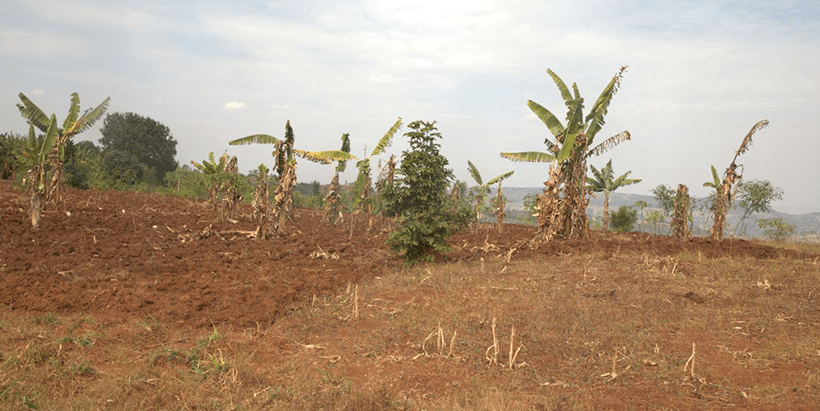
For the last 10 plus years, the yield and production of this important crop in Rwanda have been severely affected by the Xanthomonas wilt of banana (BXW) disease, affecting yield and production for Rwandan farmers.
Novel and effective technique to control Banana Xanthomonas wilt is suitable for Rwandan agroecology
Xanthomonas wilt of banana can cause yield losses up to 100%.

BXW is a bacterial disease that has seriously affected banana production in the East and Central African (ECA) region, with yield losses of up to 100% reported. The disease was first discovered on Enset (a banana-relative, also called false banana) in Ethiopia in 1967 and first spread to the ECA region (Uganda) in 2001. In Rwanda, BXW was officially reported in 2005 and reportedly caused reduced banana availability in households and markets, making it a considerable threat to food security and income.

There is no cure for BXW, but scientists have formulated technical recommendations to reduce the probability of infection and to manage and control existing infections.

The Government of Rwanda set up various approaches to address BXW, such as working through Umuganda, a monthly holiday of community service in Rwanda, where people uprooted infected banana mats and buried them in the soil. This practice to control BXW is referred to as “Complete Diseased Mat Uprooting (CDMU)”.

In Rwanda, CDMU has been proposed as the only correct measure to control BXW, though it has only been partially effective because it is costly, time-consuming, and severely affects the continuity of bunch harvests.
Novel and effective technique to control Banana Xanthomonas wilt is suitable for Rwandan agroecology
“Single Diseased Stem Removal” helps to control BXW more efficiently than “Complete Diseased Mat Uprooting”.

A novel technique to control BXW in banana, called Single Diseased Stem Removal (SDSR), developed and tested by the Alliance of Bioversity International and CIAT in neighboring countries over the past years, has recently been tested at field sites in Rwanda and showed good results.

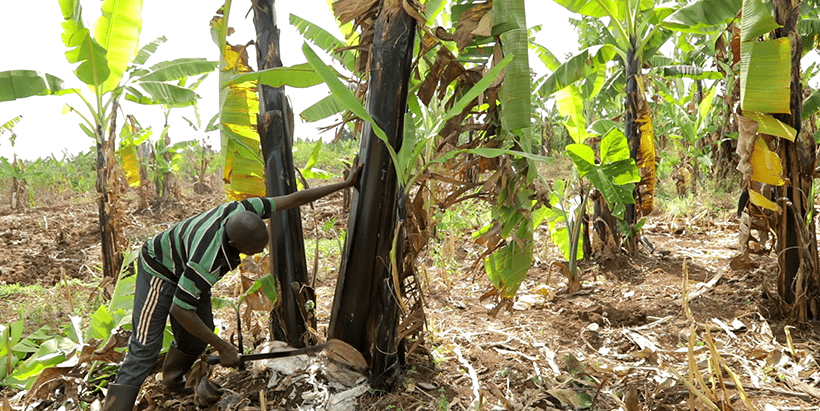
SDSR is a disease management practice to control BXW and recover banana production rapidly. Instead of uprooting the whole sick banana mat, only the stem of a plant showing symptoms of BXW is cut at soil level. Scientists recommend supporting SDSR by sterilizing garden tools used for cutting diseased stems, either by holding the tool in fire for up to a minute or by cleaning it with soap and water or chlorine. Ideally, this work is associated with removing the male floral bud after the formation of the last cluster on the bunch, using a forked stick.

The Alliance of Bioversity International and CIAT conducted the study on the SDSR technique in Rwanda, in partnership with the Rwanda Agriculture and Animal Resources Development Board (RAB) and the International Institute of Tropical Agriculture (IITA) through the CGIAR Research Program on Roots, Tubers and Bananas (RTB) flagship project.

The trials were set in four sites located in Kayonza, Gisagara, Rulindo, and Rubavu districts. The objectives of the study were to: 1) assess the potential of both CDMU and SDSR in controlling BXW under Rwandan agroecological conditions and 2) conduct a cost-benefit analysis for both technologies, measuring the time needed and labor costs to apply the technology and banana bunch harvests/yield.

The results show that in all four sites, both SDSR and CDMU were highly effective in halting the disease: disease incidence dropped below 1% by the end of the first month. In subsequent months, during which the banana plants were regularly monitored for symptoms of BXW, incidence remained below 2% when either SDSR or CDMU was applied, respectively, on sick plants or mats. This was a marked difference from the plots with BXW where no techniques were applied to control the disease. In these plots, incidence rapidly increased in the first month at all four sites with an average of 7.5%.

Although disease incidence declines were similar for both BXW control technologies, it is important to note that in the CDMU plots, all plants in a sick banana mat were uprooted, whereas in the SDSR plots, all healthy-looking plants were left in place, leading to continued bunch production. For banana farmers, this makes an enormous difference.

Moreover, the results show that SDSR takes much less time than CDMU. The total time (cutting/uprooting, processing plant debris, and even replanting in the case of CDMU) needed for SDSR is 88% less than for CDMU, averaging 4.3 ± 0.3 minutes treatment time for removing one affected plant, compared to 36.5 ± 4.5 minutes for uprooting one affected whole mat. It logically follows that the labor costs associated with CDMU are much higher.

Scientists recommend the SDSR technique to control BXW to Rwandan banana farmers because it is easy to apply and highly effective in controlling and halting the dissemination of BXW in banana gardens.

Read the research brief here: https://www.rtb.cgiar.org/publications/a-superior-technology-to-control-banana-xanthomonas-wilt-bxw-in-rwanda/


Contribué par

Nouvelles connexes

Aucun article trouvé

Laisser un commentaire

Votre adresse e-mail ne sera pas publiée. Les champs obligatoires sont indiqués avec *

Retour en haut
Olaosebikan, Olamide

Olamide Deborah Nwanze est une chercheuse principale spécialisée dans la recherche sur l'approche "genre" afin d'éclairer les politiques de sélection participative et inclusive, de développement de variétés et de systèmes semenciers concernant les cultures de racines, tubercules et bananes (RTB) au siège de l'Institut International d'Agriculture Tropicale, à Ibadan, au Nigeria. Elle est candidate au doctorat à l'Université d'Ibadan et titulaire d'un master et d'un diplôme d'ingénieur agronome en vulgarisation agricole et développement rural. Olamide est membre du programme African Women in Agricultural Research and Development – Gender Responsive Agricultural Systems Policy (SAISIE DE RÉCOMPENSEet les Chercheuses Sensibles au Genre Équipées pour la Transformation Agricole (SUPER. Elle cherche à appliquer ses apprentissages en matière d’approche genre, recherche sensible au genre, et expertise en développement et examen de politiques pour faciliter l’accès et l’adoption par les femmes, les jeunes, les enfants et les groupes sociaux vulnérables aux innovations agricoles qui garantissent la sécurité alimentaire, nutritionnelle, des revenus et des moyens de subsistance en Afrique. Ses rôles actuels comprennent le mentorat de chercheurs stagiaires, le développement de guides et manuels de formation, la mise en œuvre et l'adaptation de cadres et d'outils genre, l'engagement des acteurs de la chaîne de valeur en tant que partenaires de la science citoyenne, l'examen et la refonte des politiques, la gestion et l'analyse des données. Ses recherches actuelles portent sur les méthodes mixtes ainsi que sur les approches participatives et interdisciplinaires pour saisir et mettre en évidence les dynamiques de genre, les besoins, les préférences et les défis rencontrés par les parties prenantes au sein de la chaîne de valeur des moyens de subsistance agricoles afin de prioriser des stratégies axées sur le genre dans les programmes de sélection, la conception et la mise en œuvre des politiques.

À l'IITA, elle contribue à la mise en œuvre du CGIAR Initiative d'Élevage Accéléré et Innovation génétique Programmes ; recherche participative et genre au sein des Prochaine Génération ManiocHarvestPlusRTBAliments, et Tricot-ClimMob 1000Fermes Projets ; et la communication des connaissances sur le genre via le Série de webinaires G-LENS, vidéo documentaire, notes de politiquepublications, et blogs.


Publications récentes

de Sousa, K., van Etten, J., Manners, R. Bello, A., Teeken, B., Olaosebikan, O., et al. 2024. L'approche tricot : un cadre agile pour les essais décentralisés à la ferme soutenus par la science citoyenne. Une rétrospective. Agron. Sustain. Dev. 44, 8. https://doi.org/10.1007/s13593-023-00937-1

Madu, T., Onwuka, S., Nwafor, S., Onyemauwa, N., Ejechi, M., Ofoeze, M., Ukeje, B., Eluagu, C., Olaosebikan, O., Okoye, B., 2024. Les études sur les consommateurs inclusifs en matière de genre améliorent l'amélioration du manioc au Nigeria dans : Frontiers in Sociology, volume 9, numéro : 1224504, doi : 10.3389/fsoc.2024.1224504

Olaosebikan, O. ; Bello, A. ; Utoblo, O. ; Okoye, B. ; Olutegbe, N. ; Garner, E. ; Teeken, B. ; Bryan, E. ; Forsythe, L. ; Cole, S. ; Madu, T. 2023. Facteurs de stress et résilience au sein de la chaîne de valeur du manioc au Nigeria : Caractéristiques préférées des variétés de manioc et stratégies de réponse des hommes et des femmes pour informer l'amélioration variétale. Sustainability 15, 7837. https://doi.org/10.3390/su15107837

Okoye, B., Ofoeze, M., Ejechi, M., Onwuka, S., Nwafor, S., Onyemauwa, N., Ukeje, B., Eluagu, C., Obidiegwu, J.*, Olaosebikan, O., Madu, T.* 2023. Priorisation des traits préférés dans la chaîne de valeur de l'igname au Nigeria : une analyse de la situation en matière de genre in: Frontiers in Sociology, volume 8, numéro : 1232626, pages 1 – 9, ISSN 2297-7775, 2023. https://www.frontiersin.org/articles/10.3389/fsoc.2023.1232626/full

Olaosebikan, O., Bello, A. A., de Sousa, K., Ndjouenkeu, R., Adesokan, M., Alamu, E. O., Agbona, A., van Etten, J., Kegah, F. N.*, Dufour, D., Bouniol, A., Teeken, B. 2023. Acceptabilité par les consommateurs des produits alimentaires à base de gari-eba de manioc dans des contextes culturels et environnementaux variés en utilisant l'approche triade de comparaison des technologies (tricot) dans : Journal of the Science of Food and Agriculture,

Teeken, B., Olaosebikan, O., Bello, A. A., Madu, T.*, Cole, S. M. 2023. Évaluation qualitative de la positionnalité et des préférences des dyades en relation avec les activités liées au manioc : travailler avec des scientifiques citoyens du procès tricot https://hdl.handle.net/10568/138326 Type : Manuel

Bouniol, A., Ceballos, H., Bello, A. A., Teeken, B., Olaosebikan, O., Owoade, D., Agbona, A., Fotso Kuate, A., Madu, T.*, Okoye, B.*, Ofoeze, M.*, Nwafor, S.*, Onyemauwa, N.*, Adinsi, L.*, Forsythe, L., Dufour, D. 2023. Impact variétal sur le travail des femmes, la charge de travail et la pénibilité associée dans le traitement des plantes à racines, tubercules et bananes : focus sur le manioc en Afrique subsaharienne dans : Journal of the Science of Food and Agriculture, pages 1 – 25, ISSN 0022-5142,

Bello, A. A., Agbona, A., Olaosebikan, O., Edughaen, G., Dufour, D., Bouniol, A., Iluebbey, P., Ndjouenkeu, R.*, Rabbi, I. Y., Teeken, B. 2023. Effets génétiques et environnementaux sur la productivité de la transformation et le rendement des produits alimentaires : la pénibilité du travail des femmes dans : Journal of the Science of Food and Agriculture, pages 1 – 32, ISSN 0022-5142, 5

Cavicchioli, M., Zimbiti, T., Teeken, B., Nwanze, D.O., Liani, M., Parkes, E. & Bello, A. 2023. Rapport sur la formation en sélection génétique sensible au genre à l'IITA. Genetic Resources Center, IITA-HQ, Ibadan, 21-23 septembre 2022. Ibadan, Nigéria : IITA, (34 p.).https://hdl.handle.net/10568/131368

Agbona, A. Peteti P., Teeken B., Olaosebikan O. Bello, A. A., Parkes, E., Rabbi, I. Y., Mueller, L., Egesi, C., Kulakow, P. 2022. Gestion des données dans les programmes d'amélioration des cultures RTB africaines multidisciplinaires. In : Williamson, H.F., Leonelli, S. (eds) Towards Responsible Plant Data Linkage: Data Challenges for Agricultural Research and Development. Springer, Cham. https://doi.org/10.1007/978-3-031-13276-6_5

Lora Forsythe, Pricilla Marimo, Sarah Mayanja, Olamide D. Olaosebikan, Esme Stuart, Bela Teeken, Benjamin Okoye, Tessy Madu, (2021). Analyse transversale du genre dans RTBfoods Étape 2 Cartographie des genres sur les produits RTB. Comprendre les moteurs des préférences en matière de traits et le développement de profils de produits RTB multi-utilisateurs, WP1. Londres, Royaume-Uni : Rapport scientifique de terrain RTBfoods, 30 p.

Teeken, B., Garner, E., Agbona, A., Balogun, I., Olaosebikan, O., Bello, A., Madu, T., Okoye, B., Egesi, C., Kulakow, P. et Tufan, H.A. 2021. Au-delà des “ traits des femmes ” : explorer comment le genre, les différences sociales et les caractéristiques des ménages influencent les préférences pour les traits. Frontiers Systèmes alimentaires durables 5:740926. https://doi.org/10.3389/fsufs.2021.740926

Teeken, B., Agbona, A., Bello, A., Olaosebikan, O., Alamu, E., Adesokan, M., Awoyale, W., Madu, T., Okoye, B., Chijioke, U., Owoade, D., Okoro, M., Bouniol, A., Dufour, D., Hershey, C., Rabbi, I., Maziya‐Dixon, B., Egesi, C., Tufan, H. et Kulakow, P. (020. Comprendre les préférences variétales du manioc par le classement par paires du gari-eba et du fufu préparés par des agriculteurs-transformateurs locaux. Int J Food Sci Technol. https://doi.org/10.1111/ijfs.14862

Bela Teeken, Olamide Olaosebikan, Ireti Balogun, Benjamin Okoye, Tessy Madu, Steven Cole, Abolore Bello, Elizabeth Parkes. (2020). Pilotage des outils de profil client et produit G+ pour l'amélioration sensible au genre du manioc au Nigeria. Nigeria : Institut international d'agriculture tropicale (IIAT). https://hdl.handle.net/20.500.11766/13000