
One on one: Regina Kapinga
avril 20, 2019
IITA’s Queen of Roots and Tubers
As we continue to celebrate women in science, we interviewed Regina Kapinga, IITA’s first Head of Advocacy and Resource Mobilization, also known as the Queen of Roots and Tubers. Her years of working on cassava and sweet potato earned her an “Appreciation award for outstanding leadership and contribution to the development of Root and Tuber crops in Africa” from the International Symposium for the International Society for Tropical Root Crops-Africa Branch (ISTRC-AB), held in Dar es Salaam, Tanzania in 2018.
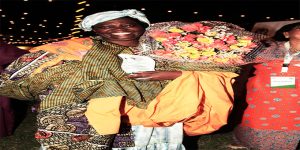 In this interview, Kapinga talks about her successful career spanning science, grants and project management, and now fundraising.IN: Tell us about yourself
RK: I am a Tanzanian, born and raised on the shores of Lake Victoria in Bukoba District in the North-Western Zone of Tanzania. I started my career with the Ministry of Agriculture as an agricultural researcher for 15 years up to 2000. Thereafter, I joined the Tanzania Commission for Science and Technology as the Director of Research Coordination and Promotion Directorate and worked there until August 2001. My new post was good but had a lot of governance and policy coordination tasks which, at that time, as a scientist didn’t motivate me.
So I moved to Uganda to work for Centre international de la pomme de terre (CIP) as a sweet potato breeder for the sub-Saharan Africa and country liaison office until early 2009 when I joined the Bill & Melinda Gates Foundation in Seattle as a Senior Program Officer. My responsibilities there were to make and manage grants in the Roots and Tubers portfolio until early 2015 when I joined IITA as the Head of Advocacy and Resource Mobilization Unit under the General Directorate. From January, this year, I am also the Country Representative for Uganda.
I have a PhD in Agronomy (1994) and an MSc in Crop Science (1988) from the University of Ibadan, Nigeria, and a BSc (major in Botany and Chemistry) from the University of Dar es Salaam, Tanzania.
I did both my MSc and PhD degrees at IITA-Ibadan so joining IITA long after studentship was like coming back home. I am married to Emil and we’re blessed with three children, but our first son recently passed away leaving us with four beautiful grandchildren (Baraka, Helen, and the twins Esther & Elijah).
IN: What have been some of the major challenges in your new post at IITA and how have you turned them into opportunities?
RK: When I joined in 2015, this was a new unit with one member of staff—me. The only thing provided was my salary and a limited budget for operations. Therefore, although I was hired to support all regional hubs, this wasn’t easy, so the first projects I developed with the research teams in Nigeria, Tanzania and the P4D colleagues, innovatively, I included my staff time, advocacy, and mainstreaming activities, which generated some funds to hire staff and run the unit.
So now at least I have some support staff who work with me and in some regions where I can’t reach on a regular basis, I have supported them with funds to hire a consultant and work with the teams to write proposals.
For Tanzania and neighboring countries, I work closely with the team to identify funding opportunities. As I move to Uganda, I have big hopes that through linkages with the team and other key stakeholders, we will raise funds especially in the areas prioritized by the Government, for instance combating aflatoxin in maize and groundnut, industrializing cassava, and strengthening youth in agribusiness.
IN: What have been some of the defining moments in your career?
RK: My prior work for eight years at CIP where we worked with more than 20 organizations to promote Vitamin A sweet potato in the SSA region targeting children under five and women of reproductive ages. As one of the pioneers, in 2016, I was overjoyed when the work on biofortification was internationally recognized by receiving the World Food Prize in Des Moines, Iowa, United States. This is an international award recognizing the achievements of individuals who have advanced human development by improving the quality, quantity, or availability of food in the world. So seeing myself to have contributed to this journey, it indeed defined my moment in the professional world.
IN: What are some of the challenges you have encountered as a woman in science and how have you overcome them?
RK: As a married woman, there hasn’t been much flexibility in taking up international jobs which entail relocating from my home country without my family members. A good example is in the USA where I successfully worked at the Bill & Melinda Gates Foundation. My family couldn’t stay with me there, so I had to prioritize and make a hard choice. I gave up my prestigious job and came back home—thanks to IITA which absorbed me immediately.
IN: Advice to young women working in science and who would like to advance in their career
RK: This can’t be different from what others will advise them and that is: To be determined and focused. They should focus less on the job they have and more on knowing who they are so that they can become more adaptable, confident, and resourceful in their jobs and lives in general. They should be critical thinkers, take risks, and be innovative. They should spend their time exploring their strengths, interests, and skills to find jobs that fit them best. They should use where they are now to get them to their next job.
In this interview, Kapinga talks about her successful career spanning science, grants and project management, and now fundraising.IN: Tell us about yourself
RK: I am a Tanzanian, born and raised on the shores of Lake Victoria in Bukoba District in the North-Western Zone of Tanzania. I started my career with the Ministry of Agriculture as an agricultural researcher for 15 years up to 2000. Thereafter, I joined the Tanzania Commission for Science and Technology as the Director of Research Coordination and Promotion Directorate and worked there until August 2001. My new post was good but had a lot of governance and policy coordination tasks which, at that time, as a scientist didn’t motivate me.
So I moved to Uganda to work for Centre international de la pomme de terre (CIP) as a sweet potato breeder for the sub-Saharan Africa and country liaison office until early 2009 when I joined the Bill & Melinda Gates Foundation in Seattle as a Senior Program Officer. My responsibilities there were to make and manage grants in the Roots and Tubers portfolio until early 2015 when I joined IITA as the Head of Advocacy and Resource Mobilization Unit under the General Directorate. From January, this year, I am also the Country Representative for Uganda.
I have a PhD in Agronomy (1994) and an MSc in Crop Science (1988) from the University of Ibadan, Nigeria, and a BSc (major in Botany and Chemistry) from the University of Dar es Salaam, Tanzania.
I did both my MSc and PhD degrees at IITA-Ibadan so joining IITA long after studentship was like coming back home. I am married to Emil and we’re blessed with three children, but our first son recently passed away leaving us with four beautiful grandchildren (Baraka, Helen, and the twins Esther & Elijah).
IN: What have been some of the major challenges in your new post at IITA and how have you turned them into opportunities?
RK: When I joined in 2015, this was a new unit with one member of staff—me. The only thing provided was my salary and a limited budget for operations. Therefore, although I was hired to support all regional hubs, this wasn’t easy, so the first projects I developed with the research teams in Nigeria, Tanzania and the P4D colleagues, innovatively, I included my staff time, advocacy, and mainstreaming activities, which generated some funds to hire staff and run the unit.
So now at least I have some support staff who work with me and in some regions where I can’t reach on a regular basis, I have supported them with funds to hire a consultant and work with the teams to write proposals.
For Tanzania and neighboring countries, I work closely with the team to identify funding opportunities. As I move to Uganda, I have big hopes that through linkages with the team and other key stakeholders, we will raise funds especially in the areas prioritized by the Government, for instance combating aflatoxin in maize and groundnut, industrializing cassava, and strengthening youth in agribusiness.
IN: What have been some of the defining moments in your career?
RK: My prior work for eight years at CIP where we worked with more than 20 organizations to promote Vitamin A sweet potato in the SSA region targeting children under five and women of reproductive ages. As one of the pioneers, in 2016, I was overjoyed when the work on biofortification was internationally recognized by receiving the World Food Prize in Des Moines, Iowa, United States. This is an international award recognizing the achievements of individuals who have advanced human development by improving the quality, quantity, or availability of food in the world. So seeing myself to have contributed to this journey, it indeed defined my moment in the professional world.
IN: What are some of the challenges you have encountered as a woman in science and how have you overcome them?
RK: As a married woman, there hasn’t been much flexibility in taking up international jobs which entail relocating from my home country without my family members. A good example is in the USA where I successfully worked at the Bill & Melinda Gates Foundation. My family couldn’t stay with me there, so I had to prioritize and make a hard choice. I gave up my prestigious job and came back home—thanks to IITA which absorbed me immediately.
IN: Advice to young women working in science and who would like to advance in their career
RK: This can’t be different from what others will advise them and that is: To be determined and focused. They should focus less on the job they have and more on knowing who they are so that they can become more adaptable, confident, and resourceful in their jobs and lives in general. They should be critical thinkers, take risks, and be innovative. They should spend their time exploring their strengths, interests, and skills to find jobs that fit them best. They should use where they are now to get them to their next job.
Regina Kapinga.
Contribué par
Histoires récentes
Aucun article trouvé