
NOUVELLES DE L'IITA

Partners in Eastern Africa praise IITA contributions to agric sector at 50th anniversary celebration in the region
août 7, 2017
IITA’s 50th anniversary celebration moved to its Eastern Africa hub in Dar es Salaam, Tanzania with an exciting two-day program on 11-12 July. The first day brought together major partners and all staff from IITA stations in Kenya, Tanzania, and Uganda to mark this important milestone.
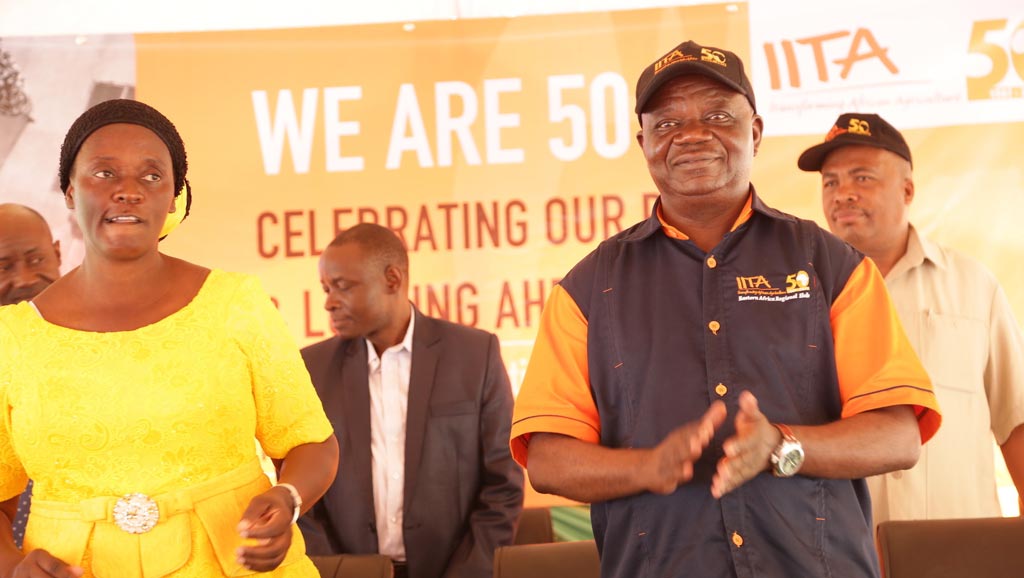
Picture of the guest of honor, Ms Simkanga (in yellow), with hub Director Victor Manyong at the even

The guest of honor, Ms Simkanga (in yellow), with hub Director Victor Manyong at the even

The event was graced by Ms Nkuvililwa Simkanga, the Director of Policy and Planning, who represented the Minister of Agriculture, Livestock and Fisheries in Tanzania; Dr Hussein Mansoor, the Director of Research and Development in the same ministry; Hon. Christophe Bazivamo, the Deputy Secretary, Productive and Social Sectors; and His Excellency Paul Cartier, the Ambassador for Belgium in Tanzania. Mr Fred Kafeero, Country Representative for FAO, and Dr Betty Maeda, Agricultural Research Specialist, USAID Mission in Tanzania, were the other notable dignitaries at the event along with representatives from national research institutes, universities, private sector, farmers, and the media.
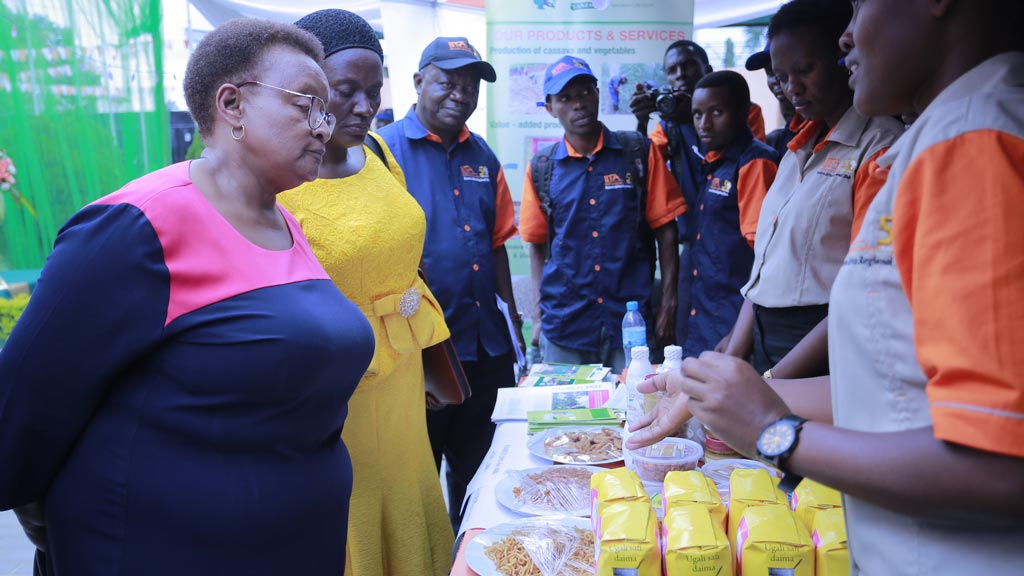
Picture of dignitaries visiting the exhibitions.

Dignitaries visiting the exhibitions.

With the theme “Celebrating our past and looking ahead”, the program combined plenary presentations, poster exhibits, and product exhibitions during which the staff showcased the Institute’s progress and achievements and shared plans.
Tanzania minister commends IITA efforts on crop improvement

The Minister, Hon. Dr Charles Tizeba, in a speech read on his behalf by Ms Nkuvililwa Simkanga, Director for Policy and Planning, congratulated IITA for this important milestone and thanked the Institute for its efforts in finding sustainable solutions to some of the critical challenges facing smallholder farmers in the country. These include lack of access to improved varieties, lack of modern agricultural production skills and knowledge, attack by pests and diseases, and postharvest losses.
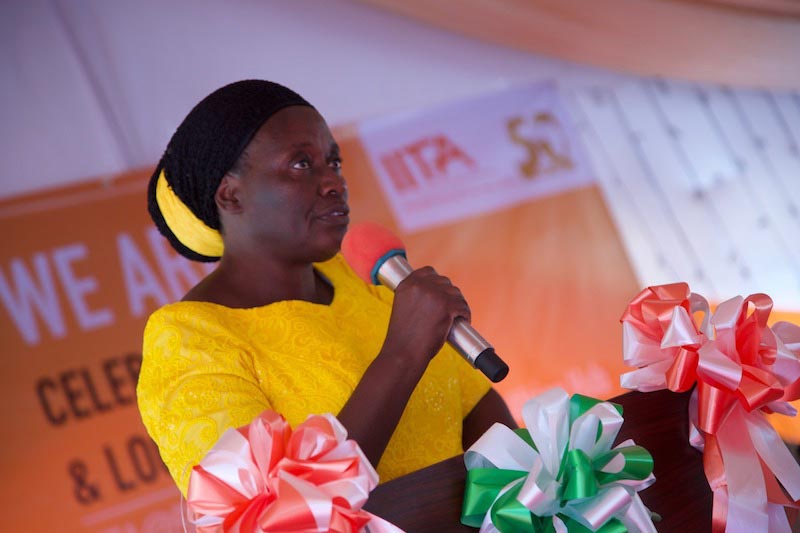
Picture of Simkanga reading the Hon. Minister’s speech.

Simkanga reading the Hon. Minister’s speech.

“I take this opportunity to applaud  IITA  on the various successes it has had in addressing the challenges faced by smallholder farmers; from developing improved varieties of major crops such as cassava and banana and spearheading efforts to commercialize agriculture,” he said. He noted 20 improved varieties of cassava that are high yielding and disease resistant had been released in Tanzania in the last 10 years from efforts by IITA and the national breeding team.

IITA aflatoxin prevention and control efforts in EAC praised

IITA’s efforts to control aflatoxin contamination in food and feed in the East African Community region and in Tanzania were noted as major achievements of the Institute by Hon. Bazivamo from the EAC secretariat and Dr Betty Maeda from the USAID Mission in Tanzania. Hon Bazivamo said that IITA was a global center of excellence in agricultural sciences, technology, and innovation, which had made conspicuous interventions in “addressing the pressing challenges of hunger, malnutrition, poverty, and natural resource degradation in Africa.” “I take this opportunity to acknowledge in a special way the contribution that IITA has made in the EAC integration process. IITA has provided tremendous support in implementing the aflatoxin prevention and control project. With IITA support we have been able to develop a robust EAC aflatoxin and prevention control strategy and action plan aimed at addressing the effects of aflatoxins along the food and feed value chains with the associated health, economic, and farm level benefits,” he said. Maeda highlighted the joint efforts between IITA and USAID in building the country’s research capacity and addressing aflatoxins. “Together we have strengthened national research institutions paving the way for improved research products and services. And together we have built a lasting relationship by establishing partnerships with the donor community and local government and farmers’ organizations to allow technologies to reach the beneficiaries,” she said. She said for the last four years, USAID had supported IITA to carry out research to develop aflasafe, a biocontrol product to address aflatoxin contamination. She said the biocontrol product was awaiting official registration to be commercially available for use. She said USAID had also provided funds to IITA for sensitization and awareness creation of aflatoxins that had seen hundreds of farmers as well as researchers and extension staff trained.

Speed dating IITA scientists

The afternoon session of the program took the guests and staff on a speed date with scientists representing the key research themes at IITA. These were Crop improvement and biotechnology led by Leena Tripathi, Plant health led by James Legg, Social science and agribusiness led by Shiferaw Feleke, Natural Resource Management led by Danny Coyne, and Partnership and capacity development (PCD) led by Regina Kapinga. The teams shared their successes in Eastern Africa with the guests and visiting staff who went on a 20-minute “date” with each of them. The speed date was highlighted as another exciting program of the event that all participants appreciated.

Contribué par

Nouvelles connexes

Aucun article trouvé

Laisser un commentaire

Votre adresse e-mail ne sera pas publiée. Les champs obligatoires sont indiqués avec *

Retour en haut
Olaosebikan, Olamide

Olamide Deborah Nwanze est une chercheuse principale spécialisée dans la recherche sur l'approche "genre" afin d'éclairer les politiques de sélection participative et inclusive, de développement de variétés et de systèmes semenciers concernant les cultures de racines, tubercules et bananes (RTB) au siège de l'Institut International d'Agriculture Tropicale, à Ibadan, au Nigeria. Elle est candidate au doctorat à l'Université d'Ibadan et titulaire d'un master et d'un diplôme d'ingénieur agronome en vulgarisation agricole et développement rural. Olamide est membre du programme African Women in Agricultural Research and Development – Gender Responsive Agricultural Systems Policy (SAISIE DE RÉCOMPENSEet les Chercheuses Sensibles au Genre Équipées pour la Transformation Agricole (SUPER. Elle cherche à appliquer ses apprentissages en matière d’approche genre, recherche sensible au genre, et expertise en développement et examen de politiques pour faciliter l’accès et l’adoption par les femmes, les jeunes, les enfants et les groupes sociaux vulnérables aux innovations agricoles qui garantissent la sécurité alimentaire, nutritionnelle, des revenus et des moyens de subsistance en Afrique. Ses rôles actuels comprennent le mentorat de chercheurs stagiaires, le développement de guides et manuels de formation, la mise en œuvre et l'adaptation de cadres et d'outils genre, l'engagement des acteurs de la chaîne de valeur en tant que partenaires de la science citoyenne, l'examen et la refonte des politiques, la gestion et l'analyse des données. Ses recherches actuelles portent sur les méthodes mixtes ainsi que sur les approches participatives et interdisciplinaires pour saisir et mettre en évidence les dynamiques de genre, les besoins, les préférences et les défis rencontrés par les parties prenantes au sein de la chaîne de valeur des moyens de subsistance agricoles afin de prioriser des stratégies axées sur le genre dans les programmes de sélection, la conception et la mise en œuvre des politiques.

À l'IITA, elle contribue à la mise en œuvre du CGIAR Initiative d'Élevage Accéléré et Innovation génétique Programmes ; recherche participative et genre au sein des Prochaine Génération ManiocHarvestPlusRTBAliments, et Tricot-ClimMob 1000Fermes Projets ; et la communication des connaissances sur le genre via le Série de webinaires G-LENS, vidéo documentaire, notes de politiquepublications, et blogs.


Publications récentes

de Sousa, K., van Etten, J., Manners, R. Bello, A., Teeken, B., Olaosebikan, O., et al. 2024. L'approche tricot : un cadre agile pour les essais décentralisés à la ferme soutenus par la science citoyenne. Une rétrospective. Agron. Sustain. Dev. 44, 8. https://doi.org/10.1007/s13593-023-00937-1

Madu, T., Onwuka, S., Nwafor, S., Onyemauwa, N., Ejechi, M., Ofoeze, M., Ukeje, B., Eluagu, C., Olaosebikan, O., Okoye, B., 2024. Les études sur les consommateurs inclusifs en matière de genre améliorent l'amélioration du manioc au Nigeria dans : Frontiers in Sociology, volume 9, numéro : 1224504, doi : 10.3389/fsoc.2024.1224504

Olaosebikan, O. ; Bello, A. ; Utoblo, O. ; Okoye, B. ; Olutegbe, N. ; Garner, E. ; Teeken, B. ; Bryan, E. ; Forsythe, L. ; Cole, S. ; Madu, T. 2023. Facteurs de stress et résilience au sein de la chaîne de valeur du manioc au Nigeria : Caractéristiques préférées des variétés de manioc et stratégies de réponse des hommes et des femmes pour informer l'amélioration variétale. Sustainability 15, 7837. https://doi.org/10.3390/su15107837

Okoye, B., Ofoeze, M., Ejechi, M., Onwuka, S., Nwafor, S., Onyemauwa, N., Ukeje, B., Eluagu, C., Obidiegwu, J.*, Olaosebikan, O., Madu, T.* 2023. Priorisation des traits préférés dans la chaîne de valeur de l'igname au Nigeria : une analyse de la situation en matière de genre in: Frontiers in Sociology, volume 8, numéro : 1232626, pages 1 – 9, ISSN 2297-7775, 2023. https://www.frontiersin.org/articles/10.3389/fsoc.2023.1232626/full

Olaosebikan, O., Bello, A. A., de Sousa, K., Ndjouenkeu, R., Adesokan, M., Alamu, E. O., Agbona, A., van Etten, J., Kegah, F. N.*, Dufour, D., Bouniol, A., Teeken, B. 2023. Acceptabilité par les consommateurs des produits alimentaires à base de gari-eba de manioc dans des contextes culturels et environnementaux variés en utilisant l'approche triade de comparaison des technologies (tricot) dans : Journal of the Science of Food and Agriculture,

Teeken, B., Olaosebikan, O., Bello, A. A., Madu, T.*, Cole, S. M. 2023. Évaluation qualitative de la positionnalité et des préférences des dyades en relation avec les activités liées au manioc : travailler avec des scientifiques citoyens du procès tricot https://hdl.handle.net/10568/138326 Type : Manuel

Bouniol, A., Ceballos, H., Bello, A. A., Teeken, B., Olaosebikan, O., Owoade, D., Agbona, A., Fotso Kuate, A., Madu, T.*, Okoye, B.*, Ofoeze, M.*, Nwafor, S.*, Onyemauwa, N.*, Adinsi, L.*, Forsythe, L., Dufour, D. 2023. Impact variétal sur le travail des femmes, la charge de travail et la pénibilité associée dans le traitement des plantes à racines, tubercules et bananes : focus sur le manioc en Afrique subsaharienne dans : Journal of the Science of Food and Agriculture, pages 1 – 25, ISSN 0022-5142,

Bello, A. A., Agbona, A., Olaosebikan, O., Edughaen, G., Dufour, D., Bouniol, A., Iluebbey, P., Ndjouenkeu, R.*, Rabbi, I. Y., Teeken, B. 2023. Effets génétiques et environnementaux sur la productivité de la transformation et le rendement des produits alimentaires : la pénibilité du travail des femmes dans : Journal of the Science of Food and Agriculture, pages 1 – 32, ISSN 0022-5142, 5

Cavicchioli, M., Zimbiti, T., Teeken, B., Nwanze, D.O., Liani, M., Parkes, E. & Bello, A. 2023. Rapport sur la formation en sélection génétique sensible au genre à l'IITA. Genetic Resources Center, IITA-HQ, Ibadan, 21-23 septembre 2022. Ibadan, Nigéria : IITA, (34 p.).https://hdl.handle.net/10568/131368

Agbona, A. Peteti P., Teeken B., Olaosebikan O. Bello, A. A., Parkes, E., Rabbi, I. Y., Mueller, L., Egesi, C., Kulakow, P. 2022. Gestion des données dans les programmes d'amélioration des cultures RTB africaines multidisciplinaires. In : Williamson, H.F., Leonelli, S. (eds) Towards Responsible Plant Data Linkage: Data Challenges for Agricultural Research and Development. Springer, Cham. https://doi.org/10.1007/978-3-031-13276-6_5

Lora Forsythe, Pricilla Marimo, Sarah Mayanja, Olamide D. Olaosebikan, Esme Stuart, Bela Teeken, Benjamin Okoye, Tessy Madu, (2021). Analyse transversale du genre dans RTBfoods Étape 2 Cartographie des genres sur les produits RTB. Comprendre les moteurs des préférences en matière de traits et le développement de profils de produits RTB multi-utilisateurs, WP1. Londres, Royaume-Uni : Rapport scientifique de terrain RTBfoods, 30 p.

Teeken, B., Garner, E., Agbona, A., Balogun, I., Olaosebikan, O., Bello, A., Madu, T., Okoye, B., Egesi, C., Kulakow, P. et Tufan, H.A. 2021. Au-delà des “ traits des femmes ” : explorer comment le genre, les différences sociales et les caractéristiques des ménages influencent les préférences pour les traits. Frontiers Systèmes alimentaires durables 5:740926. https://doi.org/10.3389/fsufs.2021.740926

Teeken, B., Agbona, A., Bello, A., Olaosebikan, O., Alamu, E., Adesokan, M., Awoyale, W., Madu, T., Okoye, B., Chijioke, U., Owoade, D., Okoro, M., Bouniol, A., Dufour, D., Hershey, C., Rabbi, I., Maziya‐Dixon, B., Egesi, C., Tufan, H. et Kulakow, P. (020. Comprendre les préférences variétales du manioc par le classement par paires du gari-eba et du fufu préparés par des agriculteurs-transformateurs locaux. Int J Food Sci Technol. https://doi.org/10.1111/ijfs.14862

Bela Teeken, Olamide Olaosebikan, Ireti Balogun, Benjamin Okoye, Tessy Madu, Steven Cole, Abolore Bello, Elizabeth Parkes. (2020). Pilotage des outils de profil client et produit G+ pour l'amélioration sensible au genre du manioc au Nigeria. Nigeria : Institut international d'agriculture tropicale (IIAT). https://hdl.handle.net/20.500.11766/13000