
NOUVELLES DE L'IITA

Promoting Gender Equality and Social Inclusion: Highlights from the 2023 Annual CGIAR Gender Research Conference
novembre 10, 2023

The recent gathering of international experts at the 2023 Annual CGIAR Gender Research Conference, co-hosted by the Plateforme « GENDER Impact » du CGIAR et le Indian Council of Agricultural Research (ICAR), underscored the crucial role of gender inclusivity in the global agricultural landscape. From 9 to 12 October, the event held in New Delhi, India, focused on the vital theme “From Research to Impact: Towards a Just and Resilient Agri-food Systems.”
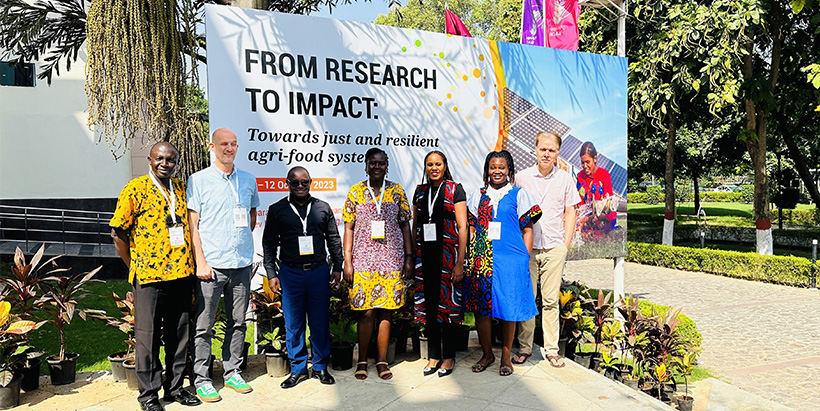
IITA participants at the Gender Conference.

The conference highlighted the fundamental issue of gender and social inequalities deeply embedded within food systems and sought to facilitate a more inclusive approach to agricultural research and practice. With a key emphasis on bridging the gap between research and tangible outcomes, the event aimed to foster resilient, socially just, and gender-equal food systems.

The conference was a vibrant platform for researchers from diverse organizations to engage in meaningful scientific exchanges and dialogues. It provided a conducive environment for sharing innovative insights to transform food systems in line with the global agenda for sustainable development. Throughout the conference, efforts were dedicated to strengthening social networks and cultivating partnerships to drive impactful change in the agricultural landscape.
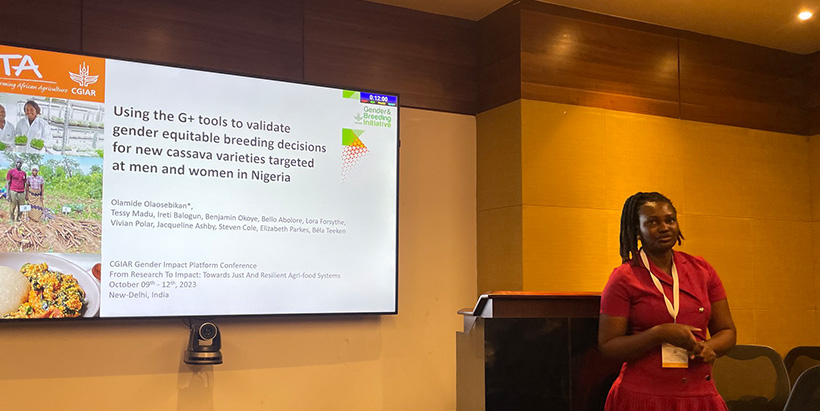
Olamide Olaosebikan presenting on applying the G+ tools for customer, breeding, and food product profiling in cassava. Gender Agrifood conference. New Delhi, India (Photo Credit: Teeken Bela)

In her speech, CGIAR GENDER Impact Platform Director Nicoline de Haan highlighted the persistent challenges arising from gender disparities within agri-food systems. “We are combining research, evidence, and practical understanding to guide policymakers and investors towards best-bet solutions that can help us get on track to achieve Global Goals on gender equality and women’s empowerment,” she affirmed.

Echoing the sentiment, India President Smt. Draupadi Murmu emphasized the need for ecologically sustainable, ethically desirable, economically affordable, and socially justifiable agricultural production. She emphasized that robust research efforts were critical in enabling conditions conducive to achieving these goals.
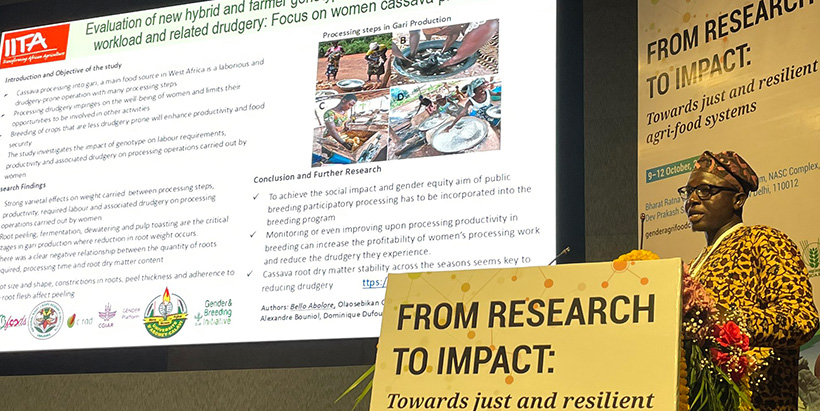
Abolore Bello pitching a poster on the varietal effect on processing productivity and related drudgery of women cassava processors. Gender and Agrifood Conference in New Delhi, India (Photo Credit: Teeken Bela)

Notable presenters from various disciplines and backgrounds illuminated the conference through fifty-five insightful sessions and four high-level plenaries. The diverse session formats, including capacity-building workshops, scientific discussions, panel sessions, open forums, and poster presentations, facilitated a comprehensive exploration of key issues.

Among the contributors, the IITA Gender Research Team shared their valuable insights and experiences, shedding light on impactful best practices that strengthen the role of women in agriculture. Their presentations delved into diverse topics, ranging from measuring gender transformative change in the context of food security and sustainable agriculture to the intricacies of gendered coping mechanisms amidst climate change challenges.
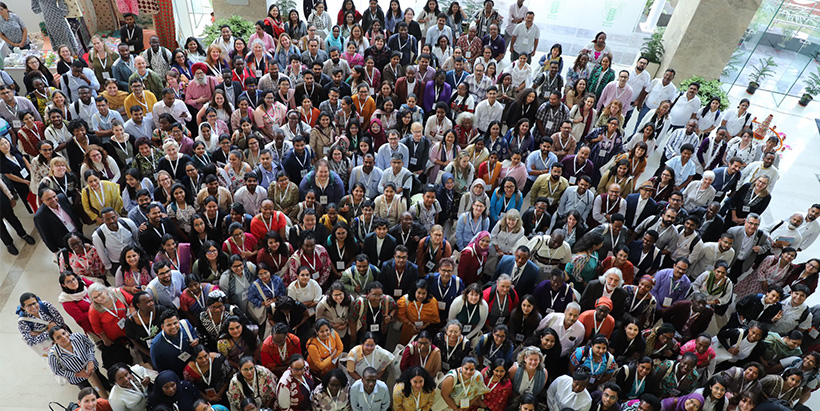
Participants - Researchers, experts, and practitioners from different organizations within 68 countries in the gender conference 2023 (Photo credit: Organizing Committee)
Participants – Researchers, experts, and practitioners from different organizations within 68 countries in the gender conference 2023 (Photo credit: Organizing Committee)

With extensive research, the team illustrated the potential for transformative change within the agricultural sector. The presenters included Senior Scientist and Gender Specialist Steven Cole, Gender Research Postdoctoral Fellow Millicent Liani, Gender Research Assistant Sarah Msita, Gender Research Assistant Rich Kofi Kofituo, Gender Field Research Coordinator Devis Mwakanyamale, Senior Research Associate Olamide Nwanze, Gender Research Associate Scientist Bela Teeken, and Senior Research Supervisor Bello Abolore.

The Country Representative for India and Research Leader of Gender and Livelihoods at the International Rice Research Institute (IRRI), Ranjitha Puskur, lauded the conference as a pivotal platform for meaningful discourse. “This gathering serves as an impactful, constructive dialogue, bringing women to the forefront of just and resilient agri-food systems,” she emphasized. The collaborative spirit and shared dedication exhibited by delegates from across the globe spoke volumes about the collective commitment to translating research into tangible, positive impacts.

Contributed by Sarah Msita and Ochuwa Favour Daramola


Contribué par

Nouvelles connexes

Aucun article trouvé

Laisser un commentaire

Votre adresse e-mail ne sera pas publiée. Les champs obligatoires sont indiqués avec *

Retour en haut
Olaosebikan, Olamide

Olamide Deborah Nwanze est une chercheuse principale spécialisée dans la recherche sur l'approche "genre" afin d'éclairer les politiques de sélection participative et inclusive, de développement de variétés et de systèmes semenciers concernant les cultures de racines, tubercules et bananes (RTB) au siège de l'Institut International d'Agriculture Tropicale, à Ibadan, au Nigeria. Elle est candidate au doctorat à l'Université d'Ibadan et titulaire d'un master et d'un diplôme d'ingénieur agronome en vulgarisation agricole et développement rural. Olamide est membre du programme African Women in Agricultural Research and Development – Gender Responsive Agricultural Systems Policy (SAISIE DE RÉCOMPENSEet les Chercheuses Sensibles au Genre Équipées pour la Transformation Agricole (SUPER. Elle cherche à appliquer ses apprentissages en matière d’approche genre, recherche sensible au genre, et expertise en développement et examen de politiques pour faciliter l’accès et l’adoption par les femmes, les jeunes, les enfants et les groupes sociaux vulnérables aux innovations agricoles qui garantissent la sécurité alimentaire, nutritionnelle, des revenus et des moyens de subsistance en Afrique. Ses rôles actuels comprennent le mentorat de chercheurs stagiaires, le développement de guides et manuels de formation, la mise en œuvre et l'adaptation de cadres et d'outils genre, l'engagement des acteurs de la chaîne de valeur en tant que partenaires de la science citoyenne, l'examen et la refonte des politiques, la gestion et l'analyse des données. Ses recherches actuelles portent sur les méthodes mixtes ainsi que sur les approches participatives et interdisciplinaires pour saisir et mettre en évidence les dynamiques de genre, les besoins, les préférences et les défis rencontrés par les parties prenantes au sein de la chaîne de valeur des moyens de subsistance agricoles afin de prioriser des stratégies axées sur le genre dans les programmes de sélection, la conception et la mise en œuvre des politiques.

À l'IITA, elle contribue à la mise en œuvre du CGIAR Initiative d'Élevage Accéléré et Innovation génétique Programmes ; recherche participative et genre au sein des Prochaine Génération ManiocHarvestPlusRTBAliments, et Tricot-ClimMob 1000Fermes Projets ; et la communication des connaissances sur le genre via le Série de webinaires G-LENS, vidéo documentaire, notes de politiquepublications, et blogs.


Publications récentes

de Sousa, K., van Etten, J., Manners, R. Bello, A., Teeken, B., Olaosebikan, O., et al. 2024. L'approche tricot : un cadre agile pour les essais décentralisés à la ferme soutenus par la science citoyenne. Une rétrospective. Agron. Sustain. Dev. 44, 8. https://doi.org/10.1007/s13593-023-00937-1

Madu, T., Onwuka, S., Nwafor, S., Onyemauwa, N., Ejechi, M., Ofoeze, M., Ukeje, B., Eluagu, C., Olaosebikan, O., Okoye, B., 2024. Les études sur les consommateurs inclusifs en matière de genre améliorent l'amélioration du manioc au Nigeria dans : Frontiers in Sociology, volume 9, numéro : 1224504, doi : 10.3389/fsoc.2024.1224504

Olaosebikan, O. ; Bello, A. ; Utoblo, O. ; Okoye, B. ; Olutegbe, N. ; Garner, E. ; Teeken, B. ; Bryan, E. ; Forsythe, L. ; Cole, S. ; Madu, T. 2023. Facteurs de stress et résilience au sein de la chaîne de valeur du manioc au Nigeria : Caractéristiques préférées des variétés de manioc et stratégies de réponse des hommes et des femmes pour informer l'amélioration variétale. Sustainability 15, 7837. https://doi.org/10.3390/su15107837

Okoye, B., Ofoeze, M., Ejechi, M., Onwuka, S., Nwafor, S., Onyemauwa, N., Ukeje, B., Eluagu, C., Obidiegwu, J.*, Olaosebikan, O., Madu, T.* 2023. Priorisation des traits préférés dans la chaîne de valeur de l'igname au Nigeria : une analyse de la situation en matière de genre in: Frontiers in Sociology, volume 8, numéro : 1232626, pages 1 – 9, ISSN 2297-7775, 2023. https://www.frontiersin.org/articles/10.3389/fsoc.2023.1232626/full

Olaosebikan, O., Bello, A. A., de Sousa, K., Ndjouenkeu, R., Adesokan, M., Alamu, E. O., Agbona, A., van Etten, J., Kegah, F. N.*, Dufour, D., Bouniol, A., Teeken, B. 2023. Acceptabilité par les consommateurs des produits alimentaires à base de gari-eba de manioc dans des contextes culturels et environnementaux variés en utilisant l'approche triade de comparaison des technologies (tricot) dans : Journal of the Science of Food and Agriculture,

Teeken, B., Olaosebikan, O., Bello, A. A., Madu, T.*, Cole, S. M. 2023. Évaluation qualitative de la positionnalité et des préférences des dyades en relation avec les activités liées au manioc : travailler avec des scientifiques citoyens du procès tricot https://hdl.handle.net/10568/138326 Type : Manuel

Bouniol, A., Ceballos, H., Bello, A. A., Teeken, B., Olaosebikan, O., Owoade, D., Agbona, A., Fotso Kuate, A., Madu, T.*, Okoye, B.*, Ofoeze, M.*, Nwafor, S.*, Onyemauwa, N.*, Adinsi, L.*, Forsythe, L., Dufour, D. 2023. Impact variétal sur le travail des femmes, la charge de travail et la pénibilité associée dans le traitement des plantes à racines, tubercules et bananes : focus sur le manioc en Afrique subsaharienne dans : Journal of the Science of Food and Agriculture, pages 1 – 25, ISSN 0022-5142,

Bello, A. A., Agbona, A., Olaosebikan, O., Edughaen, G., Dufour, D., Bouniol, A., Iluebbey, P., Ndjouenkeu, R.*, Rabbi, I. Y., Teeken, B. 2023. Effets génétiques et environnementaux sur la productivité de la transformation et le rendement des produits alimentaires : la pénibilité du travail des femmes dans : Journal of the Science of Food and Agriculture, pages 1 – 32, ISSN 0022-5142, 5

Cavicchioli, M., Zimbiti, T., Teeken, B., Nwanze, D.O., Liani, M., Parkes, E. & Bello, A. 2023. Rapport sur la formation en sélection génétique sensible au genre à l'IITA. Genetic Resources Center, IITA-HQ, Ibadan, 21-23 septembre 2022. Ibadan, Nigéria : IITA, (34 p.).https://hdl.handle.net/10568/131368

Agbona, A. Peteti P., Teeken B., Olaosebikan O. Bello, A. A., Parkes, E., Rabbi, I. Y., Mueller, L., Egesi, C., Kulakow, P. 2022. Gestion des données dans les programmes d'amélioration des cultures RTB africaines multidisciplinaires. In : Williamson, H.F., Leonelli, S. (eds) Towards Responsible Plant Data Linkage: Data Challenges for Agricultural Research and Development. Springer, Cham. https://doi.org/10.1007/978-3-031-13276-6_5

Lora Forsythe, Pricilla Marimo, Sarah Mayanja, Olamide D. Olaosebikan, Esme Stuart, Bela Teeken, Benjamin Okoye, Tessy Madu, (2021). Analyse transversale du genre dans RTBfoods Étape 2 Cartographie des genres sur les produits RTB. Comprendre les moteurs des préférences en matière de traits et le développement de profils de produits RTB multi-utilisateurs, WP1. Londres, Royaume-Uni : Rapport scientifique de terrain RTBfoods, 30 p.

Teeken, B., Garner, E., Agbona, A., Balogun, I., Olaosebikan, O., Bello, A., Madu, T., Okoye, B., Egesi, C., Kulakow, P. et Tufan, H.A. 2021. Au-delà des “ traits des femmes ” : explorer comment le genre, les différences sociales et les caractéristiques des ménages influencent les préférences pour les traits. Frontiers Systèmes alimentaires durables 5:740926. https://doi.org/10.3389/fsufs.2021.740926

Teeken, B., Agbona, A., Bello, A., Olaosebikan, O., Alamu, E., Adesokan, M., Awoyale, W., Madu, T., Okoye, B., Chijioke, U., Owoade, D., Okoro, M., Bouniol, A., Dufour, D., Hershey, C., Rabbi, I., Maziya‐Dixon, B., Egesi, C., Tufan, H. et Kulakow, P. (020. Comprendre les préférences variétales du manioc par le classement par paires du gari-eba et du fufu préparés par des agriculteurs-transformateurs locaux. Int J Food Sci Technol. https://doi.org/10.1111/ijfs.14862

Bela Teeken, Olamide Olaosebikan, Ireti Balogun, Benjamin Okoye, Tessy Madu, Steven Cole, Abolore Bello, Elizabeth Parkes. (2020). Pilotage des outils de profil client et produit G+ pour l'amélioration sensible au genre du manioc au Nigeria. Nigeria : Institut international d'agriculture tropicale (IIAT). https://hdl.handle.net/20.500.11766/13000