
NEWS

R4D Special: Spirited effort by IITA team to manage the viruses destroying cassava in Africa
27 juin 2017
From convincing communities to uproot all their cassava to replace with new clean planting materials, piloting a commercial system to supply disease-free planting materials, to developing new rapid methods to diagnose the viruses, the IITA Vector Entomology team in Eastern Africa has certainly been busy exploring all options to save the cassava in Eastern and parts of Central Africa.
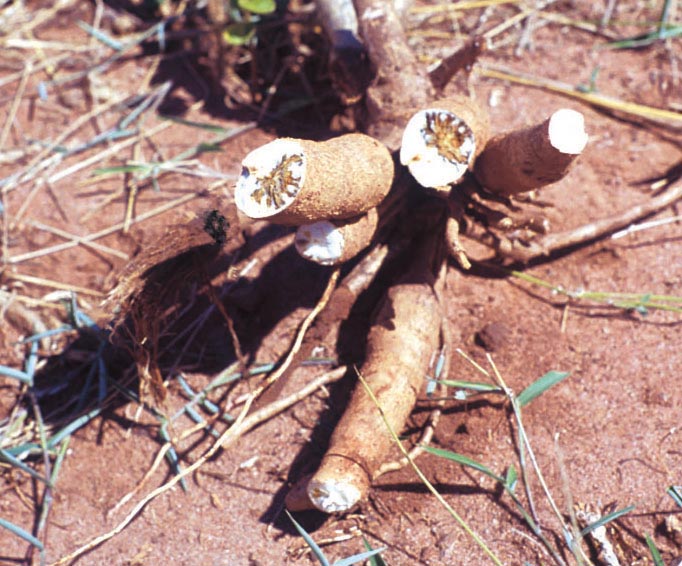
Picture of brown streak disease in cassava.

Brown streak disease in cassava.

A seminar presentation by James Legg, a plant virologist at IITA who is leading the team, shared information about the various activities the team has been conducting to control two devastating diseases of cassava. The seminar was held recently at IITA’s Eastern Africa hub offices, in Dar es Salaam, Tanzania. Cassava is an important food crop in sub-Saharan Africa with the potential to become a commercial crop too. However, two viral diseases, cassava mosaic disease (CMD) and cassava brown streak disease (CBSD), are threatening to wipe off the crop in Eastern and Central Africa. The diseases have been spreading fast causing huge losses to farmers and affecting the food and income of millions of farmers. Africa-wide losses are estimated at US$1 billion annually.

Setting up a commercial clean seed system

The virus diseases are transmitted by whiteflies but get a helping hand from farmers as they share planting materials with each other. There has been little interest from private sector companies to set up a commercial seed system. This creates a challenge on how to supply farmers with top quality disease-free seeds of the best available varieties produced by research. Legg says the team has been piloting a system to supply clean seeds to farmers in Tanzania – the first in the country. [su_quote]“To supply farmers with clean seeds, we need to start with planting materials that are disease-free and multiply them on farms that are isolated from surrounding sources of disease. We also need good, affordable diagnostics for detecting the viruses, and regulations in place for clean seed certification.”[/su_quote] [su_quote]“Working with the National Research System, we have established clean sites in all the major cassava-growing parts of the country. We have selected locations where the disease pressure is very low. We’ve put in place a rigorous system for keeping the plants healthy through regular surveillance and uprooting any plant that shows any symptoms.”[/su_quote] [su_quote]“Although the work started by using varieties that have been ‘in the system’ for some time, in the last couple of years many of the newly released elite varieties have also been introduced, so that currently there are more than 10 varieties in Tanzania’s clean seed system for cassava”, Legg adds.[/su_quote] The team has been working with Tanzania’s national seed certification body, TOSCI, to develop guidelines on acceptable limits for CMD, CBSD, and pests such as mealybug and green mite in the planting materials and for inspection. These guidelines were incorporated into the country’s Seed Act, which represented a major step forward. They are now being used routinely in certification of pre-basic, basic, and certified cassava seed production sites. A major challenge in the certification of cassava seeds is testing for the virus in the plants. The plants do not always show symptoms. This calls for sophisticated testing methods such as real-time PCR. The team has therefore built the capacity of TOSCI for testing the viruses using this technology. But it doesn’t stop there. The team is also exploring novel ways of detecting cassava disease in Tanzania. [su_quote]Q“We are looking at technologies such as digital diagnostics that makes use of photos of leaves taken by smart phones to automatically identify major diseases. This is something farmers will be able to do on their own farms, both quickly and cheaply. Through collaboration with Penn State University working with Google, computers are being trained to recognize symptoms. So far, they have been achieving 90% accuracy for healthy, CMD or CBSD infected leaves,” said Legg.[/su_quote]

Working with the community

The team has also tested how communities can control the viruses. They went to selected villages in Chato and Mkuranga Districts and asked farmers to uproot all their cassava plants and gave them new healthy planting material. This is not easy as farmers always have their cassava crop for food security. The team held many sensitization meetings with the communities, because for it to work, it needed the cooperation of all farmers. [su_quote]“In communities where the disease pressure was high we got the highest cooperation. This is because they were harvesting almost nothing from their fields. Communities practicing phytosanitation were compared to control villages, where only a small number of randomly selected farmers were given new planting material, and where they were not asked to remove infected plants from their fields,” Legg said.[/su_quote] The results were interesting. In year 1–3, disease pressure was very low in the phytosanitation-practicing communities. By year 3 we started seeing symptoms of the disease but this is because farmers again started introducing small amounts of their local varieties. Overall, yields were almost doubled and disease pressure greatly reduced in phytosanitation-practicing communities, while these benefits were not achieved in the control areas. [su_quote]“Is this the best approach to managing CBSD? Yes and no. Although phytosanitation reduced disease and increased yields, the process was expensive and only one new variety was available for each target community. The results did show clearly, however, if healthy material of new varieties is introduced to an area, there is a great benefit if farmers do this together, at the same time as working to reduce the amount of infected cassava material in their neighborhoods.” Legg said.[/su_quote] The team has also been studying the whitefly vector to understand their genetic diversity in the region, the crops they feed on, how they are attracted to cassava and the mechanism for spreading the viruses. Another area the team is looking at is how climate change has affected and will affect the spread of the vectors. Their work supplements the efforts by the IITA breeding team to develop new improved cassava varieties that are tolerant to the two diseases.

Contribué par

Histoires récentes

Aucun article trouvé

Laisser un commentaire

Votre adresse e-mail ne sera pas publiée. Les champs obligatoires sont indiqués avec *

Retour en haut
Olaosebikan, Olamide

Olamide Deborah Nwanze est une chercheuse principale spécialisée dans la recherche sur l'approche "genre" afin d'éclairer les politiques de sélection participative et inclusive, de développement de variétés et de systèmes semenciers concernant les cultures de racines, tubercules et bananes (RTB) au siège de l'Institut International d'Agriculture Tropicale, à Ibadan, au Nigeria. Elle est candidate au doctorat à l'Université d'Ibadan et titulaire d'un master et d'un diplôme d'ingénieur agronome en vulgarisation agricole et développement rural. Olamide est membre du programme African Women in Agricultural Research and Development – Gender Responsive Agricultural Systems Policy (SAISIE DE RÉCOMPENSEet les Chercheuses Sensibles au Genre Équipées pour la Transformation Agricole (SUPER. Elle cherche à appliquer ses apprentissages en matière d’approche genre, recherche sensible au genre, et expertise en développement et examen de politiques pour faciliter l’accès et l’adoption par les femmes, les jeunes, les enfants et les groupes sociaux vulnérables aux innovations agricoles qui garantissent la sécurité alimentaire, nutritionnelle, des revenus et des moyens de subsistance en Afrique. Ses rôles actuels comprennent le mentorat de chercheurs stagiaires, le développement de guides et manuels de formation, la mise en œuvre et l'adaptation de cadres et d'outils genre, l'engagement des acteurs de la chaîne de valeur en tant que partenaires de la science citoyenne, l'examen et la refonte des politiques, la gestion et l'analyse des données. Ses recherches actuelles portent sur les méthodes mixtes ainsi que sur les approches participatives et interdisciplinaires pour saisir et mettre en évidence les dynamiques de genre, les besoins, les préférences et les défis rencontrés par les parties prenantes au sein de la chaîne de valeur des moyens de subsistance agricoles afin de prioriser des stratégies axées sur le genre dans les programmes de sélection, la conception et la mise en œuvre des politiques.

À l'IITA, elle contribue à la mise en œuvre du CGIAR Initiative d'Élevage Accéléré et Innovation génétique Programmes ; recherche participative et genre au sein des Prochaine Génération ManiocHarvestPlusRTBAliments, et Tricot-ClimMob 1000Fermes Projets ; et la communication des connaissances sur le genre via le Série de webinaires G-LENS, vidéo documentaire, notes de politiquepublications, et blogs.


Publications récentes

de Sousa, K., van Etten, J., Manners, R. Bello, A., Teeken, B., Olaosebikan, O., et al. 2024. L'approche tricot : un cadre agile pour les essais décentralisés à la ferme soutenus par la science citoyenne. Une rétrospective. Agron. Sustain. Dev. 44, 8. https://doi.org/10.1007/s13593-023-00937-1

Madu, T., Onwuka, S., Nwafor, S., Onyemauwa, N., Ejechi, M., Ofoeze, M., Ukeje, B., Eluagu, C., Olaosebikan, O., Okoye, B., 2024. Les études sur les consommateurs inclusifs en matière de genre améliorent l'amélioration du manioc au Nigeria dans : Frontiers in Sociology, volume 9, numéro : 1224504, doi : 10.3389/fsoc.2024.1224504

Olaosebikan, O. ; Bello, A. ; Utoblo, O. ; Okoye, B. ; Olutegbe, N. ; Garner, E. ; Teeken, B. ; Bryan, E. ; Forsythe, L. ; Cole, S. ; Madu, T. 2023. Facteurs de stress et résilience au sein de la chaîne de valeur du manioc au Nigeria : Caractéristiques préférées des variétés de manioc et stratégies de réponse des hommes et des femmes pour informer l'amélioration variétale. Sustainability 15, 7837. https://doi.org/10.3390/su15107837

Okoye, B., Ofoeze, M., Ejechi, M., Onwuka, S., Nwafor, S., Onyemauwa, N., Ukeje, B., Eluagu, C., Obidiegwu, J.*, Olaosebikan, O., Madu, T.* 2023. Priorisation des traits préférés dans la chaîne de valeur de l'igname au Nigeria : une analyse de la situation en matière de genre in: Frontiers in Sociology, volume 8, numéro : 1232626, pages 1 – 9, ISSN 2297-7775, 2023. https://www.frontiersin.org/articles/10.3389/fsoc.2023.1232626/full

Olaosebikan, O., Bello, A. A., de Sousa, K., Ndjouenkeu, R., Adesokan, M., Alamu, E. O., Agbona, A., van Etten, J., Kegah, F. N.*, Dufour, D., Bouniol, A., Teeken, B. 2023. Acceptabilité par les consommateurs des produits alimentaires à base de gari-eba de manioc dans des contextes culturels et environnementaux variés en utilisant l'approche triade de comparaison des technologies (tricot) dans : Journal of the Science of Food and Agriculture,

Teeken, B., Olaosebikan, O., Bello, A. A., Madu, T.*, Cole, S. M. 2023. Évaluation qualitative de la positionnalité et des préférences des dyades en relation avec les activités liées au manioc : travailler avec des scientifiques citoyens du procès tricot https://hdl.handle.net/10568/138326 Type : Manuel

Bouniol, A., Ceballos, H., Bello, A. A., Teeken, B., Olaosebikan, O., Owoade, D., Agbona, A., Fotso Kuate, A., Madu, T.*, Okoye, B.*, Ofoeze, M.*, Nwafor, S.*, Onyemauwa, N.*, Adinsi, L.*, Forsythe, L., Dufour, D. 2023. Impact variétal sur le travail des femmes, la charge de travail et la pénibilité associée dans le traitement des plantes à racines, tubercules et bananes : focus sur le manioc en Afrique subsaharienne dans : Journal of the Science of Food and Agriculture, pages 1 – 25, ISSN 0022-5142,

Bello, A. A., Agbona, A., Olaosebikan, O., Edughaen, G., Dufour, D., Bouniol, A., Iluebbey, P., Ndjouenkeu, R.*, Rabbi, I. Y., Teeken, B. 2023. Effets génétiques et environnementaux sur la productivité de la transformation et le rendement des produits alimentaires : la pénibilité du travail des femmes dans : Journal of the Science of Food and Agriculture, pages 1 – 32, ISSN 0022-5142, 5

Cavicchioli, M., Zimbiti, T., Teeken, B., Nwanze, D.O., Liani, M., Parkes, E. & Bello, A. 2023. Rapport sur la formation en sélection génétique sensible au genre à l'IITA. Genetic Resources Center, IITA-HQ, Ibadan, 21-23 septembre 2022. Ibadan, Nigéria : IITA, (34 p.).https://hdl.handle.net/10568/131368

Agbona, A. Peteti P., Teeken B., Olaosebikan O. Bello, A. A., Parkes, E., Rabbi, I. Y., Mueller, L., Egesi, C., Kulakow, P. 2022. Gestion des données dans les programmes d'amélioration des cultures RTB africaines multidisciplinaires. In : Williamson, H.F., Leonelli, S. (eds) Towards Responsible Plant Data Linkage: Data Challenges for Agricultural Research and Development. Springer, Cham. https://doi.org/10.1007/978-3-031-13276-6_5

Lora Forsythe, Pricilla Marimo, Sarah Mayanja, Olamide D. Olaosebikan, Esme Stuart, Bela Teeken, Benjamin Okoye, Tessy Madu, (2021). Analyse transversale du genre dans RTBfoods Étape 2 Cartographie des genres sur les produits RTB. Comprendre les moteurs des préférences en matière de traits et le développement de profils de produits RTB multi-utilisateurs, WP1. Londres, Royaume-Uni : Rapport scientifique de terrain RTBfoods, 30 p.

Teeken, B., Garner, E., Agbona, A., Balogun, I., Olaosebikan, O., Bello, A., Madu, T., Okoye, B., Egesi, C., Kulakow, P. et Tufan, H.A. 2021. Au-delà des “ traits des femmes ” : explorer comment le genre, les différences sociales et les caractéristiques des ménages influencent les préférences pour les traits. Frontiers Systèmes alimentaires durables 5:740926. https://doi.org/10.3389/fsufs.2021.740926

Teeken, B., Agbona, A., Bello, A., Olaosebikan, O., Alamu, E., Adesokan, M., Awoyale, W., Madu, T., Okoye, B., Chijioke, U., Owoade, D., Okoro, M., Bouniol, A., Dufour, D., Hershey, C., Rabbi, I., Maziya‐Dixon, B., Egesi, C., Tufan, H. et Kulakow, P. (020. Comprendre les préférences variétales du manioc par le classement par paires du gari-eba et du fufu préparés par des agriculteurs-transformateurs locaux. Int J Food Sci Technol. https://doi.org/10.1111/ijfs.14862

Bela Teeken, Olamide Olaosebikan, Ireti Balogun, Benjamin Okoye, Tessy Madu, Steven Cole, Abolore Bello, Elizabeth Parkes. (2020). Pilotage des outils de profil client et produit G+ pour l'amélioration sensible au genre du manioc au Nigeria. Nigeria : Institut international d'agriculture tropicale (IIAT). https://hdl.handle.net/20.500.11766/13000