
The world has been dealing with the effects of the COVID-19 pandemic, climate change such as irregular weather patterns, heat waves, droughts and floods, and international conflicts. These crises have caused reduced agricultural productivity, impacting global food security and nutrition.
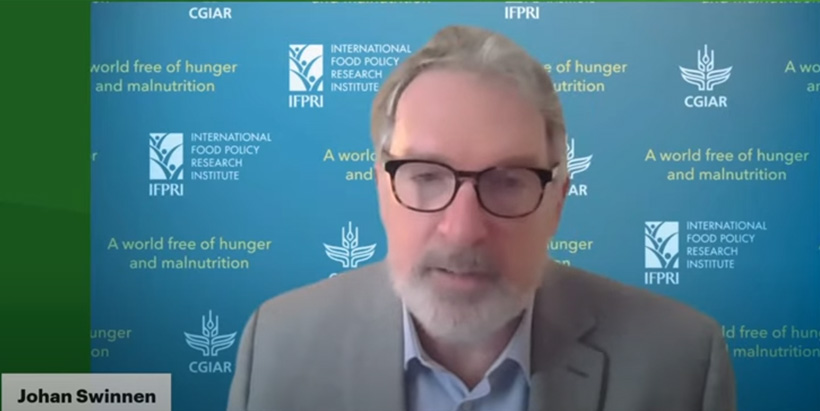
A policy seminar co-organized by CGIAR, Institut international de recherche sur les politiques alimentaires (IFPRI), et Germany’s Federal Ministry for Economic Cooperation and Development (BMZ) on 1 September highlighted potential solutions to achieve more resilient agriculture, food systems, and effective crisis response across the globe. IFPRI Director of Communications and Public Affairs Charlotte Hebebrand moderated the session.
IFPRI Director General and CGIAR Managing Director Systems Transformation Science Group Johan Swinnen appreciated the German government’s active involvement in food system transformation and support to CGIAR. He highlighted the high volatility in the food market in the last twenty-five years, which has created many challenges for policymakers.
BMZ Director General of Global Health, Employment, Transformation of the Economy, Digital Technologies, Food and Nutrition Security, Dirk Meryer, spoke on Crisis Response and Resilience-Building: Priority Actions of the German Government. He stated that “building resilient agricultural and food systems is the way forward.”

Therefore, to address the underlying food crisis and structural changes and challenges in the agricultural system, there is a need to support African and Asian countries in combating the causes of malnutrition in women, particularly in healthy food production, processing, and storage.
IFPRI Senior Research Fellow and Co-lead of CGIAR Research Initiative on Fragility, Conflict, and Migration, Katrina Kosec, expounded on the need to call for resilience building and crisis response. Her presentation highlighted major approaches to building resilience, including effective governance, creating effective food systems, supporting and empowering the most vulnerable, and sufficient and flexible funding.
“Understanding these approaches would help stakeholders rethink and strengthen the way forward to build resilience and respond to crises across the globe,” she stated.
During a presentation, IITA Director General and Regional Director for Continental Africa, Simeon Ehui, said CGIAR is utilizing research to achieve zero hunger by 2030. He stressed that science and innovation must be accelerated through partnerships with development organizations to fight the food crisis. He added that promoting stronger ties between CGIAR researchers and African food producers, policymakers, private sector leaders, community champions, media, and other stakeholders is crucial to transforming African agriculture.
Ehui also provided an overview of how strengthening market functionality, diversifying assets, and reforming public policy will help Africa create resilience.
Wrapping up the discussion, Harvest Plus Director of Alliances and Policy, Innovation Policy and Scaling, Lynn Brown, stressed the significance of giving women leverage to achieve a resilient agricultural food system. World Bank Global Director for Agriculture and Food Global Practice, Martin Van Nieuwkoop, stated that incentives and global public support should be provided for the agricultural sector, and public-private compact should be made available in every country.
Contribué par Anita AkinyomadeContribué par
Histoires récentes