
NOUVELLES DE L'IITA

Scientists to detail progress and challenges regarding global cassava threats at meetings in Nigeria
mars 9, 2017

Gathering in Ibadan, cassava experts will report progress on efforts to shorten the cassava breeding cycle, enhance flowering and seed set, educate and train African plant breeders, and implement gender-responsive variety selection

IBADAN, NIGERIA: The world’s top cassava experts will gather in Nigeria to report progress on developing new varieties of cassava with higher yield and nutritional content. The meeting will take place on March 14-16, at the International Institute of Tropical Agriculture (IITA), in Ibadan.
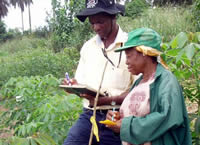
Picture of Field scientist  and woman farmer in the field
Field scientist and woman farmer in the field

“Africa produces more than half of the world’s cassava — about 86 million tons from over 10 million hectares,” said Chiedozie Egesi, IITA-based project manager of the Next Generation Cassava Breeding (NextGen Cassava) project, who also works to biofortify cassava with essential micronutrients. “But disease pathogens and climate change threaten cassava production and jeopardize the income and food security of smallholder farmers. Since 2012, scientists on the NextGen Cassava project have been working to significantly increase the rate of genetic improvement in cassava breeding and unlock cassava’s full potential.”

Cassava is a clonally propagated crop and seed set is difficult. New varieties with enhanced productivity and nutritional traits typically take up to 10 years to develop.

Scientists on the NextGen project are focused on giving breeders in Africa access to the most advanced plant breeding technologies to deliver improved varieties to farmers more rapidly.

“Partners of NextGen Cassava are using a state-of-the-art plant breeding approach known as genomic selection to improve cassava productivity for the 21st century,” said Ronnie Coffman, Cornell professor of plant breeding and genetics, director of International Programs, who is the principal investigator on the multi-partner grant.

Genomic selection shortens breeding cycles, provides more accurate evaluation at the seedling stage, and gives plant breeders the ability to evaluate a much larger number of clones without the need to plant them in the target environment. Using genomic selection, new releases of cassava are ready in as little as six years.

“The best clones from NextGen Cassava genomic selection efforts are in Uniform Yield Trials this year and are due to be released to farmers in the next two years,” said Egesi.

Cassava is predicted to be one of the few crops that will benefit from climate change because it requires few inputs and can withst and drought, marginal soils and long-term underground storage. A cash and subsistence crop, the storage roots of this perennial woody shrub are processed, consumed freshly boiled or raw, and eaten by people as well as animals as a low-cost source of carbohydrates. No other continent depends on cassava to feed as many people as does Africa, where 500 million people consume it daily. “The purpose of NextGen Cassava project is to improve the cassava breeding process making it faster and more efficient to produce the varieties farmers need,” said Peter Kulakow, cassava breeder at IITA, Ibadan.

In 2012, the Bill & Melinda Gates Foundation and the Department for International Development of the United Kingdom (DFID) under its UK Aid program invested $25.2M to improve the staple crop’s productivity and build human and technical capacity for plant breeding in sub-Saharan Africa.

The five-year project, led by Cornell University, works with 10 institutional partners across six countries on three continents: Boyce Thompson Institute (BTI/USA), Embrapa (Brazil), International Center for Tropical Agriculture (CIAT/Colombia), International Institute of Tropical Agriculture (IITA/Nigeria), National Crops Resources Research Institute (NaCRRI/Ug anda), National Root Crops Research Institute (NRCRI/Nigeria), University of Hawaii (USA), U.S. Department of Agriculture-Agricultural Research Service, and U.S. Department of Energy Joint Genome Institute. Most recently, NextGen Cassava has exp anded to include Tanzania, partnering with the Lake Zone Agricultural Research and Development Institute (LZARDI).

The partners share cassava data, expertise, and information on a publicly available website (www.cassavabase.org ).

In addition to reporting on the latest genomic information from cassava sequencing to improve productivity and yield, project partners will discuss progress on incorporating cassava germplasm diversity from South America into African breeding programs, training the next generation of plant breeders, and improving infrastructure at African institutions.

Pour plus d'informations, voir www.nextgencassava.org

Follow live: #NGcassava17 | @NEXTGENCassava


Contribué par

Histoires récentes

Aucun article trouvé

Laisser un commentaire

Votre adresse e-mail ne sera pas publiée. Les champs obligatoires sont indiqués avec *

Retour en haut
Olaosebikan, Olamide

Olamide Deborah Nwanze est une chercheuse principale spécialisée dans la recherche sur l'approche "genre" afin d'éclairer les politiques de sélection participative et inclusive, de développement de variétés et de systèmes semenciers concernant les cultures de racines, tubercules et bananes (RTB) au siège de l'Institut International d'Agriculture Tropicale, à Ibadan, au Nigeria. Elle est candidate au doctorat à l'Université d'Ibadan et titulaire d'un master et d'un diplôme d'ingénieur agronome en vulgarisation agricole et développement rural. Olamide est membre du programme African Women in Agricultural Research and Development – Gender Responsive Agricultural Systems Policy (SAISIE DE RÉCOMPENSEet les Chercheuses Sensibles au Genre Équipées pour la Transformation Agricole (SUPER. Elle cherche à appliquer ses apprentissages en matière d’approche genre, recherche sensible au genre, et expertise en développement et examen de politiques pour faciliter l’accès et l’adoption par les femmes, les jeunes, les enfants et les groupes sociaux vulnérables aux innovations agricoles qui garantissent la sécurité alimentaire, nutritionnelle, des revenus et des moyens de subsistance en Afrique. Ses rôles actuels comprennent le mentorat de chercheurs stagiaires, le développement de guides et manuels de formation, la mise en œuvre et l'adaptation de cadres et d'outils genre, l'engagement des acteurs de la chaîne de valeur en tant que partenaires de la science citoyenne, l'examen et la refonte des politiques, la gestion et l'analyse des données. Ses recherches actuelles portent sur les méthodes mixtes ainsi que sur les approches participatives et interdisciplinaires pour saisir et mettre en évidence les dynamiques de genre, les besoins, les préférences et les défis rencontrés par les parties prenantes au sein de la chaîne de valeur des moyens de subsistance agricoles afin de prioriser des stratégies axées sur le genre dans les programmes de sélection, la conception et la mise en œuvre des politiques.

À l'IITA, elle contribue à la mise en œuvre du CGIAR Initiative d'Élevage Accéléré et Innovation génétique Programmes ; recherche participative et genre au sein des Prochaine Génération ManiocHarvestPlusRTBAliments, et Tricot-ClimMob 1000Fermes Projets ; et la communication des connaissances sur le genre via le Série de webinaires G-LENS, vidéo documentaire, notes de politiquepublications, et blogs.


Publications récentes

de Sousa, K., van Etten, J., Manners, R. Bello, A., Teeken, B., Olaosebikan, O., et al. 2024. L'approche tricot : un cadre agile pour les essais décentralisés à la ferme soutenus par la science citoyenne. Une rétrospective. Agron. Sustain. Dev. 44, 8. https://doi.org/10.1007/s13593-023-00937-1

Madu, T., Onwuka, S., Nwafor, S., Onyemauwa, N., Ejechi, M., Ofoeze, M., Ukeje, B., Eluagu, C., Olaosebikan, O., Okoye, B., 2024. Les études sur les consommateurs inclusifs en matière de genre améliorent l'amélioration du manioc au Nigeria dans : Frontiers in Sociology, volume 9, numéro : 1224504, doi : 10.3389/fsoc.2024.1224504

Olaosebikan, O. ; Bello, A. ; Utoblo, O. ; Okoye, B. ; Olutegbe, N. ; Garner, E. ; Teeken, B. ; Bryan, E. ; Forsythe, L. ; Cole, S. ; Madu, T. 2023. Facteurs de stress et résilience au sein de la chaîne de valeur du manioc au Nigeria : Caractéristiques préférées des variétés de manioc et stratégies de réponse des hommes et des femmes pour informer l'amélioration variétale. Sustainability 15, 7837. https://doi.org/10.3390/su15107837

Okoye, B., Ofoeze, M., Ejechi, M., Onwuka, S., Nwafor, S., Onyemauwa, N., Ukeje, B., Eluagu, C., Obidiegwu, J.*, Olaosebikan, O., Madu, T.* 2023. Priorisation des traits préférés dans la chaîne de valeur de l'igname au Nigeria : une analyse de la situation en matière de genre in: Frontiers in Sociology, volume 8, numéro : 1232626, pages 1 – 9, ISSN 2297-7775, 2023. https://www.frontiersin.org/articles/10.3389/fsoc.2023.1232626/full

Olaosebikan, O., Bello, A. A., de Sousa, K., Ndjouenkeu, R., Adesokan, M., Alamu, E. O., Agbona, A., van Etten, J., Kegah, F. N.*, Dufour, D., Bouniol, A., Teeken, B. 2023. Acceptabilité par les consommateurs des produits alimentaires à base de gari-eba de manioc dans des contextes culturels et environnementaux variés en utilisant l'approche triade de comparaison des technologies (tricot) dans : Journal of the Science of Food and Agriculture,

Teeken, B., Olaosebikan, O., Bello, A. A., Madu, T.*, Cole, S. M. 2023. Évaluation qualitative de la positionnalité et des préférences des dyades en relation avec les activités liées au manioc : travailler avec des scientifiques citoyens du procès tricot https://hdl.handle.net/10568/138326 Type : Manuel

Bouniol, A., Ceballos, H., Bello, A. A., Teeken, B., Olaosebikan, O., Owoade, D., Agbona, A., Fotso Kuate, A., Madu, T.*, Okoye, B.*, Ofoeze, M.*, Nwafor, S.*, Onyemauwa, N.*, Adinsi, L.*, Forsythe, L., Dufour, D. 2023. Impact variétal sur le travail des femmes, la charge de travail et la pénibilité associée dans le traitement des plantes à racines, tubercules et bananes : focus sur le manioc en Afrique subsaharienne dans : Journal of the Science of Food and Agriculture, pages 1 – 25, ISSN 0022-5142,

Bello, A. A., Agbona, A., Olaosebikan, O., Edughaen, G., Dufour, D., Bouniol, A., Iluebbey, P., Ndjouenkeu, R.*, Rabbi, I. Y., Teeken, B. 2023. Effets génétiques et environnementaux sur la productivité de la transformation et le rendement des produits alimentaires : la pénibilité du travail des femmes dans : Journal of the Science of Food and Agriculture, pages 1 – 32, ISSN 0022-5142, 5

Cavicchioli, M., Zimbiti, T., Teeken, B., Nwanze, D.O., Liani, M., Parkes, E. & Bello, A. 2023. Rapport sur la formation en sélection génétique sensible au genre à l'IITA. Genetic Resources Center, IITA-HQ, Ibadan, 21-23 septembre 2022. Ibadan, Nigéria : IITA, (34 p.).https://hdl.handle.net/10568/131368

Agbona, A. Peteti P., Teeken B., Olaosebikan O. Bello, A. A., Parkes, E., Rabbi, I. Y., Mueller, L., Egesi, C., Kulakow, P. 2022. Gestion des données dans les programmes d'amélioration des cultures RTB africaines multidisciplinaires. In : Williamson, H.F., Leonelli, S. (eds) Towards Responsible Plant Data Linkage: Data Challenges for Agricultural Research and Development. Springer, Cham. https://doi.org/10.1007/978-3-031-13276-6_5

Lora Forsythe, Pricilla Marimo, Sarah Mayanja, Olamide D. Olaosebikan, Esme Stuart, Bela Teeken, Benjamin Okoye, Tessy Madu, (2021). Analyse transversale du genre dans RTBfoods Étape 2 Cartographie des genres sur les produits RTB. Comprendre les moteurs des préférences en matière de traits et le développement de profils de produits RTB multi-utilisateurs, WP1. Londres, Royaume-Uni : Rapport scientifique de terrain RTBfoods, 30 p.

Teeken, B., Garner, E., Agbona, A., Balogun, I., Olaosebikan, O., Bello, A., Madu, T., Okoye, B., Egesi, C., Kulakow, P. et Tufan, H.A. 2021. Au-delà des “ traits des femmes ” : explorer comment le genre, les différences sociales et les caractéristiques des ménages influencent les préférences pour les traits. Frontiers Systèmes alimentaires durables 5:740926. https://doi.org/10.3389/fsufs.2021.740926

Teeken, B., Agbona, A., Bello, A., Olaosebikan, O., Alamu, E., Adesokan, M., Awoyale, W., Madu, T., Okoye, B., Chijioke, U., Owoade, D., Okoro, M., Bouniol, A., Dufour, D., Hershey, C., Rabbi, I., Maziya‐Dixon, B., Egesi, C., Tufan, H. et Kulakow, P. (020. Comprendre les préférences variétales du manioc par le classement par paires du gari-eba et du fufu préparés par des agriculteurs-transformateurs locaux. Int J Food Sci Technol. https://doi.org/10.1111/ijfs.14862

Bela Teeken, Olamide Olaosebikan, Ireti Balogun, Benjamin Okoye, Tessy Madu, Steven Cole, Abolore Bello, Elizabeth Parkes. (2020). Pilotage des outils de profil client et produit G+ pour l'amélioration sensible au genre du manioc au Nigeria. Nigeria : Institut international d'agriculture tropicale (IIAT). https://hdl.handle.net/20.500.11766/13000