
Stakeholders strategize to harmonize and strengthen ME&L system
juin 9, 2018
In line with the key messages conveyed by the CGIAR Platform for Big Data in Agriculture during the BigDatainAg Convention 2017, stakeholders across four CGIAR centers working under the CGIAR Research Program on Roots, Tubers and Bananas (RTB), convened at IITA Headquarters, on 22–25 May, to promote harmonization, standardization, and interoperability of systems, more than looking for a “one-size-fits-all” solution. Thus, in this context, defining harmonized result and indicator frameworks, as well as sharing approaches and tools for Monitoring, Evaluation & Learning (ME&L) is essential for the overall viability and soundness of the system.
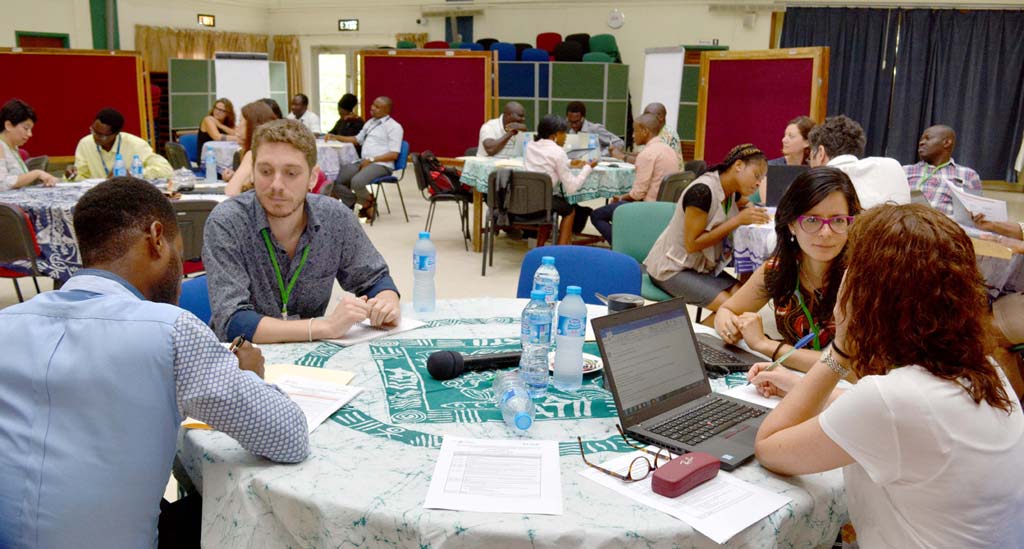 The 4-day event, organized by RTB and strongly supported by the Centre international de la pomme de terre (CIP) and IITA, was attended by M&E specialists, managers, management staff with M&E responsibilities, and M&E officers from the Centre international d'agriculture tropicale (CIAT), Centre international de la pomme de terre (CIP), Bioversity International, Agricultural Research Center for International Development (CIRAD) and IITA with backstopping from ALINE (Agricultural Learning and Impacts Network). Amid creating opportunities for learning and knowledge sharing, the meeting aimed to foster synchronization and strengthening of the existing ME&L systems at the center and CRP levels, and draw a roadmap and workplan for the rollout of the harmonized MEL system with roles and responsibilities defined.
In her remarks, Rosern Rwampororo, Head of IITA’s Monitoring and Evaluation Unit, applauded the participants for their efforts to strengthen communication and collaboration among ME&L personnel within and across centers for the successful implementation of center and CRP-level M&E systems. “The harmonization process is crucial for ensuring that data and findings can be meaningfully aggregated from the bottom (i.e., project, country-specific data) to the Center, CRP, and System levels,” she added.
The integrated framework will build on and articulate efforts made by several entities (projects, centers, partners, CRPs) to generate and consolidate relevant information such as ex-ante appraisal, continuous monitoring and evaluation of findings, and impact assessment data into a system that optimally serves the management needs of CGIAR and its partners. Some of the indicators, recently approved by the System Council as part of the common CGIAR progress reporting indicators, include number of innovations, gender equality, youth, number of agribusinesses, partnerships, training/workshops, and number of new innovations. This was of particular interest in defining common standards and practices.
During the plenary session, topical presentations made by stakeholders on diverse fields cut across the various M&E pipelines, ranging from system level perspectives on results reporting and performance-based management, harmonizing indicators and aggregation in complex ME&L systems, the ME&L system in the RTB community, aligning currently collected indicators with the common indicators and SRF targets, visualizing indicators, and evaluating challenges in a funding scenario.
[su_quote]Reacting to the progress achieved, Richard Ofei, RTB – Project Management Officer (PMO) for IITA, stated, “Strengthening the M&E system is the best way to show the evidence of what we have done. Therefore, there is a need to synergize efforts to ensure that all that has been said in this workshop is implemented immediately for better impact.”[/su_quote]
The 4-day event, organized by RTB and strongly supported by the Centre international de la pomme de terre (CIP) and IITA, was attended by M&E specialists, managers, management staff with M&E responsibilities, and M&E officers from the Centre international d'agriculture tropicale (CIAT), Centre international de la pomme de terre (CIP), Bioversity International, Agricultural Research Center for International Development (CIRAD) and IITA with backstopping from ALINE (Agricultural Learning and Impacts Network). Amid creating opportunities for learning and knowledge sharing, the meeting aimed to foster synchronization and strengthening of the existing ME&L systems at the center and CRP levels, and draw a roadmap and workplan for the rollout of the harmonized MEL system with roles and responsibilities defined.
In her remarks, Rosern Rwampororo, Head of IITA’s Monitoring and Evaluation Unit, applauded the participants for their efforts to strengthen communication and collaboration among ME&L personnel within and across centers for the successful implementation of center and CRP-level M&E systems. “The harmonization process is crucial for ensuring that data and findings can be meaningfully aggregated from the bottom (i.e., project, country-specific data) to the Center, CRP, and System levels,” she added.
The integrated framework will build on and articulate efforts made by several entities (projects, centers, partners, CRPs) to generate and consolidate relevant information such as ex-ante appraisal, continuous monitoring and evaluation of findings, and impact assessment data into a system that optimally serves the management needs of CGIAR and its partners. Some of the indicators, recently approved by the System Council as part of the common CGIAR progress reporting indicators, include number of innovations, gender equality, youth, number of agribusinesses, partnerships, training/workshops, and number of new innovations. This was of particular interest in defining common standards and practices.
During the plenary session, topical presentations made by stakeholders on diverse fields cut across the various M&E pipelines, ranging from system level perspectives on results reporting and performance-based management, harmonizing indicators and aggregation in complex ME&L systems, the ME&L system in the RTB community, aligning currently collected indicators with the common indicators and SRF targets, visualizing indicators, and evaluating challenges in a funding scenario.
[su_quote]Reacting to the progress achieved, Richard Ofei, RTB – Project Management Officer (PMO) for IITA, stated, “Strengthening the M&E system is the best way to show the evidence of what we have done. Therefore, there is a need to synergize efforts to ensure that all that has been said in this workshop is implemented immediately for better impact.”[/su_quote]
 The implementation of this integrated framework occurs in a context where projects, centers, and CRPs are already implementing their own management strategies and associated M&E systems. To be efficient, the integrated framework will need to build on the existing structures and processes, and facilitate the exchange and aggregation, across levels and entities, of data and information that will be useful for decision making, learning, and accountability.
Round table discussion of the participants based on their area of indicator interest
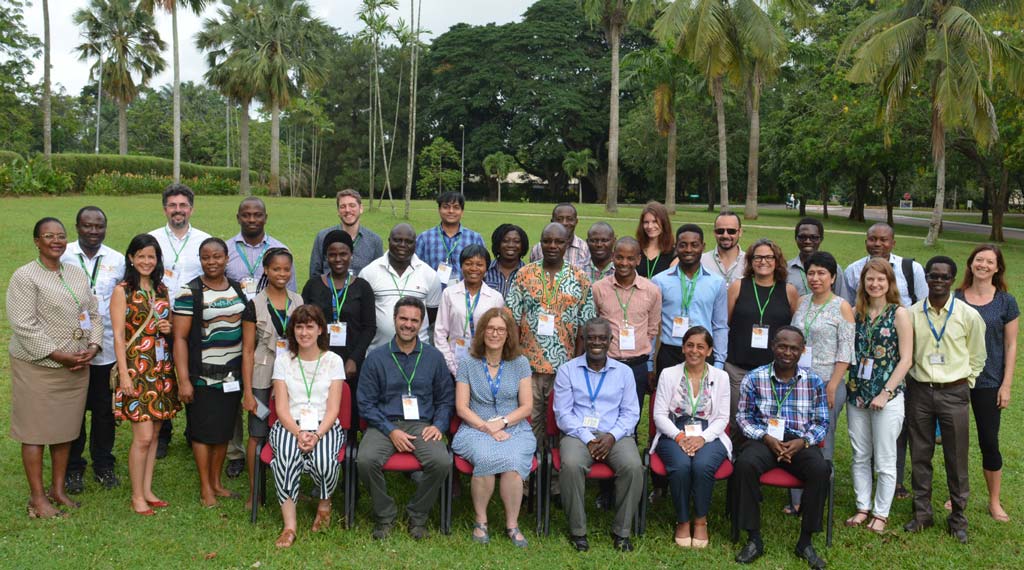
Group photograph of the workshop participants at IITA Ibadan
Contribué par
Histoires récentes
Aucun article trouvé