Renforcement du réseau de développement et d'évaluation des variétés de soja : L'IITA organise une formation collaborative pour les obtenteurs d'Afrique de l'Ouest
8 juillet 2024
Le programme Soja de l'IITA a organisé une session de formation pour les partenaires des Systèmes nationaux de recherche agricole (SNRA) en Afrique de l'Ouest dans le cadre du projet ‘ Renforcement de l'amélioration du soja pour l'Afrique ’. Ce projet, financé par la Fondation Bill & Melinda Gates, vise à renforcer le partenariat entre le CGIAR et les SNRA concernant les efforts de développement et d'évaluation des variétés. La formation inaugurale, qui s'est déroulée au siège de l'IITA du 19 au 22 juin, avait pour objectif d'harmoniser et de standardiser le développement des variétés de soja, l'évaluation, les protocoles d'essais, ainsi que les techniques de collecte et de gestion des données parmi IITA–CGIAR et les partenaires de NARS.
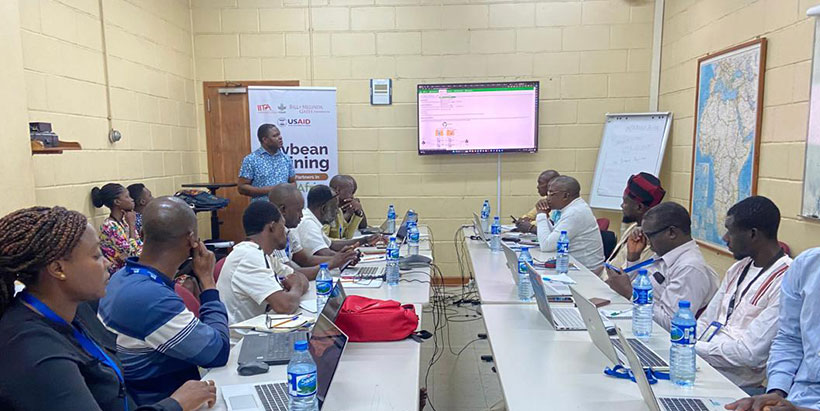
Les participants écoutent un animateur pendant l'atelier.
Le sélectionneur de soja de l'IITA et organisateur de l'événement, Abush Abebe, a souligné que la réunion n'était pas seulement une session de formation, mais une plateforme pour partager des expériences et créer une compréhension commune entre les sélectionneurs représentant les divers partenaires des SNAR, c'est-à-dire les programmes nationaux de sélection du soja du Bénin, du Mali et du Nigéria, et des universités nigérianes (l'Université Ajayi Crowther, l'Université d'Ilorin, l'Université Joseph Sarwuan Tarka (JoSTUM) (anciennement l'Université fédérale d'agriculture) de Makurdi, et l'Université d'Ekiti) sur divers domaines de collaboration avec les partenaires des SNAR. Il a insisté sur l'importance de renforcer les partenariats et de développer un protocole standardisé de test et d'évaluation des variétés afin d'accroître l'efficacité et d'améliorer la sélection et la recherche sur le soja. “ De mauvaises données induisent les utilisateurs finaux en erreur, mais de bonnes données équivalent à de bonnes décisions ”, a-t-il déclaré, soulignant le rôle crucial de données de haute qualité.
Dans son allocution d'ouverture, le directeur général adjoint de l'IITA, chargé des partenariats pour la mise en œuvre (DDG-P4D), Kenton Dashiell, un sélectionneur de soja à l'IITA de 1983 à 2001, a exprimé son enthousiasme lors de la réunion. Il a encouragé le réseau à élargir son programme de sélection et à constituer une équipe solide pour atteindre ses objectifs plus efficacement. “ Le succès de ce programme repose sur le travail que vous effectuez dans vos stations, c'est pourquoi cet atelier est important ”, a-t-il déclaré.
Le responsable du programme de sélection du soja de l'IITA, Godfree Chigeza, a souligné l'importance du partenariat CGIAR-NARS et du réseau africain d'amélioration du soja. Il a exposé les objectifs, le cadre, les attentes et les exigences de partenariat du réseau, en insistant sur le passage de la sélection variétale participative à la sélection participative, où la définition conjointe des priorités et la prise de décision commune sont essentielles.
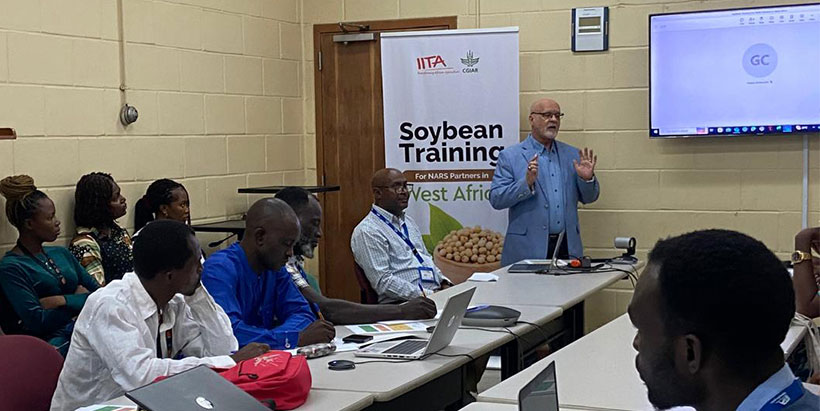
Le Dr Kenton Dashiell, directeur général adjoint des partenariats pour la livraison de l'IITA, lors des allocutions d'ouverture du premier jour de l'atelier.
Le responsable de la sélection végétale de l'IITA, Mushoriwa Hapson, a souligné le passage du renforcement des capacités au partage des capacités, en se concentrant sur l'échange d'idées et d'informations. Il a indiqué que cette formation devrait renforcer la collaboration du réseau pour obtenir de meilleurs résultats et amplifier l'impact. Le programme de recherche sur le soja de l'IITA vise à mettre en place un système semencier inclusif afin de produire des semences en quantité suffisante et de fournir des variétés de soja à haut rendement, préférées par les agriculteurs et le marché. “ J'espère que le programme de sélection du soja, avec vous, co-développera, co-mettra en œuvre et co-réalisera les meilleurs résultats en matière de sélection du soja ”, a-t-il déclaré.
Abebe a présenté un aperçu de la recherche sur le soja en Afrique de l'Ouest, retraçant l'historique du programme d'amélioration du soja de l'IITA qui a débuté en 1974. Il a souligné que les défis initiaux tels que les faibles rendements, la piètre viabilité des semences, la mauvaise nodulation avec les Rhizobium natifs, l'égrenage élevé dans différentes zones et l'utilisation limitée en raison du peu de recettes adaptées pour les petits agriculteurs ont été les principaux moteurs de la création du programme d'amélioration du soja de l'IITA. Il a insisté sur la nécessité d'une stratégie visant à remplacer régulièrement les variétés pour garantir une plus grande productivité, réduire l'impact des maladies et des ravageurs émergents, répondre à l'évolution des préférences des consommateurs et du marché, et augmenter les taux d'adoption. Les facteurs qui stimulent la demande de nouvelles variétés comprennent l'amélioration du potentiel de rendement, de la qualité et de la précocité, ainsi que l'atténuation du changement climatique.
Soulignant certaines des principales raisons de déployer des efforts énergiques pour développer de nouvelles variétés en Afrique de l'Ouest, Abebe a mentionné les rendements de soja très faibles dans de nombreux pays d'Afrique subsaharienne, l'expansion de la production de soja sur le continent qui exige un plus grand nombre de nouvelles variétés, l'intérêt croissant pour la recherche sur le soja en vue de sa livraison, la demande accrue de produits à base de soja tels que l'huile et tourteau de soja, les programmes nationaux de sélection limités qui ont entraîné des réseaux faibles d'essai et d'enregistrement des variétés, et la lenteur du remplacement des anciennes variétés par des variétés nouvelles et à haut rendement.
Ibnou Dieng, un biométricien de l'IITA, a discuté de la nécessité de garantir la qualité et l'intégrité des données, des implications de données de mauvaise qualité et des moyens de minimiser les erreurs expérimentales. Il a également fourni une démonstration pratique de l'analyse de l'amélioration génétique en utilisant l'application d'intelligence de marché du CGIAR. Dean Muungani, gestionnaire de produits pour les cultures céréalières à l'IITA, a guidé les participants à travers les tests à la ferme tricot pour le soja, l'évaluation du programme d'amélioration et l'estimation des coûts. Les participants ont également visité les installations du programme d'amélioration du soja de l'IITA et ont mené des démonstrations pratiques sur le terrain concernant la disposition des essais, la plantation et les croisements.
À la fin de la formation, des outils numériques tels que des tablettes ont été fournis aux participants pour une saisie efficace des données électroniques. Abebe a souligné que des plans sont en place pour fournir davantage d'outils afin d'aider à standardiser les techniques de collecte de données et de garantir la qualité des données.
Olamide Deborah Nwanze est une chercheuse principale spécialisée dans la recherche sur l'approche "genre" afin d'éclairer les politiques de sélection participative et inclusive, de développement de variétés et de systèmes semenciers concernant les cultures de racines, tubercules et bananes (RTB) au siège de l'Institut International d'Agriculture Tropicale, à Ibadan, au Nigeria. Elle est candidate au doctorat à l'Université d'Ibadan et titulaire d'un master et d'un diplôme d'ingénieur agronome en vulgarisation agricole et développement rural. Olamide est membre du programme African Women in Agricultural Research and Development – Gender Responsive Agricultural Systems Policy (SAISIE DE RÉCOMPENSEet les Chercheuses Sensibles au Genre Équipées pour la Transformation Agricole (SUPER. Elle cherche à appliquer ses apprentissages en matière d’approche genre, recherche sensible au genre, et expertise en développement et examen de politiques pour faciliter l’accès et l’adoption par les femmes, les jeunes, les enfants et les groupes sociaux vulnérables aux innovations agricoles qui garantissent la sécurité alimentaire, nutritionnelle, des revenus et des moyens de subsistance en Afrique. Ses rôles actuels comprennent le mentorat de chercheurs stagiaires, le développement de guides et manuels de formation, la mise en œuvre et l'adaptation de cadres et d'outils genre, l'engagement des acteurs de la chaîne de valeur en tant que partenaires de la science citoyenne, l'examen et la refonte des politiques, la gestion et l'analyse des données. Ses recherches actuelles portent sur les méthodes mixtes ainsi que sur les approches participatives et interdisciplinaires pour saisir et mettre en évidence les dynamiques de genre, les besoins, les préférences et les défis rencontrés par les parties prenantes au sein de la chaîne de valeur des moyens de subsistance agricoles afin de prioriser des stratégies axées sur le genre dans les programmes de sélection, la conception et la mise en œuvre des politiques.
de Sousa, K., van Etten, J., Manners, R. Bello, A., Teeken, B., Olaosebikan, O., et al. 2024. L'approche tricot : un cadre agile pour les essais décentralisés à la ferme soutenus par la science citoyenne. Une rétrospective. Agron. Sustain. Dev. 44, 8. https://doi.org/10.1007/s13593-023-00937-1
Madu, T., Onwuka, S., Nwafor, S., Onyemauwa, N., Ejechi, M., Ofoeze, M., Ukeje, B., Eluagu, C., Olaosebikan, O., Okoye, B., 2024. Les études sur les consommateurs inclusifs en matière de genre améliorent l'amélioration du manioc au Nigeria dans : Frontiers in Sociology, volume 9, numéro : 1224504, doi : 10.3389/fsoc.2024.1224504
Olaosebikan, O. ; Bello, A. ; Utoblo, O. ; Okoye, B. ; Olutegbe, N. ; Garner, E. ; Teeken, B. ; Bryan, E. ; Forsythe, L. ; Cole, S. ; Madu, T. 2023. Facteurs de stress et résilience au sein de la chaîne de valeur du manioc au Nigeria : Caractéristiques préférées des variétés de manioc et stratégies de réponse des hommes et des femmes pour informer l'amélioration variétale. Sustainability 15, 7837. https://doi.org/10.3390/su15107837
Okoye, B., Ofoeze, M., Ejechi, M., Onwuka, S., Nwafor, S., Onyemauwa, N., Ukeje, B., Eluagu, C., Obidiegwu, J.*, Olaosebikan, O., Madu, T.* 2023. Priorisation des traits préférés dans la chaîne de valeur de l'igname au Nigeria : une analyse de la situation en matière de genre in: Frontiers in Sociology, volume 8, numéro : 1232626, pages 1 – 9, ISSN 2297-7775, 2023. https://www.frontiersin.org/articles/10.3389/fsoc.2023.1232626/full
Olaosebikan, O., Bello, A. A., de Sousa, K., Ndjouenkeu, R., Adesokan, M., Alamu, E. O., Agbona, A., van Etten, J., Kegah, F. N.*, Dufour, D., Bouniol, A., Teeken, B. 2023. Acceptabilité par les consommateurs des produits alimentaires à base de gari-eba de manioc dans des contextes culturels et environnementaux variés en utilisant l'approche triade de comparaison des technologies (tricot) dans : Journal of the Science of Food and Agriculture,
Teeken, B., Olaosebikan, O., Bello, A. A., Madu, T.*, Cole, S. M. 2023. Évaluation qualitative de la positionnalité et des préférences des dyades en relation avec les activités liées au manioc : travailler avec des scientifiques citoyens du procès tricot https://hdl.handle.net/10568/138326 Type : Manuel
Bouniol, A., Ceballos, H., Bello, A. A., Teeken, B., Olaosebikan, O., Owoade, D., Agbona, A., Fotso Kuate, A., Madu, T.*, Okoye, B.*, Ofoeze, M.*, Nwafor, S.*, Onyemauwa, N.*, Adinsi, L.*, Forsythe, L., Dufour, D. 2023. Impact variétal sur le travail des femmes, la charge de travail et la pénibilité associée dans le traitement des plantes à racines, tubercules et bananes : focus sur le manioc en Afrique subsaharienne dans : Journal of the Science of Food and Agriculture, pages 1 – 25, ISSN 0022-5142,
Bello, A. A., Agbona, A., Olaosebikan, O., Edughaen, G., Dufour, D., Bouniol, A., Iluebbey, P., Ndjouenkeu, R.*, Rabbi, I. Y., Teeken, B. 2023. Effets génétiques et environnementaux sur la productivité de la transformation et le rendement des produits alimentaires : la pénibilité du travail des femmes dans : Journal of the Science of Food and Agriculture, pages 1 – 32, ISSN 0022-5142, 5
Cavicchioli, M., Zimbiti, T., Teeken, B., Nwanze, D.O., Liani, M., Parkes, E. & Bello, A. 2023. Rapport sur la formation en sélection génétique sensible au genre à l'IITA. Genetic Resources Center, IITA-HQ, Ibadan, 21-23 septembre 2022. Ibadan, Nigéria : IITA, (34 p.).https://hdl.handle.net/10568/131368
Agbona, A. Peteti P., Teeken B., Olaosebikan O. Bello, A. A., Parkes, E., Rabbi, I. Y., Mueller, L., Egesi, C., Kulakow, P. 2022. Gestion des données dans les programmes d'amélioration des cultures RTB africaines multidisciplinaires. In : Williamson, H.F., Leonelli, S. (eds) Towards Responsible Plant Data Linkage: Data Challenges for Agricultural Research and Development. Springer, Cham. https://doi.org/10.1007/978-3-031-13276-6_5
Lora Forsythe, Pricilla Marimo, Sarah Mayanja, Olamide D. Olaosebikan, Esme Stuart, Bela Teeken, Benjamin Okoye, Tessy Madu, (2021). Analyse transversale du genre dans RTBfoods Étape 2 Cartographie des genres sur les produits RTB. Comprendre les moteurs des préférences en matière de traits et le développement de profils de produits RTB multi-utilisateurs, WP1. Londres, Royaume-Uni : Rapport scientifique de terrain RTBfoods, 30 p.
Teeken, B., Garner, E., Agbona, A., Balogun, I., Olaosebikan, O., Bello, A., Madu, T., Okoye, B., Egesi, C., Kulakow, P. et Tufan, H.A. 2021. Au-delà des “ traits des femmes ” : explorer comment le genre, les différences sociales et les caractéristiques des ménages influencent les préférences pour les traits. Frontiers Systèmes alimentaires durables 5:740926. https://doi.org/10.3389/fsufs.2021.740926
Teeken, B., Agbona, A., Bello, A., Olaosebikan, O., Alamu, E., Adesokan, M., Awoyale, W., Madu, T., Okoye, B., Chijioke, U., Owoade, D., Okoro, M., Bouniol, A., Dufour, D., Hershey, C., Rabbi, I., Maziya‐Dixon, B., Egesi, C., Tufan, H. et Kulakow, P. (020. Comprendre les préférences variétales du manioc par le classement par paires du gari-eba et du fufu préparés par des agriculteurs-transformateurs locaux. Int J Food Sci Technol.https://doi.org/10.1111/ijfs.14862
Bela Teeken, Olamide Olaosebikan, Ireti Balogun, Benjamin Okoye, Tessy Madu, Steven Cole, Abolore Bello, Elizabeth Parkes. (2020). Pilotage des outils de profil client et produit G+ pour l'amélioration sensible au genre du manioc au Nigeria. Nigeria : Institut international d'agriculture tropicale (IIAT). https://hdl.handle.net/20.500.11766/13000