
NOUVELLES DE L'IITA

Sudan delegation visits IITA, initiates collaboration, and signs MoU for introducing cassava
novembre 16, 2018

A 6-member delegation from the Université de Khartoum (UofK), and the Office of the President, Sudan, visited IITA on 6–10 November to familiarize themselves with the Institute, exchange ideas, explore areas for collaboration, and sign a memor andum of underst anding (MoU).
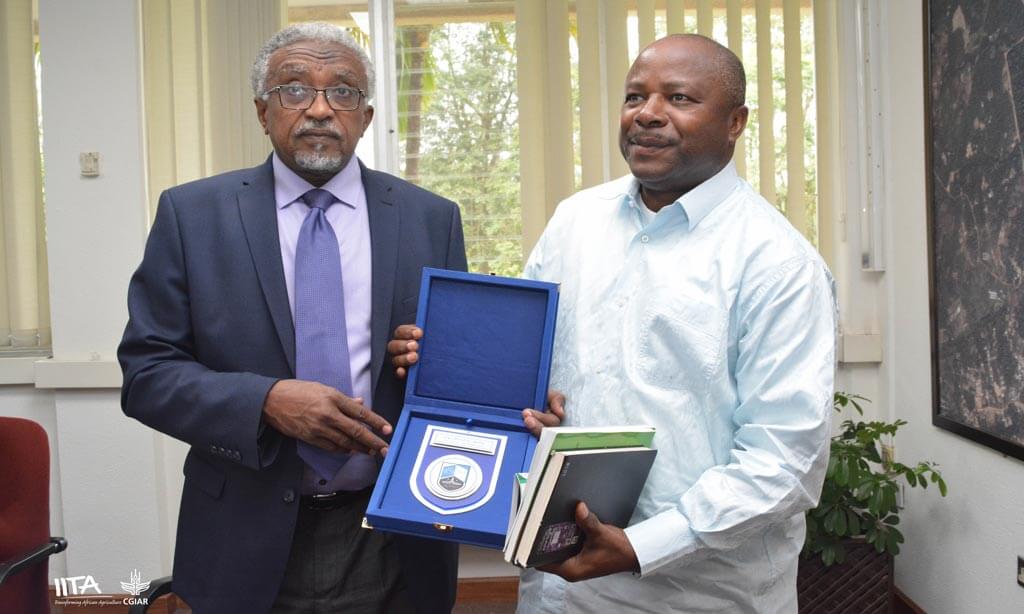
Picture of UofK VC, Professor Ahmed Mohamed Suliman(left) presenting a gift to IITA Director General, Nteranya Sanginga
UofK VC, Professor Ahmed Mohamed Suliman(left) presenting a gift to IITA Director General, Nteranya Sanginga.

The 5-day exploratory visit was led by Prof Ahmed Mohamed Suliman, Vice-Chancellor of UofK, and Dr Abuelgasim Elzein, Head, Department of Agricultural Biotechnology, also a former scientist with IITA, and accompanied by Abdalla Higazi and Hala Ahmed Elamin, both from the Internal Political Affairs unit of the office of the Sudan President and two other professors from the University. Receiving the delegation, IITA Director General Nteranya Sanginga gave an overview of the Institute’s achievements and success stories from inception to date and highlighted the efforts made to generate agricultural innovations to meet Africa’s most pressing challenges of hunger, malnutrition, and poverty, and secure the path to food security.

“We are ready to exp and into Sudan with a strengthened diversified portfolio to contribute to improved livelihoods and incomes for small-scale farmers in the country. We are optimistic that this collaboration will put smiles on the faces of the Sudanese,” he added.

Stating the purpose of their visit, Suliman said, “UofK is leading an initiative to adopt one of the best-bet proven technologies developed by IITA which is High Quality Cassava Flour (HQCF) and its processing techniques for which IITA is known worldwide and has made significant breakthroughs, achievements, and impacts. UofK has plans to adopt and promote this technology with strong support of the Presidential Office of the Republic of the Sudan to make up for the shortage in wheat flour. Our Presidential Office is very much interested in supporting the inclusion of HQCF in bread and other forms of confectionery as part of efforts to improve food security and the livelihoods of farmers in the country. On that note, I would initiate an immediate development of an MoU with IITA to serve as a guide to common interests between the two institutions,” he added.

Elzein corroborated this stating, “Even though the Republic of Sudan is not a cassava-producing country, I know that as soon as the cassava breeding program is replicated in our farming system, agriculture will take a new dimension. With that in place, HQCF will be available to make bread and other confectionary. As an IITA alumnus, I assure you that I will continue to be an active ambassador for IITA in my home country Sudan and in other relevant occasions. I am optimistic that this collaboration would open more opportunities for Sudan and strengthen future fruitful linkages with IITA and other institutional partners.’’

Due to the strong motivation indicated by the Sudanese delegates, the two organizations officially signed a memor andum of underst anding.
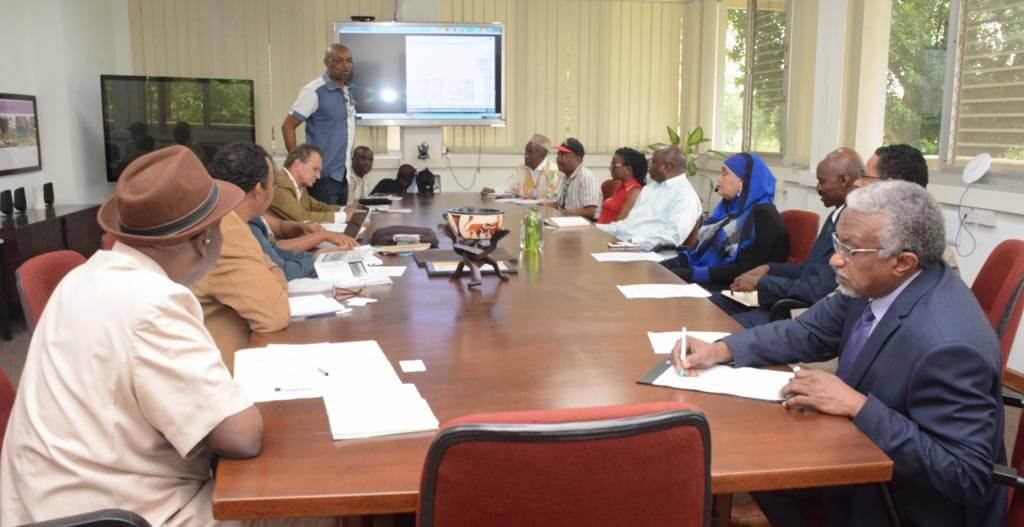
Picture of Iheanacho Okike, Cassava Peel Technologist, giving a presentation during the Sudan delegates’ visit to IITA
Iheanacho Okike, Cassava Peel Technologist, giving a presentation during the Sudan delegates’ visit to IITA.

Discussions were held regarding the type of cassava technology to be introduced in the country, soil topography, climatic conditions and action plans for immediate implementation. Alfred Dixon, Director of the Development and Delivery Office said, “Cassava is the third largest crop in the tropics, and a major staple food in sub-Saharan Africa, providing a basic staple for over half a billion people. It is one of the most drought-tolerant crops, capable of growing on marginal soils. However, with the help of cassava experts from IITA and good agronomic and weed management practices, I am certain that in no distant time, Sudan will be known for cassava production,” he added.

During the tour of the Institute’s facilities including the GoSeed facility, Semi Autotrophic Hydroponics, Bioscience laboratory, fabrication workshop, and I-House pastry section, VC Suliman asserted: “Having taken a close look at IITA’s unique innovation and with the Institute’s technology developers, I must confess that I have identified more areas of collaboration. But first, we will start with the production and processing of cassava, machine fabrication for cassava processing, and rapid multiplication of clean seeds. I am sure the Sudan President will be excited to know that our mission was successful!”

Highlights of the 5-day visit include presentations by key IITA staff; Frederick Schreurs, CEO Business Incubation Platform; Ismail Rabbi, IITA Molecular Geneticist/Breeder, Festus Okunlola, IITA Youth Agripreneur (IYA); Iheanacho Okike, IITA Cassava Peel technologist; and Thierno Diallo, IITA Machine Fabricator, all directed towards showcasing the benefits of cassava and its role in economic development. The delegates also had the opportunity to undergo h ands-on training at the IITA Food and Nutrition Science Laboratory on how to bake bread, croissant, chin-chin, and Tidbits using HQCF.


Contribué par

Nouvelles connexes

Aucun article trouvé

Laisser un commentaire

Votre adresse e-mail ne sera pas publiée. Les champs obligatoires sont indiqués avec *

Retour en haut
Olaosebikan, Olamide

Olamide Deborah Nwanze est une chercheuse principale spécialisée dans la recherche sur l'approche "genre" afin d'éclairer les politiques de sélection participative et inclusive, de développement de variétés et de systèmes semenciers concernant les cultures de racines, tubercules et bananes (RTB) au siège de l'Institut International d'Agriculture Tropicale, à Ibadan, au Nigeria. Elle est candidate au doctorat à l'Université d'Ibadan et titulaire d'un master et d'un diplôme d'ingénieur agronome en vulgarisation agricole et développement rural. Olamide est membre du programme African Women in Agricultural Research and Development – Gender Responsive Agricultural Systems Policy (SAISIE DE RÉCOMPENSEet les Chercheuses Sensibles au Genre Équipées pour la Transformation Agricole (SUPER. Elle cherche à appliquer ses apprentissages en matière d’approche genre, recherche sensible au genre, et expertise en développement et examen de politiques pour faciliter l’accès et l’adoption par les femmes, les jeunes, les enfants et les groupes sociaux vulnérables aux innovations agricoles qui garantissent la sécurité alimentaire, nutritionnelle, des revenus et des moyens de subsistance en Afrique. Ses rôles actuels comprennent le mentorat de chercheurs stagiaires, le développement de guides et manuels de formation, la mise en œuvre et l'adaptation de cadres et d'outils genre, l'engagement des acteurs de la chaîne de valeur en tant que partenaires de la science citoyenne, l'examen et la refonte des politiques, la gestion et l'analyse des données. Ses recherches actuelles portent sur les méthodes mixtes ainsi que sur les approches participatives et interdisciplinaires pour saisir et mettre en évidence les dynamiques de genre, les besoins, les préférences et les défis rencontrés par les parties prenantes au sein de la chaîne de valeur des moyens de subsistance agricoles afin de prioriser des stratégies axées sur le genre dans les programmes de sélection, la conception et la mise en œuvre des politiques.

À l'IITA, elle contribue à la mise en œuvre du CGIAR Initiative d'Élevage Accéléré et Innovation génétique Programmes ; recherche participative et genre au sein des Prochaine Génération ManiocHarvestPlusRTBAliments, et Tricot-ClimMob 1000Fermes Projets ; et la communication des connaissances sur le genre via le Série de webinaires G-LENS, vidéo documentaire, notes de politiquepublications, et blogs.


Publications récentes

de Sousa, K., van Etten, J., Manners, R. Bello, A., Teeken, B., Olaosebikan, O., et al. 2024. L'approche tricot : un cadre agile pour les essais décentralisés à la ferme soutenus par la science citoyenne. Une rétrospective. Agron. Sustain. Dev. 44, 8. https://doi.org/10.1007/s13593-023-00937-1

Madu, T., Onwuka, S., Nwafor, S., Onyemauwa, N., Ejechi, M., Ofoeze, M., Ukeje, B., Eluagu, C., Olaosebikan, O., Okoye, B., 2024. Les études sur les consommateurs inclusifs en matière de genre améliorent l'amélioration du manioc au Nigeria dans : Frontiers in Sociology, volume 9, numéro : 1224504, doi : 10.3389/fsoc.2024.1224504

Olaosebikan, O. ; Bello, A. ; Utoblo, O. ; Okoye, B. ; Olutegbe, N. ; Garner, E. ; Teeken, B. ; Bryan, E. ; Forsythe, L. ; Cole, S. ; Madu, T. 2023. Facteurs de stress et résilience au sein de la chaîne de valeur du manioc au Nigeria : Caractéristiques préférées des variétés de manioc et stratégies de réponse des hommes et des femmes pour informer l'amélioration variétale. Sustainability 15, 7837. https://doi.org/10.3390/su15107837

Okoye, B., Ofoeze, M., Ejechi, M., Onwuka, S., Nwafor, S., Onyemauwa, N., Ukeje, B., Eluagu, C., Obidiegwu, J.*, Olaosebikan, O., Madu, T.* 2023. Priorisation des traits préférés dans la chaîne de valeur de l'igname au Nigeria : une analyse de la situation en matière de genre in: Frontiers in Sociology, volume 8, numéro : 1232626, pages 1 – 9, ISSN 2297-7775, 2023. https://www.frontiersin.org/articles/10.3389/fsoc.2023.1232626/full

Olaosebikan, O., Bello, A. A., de Sousa, K., Ndjouenkeu, R., Adesokan, M., Alamu, E. O., Agbona, A., van Etten, J., Kegah, F. N.*, Dufour, D., Bouniol, A., Teeken, B. 2023. Acceptabilité par les consommateurs des produits alimentaires à base de gari-eba de manioc dans des contextes culturels et environnementaux variés en utilisant l'approche triade de comparaison des technologies (tricot) dans : Journal of the Science of Food and Agriculture,

Teeken, B., Olaosebikan, O., Bello, A. A., Madu, T.*, Cole, S. M. 2023. Évaluation qualitative de la positionnalité et des préférences des dyades en relation avec les activités liées au manioc : travailler avec des scientifiques citoyens du procès tricot https://hdl.handle.net/10568/138326 Type : Manuel

Bouniol, A., Ceballos, H., Bello, A. A., Teeken, B., Olaosebikan, O., Owoade, D., Agbona, A., Fotso Kuate, A., Madu, T.*, Okoye, B.*, Ofoeze, M.*, Nwafor, S.*, Onyemauwa, N.*, Adinsi, L.*, Forsythe, L., Dufour, D. 2023. Impact variétal sur le travail des femmes, la charge de travail et la pénibilité associée dans le traitement des plantes à racines, tubercules et bananes : focus sur le manioc en Afrique subsaharienne dans : Journal of the Science of Food and Agriculture, pages 1 – 25, ISSN 0022-5142,

Bello, A. A., Agbona, A., Olaosebikan, O., Edughaen, G., Dufour, D., Bouniol, A., Iluebbey, P., Ndjouenkeu, R.*, Rabbi, I. Y., Teeken, B. 2023. Effets génétiques et environnementaux sur la productivité de la transformation et le rendement des produits alimentaires : la pénibilité du travail des femmes dans : Journal of the Science of Food and Agriculture, pages 1 – 32, ISSN 0022-5142, 5

Cavicchioli, M., Zimbiti, T., Teeken, B., Nwanze, D.O., Liani, M., Parkes, E. & Bello, A. 2023. Rapport sur la formation en sélection génétique sensible au genre à l'IITA. Genetic Resources Center, IITA-HQ, Ibadan, 21-23 septembre 2022. Ibadan, Nigéria : IITA, (34 p.).https://hdl.handle.net/10568/131368

Agbona, A. Peteti P., Teeken B., Olaosebikan O. Bello, A. A., Parkes, E., Rabbi, I. Y., Mueller, L., Egesi, C., Kulakow, P. 2022. Gestion des données dans les programmes d'amélioration des cultures RTB africaines multidisciplinaires. In : Williamson, H.F., Leonelli, S. (eds) Towards Responsible Plant Data Linkage: Data Challenges for Agricultural Research and Development. Springer, Cham. https://doi.org/10.1007/978-3-031-13276-6_5

Lora Forsythe, Pricilla Marimo, Sarah Mayanja, Olamide D. Olaosebikan, Esme Stuart, Bela Teeken, Benjamin Okoye, Tessy Madu, (2021). Analyse transversale du genre dans RTBfoods Étape 2 Cartographie des genres sur les produits RTB. Comprendre les moteurs des préférences en matière de traits et le développement de profils de produits RTB multi-utilisateurs, WP1. Londres, Royaume-Uni : Rapport scientifique de terrain RTBfoods, 30 p.

Teeken, B., Garner, E., Agbona, A., Balogun, I., Olaosebikan, O., Bello, A., Madu, T., Okoye, B., Egesi, C., Kulakow, P. et Tufan, H.A. 2021. Au-delà des “ traits des femmes ” : explorer comment le genre, les différences sociales et les caractéristiques des ménages influencent les préférences pour les traits. Frontiers Systèmes alimentaires durables 5:740926. https://doi.org/10.3389/fsufs.2021.740926

Teeken, B., Agbona, A., Bello, A., Olaosebikan, O., Alamu, E., Adesokan, M., Awoyale, W., Madu, T., Okoye, B., Chijioke, U., Owoade, D., Okoro, M., Bouniol, A., Dufour, D., Hershey, C., Rabbi, I., Maziya‐Dixon, B., Egesi, C., Tufan, H. et Kulakow, P. (020. Comprendre les préférences variétales du manioc par le classement par paires du gari-eba et du fufu préparés par des agriculteurs-transformateurs locaux. Int J Food Sci Technol. https://doi.org/10.1111/ijfs.14862

Bela Teeken, Olamide Olaosebikan, Ireti Balogun, Benjamin Okoye, Tessy Madu, Steven Cole, Abolore Bello, Elizabeth Parkes. (2020). Pilotage des outils de profil client et produit G+ pour l'amélioration sensible au genre du manioc au Nigeria. Nigeria : Institut international d'agriculture tropicale (IIAT). https://hdl.handle.net/20.500.11766/13000