
NOUVELLES DE L'IITA

Supporting farmers in Tanzania to cope with climate change
juillet 24, 2018
“Soil erosion is a big problem in this area and we are therefore demonstrating construction of contour ridges along the hillsides. We are also demonstrating the use of tie ridges as well as chololo to help conserve water in the fields for the crops and the use of improved varieties of sorghum, pearl millet, cowpea, and Bambara nut. These are hardy crops that tolerate drought and are therefore suitable for semi-arid conditions,” says Dr Fidelis Myaka, a Senior Field Manager at IITA.
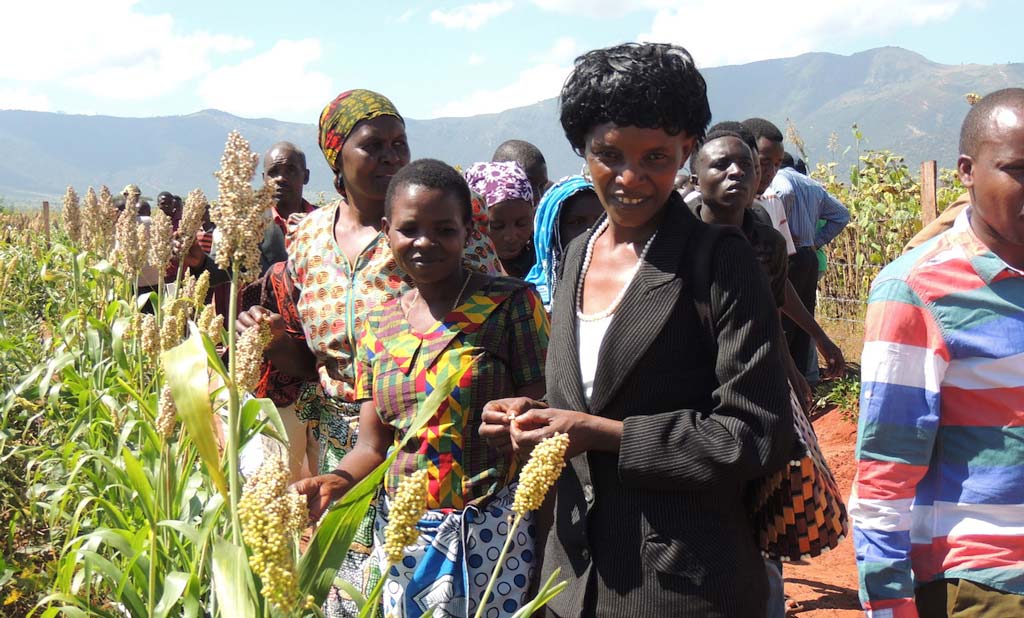
Picture of Farmers looking at the improved sorghum varieties intercropped with cowpea at their demonstration site.

Farmers looking at the improved sorghum varieties intercropped with cowpea at their demonstration site.

IITA has established three demonstration sites in Dodoma region to showcase to farmers appropriate Climate Smart Agriculture (CSA) practices for arid and semi-arid areas. CSA practices aim at increasing agriculture production and resilience to climate change while reducing agriculture’s contribution to climate change such as emission of greenhouses. Setting up these demonstration sites on CSA practices for various agroecologies across the country is one of the main activities of the Building Capacity for Resilient Food Security Project in Tanzania initiated in 2017 to strengthen the country’s capacity to respond to the challenges posed by climate change to the agriculture sector. The project is targeting Tanzania’s Ministry of Agriculture (MoA) and the Ministry of Livestock and Fisheries (MLF) and Zanzibar’s Ministry of Agriculture, Natural Resources, Livestock and Fisheries (MANRLF), Tanzania’s Meteorological Agency (TMA), and the President’s Office of Regional Administration and Local Government (PORALG) as well as regional training centers. It is led by the Government of Tanzania in collaboration with the United States Department of Agriculture (USDA) and is being implemented by IITA, the World Agroforestry Centre (ICRAF), and UN’s Food and Agriculture Organization (FAO). The project is funded by the US Agency for International Development (USAID) Tanzania Mission.

Demonstrating and communicating CSA practices

“Climate change has brought many challenges to our farmers. In one season, they are grappling with too much rain and in another with too little rain. This project, which creates awareness on appropriate CSA practices among farmers, including suitable varieties to grow, will help them to adapt and cope with these challenges,” says Ms Shakwaanande Natai, Head of Environment Management Unit at the Ministry of Agriculture. In the project, IITA has been tasked to build the capacity of the government to demonstrate appropriate CSA practices for the major agroecological zones as outlined in the country’s National CSA Guideline and to create awareness among the different stakeholders from farmers to policymakers on CSA. The Government of Tanzania officially launched the national CSA Guideline in 2017 and its aim is to guide the agriculture sector and stakeholders in identifying practices and technologies that are specific to each agro-climatic zone to support crop, livestock, and fisheries production to cope with climate change.

Feedback from farmers

The project has organized farmers’ field days in the two sites, inviting farmers to the demonstration plots to expose them to the technologies and practices and to get their views on which technologies they would readily adopt. The farmers are happy with the project and technologies, acknowledging that climate change was indeed one of their major challenges. [su_quote]“Farming is our main source of livelihood and our soils are fragile. We need to use these CSA technologies to increase our yield and in turn our incomes. If we follow these technologies, for sure our lives will get better,” says Sina Mde, Head of Nghumbi village.[/su_quote] His village is one of the sites in Dodoma region in which IITA is demonstrating CSA practices suitable for semi-arid areas in partnership with Hombolo Agricultural Research Institute. Forty-one-year old Martha Paulo, also from Nghumbi village, is among farmers who are already applying some of these CSA practices, having learned from the demonstration plots. [su_quote]“When we were making these chololo pits and tie ridges in this (demonstration) farm, I found the technologies labor intensive. However, I still went ahead and tried them on my farm. Now I am very happy with the results. The crops are doing very well and weed management was very easy. First the weeds were few. All I did was pluck them out,” she said.[/su_quote] As part of the project, IITA will also work with the trainers in the country’s agriculture tertiary institutions to develop material on CSA for inclusion in the country’s agriculture training programs. FAO and TMA will disseminate easy- to-use weather information using appropriate technologies including mobile phones while ICRAF will quantify the trade-offs and benefits of these CSA practices for decision making.

Contribué par

Recent stories

Aucun article trouvé

Laisser un commentaire

Votre adresse e-mail ne sera pas publiée. Les champs obligatoires sont indiqués avec *

Retour en haut
Olaosebikan, Olamide

Olamide Deborah Nwanze est une chercheuse principale spécialisée dans la recherche sur l'approche "genre" afin d'éclairer les politiques de sélection participative et inclusive, de développement de variétés et de systèmes semenciers concernant les cultures de racines, tubercules et bananes (RTB) au siège de l'Institut International d'Agriculture Tropicale, à Ibadan, au Nigeria. Elle est candidate au doctorat à l'Université d'Ibadan et titulaire d'un master et d'un diplôme d'ingénieur agronome en vulgarisation agricole et développement rural. Olamide est membre du programme African Women in Agricultural Research and Development – Gender Responsive Agricultural Systems Policy (SAISIE DE RÉCOMPENSEet les Chercheuses Sensibles au Genre Équipées pour la Transformation Agricole (SUPER. Elle cherche à appliquer ses apprentissages en matière d’approche genre, recherche sensible au genre, et expertise en développement et examen de politiques pour faciliter l’accès et l’adoption par les femmes, les jeunes, les enfants et les groupes sociaux vulnérables aux innovations agricoles qui garantissent la sécurité alimentaire, nutritionnelle, des revenus et des moyens de subsistance en Afrique. Ses rôles actuels comprennent le mentorat de chercheurs stagiaires, le développement de guides et manuels de formation, la mise en œuvre et l'adaptation de cadres et d'outils genre, l'engagement des acteurs de la chaîne de valeur en tant que partenaires de la science citoyenne, l'examen et la refonte des politiques, la gestion et l'analyse des données. Ses recherches actuelles portent sur les méthodes mixtes ainsi que sur les approches participatives et interdisciplinaires pour saisir et mettre en évidence les dynamiques de genre, les besoins, les préférences et les défis rencontrés par les parties prenantes au sein de la chaîne de valeur des moyens de subsistance agricoles afin de prioriser des stratégies axées sur le genre dans les programmes de sélection, la conception et la mise en œuvre des politiques.

À l'IITA, elle contribue à la mise en œuvre du CGIAR Initiative d'Élevage Accéléré et Innovation génétique Programmes ; recherche participative et genre au sein des Prochaine Génération ManiocHarvestPlusRTBAliments, et Tricot-ClimMob 1000Fermes Projets ; et la communication des connaissances sur le genre via le Série de webinaires G-LENS, vidéo documentaire, notes de politiquepublications, et blogs.


Publications récentes

de Sousa, K., van Etten, J., Manners, R. Bello, A., Teeken, B., Olaosebikan, O., et al. 2024. L'approche tricot : un cadre agile pour les essais décentralisés à la ferme soutenus par la science citoyenne. Une rétrospective. Agron. Sustain. Dev. 44, 8. https://doi.org/10.1007/s13593-023-00937-1

Madu, T., Onwuka, S., Nwafor, S., Onyemauwa, N., Ejechi, M., Ofoeze, M., Ukeje, B., Eluagu, C., Olaosebikan, O., Okoye, B., 2024. Les études sur les consommateurs inclusifs en matière de genre améliorent l'amélioration du manioc au Nigeria dans : Frontiers in Sociology, volume 9, numéro : 1224504, doi : 10.3389/fsoc.2024.1224504

Olaosebikan, O. ; Bello, A. ; Utoblo, O. ; Okoye, B. ; Olutegbe, N. ; Garner, E. ; Teeken, B. ; Bryan, E. ; Forsythe, L. ; Cole, S. ; Madu, T. 2023. Facteurs de stress et résilience au sein de la chaîne de valeur du manioc au Nigeria : Caractéristiques préférées des variétés de manioc et stratégies de réponse des hommes et des femmes pour informer l'amélioration variétale. Sustainability 15, 7837. https://doi.org/10.3390/su15107837

Okoye, B., Ofoeze, M., Ejechi, M., Onwuka, S., Nwafor, S., Onyemauwa, N., Ukeje, B., Eluagu, C., Obidiegwu, J.*, Olaosebikan, O., Madu, T.* 2023. Priorisation des traits préférés dans la chaîne de valeur de l'igname au Nigeria : une analyse de la situation en matière de genre in: Frontiers in Sociology, volume 8, numéro : 1232626, pages 1 – 9, ISSN 2297-7775, 2023. https://www.frontiersin.org/articles/10.3389/fsoc.2023.1232626/full

Olaosebikan, O., Bello, A. A., de Sousa, K., Ndjouenkeu, R., Adesokan, M., Alamu, E. O., Agbona, A., van Etten, J., Kegah, F. N.*, Dufour, D., Bouniol, A., Teeken, B. 2023. Acceptabilité par les consommateurs des produits alimentaires à base de gari-eba de manioc dans des contextes culturels et environnementaux variés en utilisant l'approche triade de comparaison des technologies (tricot) dans : Journal of the Science of Food and Agriculture,

Teeken, B., Olaosebikan, O., Bello, A. A., Madu, T.*, Cole, S. M. 2023. Évaluation qualitative de la positionnalité et des préférences des dyades en relation avec les activités liées au manioc : travailler avec des scientifiques citoyens du procès tricot https://hdl.handle.net/10568/138326 Type : Manuel

Bouniol, A., Ceballos, H., Bello, A. A., Teeken, B., Olaosebikan, O., Owoade, D., Agbona, A., Fotso Kuate, A., Madu, T.*, Okoye, B.*, Ofoeze, M.*, Nwafor, S.*, Onyemauwa, N.*, Adinsi, L.*, Forsythe, L., Dufour, D. 2023. Impact variétal sur le travail des femmes, la charge de travail et la pénibilité associée dans le traitement des plantes à racines, tubercules et bananes : focus sur le manioc en Afrique subsaharienne dans : Journal of the Science of Food and Agriculture, pages 1 – 25, ISSN 0022-5142,

Bello, A. A., Agbona, A., Olaosebikan, O., Edughaen, G., Dufour, D., Bouniol, A., Iluebbey, P., Ndjouenkeu, R.*, Rabbi, I. Y., Teeken, B. 2023. Effets génétiques et environnementaux sur la productivité de la transformation et le rendement des produits alimentaires : la pénibilité du travail des femmes dans : Journal of the Science of Food and Agriculture, pages 1 – 32, ISSN 0022-5142, 5

Cavicchioli, M., Zimbiti, T., Teeken, B., Nwanze, D.O., Liani, M., Parkes, E. & Bello, A. 2023. Rapport sur la formation en sélection génétique sensible au genre à l'IITA. Genetic Resources Center, IITA-HQ, Ibadan, 21-23 septembre 2022. Ibadan, Nigéria : IITA, (34 p.).https://hdl.handle.net/10568/131368

Agbona, A. Peteti P., Teeken B., Olaosebikan O. Bello, A. A., Parkes, E., Rabbi, I. Y., Mueller, L., Egesi, C., Kulakow, P. 2022. Gestion des données dans les programmes d'amélioration des cultures RTB africaines multidisciplinaires. In : Williamson, H.F., Leonelli, S. (eds) Towards Responsible Plant Data Linkage: Data Challenges for Agricultural Research and Development. Springer, Cham. https://doi.org/10.1007/978-3-031-13276-6_5

Lora Forsythe, Pricilla Marimo, Sarah Mayanja, Olamide D. Olaosebikan, Esme Stuart, Bela Teeken, Benjamin Okoye, Tessy Madu, (2021). Analyse transversale du genre dans RTBfoods Étape 2 Cartographie des genres sur les produits RTB. Comprendre les moteurs des préférences en matière de traits et le développement de profils de produits RTB multi-utilisateurs, WP1. Londres, Royaume-Uni : Rapport scientifique de terrain RTBfoods, 30 p.

Teeken, B., Garner, E., Agbona, A., Balogun, I., Olaosebikan, O., Bello, A., Madu, T., Okoye, B., Egesi, C., Kulakow, P. et Tufan, H.A. 2021. Au-delà des “ traits des femmes ” : explorer comment le genre, les différences sociales et les caractéristiques des ménages influencent les préférences pour les traits. Frontiers Systèmes alimentaires durables 5:740926. https://doi.org/10.3389/fsufs.2021.740926

Teeken, B., Agbona, A., Bello, A., Olaosebikan, O., Alamu, E., Adesokan, M., Awoyale, W., Madu, T., Okoye, B., Chijioke, U., Owoade, D., Okoro, M., Bouniol, A., Dufour, D., Hershey, C., Rabbi, I., Maziya‐Dixon, B., Egesi, C., Tufan, H. et Kulakow, P. (020. Comprendre les préférences variétales du manioc par le classement par paires du gari-eba et du fufu préparés par des agriculteurs-transformateurs locaux. Int J Food Sci Technol. https://doi.org/10.1111/ijfs.14862

Bela Teeken, Olamide Olaosebikan, Ireti Balogun, Benjamin Okoye, Tessy Madu, Steven Cole, Abolore Bello, Elizabeth Parkes. (2020). Pilotage des outils de profil client et produit G+ pour l'amélioration sensible au genre du manioc au Nigeria. Nigeria : Institut international d'agriculture tropicale (IIAT). https://hdl.handle.net/20.500.11766/13000