
TAAT discusses ongoing activities in workshop
juillet 3, 2019
Technologies pour la transformation de l'agriculture en Afrique (TAAT), a program initiated by the Banque africaine de développement (AfDB) as part of its Feed Africa Initiative, held a workshop at IITA, Ibadan. The meeting, which took place 27-28 June, brought together representatives from AfDB as well as executing and implementing agencies, the TAAT Program Unit, the Clearinghouse, and coordinators of the 15 TAAT Compacts.
 The workshop was organized to ensure that every component of the program understands how TAAT progresses with the post-Mid-Term Review (MTR) implementation. The expected key outcomes of the meeting include key findings and implications of the MTR, expectations from TAAT Compacts, and understanding the new TAAT as well as improvements to the management structure.
The core objective of the TAAT program is to improve the business of agriculture across Africa by raising agricultural productivity, mitigating risks, and promoting diversification and processing in 18 agricultural value chains within eight Priority Intervention Areas (PIAs).
The program is implemented by IITA in close partnership with other CGIAR Centers: AfricaRice, Centre international d'agriculture tropicale (CIAT), Centre international de la pomme de terre (CIP), International Center for Agriculture Research in the Dry Areas (ICARDA), Institut international de recherche sur les cultures des zones tropicales semiarides (ICRISAT), International Water Management Institute (IWMI), and WorldFish. TAAT is also involved with specialized technical centers like the African Agricultural Technology Foundation (AATF), the Forum for Agricultural Research in Africa (FARA), and the International Fertilizer Development Center (IFDC) as well as national agricultural research and extension systems and private sector partners.
While TAAT is not a research program, it seeks to promote and disseminate proven, high-performance food production technologies to millions of farmers in a commercially sustainable way. This it does through a network of people and institutions forming a Regional Technology Delivery Infrastructure (RTDI) within an enabling environment.
The workshop was organized to ensure that every component of the program understands how TAAT progresses with the post-Mid-Term Review (MTR) implementation. The expected key outcomes of the meeting include key findings and implications of the MTR, expectations from TAAT Compacts, and understanding the new TAAT as well as improvements to the management structure.
The core objective of the TAAT program is to improve the business of agriculture across Africa by raising agricultural productivity, mitigating risks, and promoting diversification and processing in 18 agricultural value chains within eight Priority Intervention Areas (PIAs).
The program is implemented by IITA in close partnership with other CGIAR Centers: AfricaRice, Centre international d'agriculture tropicale (CIAT), Centre international de la pomme de terre (CIP), International Center for Agriculture Research in the Dry Areas (ICARDA), Institut international de recherche sur les cultures des zones tropicales semiarides (ICRISAT), International Water Management Institute (IWMI), and WorldFish. TAAT is also involved with specialized technical centers like the African Agricultural Technology Foundation (AATF), the Forum for Agricultural Research in Africa (FARA), and the International Fertilizer Development Center (IFDC) as well as national agricultural research and extension systems and private sector partners.
While TAAT is not a research program, it seeks to promote and disseminate proven, high-performance food production technologies to millions of farmers in a commercially sustainable way. This it does through a network of people and institutions forming a Regional Technology Delivery Infrastructure (RTDI) within an enabling environment.
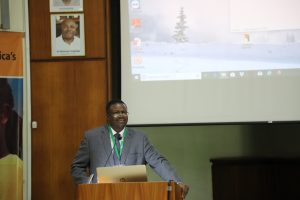
Director of Agriculture at the AfDB, Dr Martins Fregene, speaking at the workshop.
The TAAT program operates as a network of interacting “Compacts” with nine of these compacts devoted to specific commodity value chains and six others serving as “Enablers” that provide needed specialist services.
Contribué par
Histoires récentes
Aucun article trouvé