The Kugwiza Project: Transforming agriculture in Burundi
14 juin 2024
The Great Lakes Accelerated Innovation Delivery Initiative Rapid Delivery Hub (AID-I GLR), locally known as the ‘Kugwiza Project,’ is making significant strides in enhancing and improving the agricultural value chains of key food-security crops and livestock in Burundi. Initiated in January 2023, Kugwiza brings transformative change to Burundi’s agriculture and livestock sector.
Since its inception, Kugwiza has focused on key crops such as beans, cassava, maize, orange-fleshed sweet potatoes, rice, and livestock (insemination, vaccination, poultry, and fodder). The project collaborates with local partners and national seed systems, leveraging the expertise of World Vision, l’Association de coopération et de recherche pour le développement (ACORD), Confédération des Associations des Producteurs Agricoles pour le Développement (CAPAD), Welthungerhife (WHH), Vétérinaires Sans Frontières (VSF), World Food Programme (WFP) and One Acre Fund.
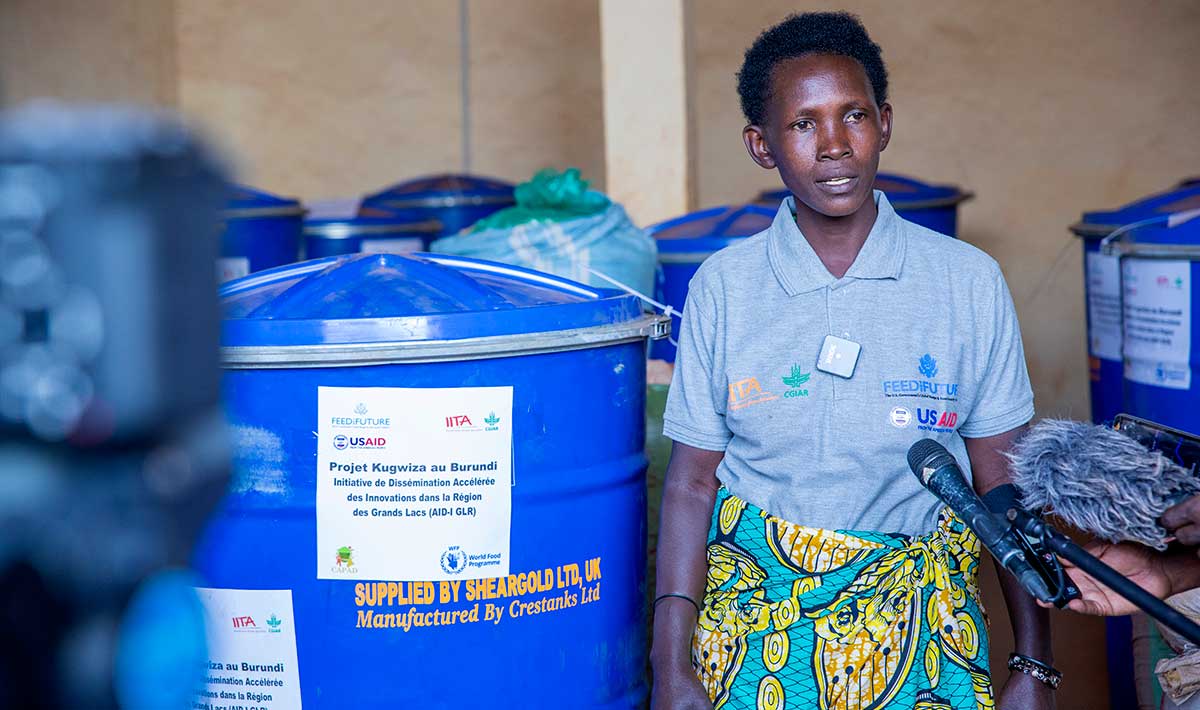
A farmer in Gitega Province testified about the role of the storage silos provided by the project, which allow for better crop storage for up to four years without damage.
These partnerships ensure the dissemination of innovations for the effective adoption of improved agricultural and livestock technologies, supported by national research centers, particularly l’Institut des Sciences Agronomiques du Burundi (ISABU), and CGIAR centers (mainly the International Potato Center (CIP), the International Livestock Research Institute (ILRI), the International Rice Research Institute (IRRI), the Alliance of Bioversity International and CIAT, and support service providers such as the Seed Systems Group (SSG) and Scientific Animations Without Borders (SAWBO)).
A core element of Kugwiza’s success is its collaboration with stakeholders in the production and marketing value chains of high-quality, high-yield seeds. In Burundi, the project works with two seed companies: CoopEden and the Haguruka Cooperative. The project promotes the use of quality seeds and the best agronomic practices by providing farmers with training to improve their skills and resources. This includes pest management, fertilizer application (mineral and organic), and postharvest management techniques, which are critical to boosting production.
Another innovative approach introduced by the project is the establishment of agricultural and livestock extension workers called ‘Village-Based Advisors’ (VBAs). These VBAs who are selected by their peers and are the innovations’ producers and leaders and have been well-trained through theoretical (workshops) and practical (demonstration plots) modules on good agronomic practices (farming, sowing, fertilizer application, disease control, postharvest management, and processing). VBAs disseminate the knowledge they have acquired to farmers in surrounding villages to enable the easy and rapid diffusion and adoption of technologies within the community. The demonstration plots managed by the VBAs and the farmers’ fields allow for practical, concrete, and hands-on learning.
The impact of these efforts is evident. As of March 2024, Kugwiza had reached more than 470,000 farmers, with 430,000 accessing improved agricultural and livestock technologies, advisory information, and small packs for initial experimentation. In collaboration with ISABU, the project has produced and supplied approximately 54 metric tons of early-generation seed to seed entrepreneurs, significantly strengthening the seed system by ensuring the availability of certified seeds through sales points established across various communes where the project is being implemented.
Kugwiza has organized a media tour from 11–13 June 2024 to highlight these achievements and share insights on implementation. The purpose is to showcase the project’s contributions to national agricultural and livestock systems, and its role in sustainable agricultural development in Burundi.
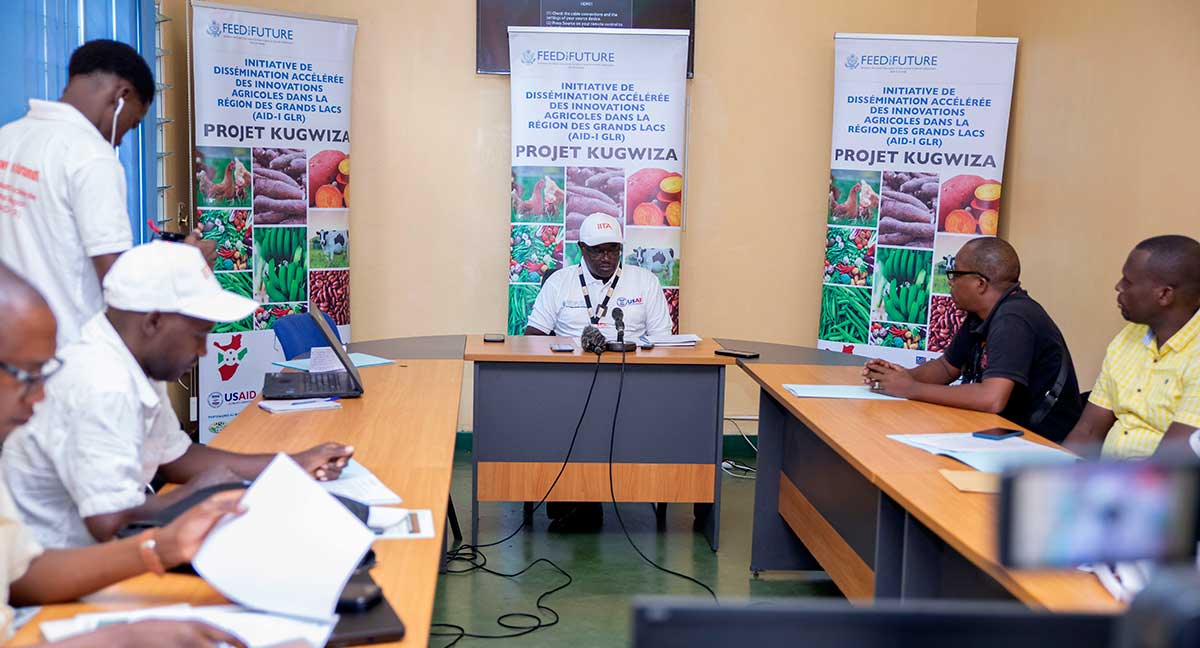
Journalists received a debriefing on the project’s objectives and approach from project officials before departing to the field.
Media tour sites
Multiplication field for animal feed (Kakamega 1 and Lablab cuttings)
The field is located on land owned by the Provincial Office of Environment, Agriculture, and Livestock in Burundi (BPEAE), Kayanza Center, Kayanza. These two varieties (Kakamega 1 and Lablab) are cultivated on 2 hectares of land. This field serves as a demonstration plot for production and a mother demo plot for supplying cuttings for widespread distribution to rural households in need.
The objective of establishing this multiplication field is to produce large quantities of Kakamega 1 and Lablab seed cuttings. Besides households, distribution to other multipliers in the various communes of the province is planned for the 2025 A season.
Demonstration plot for high-iron beans
A bio-fortified climbing bean variety has been introduced, and beneficiaries are learning soil preparation techniques, sowing, fertilizer application (mineral and organic), plant maintenance (weeding and disease control), and postharvest management. After each practical training session, farmers apply the knowledge in their various plots, using small 100-gram seed packs for personal testing in their home plots. This ‘controlled’ testing paves the way for adoption.
Production and marketing of lick-blocks for animal feed (Rugari Village, Muyinga Commune)
Kugwiza has introduced the production of lick-blocks using local products to reduce the cost of livestock inputs, which is a significant concern for cattle farmers in Burundi. Journalists will visit farmers who have been trained in the various stages of lick-block production and are now applying these skills. One of the farmers no longer imports lick-blocks from Tanzania, favoring those locally produced.
Demonstration plot for orange-fleshed sweet potatoes (OFSP)
In collaboration with the International Potato Center (CIP) and the Institute of Agronomic Sciences of Burundi (ISABU), Kugwiza has launched capacity-building initiatives to ensure the availability of clean OFSP planting material in Burundi. This includes training technicians in producing early-generation seeds and engaging private multipliers to produce high-quality certified seeds. Ten mini-screen houses managed by seed entrepreneurs have been established to support clean-seed production. Additionally, the project has introduced the production of OFSP puree in bakery products to enhance the OFSP value chain.
Demonstration plot for rice
In collaboration with the International Rice Research Institute (IRRI) and ISABU, Kugwiza has introduced new rice varieties adapted to Burundi’s different agroecological zones, particularly in high and mid-altitude regions where farmers were not accustomed to this crop. Training on rice cultivation and irrigation management has been provided. Beneficiaries, organized into cooperatives, received high-yield rice seeds to test in demonstration fields to select the best varieties. Beneficiaries trained in the demonstration fields received 100 grams of seed to test in their fields for yield validation and spur adoption.
Hybrid maize seed production
Kugwiza, in partnership with the Seeds System Group, has introduced hybrid maize seeds (Bazooka and Wannak) in Burundi. Demonstration plots showcasing proper farming practices have been established in several project intervention areas. Beneficiaries now know the seed manufacturer for future procurement. In collaboration with WFP, postharvest management silos have been introduced to reduce losses: the project aims to use these silos for cereal conservation.
Theileriosis vaccination
In collaboration with ILRI, Kugwiza has introduced a vaccine to reduce the prevalence of theileriosis in calves. Calves have been vaccinated since early 2024, and visible impacts have been reported by farmers whose calves were vaccinated.
Pour plus d'informations, veuillez contacter :
Patrick Mutuo, Country Coordinator, on pk.mutuo@cgiar.org
Christophe Gahungu, IITA Burundi, on c.gahungu@cgiar.org
About the AID-I GLR project
The Great Lakes Accelerated Innovation Delivery Initiative Rapid Delivery Hub (AID-I GLR) is a two-year, multi-stakeholder initiative funded by Feed the Future through the United States Agency for International Development (USAID) and led by the International Institute of Tropical Agriculture (IITA). The initiative is part of the United States’ response to address the immediate and long-term effects of the global food security crisis. The goal of AID-I GLR is to contribute to improving food and nutrition security in the region through the rapid adoption at scale of proven technologies and innovations developed mainly by CGIAR and partners. It aims to reach 1.2 million farming households across Burundi, the Democratic Republic of Congo (DRC), and Rwanda. AID-I GLR identifies options for scaling partnerships with the private sector, government agencies, and non-governmental organizations. AID-I GLR continually structures those partnerships to rapidly deliver proven technologies adapted to local needs to an extensive network of farmers alongside advisory services.
More on AID-I GLR
Olamide Deborah Nwanze est une chercheuse principale spécialisée dans la recherche sur l'approche "genre" afin d'éclairer les politiques de sélection participative et inclusive, de développement de variétés et de systèmes semenciers concernant les cultures de racines, tubercules et bananes (RTB) au siège de l'Institut International d'Agriculture Tropicale, à Ibadan, au Nigeria. Elle est candidate au doctorat à l'Université d'Ibadan et titulaire d'un master et d'un diplôme d'ingénieur agronome en vulgarisation agricole et développement rural. Olamide est membre du programme African Women in Agricultural Research and Development – Gender Responsive Agricultural Systems Policy (SAISIE DE RÉCOMPENSEet les Chercheuses Sensibles au Genre Équipées pour la Transformation Agricole (SUPER. Elle cherche à appliquer ses apprentissages en matière d’approche genre, recherche sensible au genre, et expertise en développement et examen de politiques pour faciliter l’accès et l’adoption par les femmes, les jeunes, les enfants et les groupes sociaux vulnérables aux innovations agricoles qui garantissent la sécurité alimentaire, nutritionnelle, des revenus et des moyens de subsistance en Afrique. Ses rôles actuels comprennent le mentorat de chercheurs stagiaires, le développement de guides et manuels de formation, la mise en œuvre et l'adaptation de cadres et d'outils genre, l'engagement des acteurs de la chaîne de valeur en tant que partenaires de la science citoyenne, l'examen et la refonte des politiques, la gestion et l'analyse des données. Ses recherches actuelles portent sur les méthodes mixtes ainsi que sur les approches participatives et interdisciplinaires pour saisir et mettre en évidence les dynamiques de genre, les besoins, les préférences et les défis rencontrés par les parties prenantes au sein de la chaîne de valeur des moyens de subsistance agricoles afin de prioriser des stratégies axées sur le genre dans les programmes de sélection, la conception et la mise en œuvre des politiques.
de Sousa, K., van Etten, J., Manners, R. Bello, A., Teeken, B., Olaosebikan, O., et al. 2024. L'approche tricot : un cadre agile pour les essais décentralisés à la ferme soutenus par la science citoyenne. Une rétrospective. Agron. Sustain. Dev. 44, 8. https://doi.org/10.1007/s13593-023-00937-1
Madu, T., Onwuka, S., Nwafor, S., Onyemauwa, N., Ejechi, M., Ofoeze, M., Ukeje, B., Eluagu, C., Olaosebikan, O., Okoye, B., 2024. Les études sur les consommateurs inclusifs en matière de genre améliorent l'amélioration du manioc au Nigeria dans : Frontiers in Sociology, volume 9, numéro : 1224504, doi : 10.3389/fsoc.2024.1224504
Olaosebikan, O. ; Bello, A. ; Utoblo, O. ; Okoye, B. ; Olutegbe, N. ; Garner, E. ; Teeken, B. ; Bryan, E. ; Forsythe, L. ; Cole, S. ; Madu, T. 2023. Facteurs de stress et résilience au sein de la chaîne de valeur du manioc au Nigeria : Caractéristiques préférées des variétés de manioc et stratégies de réponse des hommes et des femmes pour informer l'amélioration variétale. Sustainability 15, 7837. https://doi.org/10.3390/su15107837
Okoye, B., Ofoeze, M., Ejechi, M., Onwuka, S., Nwafor, S., Onyemauwa, N., Ukeje, B., Eluagu, C., Obidiegwu, J.*, Olaosebikan, O., Madu, T.* 2023. Priorisation des traits préférés dans la chaîne de valeur de l'igname au Nigeria : une analyse de la situation en matière de genre in: Frontiers in Sociology, volume 8, numéro : 1232626, pages 1 – 9, ISSN 2297-7775, 2023. https://www.frontiersin.org/articles/10.3389/fsoc.2023.1232626/full
Olaosebikan, O., Bello, A. A., de Sousa, K., Ndjouenkeu, R., Adesokan, M., Alamu, E. O., Agbona, A., van Etten, J., Kegah, F. N.*, Dufour, D., Bouniol, A., Teeken, B. 2023. Acceptabilité par les consommateurs des produits alimentaires à base de gari-eba de manioc dans des contextes culturels et environnementaux variés en utilisant l'approche triade de comparaison des technologies (tricot) dans : Journal of the Science of Food and Agriculture,
Teeken, B., Olaosebikan, O., Bello, A. A., Madu, T.*, Cole, S. M. 2023. Évaluation qualitative de la positionnalité et des préférences des dyades en relation avec les activités liées au manioc : travailler avec des scientifiques citoyens du procès tricot https://hdl.handle.net/10568/138326 Type : Manuel
Bouniol, A., Ceballos, H., Bello, A. A., Teeken, B., Olaosebikan, O., Owoade, D., Agbona, A., Fotso Kuate, A., Madu, T.*, Okoye, B.*, Ofoeze, M.*, Nwafor, S.*, Onyemauwa, N.*, Adinsi, L.*, Forsythe, L., Dufour, D. 2023. Impact variétal sur le travail des femmes, la charge de travail et la pénibilité associée dans le traitement des plantes à racines, tubercules et bananes : focus sur le manioc en Afrique subsaharienne dans : Journal of the Science of Food and Agriculture, pages 1 – 25, ISSN 0022-5142,
Bello, A. A., Agbona, A., Olaosebikan, O., Edughaen, G., Dufour, D., Bouniol, A., Iluebbey, P., Ndjouenkeu, R.*, Rabbi, I. Y., Teeken, B. 2023. Effets génétiques et environnementaux sur la productivité de la transformation et le rendement des produits alimentaires : la pénibilité du travail des femmes dans : Journal of the Science of Food and Agriculture, pages 1 – 32, ISSN 0022-5142, 5
Cavicchioli, M., Zimbiti, T., Teeken, B., Nwanze, D.O., Liani, M., Parkes, E. & Bello, A. 2023. Rapport sur la formation en sélection génétique sensible au genre à l'IITA. Genetic Resources Center, IITA-HQ, Ibadan, 21-23 septembre 2022. Ibadan, Nigéria : IITA, (34 p.).https://hdl.handle.net/10568/131368
Agbona, A. Peteti P., Teeken B., Olaosebikan O. Bello, A. A., Parkes, E., Rabbi, I. Y., Mueller, L., Egesi, C., Kulakow, P. 2022. Gestion des données dans les programmes d'amélioration des cultures RTB africaines multidisciplinaires. In : Williamson, H.F., Leonelli, S. (eds) Towards Responsible Plant Data Linkage: Data Challenges for Agricultural Research and Development. Springer, Cham. https://doi.org/10.1007/978-3-031-13276-6_5
Lora Forsythe, Pricilla Marimo, Sarah Mayanja, Olamide D. Olaosebikan, Esme Stuart, Bela Teeken, Benjamin Okoye, Tessy Madu, (2021). Analyse transversale du genre dans RTBfoods Étape 2 Cartographie des genres sur les produits RTB. Comprendre les moteurs des préférences en matière de traits et le développement de profils de produits RTB multi-utilisateurs, WP1. Londres, Royaume-Uni : Rapport scientifique de terrain RTBfoods, 30 p.
Teeken, B., Garner, E., Agbona, A., Balogun, I., Olaosebikan, O., Bello, A., Madu, T., Okoye, B., Egesi, C., Kulakow, P. et Tufan, H.A. 2021. Au-delà des “ traits des femmes ” : explorer comment le genre, les différences sociales et les caractéristiques des ménages influencent les préférences pour les traits. Frontiers Systèmes alimentaires durables 5:740926. https://doi.org/10.3389/fsufs.2021.740926
Teeken, B., Agbona, A., Bello, A., Olaosebikan, O., Alamu, E., Adesokan, M., Awoyale, W., Madu, T., Okoye, B., Chijioke, U., Owoade, D., Okoro, M., Bouniol, A., Dufour, D., Hershey, C., Rabbi, I., Maziya‐Dixon, B., Egesi, C., Tufan, H. et Kulakow, P. (020. Comprendre les préférences variétales du manioc par le classement par paires du gari-eba et du fufu préparés par des agriculteurs-transformateurs locaux. Int J Food Sci Technol.https://doi.org/10.1111/ijfs.14862
Bela Teeken, Olamide Olaosebikan, Ireti Balogun, Benjamin Okoye, Tessy Madu, Steven Cole, Abolore Bello, Elizabeth Parkes. (2020). Pilotage des outils de profil client et produit G+ pour l'amélioration sensible au genre du manioc au Nigeria. Nigeria : Institut international d'agriculture tropicale (IIAT). https://hdl.handle.net/20.500.11766/13000