
NOUVELLES DE L'IITA

Transferring aflatoxin biocontrol experiences to partners from Mali, Niger, and Pakistan
novembre 24, 2023

Supported by funding from the United States Department of Agriculture – Foreign Agricultural Service (USDA-FAS), a two-week training program was organized by the IITA Aflasafe Unit in Ibadan, Nigeria, for researchers specializing in aflatoxin biocontrol from the Institut d’Economie Rurale (IER) du Mali, Institut National de la Recherche Agronomique du Niger (INRAN), Pakistan Agricultural Research Council (PARC), and CAB International (CABI). Partners from Rafhan Maize, a subsidiary of the US-based Ingredion company and a leading private-sector maize company in Pakistan, also attended the training.
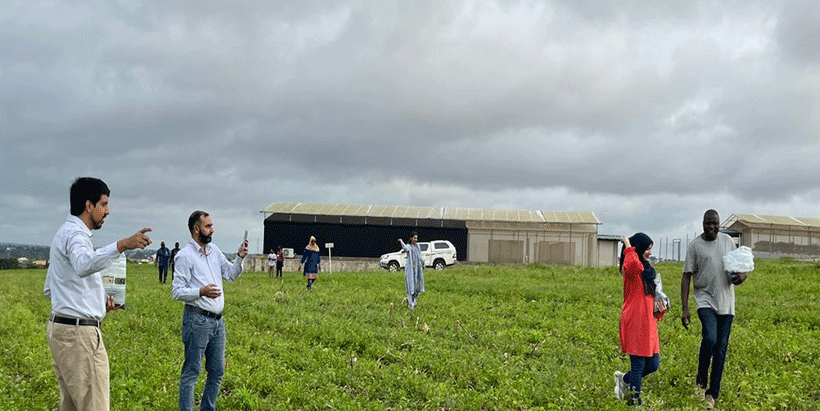
Dr. Karim Dagno (IER-Mali) on the far right training Dr. Abeera Umar (CABI-Pakistan) on Aflasafe application techniques at IITA-Ibadan. Dr. Dagno works with thousands of farmers in Mali implementing integrated aflatoxin management programs as part of the CSAT Mali project.

Dr Lloyd Garcia from USDA-FAS attended the training to facilitate collaborative solutions to advance enhanced projects and define ways forward on efforts to mitigate aflatoxin contamination in target crops. PARC, CABI, and Rafhan Maize have developed the aflatoxin biocontrol product AflaPak in collaboration with USDA – Agricultural Research Service (ARS) and IITA. IER and INRAN scientists have been collaborating with IITA Aflasafe Unit since 2017 and 2019 to develop, test, register, and commercially use Aflasafe in their countries as part of a USDA-FAS-funded project and under the Climate Smart Agricultural Technologies (CSAT) for Mali and Niger Project funded by the Royal Embassy of Norway in Mali.
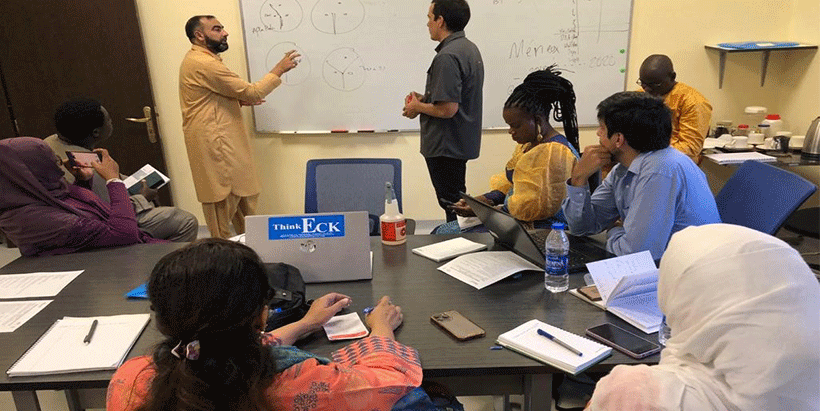
 Dr. Atif Jamal and Alejandro Ortega-Beltran discussing tracking of active ingredient biocontrol isolates using vegetative compatibility assays.
Dr. Atif Jamal and Alejandro Ortega-Beltran discussing tracking of active ingredient biocontrol isolates using vegetative compatibility assays.

The “Hands-on laboratory, industrial manufacturing, and field experience in the development, testing, registration, and scaling of aflatoxin biocontrol technology” workshop took place from 23 Oct to 3 Nov 2023 and was organized by Alejandro Ortega-Beltran, Lawrence Kaptoge, and Titilayo Falade, and supported by IITA Emeritus Scientist Dr Ranajit Bandyopadhyay.

The program included i) practical sessions in the laboratory to discuss microbiological, chemical, and molecular aspects of strain identification for aflatoxin biocontrol product development and tracking of active ingredients; ii) formulation and quality control of biocontrol products and industrial production of active ingredient spores; iii) biocontrol field application and verification of product performance; iv) demonstrations of industrial production by HarvestField Industries Limited, the licensed manufacturer and distributor of the aflatoxin biocontrol product Aflasafe in Nigeria; v) discussions with the biocontrol product regulator in Nigeria; vi) discussions on incentivization schemes for the adoption of biocontrol used in Nigeria; vii) status of biocontrol product registration in Pakistan and experiences of IITA in registering biocontrol products in 11 countries in Africa; and viii) visits to different units in IITA (Genetic Resources Center, Germplasm Health Unit, Maize, Soybean, and Banana/Plantain Improvements Programs) to foster collaboration in areas other than aflatoxin biocontrol.
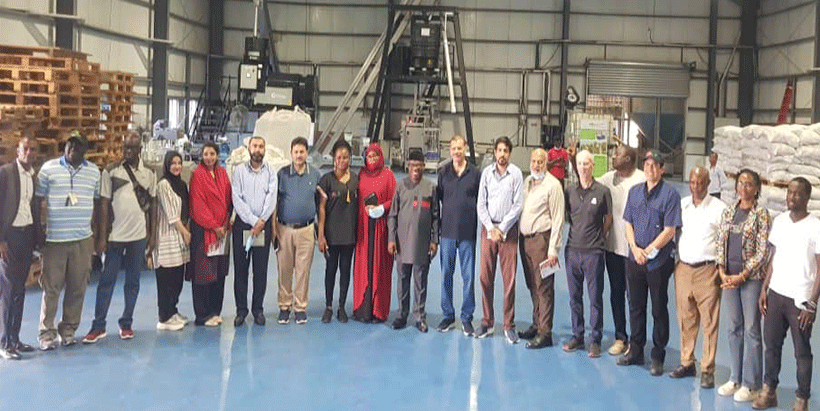
Training participants visited the Aflasafe Manufacturing Facility constructed by HarvestField Industries Limited (HIL), the licensed manufacturer and distributor of the aflatoxin biocontrol product Aflasafe in Nigeria. Mr Martins Awofisayo, Managing Director of HIL and Engr. Lawrence Kaptoge facilitated the visit and discussions. Rafhan Maize is in the process of setting up a manufacturing facility in Faisalabad, Pakistan.

During a meeting with the IITA Senior Management Team, Dr Falak Naz from the International Coordination Division of the Pakistan Agricultural Research Council expressed the training participants’ enthusiasm for the program, elaborated on the challenge posed by aflatoxin contamination in Pakistan and the necessity of collaborating with IITA, because of the several successful stories in aflatoxin management across Africa.
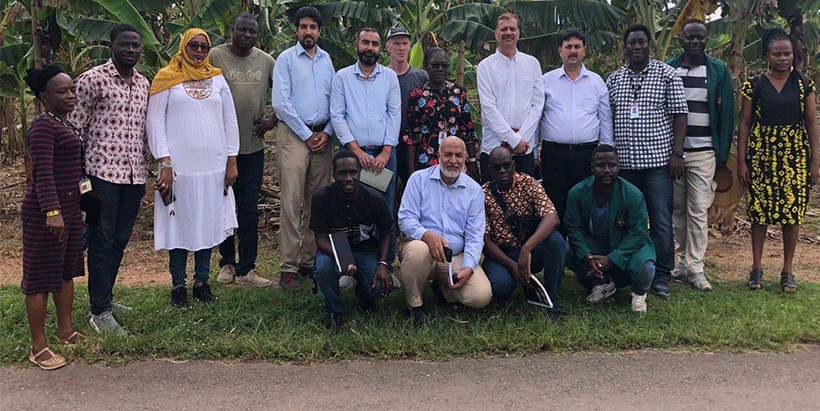
Training participants visited research fields of Banana and Plantain Improvement Unit and discussed potential areas of collaboration with Dr. Delphine Amah and Dr. Yao Kolombia.

The Pakistan delegation aims to implement similar strategies to reduce losses among Pakistani farmers. Several potential areas of collaboration, in addition to aflatoxin biocontrol, were discussed. IER Sorghum Pathologist Dr Karim Dagno emphasized the need for this training and knowledge-sharing experience, especially because in Mali, aflatoxin is a great challenge, leading to the closure of numerous industries because of the inability to source enough quantities of aflatoxin-safe crops. He extended his gratitude to IITA for supporting farmers in protecting their crops. IITA Director General Dr Simeon Ehui encouraged participants to design and implement biocontrol strategies similar to those underway in several African countries and gave several recommendations to foster collaboration in years to come.

The training program is part of the actions of the IITA Aflasafe Initiative aiming to transfer know-how and experiences in the development, testing, registration, and technology transfer of aflatoxin biocontrol obtained in over 20 years in more than 20 African countries through collaboration with USDA-ARS, alongside multiple public and private sector partners.

Contributed by Alejandro Ortega-Beltran


Contribué par

Nouvelles connexes

Aucun article trouvé

Laisser un commentaire

Votre adresse e-mail ne sera pas publiée. Les champs obligatoires sont indiqués avec *

Retour en haut
Olaosebikan, Olamide

Olamide Deborah Nwanze est une chercheuse principale spécialisée dans la recherche sur l'approche "genre" afin d'éclairer les politiques de sélection participative et inclusive, de développement de variétés et de systèmes semenciers concernant les cultures de racines, tubercules et bananes (RTB) au siège de l'Institut International d'Agriculture Tropicale, à Ibadan, au Nigeria. Elle est candidate au doctorat à l'Université d'Ibadan et titulaire d'un master et d'un diplôme d'ingénieur agronome en vulgarisation agricole et développement rural. Olamide est membre du programme African Women in Agricultural Research and Development – Gender Responsive Agricultural Systems Policy (SAISIE DE RÉCOMPENSEet les Chercheuses Sensibles au Genre Équipées pour la Transformation Agricole (SUPER. Elle cherche à appliquer ses apprentissages en matière d’approche genre, recherche sensible au genre, et expertise en développement et examen de politiques pour faciliter l’accès et l’adoption par les femmes, les jeunes, les enfants et les groupes sociaux vulnérables aux innovations agricoles qui garantissent la sécurité alimentaire, nutritionnelle, des revenus et des moyens de subsistance en Afrique. Ses rôles actuels comprennent le mentorat de chercheurs stagiaires, le développement de guides et manuels de formation, la mise en œuvre et l'adaptation de cadres et d'outils genre, l'engagement des acteurs de la chaîne de valeur en tant que partenaires de la science citoyenne, l'examen et la refonte des politiques, la gestion et l'analyse des données. Ses recherches actuelles portent sur les méthodes mixtes ainsi que sur les approches participatives et interdisciplinaires pour saisir et mettre en évidence les dynamiques de genre, les besoins, les préférences et les défis rencontrés par les parties prenantes au sein de la chaîne de valeur des moyens de subsistance agricoles afin de prioriser des stratégies axées sur le genre dans les programmes de sélection, la conception et la mise en œuvre des politiques.

À l'IITA, elle contribue à la mise en œuvre du CGIAR Initiative d'Élevage Accéléré et Innovation génétique Programmes ; recherche participative et genre au sein des Prochaine Génération ManiocHarvestPlusRTBAliments, et Tricot-ClimMob 1000Fermes Projets ; et la communication des connaissances sur le genre via le Série de webinaires G-LENS, vidéo documentaire, notes de politiquepublications, et blogs.


Publications récentes

de Sousa, K., van Etten, J., Manners, R. Bello, A., Teeken, B., Olaosebikan, O., et al. 2024. L'approche tricot : un cadre agile pour les essais décentralisés à la ferme soutenus par la science citoyenne. Une rétrospective. Agron. Sustain. Dev. 44, 8. https://doi.org/10.1007/s13593-023-00937-1

Madu, T., Onwuka, S., Nwafor, S., Onyemauwa, N., Ejechi, M., Ofoeze, M., Ukeje, B., Eluagu, C., Olaosebikan, O., Okoye, B., 2024. Les études sur les consommateurs inclusifs en matière de genre améliorent l'amélioration du manioc au Nigeria dans : Frontiers in Sociology, volume 9, numéro : 1224504, doi : 10.3389/fsoc.2024.1224504

Olaosebikan, O. ; Bello, A. ; Utoblo, O. ; Okoye, B. ; Olutegbe, N. ; Garner, E. ; Teeken, B. ; Bryan, E. ; Forsythe, L. ; Cole, S. ; Madu, T. 2023. Facteurs de stress et résilience au sein de la chaîne de valeur du manioc au Nigeria : Caractéristiques préférées des variétés de manioc et stratégies de réponse des hommes et des femmes pour informer l'amélioration variétale. Sustainability 15, 7837. https://doi.org/10.3390/su15107837

Okoye, B., Ofoeze, M., Ejechi, M., Onwuka, S., Nwafor, S., Onyemauwa, N., Ukeje, B., Eluagu, C., Obidiegwu, J.*, Olaosebikan, O., Madu, T.* 2023. Priorisation des traits préférés dans la chaîne de valeur de l'igname au Nigeria : une analyse de la situation en matière de genre in: Frontiers in Sociology, volume 8, numéro : 1232626, pages 1 – 9, ISSN 2297-7775, 2023. https://www.frontiersin.org/articles/10.3389/fsoc.2023.1232626/full

Olaosebikan, O., Bello, A. A., de Sousa, K., Ndjouenkeu, R., Adesokan, M., Alamu, E. O., Agbona, A., van Etten, J., Kegah, F. N.*, Dufour, D., Bouniol, A., Teeken, B. 2023. Acceptabilité par les consommateurs des produits alimentaires à base de gari-eba de manioc dans des contextes culturels et environnementaux variés en utilisant l'approche triade de comparaison des technologies (tricot) dans : Journal of the Science of Food and Agriculture,

Teeken, B., Olaosebikan, O., Bello, A. A., Madu, T.*, Cole, S. M. 2023. Évaluation qualitative de la positionnalité et des préférences des dyades en relation avec les activités liées au manioc : travailler avec des scientifiques citoyens du procès tricot https://hdl.handle.net/10568/138326 Type : Manuel

Bouniol, A., Ceballos, H., Bello, A. A., Teeken, B., Olaosebikan, O., Owoade, D., Agbona, A., Fotso Kuate, A., Madu, T.*, Okoye, B.*, Ofoeze, M.*, Nwafor, S.*, Onyemauwa, N.*, Adinsi, L.*, Forsythe, L., Dufour, D. 2023. Impact variétal sur le travail des femmes, la charge de travail et la pénibilité associée dans le traitement des plantes à racines, tubercules et bananes : focus sur le manioc en Afrique subsaharienne dans : Journal of the Science of Food and Agriculture, pages 1 – 25, ISSN 0022-5142,

Bello, A. A., Agbona, A., Olaosebikan, O., Edughaen, G., Dufour, D., Bouniol, A., Iluebbey, P., Ndjouenkeu, R.*, Rabbi, I. Y., Teeken, B. 2023. Effets génétiques et environnementaux sur la productivité de la transformation et le rendement des produits alimentaires : la pénibilité du travail des femmes dans : Journal of the Science of Food and Agriculture, pages 1 – 32, ISSN 0022-5142, 5

Cavicchioli, M., Zimbiti, T., Teeken, B., Nwanze, D.O., Liani, M., Parkes, E. & Bello, A. 2023. Rapport sur la formation en sélection génétique sensible au genre à l'IITA. Genetic Resources Center, IITA-HQ, Ibadan, 21-23 septembre 2022. Ibadan, Nigéria : IITA, (34 p.).https://hdl.handle.net/10568/131368

Agbona, A. Peteti P., Teeken B., Olaosebikan O. Bello, A. A., Parkes, E., Rabbi, I. Y., Mueller, L., Egesi, C., Kulakow, P. 2022. Gestion des données dans les programmes d'amélioration des cultures RTB africaines multidisciplinaires. In : Williamson, H.F., Leonelli, S. (eds) Towards Responsible Plant Data Linkage: Data Challenges for Agricultural Research and Development. Springer, Cham. https://doi.org/10.1007/978-3-031-13276-6_5

Lora Forsythe, Pricilla Marimo, Sarah Mayanja, Olamide D. Olaosebikan, Esme Stuart, Bela Teeken, Benjamin Okoye, Tessy Madu, (2021). Analyse transversale du genre dans RTBfoods Étape 2 Cartographie des genres sur les produits RTB. Comprendre les moteurs des préférences en matière de traits et le développement de profils de produits RTB multi-utilisateurs, WP1. Londres, Royaume-Uni : Rapport scientifique de terrain RTBfoods, 30 p.

Teeken, B., Garner, E., Agbona, A., Balogun, I., Olaosebikan, O., Bello, A., Madu, T., Okoye, B., Egesi, C., Kulakow, P. et Tufan, H.A. 2021. Au-delà des “ traits des femmes ” : explorer comment le genre, les différences sociales et les caractéristiques des ménages influencent les préférences pour les traits. Frontiers Systèmes alimentaires durables 5:740926. https://doi.org/10.3389/fsufs.2021.740926

Teeken, B., Agbona, A., Bello, A., Olaosebikan, O., Alamu, E., Adesokan, M., Awoyale, W., Madu, T., Okoye, B., Chijioke, U., Owoade, D., Okoro, M., Bouniol, A., Dufour, D., Hershey, C., Rabbi, I., Maziya‐Dixon, B., Egesi, C., Tufan, H. et Kulakow, P. (020. Comprendre les préférences variétales du manioc par le classement par paires du gari-eba et du fufu préparés par des agriculteurs-transformateurs locaux. Int J Food Sci Technol. https://doi.org/10.1111/ijfs.14862

Bela Teeken, Olamide Olaosebikan, Ireti Balogun, Benjamin Okoye, Tessy Madu, Steven Cole, Abolore Bello, Elizabeth Parkes. (2020). Pilotage des outils de profil client et produit G+ pour l'amélioration sensible au genre du manioc au Nigeria. Nigeria : Institut international d'agriculture tropicale (IIAT). https://hdl.handle.net/20.500.11766/13000