
NOUVELLES DE L'IITA

Tricot: A better method for on-farm crop testing
août 4, 2022

Le Prochaine Génération Manioc Breeding project, the IITA Cassava Breeding Unit, and Sahel Consulting organized a triadic comparison of technologies (Tricot) workshop with the Nigerian variety release committee recently. Sahel Consulting works with the Nigerian Variety Release Committee, through the Collaborative Seed Programme (CSP), to innovate the procedures and approaches used to enable variety release. The workshop proposed employing Tricot as an alternative and better way for on-farm testing with farmers and processors. Representatives from CGIAR research centers and National Agricultural Research and Extension Systems (NARES) from various African countries shared experiences with the Tricot method. The workshop moderated by Prof Chiedozie Egesi, Project Leader for the NextGen Cassava Breeding, highlighted the procedure for variety release, among other key areas.
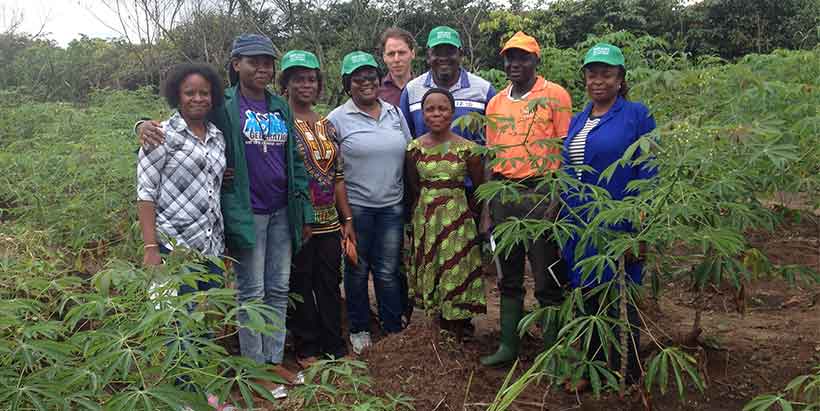
 The Nigerian Tricot research team in a Tricot trial farm for cassava
The Nigerian Tricot research team in a Tricot trial farm for cassava

During the opening remarks, National Variety Release Committee Registrar, Dr Sunday Aladele, shared the idea and process that birthed the need for the Tricot workshop. According to him, consideration to include the Tricot system in the variety release system results from brainstorming on the best way to reduce the length of time and generate more representative on-farm data that will meet the National Variety Release Committee’s requirements for registration and release in Nigeria. “This was because recent studies showed that Nigeria’s variety release system is one of the lengthiest in Africa,” he said. Chinedu Agbara presented the Collaborative Seed Programme objectives that aim to increase efficiency, transparency, and accountability in the variety release system, which will be a critical contributor to a broader seed sector transformation.

Presenting on Tricot insights, Ann Ritah Nanyonjo, a researcher at Uganda’s National Crop Resources Research Institute (NaCRRI) Cassava breeding team, shared Uganda’s experience with Tricot. She mentioned that one good quality of the approach is that many farm households are engaged in the trials. Nanyonjo added that using Tricot trials results in quick dissemination of candidate cassava clones and the release of varieties with farmers-preferred characteristics. “Local seed systems are strengthened because more choices are available to adapt to the changing climate,” she included.
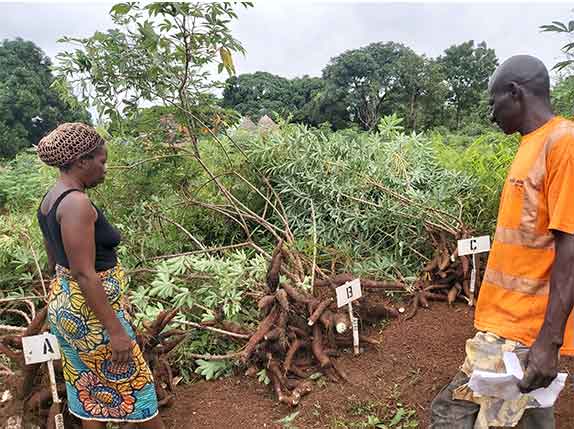
Tricot farmer (female) with the lead farmer (male) who collects data from a group of 10 farmers in Benue State

Jacob Van Etten, Research Director, Alliance of Bioversity International and CIAT, highlighted the benefits of Tricot. According to Van Etten, Tricot enables small and easy tasks for each participant, keeping them motivated. He also mentioned that the process is supported with digital tools resulting in quick analysis and robust data. “Tricot makes new types of partnerships possible,” he added. Sharing next steps, Van Etten stated the need for more capacity building on Tricot; developing protocols for specific crops and contexts; agreeing on the role of Tricot in variety release; and developing new partnerships that can create win-win situations.

Sharing Ghana’s experience with Tricot, Richard Oteng-Frimpong, Head of Groundnut Breeding in Savanah Agricultural Research Institute (CSIR-SARI), spoke about some barriers faced in implementing Tricot in groundnut production. He said requirements for crops with low multiplication rates like groundnut could limit the number of participants. He also mentioned that the availability of a reliable set of participants willing and able to participate in the process needs proper attention and skill. Oteng-Frimpong however, stated that despite the barriers the advantages clearly outweigh the barriers. Tricot has many benefits such as ability to reach large number of farmers and their ability to independently assess new genotypes. Other benefits include the low cost of capturing data and easy-to-do for a large number of people; and the approach does not require extensive training to use with support of the online platform.
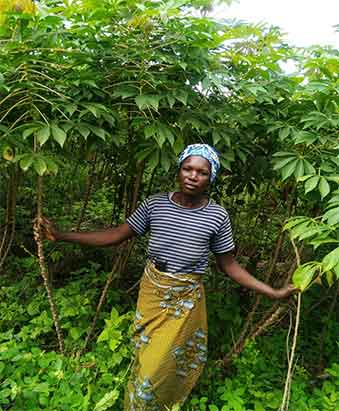
Grace Agi, a farmer and processor, in her baby trial among a Nextgen variety
Grace Agi, a farmer and processor, in her trial among a Nextgen variety

Béla Teeken, Associate Social and Gender Scientist at IITA, shared Nigeria’s experiences with Tricot. Highlighting the gender perspective of the approach, he explained the influence of gender on variety preferences cassava. Teeken mentioned that gender was the most important socio-economic driver on variety selection. He however, emphasized that although gender was not the focus of the workshop, the Tricot method allows easy and standard segregation of participants according to social dimensions and therefore integrates gender and social inclusiveness without much extra effort. The CLimMob online data and data analysis platform (www.climmob.net) is able to provide those social and other dimensions that significantly explain the variability in the data. Such information can be crucial with regard to variety adoption.  Furthermore, Tricot creates a network of experimenting users that can be used for further variety dissemination based on Tricot results and even offers a platform for the communication of other technologies.

Elyse Tuyishime from One Acre Fund in Rwanda shared the country’s experience with Tricot. He stated that Tricot made on-farm testing so much simpler because much time is gained due to the standardized approach in which data entry, cleaning and analysis are so well streamlined and automated with all the room to include particularities related to the country and crop.

Kaue de Sousa, digital inclusion researcher from Alliance of Bioversity International and CIAT, spoke about data analysis of Tricot and how it can be used for decision making. He highlighted the integrative aspects of where Tricot data were combined with climate data. He further highlighted that Tricot expertise will be integrated as a knowledge skill in the curriculum of several African educational institutes and can count as a valuable part of several BSc, MSc and PhD trajectories. He also highlighted that the current 1000farms project especially targets the support of NARES in relation to capacity building needed to apply the approach.

The workshop revealed Tricot’s potential in increasing the visibility of specific preferences by different social segments, ecological regions and intersection with gender. Importantly, it also showed the possibilities of linking Tricot data to climate and breeding data to provide various ways to test breeding trials’ external validity and assess the genetic gain in farmers’ fields.

The workshop took the Nigerian Variety Release Committee along in four areas: including more value chain actors than only farmers; notions of social impact of breeding and more representative feedback from users in general that can provide crucial information on the external validity of breeding trials; the importance of gender differences; and assessing genetic gain in farmer’s fields.

Speaking at the workshop, Dr Ibidun Adetiloye, Desk Officer of National Variety Release Committee, stated that Tricot is a new innovation that has come to stay, serving as an alternative to the present method of on-farm testing. “From the presentations, Tricot is more cost effective and more farmers are involved compared to our current practice. I appreciate IITA and Prof Egesi for organizing the workshop,” she said.

Aladele gave the closing remarks and indicated that the workshop has convincingly shown that it is a viable alternative for on-farm testing of crops for variety release. Prof Egesi wrapped up by appreciating his fellow organizers from various Institutes in CGIAR and also commended participants for their active engagement.

Watch Webinar on TRICOT: an Alternative Method for Crop On-farm Variety Evaluation Trials

Contributed by: Favour Eleta


Contribué par

Recent stories

Aucun article trouvé

Laisser un commentaire

Votre adresse e-mail ne sera pas publiée. Les champs obligatoires sont indiqués avec *

Retour en haut
Olaosebikan, Olamide

Olamide Deborah Nwanze est une chercheuse principale spécialisée dans la recherche sur l'approche "genre" afin d'éclairer les politiques de sélection participative et inclusive, de développement de variétés et de systèmes semenciers concernant les cultures de racines, tubercules et bananes (RTB) au siège de l'Institut International d'Agriculture Tropicale, à Ibadan, au Nigeria. Elle est candidate au doctorat à l'Université d'Ibadan et titulaire d'un master et d'un diplôme d'ingénieur agronome en vulgarisation agricole et développement rural. Olamide est membre du programme African Women in Agricultural Research and Development – Gender Responsive Agricultural Systems Policy (SAISIE DE RÉCOMPENSEet les Chercheuses Sensibles au Genre Équipées pour la Transformation Agricole (SUPER. Elle cherche à appliquer ses apprentissages en matière d’approche genre, recherche sensible au genre, et expertise en développement et examen de politiques pour faciliter l’accès et l’adoption par les femmes, les jeunes, les enfants et les groupes sociaux vulnérables aux innovations agricoles qui garantissent la sécurité alimentaire, nutritionnelle, des revenus et des moyens de subsistance en Afrique. Ses rôles actuels comprennent le mentorat de chercheurs stagiaires, le développement de guides et manuels de formation, la mise en œuvre et l'adaptation de cadres et d'outils genre, l'engagement des acteurs de la chaîne de valeur en tant que partenaires de la science citoyenne, l'examen et la refonte des politiques, la gestion et l'analyse des données. Ses recherches actuelles portent sur les méthodes mixtes ainsi que sur les approches participatives et interdisciplinaires pour saisir et mettre en évidence les dynamiques de genre, les besoins, les préférences et les défis rencontrés par les parties prenantes au sein de la chaîne de valeur des moyens de subsistance agricoles afin de prioriser des stratégies axées sur le genre dans les programmes de sélection, la conception et la mise en œuvre des politiques.

À l'IITA, elle contribue à la mise en œuvre du CGIAR Initiative d'Élevage Accéléré et Innovation génétique Programmes ; recherche participative et genre au sein des Prochaine Génération ManiocHarvestPlusRTBAliments, et Tricot-ClimMob 1000Fermes Projets ; et la communication des connaissances sur le genre via le Série de webinaires G-LENS, vidéo documentaire, notes de politiquepublications, et blogs.


Publications récentes

de Sousa, K., van Etten, J., Manners, R. Bello, A., Teeken, B., Olaosebikan, O., et al. 2024. L'approche tricot : un cadre agile pour les essais décentralisés à la ferme soutenus par la science citoyenne. Une rétrospective. Agron. Sustain. Dev. 44, 8. https://doi.org/10.1007/s13593-023-00937-1

Madu, T., Onwuka, S., Nwafor, S., Onyemauwa, N., Ejechi, M., Ofoeze, M., Ukeje, B., Eluagu, C., Olaosebikan, O., Okoye, B., 2024. Les études sur les consommateurs inclusifs en matière de genre améliorent l'amélioration du manioc au Nigeria dans : Frontiers in Sociology, volume 9, numéro : 1224504, doi : 10.3389/fsoc.2024.1224504

Olaosebikan, O. ; Bello, A. ; Utoblo, O. ; Okoye, B. ; Olutegbe, N. ; Garner, E. ; Teeken, B. ; Bryan, E. ; Forsythe, L. ; Cole, S. ; Madu, T. 2023. Facteurs de stress et résilience au sein de la chaîne de valeur du manioc au Nigeria : Caractéristiques préférées des variétés de manioc et stratégies de réponse des hommes et des femmes pour informer l'amélioration variétale. Sustainability 15, 7837. https://doi.org/10.3390/su15107837

Okoye, B., Ofoeze, M., Ejechi, M., Onwuka, S., Nwafor, S., Onyemauwa, N., Ukeje, B., Eluagu, C., Obidiegwu, J.*, Olaosebikan, O., Madu, T.* 2023. Priorisation des traits préférés dans la chaîne de valeur de l'igname au Nigeria : une analyse de la situation en matière de genre in: Frontiers in Sociology, volume 8, numéro : 1232626, pages 1 – 9, ISSN 2297-7775, 2023. https://www.frontiersin.org/articles/10.3389/fsoc.2023.1232626/full

Olaosebikan, O., Bello, A. A., de Sousa, K., Ndjouenkeu, R., Adesokan, M., Alamu, E. O., Agbona, A., van Etten, J., Kegah, F. N.*, Dufour, D., Bouniol, A., Teeken, B. 2023. Acceptabilité par les consommateurs des produits alimentaires à base de gari-eba de manioc dans des contextes culturels et environnementaux variés en utilisant l'approche triade de comparaison des technologies (tricot) dans : Journal of the Science of Food and Agriculture,

Teeken, B., Olaosebikan, O., Bello, A. A., Madu, T.*, Cole, S. M. 2023. Évaluation qualitative de la positionnalité et des préférences des dyades en relation avec les activités liées au manioc : travailler avec des scientifiques citoyens du procès tricot https://hdl.handle.net/10568/138326 Type : Manuel

Bouniol, A., Ceballos, H., Bello, A. A., Teeken, B., Olaosebikan, O., Owoade, D., Agbona, A., Fotso Kuate, A., Madu, T.*, Okoye, B.*, Ofoeze, M.*, Nwafor, S.*, Onyemauwa, N.*, Adinsi, L.*, Forsythe, L., Dufour, D. 2023. Impact variétal sur le travail des femmes, la charge de travail et la pénibilité associée dans le traitement des plantes à racines, tubercules et bananes : focus sur le manioc en Afrique subsaharienne dans : Journal of the Science of Food and Agriculture, pages 1 – 25, ISSN 0022-5142,

Bello, A. A., Agbona, A., Olaosebikan, O., Edughaen, G., Dufour, D., Bouniol, A., Iluebbey, P., Ndjouenkeu, R.*, Rabbi, I. Y., Teeken, B. 2023. Effets génétiques et environnementaux sur la productivité de la transformation et le rendement des produits alimentaires : la pénibilité du travail des femmes dans : Journal of the Science of Food and Agriculture, pages 1 – 32, ISSN 0022-5142, 5

Cavicchioli, M., Zimbiti, T., Teeken, B., Nwanze, D.O., Liani, M., Parkes, E. & Bello, A. 2023. Rapport sur la formation en sélection génétique sensible au genre à l'IITA. Genetic Resources Center, IITA-HQ, Ibadan, 21-23 septembre 2022. Ibadan, Nigéria : IITA, (34 p.).https://hdl.handle.net/10568/131368

Agbona, A. Peteti P., Teeken B., Olaosebikan O. Bello, A. A., Parkes, E., Rabbi, I. Y., Mueller, L., Egesi, C., Kulakow, P. 2022. Gestion des données dans les programmes d'amélioration des cultures RTB africaines multidisciplinaires. In : Williamson, H.F., Leonelli, S. (eds) Towards Responsible Plant Data Linkage: Data Challenges for Agricultural Research and Development. Springer, Cham. https://doi.org/10.1007/978-3-031-13276-6_5

Lora Forsythe, Pricilla Marimo, Sarah Mayanja, Olamide D. Olaosebikan, Esme Stuart, Bela Teeken, Benjamin Okoye, Tessy Madu, (2021). Analyse transversale du genre dans RTBfoods Étape 2 Cartographie des genres sur les produits RTB. Comprendre les moteurs des préférences en matière de traits et le développement de profils de produits RTB multi-utilisateurs, WP1. Londres, Royaume-Uni : Rapport scientifique de terrain RTBfoods, 30 p.

Teeken, B., Garner, E., Agbona, A., Balogun, I., Olaosebikan, O., Bello, A., Madu, T., Okoye, B., Egesi, C., Kulakow, P. et Tufan, H.A. 2021. Au-delà des “ traits des femmes ” : explorer comment le genre, les différences sociales et les caractéristiques des ménages influencent les préférences pour les traits. Frontiers Systèmes alimentaires durables 5:740926. https://doi.org/10.3389/fsufs.2021.740926

Teeken, B., Agbona, A., Bello, A., Olaosebikan, O., Alamu, E., Adesokan, M., Awoyale, W., Madu, T., Okoye, B., Chijioke, U., Owoade, D., Okoro, M., Bouniol, A., Dufour, D., Hershey, C., Rabbi, I., Maziya‐Dixon, B., Egesi, C., Tufan, H. et Kulakow, P. (020. Comprendre les préférences variétales du manioc par le classement par paires du gari-eba et du fufu préparés par des agriculteurs-transformateurs locaux. Int J Food Sci Technol. https://doi.org/10.1111/ijfs.14862

Bela Teeken, Olamide Olaosebikan, Ireti Balogun, Benjamin Okoye, Tessy Madu, Steven Cole, Abolore Bello, Elizabeth Parkes. (2020). Pilotage des outils de profil client et produit G+ pour l'amélioration sensible au genre du manioc au Nigeria. Nigeria : Institut international d'agriculture tropicale (IIAT). https://hdl.handle.net/20.500.11766/13000