
NOUVELLES DE L'IITA

While we are sleeping – High night temperatures affect our morning coffee
avril 27, 2015

First research report on evidence-based climate change affecting Arabica coffee growing areas calls for immediate action
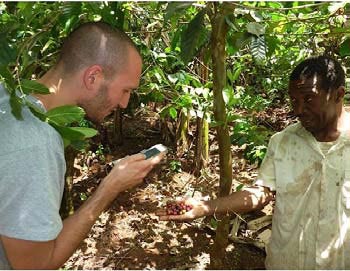
Picture of Aless andro Craparo registering coffee berries with smallholder farmers in Northern Tanzania.
Aless andro Craparo registering coffee berries with smallholder farmers in Northern Tanzania. Photo from P. van Asten.

The first on-the-ground evidence that climate change is already having an impact on the Arabica coffee sector in the East African Highl ands region is shown in a étudier called “Coffea arabica yields decline in Tanzania due to climate change: Global implications” published earlier this month in Agricultural and Forest Meteorology Journal by the Institut International d'Agriculture Tropicale, le International Center for Tropical Agriculture, and the University of Witwatersr and.

The study demonstrates that over the last 49 years, there has been a + 1.42 °C increase in night temperatures which has led to Arabica yield decrease of 195 kg/ha. The consequences for smallholders in the region are dramatic as it represents losses of 46 percent. “Coffee yields have declined to their lowest point in years, with many farmers in Tanzania giving up on coffee completely,” says Aless andro Craparo, the main author of the study.

The sensitive Coffea arabica berries need low temperatures to grow well and produce high quality coffee for consumption, which is why they are best suited to the cool tropical highl ands of East Africa, typically between 1000 – 2300 m above sea level. Using data from the northern Tanzanian highl ands, the study verifies for the first time the increasing night time (minimum) temperature as the most significant climatic variable being responsible for diminishing Arabica coffee yields between 1961 and 2012 and proves that climate change is an ongoing reality. The researchers S andro Craparo, Piet van Asten, Peter Läderach, Laurence Jassogne, and Stefan Grab used independent open-access datasets, which confirm that out of many climate variables, night temperature has the greatest correlation to coffee production.

The results of the study projected forward means that without substantial adaptation strategies, the average coffee production in Tanzania will drop to 145 ± 41 kg/ha by 2060. This is approximately an additional 35% loss in yield for the farmer, which could mean a decrease of up to US$28 million in Arabica export earnings for the country.

“The industry is aware of the impact of climate change on coffee production, but they need hard data to prove to regional decision makers, how urgently climate mitigation strategies need to be put in place,” says Dr Piet van Asten, IITA Country Representative in Ug anda and agronomist working on sustainable intensification of cropping systems. “The study is the first of its kind globally providing essential time-series evidence that climate change has already had a negative impact onCoffea arabica yields.” Whereas most coffee research focused on changes in rainfall and mean temperature, this study revealed that minimum temperatures are the biggest threat: the hotter the nights get, the higher the danger for Arabicacoffee production.

Contrary to the typical constraints found in coffee research linked to rainfall and drought stress and the climate projections for future scenarios deriving from it, the observation of minimum temperatures needed for coffee growing leads to clear empiric data and biological relationships–the hotter the nights get, the higher the danger for Arabica coffee production.

At night temperatures of 15 °C and above, the plant’s metabolism starts to change, leading to lower yields and reduced quality, which will have a significant impact on the coffee industries and processors.

The study, which was done under the CGIAR Research Program on Climate, Agriculture and Food Security , and partly financed by funds from the German Federal Ministry of Economic Cooperation and Development, BMZ, may give the coffee sector the hard figures required to encourage the public and the private sector to invest in climate change adaptation strategies that will better sustain the industry and the livelihoods of millions of smallholder farmers who depend on it.

For more information:

Andrea Gros, Head of Communication, IITA HQ, a.gros@cgiar.org
Catherine Njuguna, Communication Officer, IITA-Tanzania, c.njuguna@cgiar.org

À propos de l'IITA, www.iita.org

IITA is one of the world’s leading research partners in finding solutions for hunger, malnutrition, and poverty. Its award-winning research for development (R4D) approach addresses the development needs of tropical countries. IITA works with partners to enhance crop quality and productivity, reduce producer and consumer risks, and generate wealth from agriculture. IITA is a nonprofit organization founded in 1967 and governed by a Board of Trustees. IITA works on the following crops: cowpea, soybean, banana/plantain, yam, cassava, and maize. IITA is a member of CGIAR, a global agriculture research partnership for a food secure future.

About WITS www.wits.ac.za
Wits, a world-class research university in Africa, is renowned for its commitment to academic and research excellence. It contributes to the global knowledge economy and local transformation through the generation of high level, scarce skills and innovative research. At the forefront of a changing society, Wits is an engaged institution, dedicated to advancing the public good. It promotes intellectual communities and attracts talented students, distinguished academics and thinkers from around the globe.


Contribué par

Nouvelles connexes

Aucun article trouvé

Laisser un commentaire

Votre adresse e-mail ne sera pas publiée. Les champs obligatoires sont indiqués avec *

Retour en haut
Olaosebikan, Olamide

Olamide Deborah Nwanze est une chercheuse principale spécialisée dans la recherche sur l'approche "genre" afin d'éclairer les politiques de sélection participative et inclusive, de développement de variétés et de systèmes semenciers concernant les cultures de racines, tubercules et bananes (RTB) au siège de l'Institut International d'Agriculture Tropicale, à Ibadan, au Nigeria. Elle est candidate au doctorat à l'Université d'Ibadan et titulaire d'un master et d'un diplôme d'ingénieur agronome en vulgarisation agricole et développement rural. Olamide est membre du programme African Women in Agricultural Research and Development – Gender Responsive Agricultural Systems Policy (SAISIE DE RÉCOMPENSEet les Chercheuses Sensibles au Genre Équipées pour la Transformation Agricole (SUPER. Elle cherche à appliquer ses apprentissages en matière d’approche genre, recherche sensible au genre, et expertise en développement et examen de politiques pour faciliter l’accès et l’adoption par les femmes, les jeunes, les enfants et les groupes sociaux vulnérables aux innovations agricoles qui garantissent la sécurité alimentaire, nutritionnelle, des revenus et des moyens de subsistance en Afrique. Ses rôles actuels comprennent le mentorat de chercheurs stagiaires, le développement de guides et manuels de formation, la mise en œuvre et l'adaptation de cadres et d'outils genre, l'engagement des acteurs de la chaîne de valeur en tant que partenaires de la science citoyenne, l'examen et la refonte des politiques, la gestion et l'analyse des données. Ses recherches actuelles portent sur les méthodes mixtes ainsi que sur les approches participatives et interdisciplinaires pour saisir et mettre en évidence les dynamiques de genre, les besoins, les préférences et les défis rencontrés par les parties prenantes au sein de la chaîne de valeur des moyens de subsistance agricoles afin de prioriser des stratégies axées sur le genre dans les programmes de sélection, la conception et la mise en œuvre des politiques.

À l'IITA, elle contribue à la mise en œuvre du CGIAR Initiative d'Élevage Accéléré et Innovation génétique Programmes ; recherche participative et genre au sein des Prochaine Génération ManiocHarvestPlusRTBAliments, et Tricot-ClimMob 1000Fermes Projets ; et la communication des connaissances sur le genre via le Série de webinaires G-LENS, vidéo documentaire, notes de politiquepublications, et blogs.


Publications récentes

de Sousa, K., van Etten, J., Manners, R. Bello, A., Teeken, B., Olaosebikan, O., et al. 2024. L'approche tricot : un cadre agile pour les essais décentralisés à la ferme soutenus par la science citoyenne. Une rétrospective. Agron. Sustain. Dev. 44, 8. https://doi.org/10.1007/s13593-023-00937-1

Madu, T., Onwuka, S., Nwafor, S., Onyemauwa, N., Ejechi, M., Ofoeze, M., Ukeje, B., Eluagu, C., Olaosebikan, O., Okoye, B., 2024. Les études sur les consommateurs inclusifs en matière de genre améliorent l'amélioration du manioc au Nigeria dans : Frontiers in Sociology, volume 9, numéro : 1224504, doi : 10.3389/fsoc.2024.1224504

Olaosebikan, O. ; Bello, A. ; Utoblo, O. ; Okoye, B. ; Olutegbe, N. ; Garner, E. ; Teeken, B. ; Bryan, E. ; Forsythe, L. ; Cole, S. ; Madu, T. 2023. Facteurs de stress et résilience au sein de la chaîne de valeur du manioc au Nigeria : Caractéristiques préférées des variétés de manioc et stratégies de réponse des hommes et des femmes pour informer l'amélioration variétale. Sustainability 15, 7837. https://doi.org/10.3390/su15107837

Okoye, B., Ofoeze, M., Ejechi, M., Onwuka, S., Nwafor, S., Onyemauwa, N., Ukeje, B., Eluagu, C., Obidiegwu, J.*, Olaosebikan, O., Madu, T.* 2023. Priorisation des traits préférés dans la chaîne de valeur de l'igname au Nigeria : une analyse de la situation en matière de genre in: Frontiers in Sociology, volume 8, numéro : 1232626, pages 1 – 9, ISSN 2297-7775, 2023. https://www.frontiersin.org/articles/10.3389/fsoc.2023.1232626/full

Olaosebikan, O., Bello, A. A., de Sousa, K., Ndjouenkeu, R., Adesokan, M., Alamu, E. O., Agbona, A., van Etten, J., Kegah, F. N.*, Dufour, D., Bouniol, A., Teeken, B. 2023. Acceptabilité par les consommateurs des produits alimentaires à base de gari-eba de manioc dans des contextes culturels et environnementaux variés en utilisant l'approche triade de comparaison des technologies (tricot) dans : Journal of the Science of Food and Agriculture,

Teeken, B., Olaosebikan, O., Bello, A. A., Madu, T.*, Cole, S. M. 2023. Évaluation qualitative de la positionnalité et des préférences des dyades en relation avec les activités liées au manioc : travailler avec des scientifiques citoyens du procès tricot https://hdl.handle.net/10568/138326 Type : Manuel

Bouniol, A., Ceballos, H., Bello, A. A., Teeken, B., Olaosebikan, O., Owoade, D., Agbona, A., Fotso Kuate, A., Madu, T.*, Okoye, B.*, Ofoeze, M.*, Nwafor, S.*, Onyemauwa, N.*, Adinsi, L.*, Forsythe, L., Dufour, D. 2023. Impact variétal sur le travail des femmes, la charge de travail et la pénibilité associée dans le traitement des plantes à racines, tubercules et bananes : focus sur le manioc en Afrique subsaharienne dans : Journal of the Science of Food and Agriculture, pages 1 – 25, ISSN 0022-5142,

Bello, A. A., Agbona, A., Olaosebikan, O., Edughaen, G., Dufour, D., Bouniol, A., Iluebbey, P., Ndjouenkeu, R.*, Rabbi, I. Y., Teeken, B. 2023. Effets génétiques et environnementaux sur la productivité de la transformation et le rendement des produits alimentaires : la pénibilité du travail des femmes dans : Journal of the Science of Food and Agriculture, pages 1 – 32, ISSN 0022-5142, 5

Cavicchioli, M., Zimbiti, T., Teeken, B., Nwanze, D.O., Liani, M., Parkes, E. & Bello, A. 2023. Rapport sur la formation en sélection génétique sensible au genre à l'IITA. Genetic Resources Center, IITA-HQ, Ibadan, 21-23 septembre 2022. Ibadan, Nigéria : IITA, (34 p.).https://hdl.handle.net/10568/131368

Agbona, A. Peteti P., Teeken B., Olaosebikan O. Bello, A. A., Parkes, E., Rabbi, I. Y., Mueller, L., Egesi, C., Kulakow, P. 2022. Gestion des données dans les programmes d'amélioration des cultures RTB africaines multidisciplinaires. In : Williamson, H.F., Leonelli, S. (eds) Towards Responsible Plant Data Linkage: Data Challenges for Agricultural Research and Development. Springer, Cham. https://doi.org/10.1007/978-3-031-13276-6_5

Lora Forsythe, Pricilla Marimo, Sarah Mayanja, Olamide D. Olaosebikan, Esme Stuart, Bela Teeken, Benjamin Okoye, Tessy Madu, (2021). Analyse transversale du genre dans RTBfoods Étape 2 Cartographie des genres sur les produits RTB. Comprendre les moteurs des préférences en matière de traits et le développement de profils de produits RTB multi-utilisateurs, WP1. Londres, Royaume-Uni : Rapport scientifique de terrain RTBfoods, 30 p.

Teeken, B., Garner, E., Agbona, A., Balogun, I., Olaosebikan, O., Bello, A., Madu, T., Okoye, B., Egesi, C., Kulakow, P. et Tufan, H.A. 2021. Au-delà des “ traits des femmes ” : explorer comment le genre, les différences sociales et les caractéristiques des ménages influencent les préférences pour les traits. Frontiers Systèmes alimentaires durables 5:740926. https://doi.org/10.3389/fsufs.2021.740926

Teeken, B., Agbona, A., Bello, A., Olaosebikan, O., Alamu, E., Adesokan, M., Awoyale, W., Madu, T., Okoye, B., Chijioke, U., Owoade, D., Okoro, M., Bouniol, A., Dufour, D., Hershey, C., Rabbi, I., Maziya‐Dixon, B., Egesi, C., Tufan, H. et Kulakow, P. (020. Comprendre les préférences variétales du manioc par le classement par paires du gari-eba et du fufu préparés par des agriculteurs-transformateurs locaux. Int J Food Sci Technol. https://doi.org/10.1111/ijfs.14862

Bela Teeken, Olamide Olaosebikan, Ireti Balogun, Benjamin Okoye, Tessy Madu, Steven Cole, Abolore Bello, Elizabeth Parkes. (2020). Pilotage des outils de profil client et produit G+ pour l'amélioration sensible au genre du manioc au Nigeria. Nigeria : Institut international d'agriculture tropicale (IIAT). https://hdl.handle.net/20.500.11766/13000