
NOUVELLES DE L'IITA

IITA and partners look forward to a better CocoaSoils program
juin 14, 2022

IITA and partners organized an annual CocoaSoils forum themed “Looking back and moving forward: Overview of results, achievements, and key learnings” on 12 May. The conference highlighted the progress achieved and defined priorities for the program’s next phase.
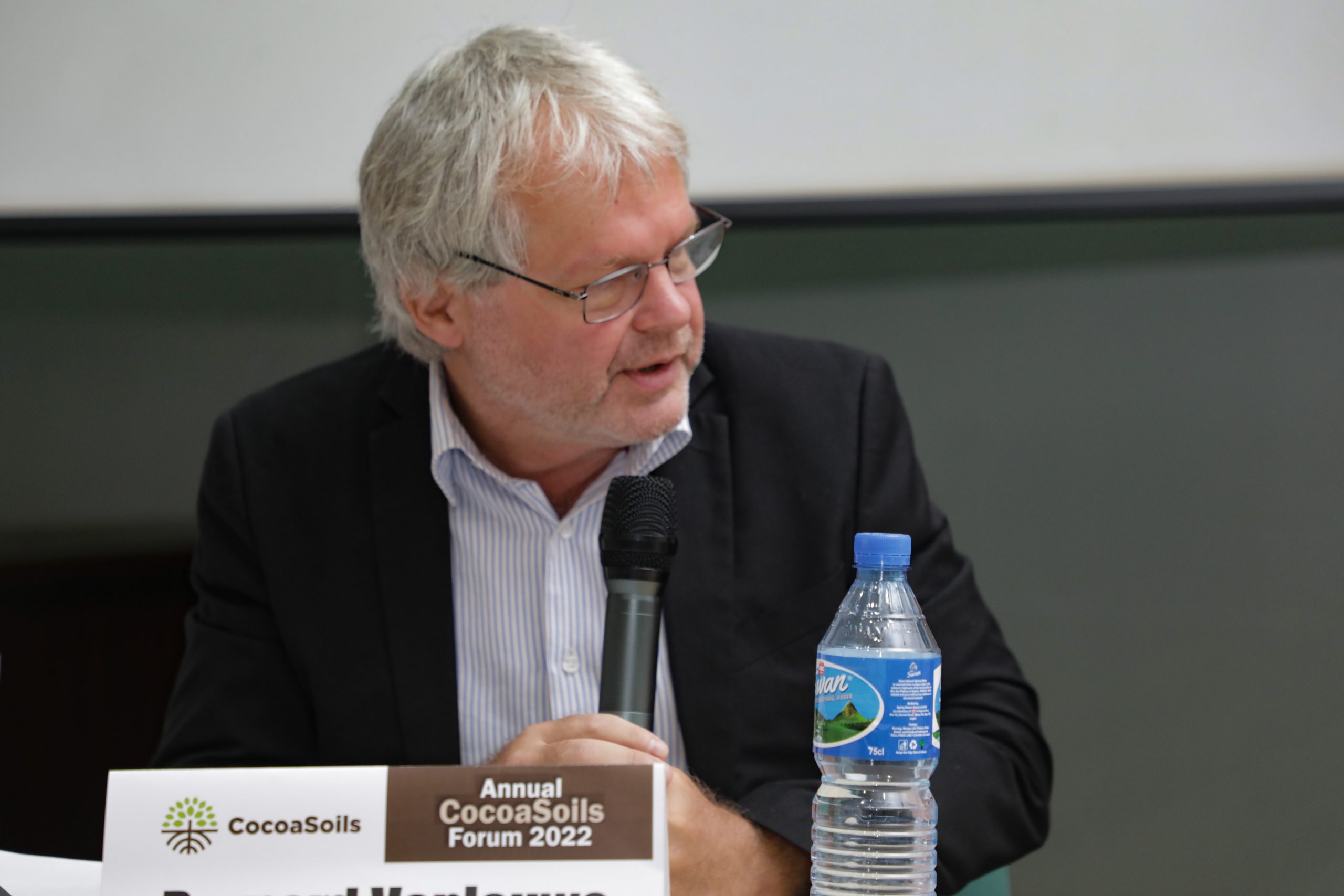
Bernard Vanlauwe welcoming participants at the forum

During the welcome address, the Director R4D, Central Africa and Natural Resource Management, Bernard Vanlauwe, said the forum aims to support the private and public sectors to improve the livelihood of cocoa farmers. Following the output presentation, Vanluawe stated, “We will be starting a second phase of the program to ensure we have conclusive data from the core and satellite trials.”

He said that the program would capitalize on the challenges encountered in the first phase and how Cocoasoils will feature in the new CGIAR.

The Senior Adviser, Norwegian Agency for Development Cooperation (Norad), Department for Climate, Energy, and Environment, Daniel van Gilst, summarized the CocoaSoils program. He said the annual forum focuses on Cocoa research with past meetings held in Ghana, Cameroon, and virtually in 2021. He noted that, based on the research outputs, Norad finds the program unique and full of potential and commits to “continue our support through the CGIAR Excellence in Agronomy initiatives,” he said.
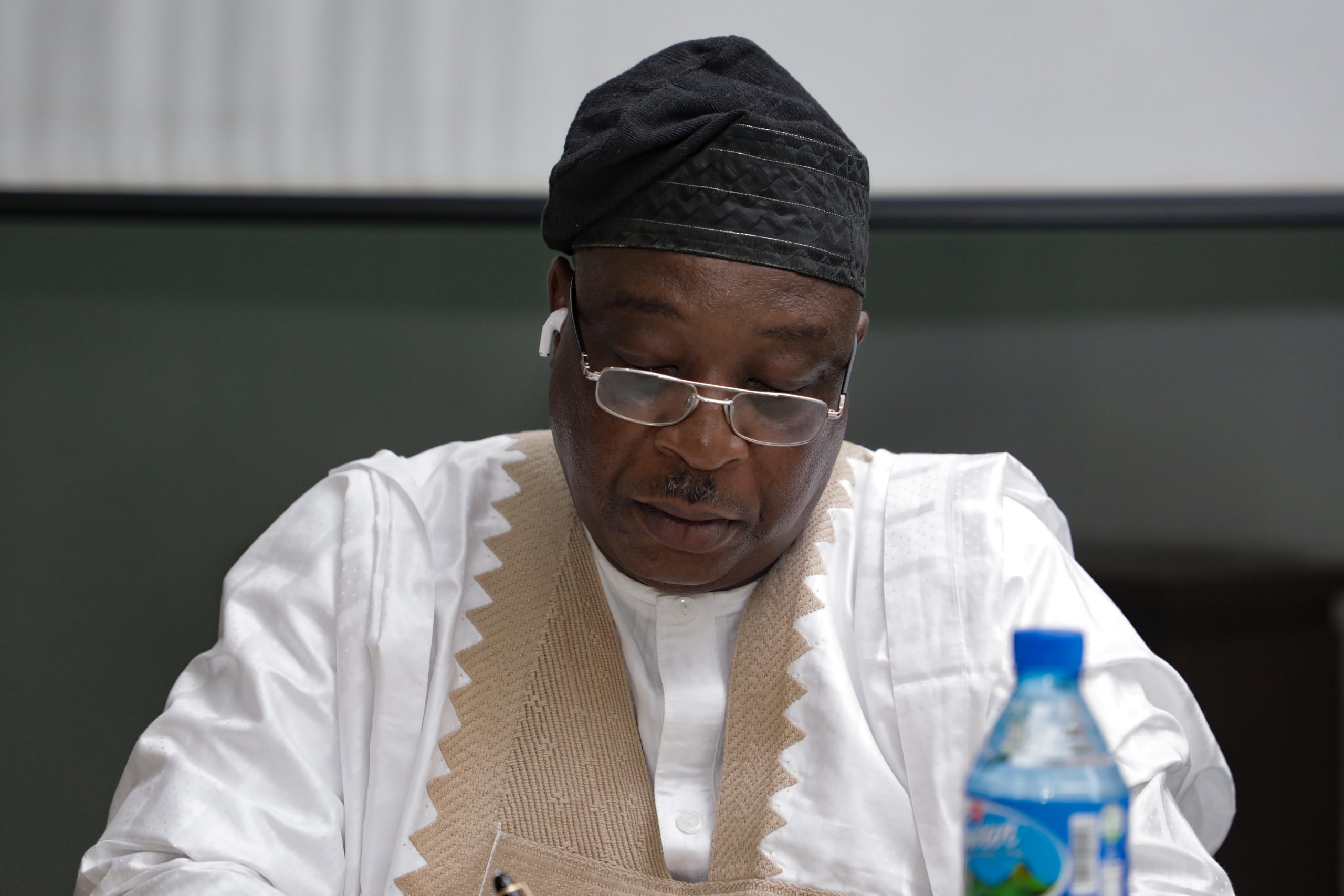
Engr Frank Kudla explaining how the findings would contribute to improving Nigeria’s economy

The Executive Director, Cocoa Research Institute of Nigeria (CRIN), Dr Patrick Adebola, commended the program for considering the issue of soil fertility and soil degradation affecting cocoa production and the program’s structure that is end-users inclusive. He added that “CRIN is delighted to be part of the program, and we will give our utmost support for it.”

Representing Dr Mohammad Abubakar, the Federal Minister of Agriculture and Rural Development (FMARD), FMARD Director of Extension, Engr Frank Kudla, complemented IITA, Norad, and other partners on the implementation strategies of CocoaSoils, and for providing all stakeholders, including farmers and extension agents, with a manual guide to decrease deforestation and increase productivity in cocoa.

Kudla said FMARD would ensure all research findings and lessons learned from Partnerships for Delivery (P4D) are adopted in the National Agricultural Extension System (NARES). “The findings will be used to meet our cocoa agronomic practices, global competitiveness to ensure food security, and improve Nigeria’s economy,” he stated.
Daniel van Glist explaining the uniqueness of the CocoaSoils program

The CocoaSoils Monitoring and Evaluation Specialist, Theresa Ampadu-Boakye, gave an overview of the results, achievements, and key learnings from the first phase of the program. She shared some of the achievements, including training 625 extension agents and 65,066 smallholder cocoa farmers on Integrated Soil Fertility Management (ISFM) and Good Agriculture Practices (GAPs), the establishment of 383 satellite trials in the four countries—Cameroon, Côte d’Ivoire, Ghana, and Nigeria—across various ecological zones. She added that private and public stakeholder partners use new cocoa ISFM-related research products. Decision-makers use tools and knowledge to avoid increased deforestation and child labor while promoting intensified cocoa production.

Similarly, the multi-stakeholder and multiple-country approaches provide a conveying platform to address the challenges faced by the cocoa industry; and partnerships with the private sector serve as an excellent avenue for data sharing and sustain the dissemination of both existing and new research recommendations.

Wageningen University and Research (WUR) Professor of Plants Production Systems, Ken Giller, moderated a panel discussion where Mondelez International Research and Development Head Dr Emmanuel Kassin, COCOBOD Research Scientist Dr Prince Pobee, and CRIN Research Scientist Dr Moses Ogunlade shared their thoughts on closing knowledge gaps.

Vanlauwe highlighted how the Excellence in Agronomy initiative would impact the future CocoaSoils program. He further explained the six elements that will deliver targets in the second phase: active partners engaging with cocoa farmers, sourcing areas of scaling partners, agronomy products for zero-deforestation cocoa intensification, scaling networks of partners, co-support of partners, and development of public goods.

He also outlined some of the activities in the second phase of the program, including selecting Core and Satellite trials, discontinuing those that are unlikely to deliver any beneficial result, developing the stepwise platform for perennial agronomy, and renewing the CocoaSoils consortium agreement.

Contributed by Anita Akinyomade


Contribué par

Nouvelles connexes

Aucun article trouvé

Laisser un commentaire

Votre adresse e-mail ne sera pas publiée. Les champs obligatoires sont indiqués avec *

Retour en haut
Olaosebikan, Olamide

Olamide Deborah Nwanze est une chercheuse principale spécialisée dans la recherche sur l'approche "genre" afin d'éclairer les politiques de sélection participative et inclusive, de développement de variétés et de systèmes semenciers concernant les cultures de racines, tubercules et bananes (RTB) au siège de l'Institut International d'Agriculture Tropicale, à Ibadan, au Nigeria. Elle est candidate au doctorat à l'Université d'Ibadan et titulaire d'un master et d'un diplôme d'ingénieur agronome en vulgarisation agricole et développement rural. Olamide est membre du programme African Women in Agricultural Research and Development – Gender Responsive Agricultural Systems Policy (SAISIE DE RÉCOMPENSEet les Chercheuses Sensibles au Genre Équipées pour la Transformation Agricole (SUPER. Elle cherche à appliquer ses apprentissages en matière d’approche genre, recherche sensible au genre, et expertise en développement et examen de politiques pour faciliter l’accès et l’adoption par les femmes, les jeunes, les enfants et les groupes sociaux vulnérables aux innovations agricoles qui garantissent la sécurité alimentaire, nutritionnelle, des revenus et des moyens de subsistance en Afrique. Ses rôles actuels comprennent le mentorat de chercheurs stagiaires, le développement de guides et manuels de formation, la mise en œuvre et l'adaptation de cadres et d'outils genre, l'engagement des acteurs de la chaîne de valeur en tant que partenaires de la science citoyenne, l'examen et la refonte des politiques, la gestion et l'analyse des données. Ses recherches actuelles portent sur les méthodes mixtes ainsi que sur les approches participatives et interdisciplinaires pour saisir et mettre en évidence les dynamiques de genre, les besoins, les préférences et les défis rencontrés par les parties prenantes au sein de la chaîne de valeur des moyens de subsistance agricoles afin de prioriser des stratégies axées sur le genre dans les programmes de sélection, la conception et la mise en œuvre des politiques.

À l'IITA, elle contribue à la mise en œuvre du CGIAR Initiative d'Élevage Accéléré et Innovation génétique Programmes ; recherche participative et genre au sein des Prochaine Génération ManiocHarvestPlusRTBAliments, et Tricot-ClimMob 1000Fermes Projets ; et la communication des connaissances sur le genre via le Série de webinaires G-LENS, vidéo documentaire, notes de politiquepublications, et blogs.


Publications récentes

de Sousa, K., van Etten, J., Manners, R. Bello, A., Teeken, B., Olaosebikan, O., et al. 2024. L'approche tricot : un cadre agile pour les essais décentralisés à la ferme soutenus par la science citoyenne. Une rétrospective. Agron. Sustain. Dev. 44, 8. https://doi.org/10.1007/s13593-023-00937-1

Madu, T., Onwuka, S., Nwafor, S., Onyemauwa, N., Ejechi, M., Ofoeze, M., Ukeje, B., Eluagu, C., Olaosebikan, O., Okoye, B., 2024. Les études sur les consommateurs inclusifs en matière de genre améliorent l'amélioration du manioc au Nigeria dans : Frontiers in Sociology, volume 9, numéro : 1224504, doi : 10.3389/fsoc.2024.1224504

Olaosebikan, O. ; Bello, A. ; Utoblo, O. ; Okoye, B. ; Olutegbe, N. ; Garner, E. ; Teeken, B. ; Bryan, E. ; Forsythe, L. ; Cole, S. ; Madu, T. 2023. Facteurs de stress et résilience au sein de la chaîne de valeur du manioc au Nigeria : Caractéristiques préférées des variétés de manioc et stratégies de réponse des hommes et des femmes pour informer l'amélioration variétale. Sustainability 15, 7837. https://doi.org/10.3390/su15107837

Okoye, B., Ofoeze, M., Ejechi, M., Onwuka, S., Nwafor, S., Onyemauwa, N., Ukeje, B., Eluagu, C., Obidiegwu, J.*, Olaosebikan, O., Madu, T.* 2023. Priorisation des traits préférés dans la chaîne de valeur de l'igname au Nigeria : une analyse de la situation en matière de genre in: Frontiers in Sociology, volume 8, numéro : 1232626, pages 1 – 9, ISSN 2297-7775, 2023. https://www.frontiersin.org/articles/10.3389/fsoc.2023.1232626/full

Olaosebikan, O., Bello, A. A., de Sousa, K., Ndjouenkeu, R., Adesokan, M., Alamu, E. O., Agbona, A., van Etten, J., Kegah, F. N.*, Dufour, D., Bouniol, A., Teeken, B. 2023. Acceptabilité par les consommateurs des produits alimentaires à base de gari-eba de manioc dans des contextes culturels et environnementaux variés en utilisant l'approche triade de comparaison des technologies (tricot) dans : Journal of the Science of Food and Agriculture,

Teeken, B., Olaosebikan, O., Bello, A. A., Madu, T.*, Cole, S. M. 2023. Évaluation qualitative de la positionnalité et des préférences des dyades en relation avec les activités liées au manioc : travailler avec des scientifiques citoyens du procès tricot https://hdl.handle.net/10568/138326 Type : Manuel

Bouniol, A., Ceballos, H., Bello, A. A., Teeken, B., Olaosebikan, O., Owoade, D., Agbona, A., Fotso Kuate, A., Madu, T.*, Okoye, B.*, Ofoeze, M.*, Nwafor, S.*, Onyemauwa, N.*, Adinsi, L.*, Forsythe, L., Dufour, D. 2023. Impact variétal sur le travail des femmes, la charge de travail et la pénibilité associée dans le traitement des plantes à racines, tubercules et bananes : focus sur le manioc en Afrique subsaharienne dans : Journal of the Science of Food and Agriculture, pages 1 – 25, ISSN 0022-5142,

Bello, A. A., Agbona, A., Olaosebikan, O., Edughaen, G., Dufour, D., Bouniol, A., Iluebbey, P., Ndjouenkeu, R.*, Rabbi, I. Y., Teeken, B. 2023. Effets génétiques et environnementaux sur la productivité de la transformation et le rendement des produits alimentaires : la pénibilité du travail des femmes dans : Journal of the Science of Food and Agriculture, pages 1 – 32, ISSN 0022-5142, 5

Cavicchioli, M., Zimbiti, T., Teeken, B., Nwanze, D.O., Liani, M., Parkes, E. & Bello, A. 2023. Rapport sur la formation en sélection génétique sensible au genre à l'IITA. Genetic Resources Center, IITA-HQ, Ibadan, 21-23 septembre 2022. Ibadan, Nigéria : IITA, (34 p.).https://hdl.handle.net/10568/131368

Agbona, A. Peteti P., Teeken B., Olaosebikan O. Bello, A. A., Parkes, E., Rabbi, I. Y., Mueller, L., Egesi, C., Kulakow, P. 2022. Gestion des données dans les programmes d'amélioration des cultures RTB africaines multidisciplinaires. In : Williamson, H.F., Leonelli, S. (eds) Towards Responsible Plant Data Linkage: Data Challenges for Agricultural Research and Development. Springer, Cham. https://doi.org/10.1007/978-3-031-13276-6_5

Lora Forsythe, Pricilla Marimo, Sarah Mayanja, Olamide D. Olaosebikan, Esme Stuart, Bela Teeken, Benjamin Okoye, Tessy Madu, (2021). Analyse transversale du genre dans RTBfoods Étape 2 Cartographie des genres sur les produits RTB. Comprendre les moteurs des préférences en matière de traits et le développement de profils de produits RTB multi-utilisateurs, WP1. Londres, Royaume-Uni : Rapport scientifique de terrain RTBfoods, 30 p.

Teeken, B., Garner, E., Agbona, A., Balogun, I., Olaosebikan, O., Bello, A., Madu, T., Okoye, B., Egesi, C., Kulakow, P. et Tufan, H.A. 2021. Au-delà des “ traits des femmes ” : explorer comment le genre, les différences sociales et les caractéristiques des ménages influencent les préférences pour les traits. Frontiers Systèmes alimentaires durables 5:740926. https://doi.org/10.3389/fsufs.2021.740926

Teeken, B., Agbona, A., Bello, A., Olaosebikan, O., Alamu, E., Adesokan, M., Awoyale, W., Madu, T., Okoye, B., Chijioke, U., Owoade, D., Okoro, M., Bouniol, A., Dufour, D., Hershey, C., Rabbi, I., Maziya‐Dixon, B., Egesi, C., Tufan, H. et Kulakow, P. (020. Comprendre les préférences variétales du manioc par le classement par paires du gari-eba et du fufu préparés par des agriculteurs-transformateurs locaux. Int J Food Sci Technol. https://doi.org/10.1111/ijfs.14862

Bela Teeken, Olamide Olaosebikan, Ireti Balogun, Benjamin Okoye, Tessy Madu, Steven Cole, Abolore Bello, Elizabeth Parkes. (2020). Pilotage des outils de profil client et produit G+ pour l'amélioration sensible au genre du manioc au Nigeria. Nigeria : Institut international d'agriculture tropicale (IIAT). https://hdl.handle.net/20.500.11766/13000