
NOUVELLES DE L'IITA

The Village-Based Advisor approach thrives in Burundi
juillet 8, 2024

Farmers observing a beans demonstration plot and learning best practices to apply in their own farms.

The concept of Farmer Promoters was previously unknown in Burundi, but it is no longer novel, thanks to the Kugwiza Project—the name by which the AID-I GLR Project is known in Burundi. Today, Farmer Promoters—locally known as Village-Based Advisors (VBAs) or lead farmers—are commonplace, having been introduced by the project. These VBAs play a crucial role in mobilizing farmers. They introduce new crop varieties to farmers and guide them in establishing baby demonstration plots of different food-security crops, which the VBAs monitor subsequently. The leading-by-doing and facilitative roles VBAs play will likely outlive the project. It would likely thrive beyond the Kugwiza Project, thus boosting community social capital now and in the future.

VBA is an innovative approach that involves engaging lead farmers within the community to serve as role models and advisors on various agricultural and livestock practices. The VBAs, who are also farmers and opinion leaders in their villages, demonstrate effective farming techniques on their own plots.
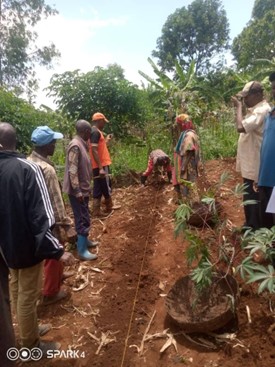
Learning by doing: Farmers in Rango Commune, Tara village, Burundi, learning good agronomic practices from their neighboring fellow farmer.

With the need to foster trust and visible and credible results, especially in peer-led programs, this model readily promotes trust and rapidly encourages other farmers to adopt and implement the new practices promoted and practiced by one of their own. Before they replicate the methods on their plots, farmers first see the tangible results the VBAs achieved for themselves.

Also, when information is from a familiar and trusted farmer within their community, farmers listen attentively and implement the advice swiftly.

The story of Generose Ahokwizera exemplifies this peer-to-peer learning approach.

Generose’s journey mirrors those of many beneficiaries of the small-pack approach, who moved from skepticism to advocacy.

“At first, I was against this approach: I saw no advantage in receiving a tiny seed pack of a mere 100 grams. I thought it was too small to be useful,” Generose recalled.

Through continuous capacity-building and sensitization by project partners in various community forums, farmers, including Generose, began to understand and appreciate the benefits of the small-pack approach.

“The project’s agronomists, in collaboration with local administration, held a gathering to explain the approach. Everyone was invited to participate in a demonstration field day for bean planting. I attended and gradually became convinced of the effectiveness of the small-pack approach,” she explained.

“Later, farmers in my community selected me to be their VBA to support the dissemination of small packs and provide technical assistance in their planting activities. Now, I am helping Kugwiza Project beneficiaries and other farmers adopt and integrate improved farming practices into their agricultural activities,” said Generose.

As a VBA, Generose assists in distributing small seed packs and helps establish baby demonstration plots where farmers plant these seeds at home. The community has selected four VBAs (two men and two women) to facilitate the awareness and adoption of the improved farming practices in their village.

It is a win-win for all involved, assuring a sustainable, seamless, and durable seed sourcing and tracking system. “After being selected, we were trained on our roles and responsibilities, particularly in monitoring and technically supporting the small-pack beneficiaries. The training was conducted by the seed company that produced the small packs. The company explained how we, as VBAs, will continue engaging with farmers to jointly track and document future seed orders,” Generose added.

VBAs mobilize farmers to adopt improved agricultural technologies for various crops, including high-iron beans, hybrid maize, orange-fleshed sweet potatoes, and rice. They communicate the crops’ nutritional benefits for children and adults, as well as their productivity. They also connect farmers with seed producers for future orders.

Generose notes the increasing adoption of good agronomic and livestock practices among farmers. “Since January, I have mobilized 55 neighboring farmers (15 men and 40 women) by distributing small packs of bean seeds. Of these, 43 farmers (10 men and 33 women) have successfully established baby demonstration plots and planted the beans according to the modern practices they learned. After the harvest, I will help them extend their farms and purchase more seeds from the seed producer,” she said.

Generose also organizes weekly meetings, typically on Saturdays after public community work, to discuss crop status, promote best agronomic practices, and address challenges. She visits farmers who are facing difficulties and provides customized advice.

One of the farmers who benefited from Generose’s interventions is Salvator Kabutokimana, from Mwurire Hill, Muyinga Commune. “I received 100 grams of seeds from the Kugwiza Project and was guided by my neighbor, Generose, in modern agronomic practices. These techniques, such as mixing organic and mineral fertilizers and staking climbing beans, were new to our community. Thanks to these innovations, I anticipate an ample harvest and plan to expand my farm next season,” he explained.

The Lead Farmer or VBA approach is proving successful and could be extended to other parts of the country to assist more farmers. Neighboring villages that have not yet benefited from these interventions are eager for support from the Kugwiza Project.

“When they see the success of the demonstration plots and the planting technologies used, they would request similar assistance, which may be provided to other communities in future seasons,” Generose hopes.

Generose’s experience highlights the profound impact of peer-to-peer learning and demonstrates the effectiveness of the VBA approach in transforming agricultural practices and improving livelihoods in Burundi.

Contributed by Ritha Bumwe


Contribué par

Recent stories

Aucun article trouvé

Laisser un commentaire

Votre adresse e-mail ne sera pas publiée. Les champs obligatoires sont indiqués avec *

Retour en haut
Olaosebikan, Olamide

Olamide Deborah Nwanze est une chercheuse principale spécialisée dans la recherche sur l'approche "genre" afin d'éclairer les politiques de sélection participative et inclusive, de développement de variétés et de systèmes semenciers concernant les cultures de racines, tubercules et bananes (RTB) au siège de l'Institut International d'Agriculture Tropicale, à Ibadan, au Nigeria. Elle est candidate au doctorat à l'Université d'Ibadan et titulaire d'un master et d'un diplôme d'ingénieur agronome en vulgarisation agricole et développement rural. Olamide est membre du programme African Women in Agricultural Research and Development – Gender Responsive Agricultural Systems Policy (SAISIE DE RÉCOMPENSEet les Chercheuses Sensibles au Genre Équipées pour la Transformation Agricole (SUPER. Elle cherche à appliquer ses apprentissages en matière d’approche genre, recherche sensible au genre, et expertise en développement et examen de politiques pour faciliter l’accès et l’adoption par les femmes, les jeunes, les enfants et les groupes sociaux vulnérables aux innovations agricoles qui garantissent la sécurité alimentaire, nutritionnelle, des revenus et des moyens de subsistance en Afrique. Ses rôles actuels comprennent le mentorat de chercheurs stagiaires, le développement de guides et manuels de formation, la mise en œuvre et l'adaptation de cadres et d'outils genre, l'engagement des acteurs de la chaîne de valeur en tant que partenaires de la science citoyenne, l'examen et la refonte des politiques, la gestion et l'analyse des données. Ses recherches actuelles portent sur les méthodes mixtes ainsi que sur les approches participatives et interdisciplinaires pour saisir et mettre en évidence les dynamiques de genre, les besoins, les préférences et les défis rencontrés par les parties prenantes au sein de la chaîne de valeur des moyens de subsistance agricoles afin de prioriser des stratégies axées sur le genre dans les programmes de sélection, la conception et la mise en œuvre des politiques.

À l'IITA, elle contribue à la mise en œuvre du CGIAR Initiative d'Élevage Accéléré et Innovation génétique Programmes ; recherche participative et genre au sein des Prochaine Génération ManiocHarvestPlusRTBAliments, et Tricot-ClimMob 1000Fermes Projets ; et la communication des connaissances sur le genre via le Série de webinaires G-LENS, vidéo documentaire, notes de politiquepublications, et blogs.


Publications récentes

de Sousa, K., van Etten, J., Manners, R. Bello, A., Teeken, B., Olaosebikan, O., et al. 2024. L'approche tricot : un cadre agile pour les essais décentralisés à la ferme soutenus par la science citoyenne. Une rétrospective. Agron. Sustain. Dev. 44, 8. https://doi.org/10.1007/s13593-023-00937-1

Madu, T., Onwuka, S., Nwafor, S., Onyemauwa, N., Ejechi, M., Ofoeze, M., Ukeje, B., Eluagu, C., Olaosebikan, O., Okoye, B., 2024. Les études sur les consommateurs inclusifs en matière de genre améliorent l'amélioration du manioc au Nigeria dans : Frontiers in Sociology, volume 9, numéro : 1224504, doi : 10.3389/fsoc.2024.1224504

Olaosebikan, O. ; Bello, A. ; Utoblo, O. ; Okoye, B. ; Olutegbe, N. ; Garner, E. ; Teeken, B. ; Bryan, E. ; Forsythe, L. ; Cole, S. ; Madu, T. 2023. Facteurs de stress et résilience au sein de la chaîne de valeur du manioc au Nigeria : Caractéristiques préférées des variétés de manioc et stratégies de réponse des hommes et des femmes pour informer l'amélioration variétale. Sustainability 15, 7837. https://doi.org/10.3390/su15107837

Okoye, B., Ofoeze, M., Ejechi, M., Onwuka, S., Nwafor, S., Onyemauwa, N., Ukeje, B., Eluagu, C., Obidiegwu, J.*, Olaosebikan, O., Madu, T.* 2023. Priorisation des traits préférés dans la chaîne de valeur de l'igname au Nigeria : une analyse de la situation en matière de genre in: Frontiers in Sociology, volume 8, numéro : 1232626, pages 1 – 9, ISSN 2297-7775, 2023. https://www.frontiersin.org/articles/10.3389/fsoc.2023.1232626/full

Olaosebikan, O., Bello, A. A., de Sousa, K., Ndjouenkeu, R., Adesokan, M., Alamu, E. O., Agbona, A., van Etten, J., Kegah, F. N.*, Dufour, D., Bouniol, A., Teeken, B. 2023. Acceptabilité par les consommateurs des produits alimentaires à base de gari-eba de manioc dans des contextes culturels et environnementaux variés en utilisant l'approche triade de comparaison des technologies (tricot) dans : Journal of the Science of Food and Agriculture,

Teeken, B., Olaosebikan, O., Bello, A. A., Madu, T.*, Cole, S. M. 2023. Évaluation qualitative de la positionnalité et des préférences des dyades en relation avec les activités liées au manioc : travailler avec des scientifiques citoyens du procès tricot https://hdl.handle.net/10568/138326 Type : Manuel

Bouniol, A., Ceballos, H., Bello, A. A., Teeken, B., Olaosebikan, O., Owoade, D., Agbona, A., Fotso Kuate, A., Madu, T.*, Okoye, B.*, Ofoeze, M.*, Nwafor, S.*, Onyemauwa, N.*, Adinsi, L.*, Forsythe, L., Dufour, D. 2023. Impact variétal sur le travail des femmes, la charge de travail et la pénibilité associée dans le traitement des plantes à racines, tubercules et bananes : focus sur le manioc en Afrique subsaharienne dans : Journal of the Science of Food and Agriculture, pages 1 – 25, ISSN 0022-5142,

Bello, A. A., Agbona, A., Olaosebikan, O., Edughaen, G., Dufour, D., Bouniol, A., Iluebbey, P., Ndjouenkeu, R.*, Rabbi, I. Y., Teeken, B. 2023. Effets génétiques et environnementaux sur la productivité de la transformation et le rendement des produits alimentaires : la pénibilité du travail des femmes dans : Journal of the Science of Food and Agriculture, pages 1 – 32, ISSN 0022-5142, 5

Cavicchioli, M., Zimbiti, T., Teeken, B., Nwanze, D.O., Liani, M., Parkes, E. & Bello, A. 2023. Rapport sur la formation en sélection génétique sensible au genre à l'IITA. Genetic Resources Center, IITA-HQ, Ibadan, 21-23 septembre 2022. Ibadan, Nigéria : IITA, (34 p.).https://hdl.handle.net/10568/131368

Agbona, A. Peteti P., Teeken B., Olaosebikan O. Bello, A. A., Parkes, E., Rabbi, I. Y., Mueller, L., Egesi, C., Kulakow, P. 2022. Gestion des données dans les programmes d'amélioration des cultures RTB africaines multidisciplinaires. In : Williamson, H.F., Leonelli, S. (eds) Towards Responsible Plant Data Linkage: Data Challenges for Agricultural Research and Development. Springer, Cham. https://doi.org/10.1007/978-3-031-13276-6_5

Lora Forsythe, Pricilla Marimo, Sarah Mayanja, Olamide D. Olaosebikan, Esme Stuart, Bela Teeken, Benjamin Okoye, Tessy Madu, (2021). Analyse transversale du genre dans RTBfoods Étape 2 Cartographie des genres sur les produits RTB. Comprendre les moteurs des préférences en matière de traits et le développement de profils de produits RTB multi-utilisateurs, WP1. Londres, Royaume-Uni : Rapport scientifique de terrain RTBfoods, 30 p.

Teeken, B., Garner, E., Agbona, A., Balogun, I., Olaosebikan, O., Bello, A., Madu, T., Okoye, B., Egesi, C., Kulakow, P. et Tufan, H.A. 2021. Au-delà des “ traits des femmes ” : explorer comment le genre, les différences sociales et les caractéristiques des ménages influencent les préférences pour les traits. Frontiers Systèmes alimentaires durables 5:740926. https://doi.org/10.3389/fsufs.2021.740926

Teeken, B., Agbona, A., Bello, A., Olaosebikan, O., Alamu, E., Adesokan, M., Awoyale, W., Madu, T., Okoye, B., Chijioke, U., Owoade, D., Okoro, M., Bouniol, A., Dufour, D., Hershey, C., Rabbi, I., Maziya‐Dixon, B., Egesi, C., Tufan, H. et Kulakow, P. (020. Comprendre les préférences variétales du manioc par le classement par paires du gari-eba et du fufu préparés par des agriculteurs-transformateurs locaux. Int J Food Sci Technol. https://doi.org/10.1111/ijfs.14862

Bela Teeken, Olamide Olaosebikan, Ireti Balogun, Benjamin Okoye, Tessy Madu, Steven Cole, Abolore Bello, Elizabeth Parkes. (2020). Pilotage des outils de profil client et produit G+ pour l'amélioration sensible au genre du manioc au Nigeria. Nigeria : Institut international d'agriculture tropicale (IIAT). https://hdl.handle.net/20.500.11766/13000