
NOUVELLES DE L'IITA

Empowering farmers: Ireland’s partnership with IITA boosts cassava innovation and market access in Malawi
novembre 8, 2024

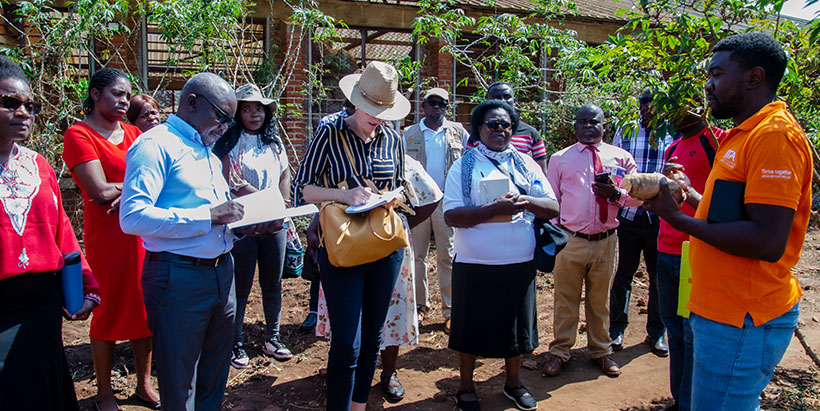
Manduwa (R) briefing the visitors on research activities at IITA.

The Embassy of Ireland in Malawi has stressed the need for strengthened collaboration to improve seed systems, technology development, market linkages, value addition, and food and nutrition activities in the ongoing phase of the RTC-MARKET Project in Malawi. 

The embassy and various project partners were visiting IITACGIAR in Malawi on a joint field visit to appreciate cassava activities under the Root and Tuber Crops RTC-MARKET Project. 

The team, led by the head of operations, Sarah McCan, was impressed with the positive contribution IITA and partners are making to cassava farmers through the RTC-MARKETS in improving seed systems, technology development, market linkages, value addition, and food and nutrition activities. McCan expressed her satisfaction with the demand-driven interventions demonstrated by IITA, citing their importance in ensuring sustainability. 

“It is good to see all the partners working together. Ireland has a long history of supporting agriculture in Africa. We are also an agriculture-based nation. For us, it is important to support technologies and extension work. We have enjoyed partnering with the Centre international de la pomme de terre (CIP) and the government of Malawi, and we would like this to continue. We believe there must be demand for products and that we should attain sustainability at the end of the project,” said McCan. 

Irish Aid has been providing financial support for root and tuber crops, focusing on delivering productive root and tuber crop technologies and management practices. Under the RTC-Market, Irish Aid is now focusing on markets, aiming to harness market incentives, and working with the private sector to create increased and equitable income opportunities in the RTC sector for farmers and micro, small, and medium-scale enterprises. It aims to contribute to a productive and sustainable agricultural sector in Malawi that generates increased employment and income opportunities and supports food security and healthy, more diverse, and affordable diets for all Malawians.  
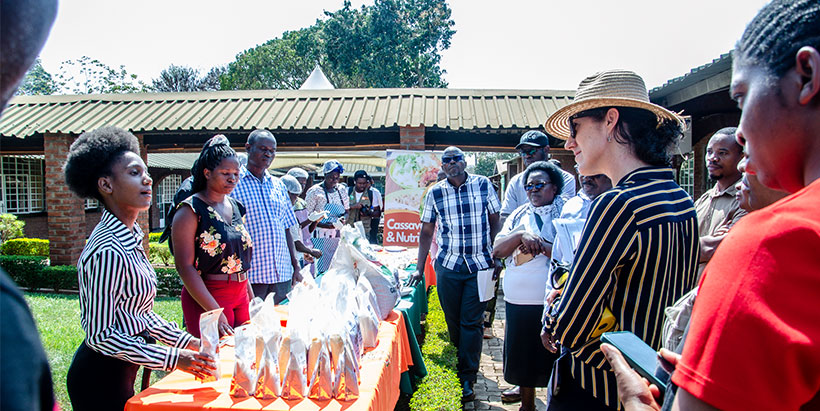
Mounted displays of processors and Cassava products.

During the visit to Lilongwe, visitors were shown how IITA and the Department of Agriculture Research Services (DARS) use the Semi-Autotrophic Hydroponics (SAH) laboratory for rapid clean seed multiplication of farmer-preferred cassava varieties. They were drawn to the effectiveness of the SAH technology in producing a high number of clean planting materials within a short period and in a small space. 

McCan and the team were updated on the ongoing experiments comparing the performance of plants generated from single-node cuttings versus those from conventional cuttings. Preliminary data suggests that plots with single-node cuttings yielded higher than those with conventional cuttings. The second-round trials, to be harvested in December, will have to confirm the first round before concluding. 

IITA and DARS are working towards increasing the nutritional value of cassava by fortifying it with beta-carotene through yellow—or orange-fleshed cassava breeding. The vision is to incorporate the high beta-carotene varieties into school feeding programs and food security interventions in cassava-consuming areas. 

Under the commercialization drive, IITA demonstrated how it is working to boost the cassava value chain by supporting processors like Kankhuyu Creations and Perisha Agro and Packaging Enterprise in enhancing their supply chain and exposing them to high-end markets. 

Perisha Agro is one of the small-scale organizations working with IITA to help empower farmers in cassava and sweet potato value chains. With over eighty-five farmers around Lilongwe, Perisha cultivates over thirty acres of land with an emphasis on new varieties. Perisha and its farmers plan to venture into winter cropping for root and tuber crops.  

In Nkhotakota, over three hundred farmers sell their cassava roots to Kankhuyu Processors. Kankhuyu Processors, owned by Lester Kasiya Maliro, has established itself as a formidable, budding business along the lakeshore districts of Malawi. He prides himself on having the capacity to produce four tons of cassava flour per month. This follows the growing demand for Kondowole (cassava flour), which people are now mixing with scarce maize to cook the staple nsima. Maliro was taken to the National Agriculture fair by IITA, with support from the Government of Ireland-funded RTC-MARKET Project. Since then, his Kankhuyu Creations have seen increased demand for his HQCF.  

“We have collaborated with DARS to train farmer clubs, processors, and businesses to increase awareness and utilization of cassava-based foods for households and small and medium enterprises,” explained Daniel Manduwa, who is a research associate working with IITA under the RTC-Markets Project. 

Sika Gbegbelegbe, IITA Malawi Country Representative, thanked McCan and the team for the visit, which strengthened the partner relationship and highlighted activities to achieve value for money. She expressed optimism that the current partnership with the national program and other partners will continue to grow and that Malawi will also attain and be able to help other countries in need, just like Ireland is doing.  

Taking his turn, the station manager for Chitedze Research Station, Dr Lawrent Pungulani, thanked Irish Aid for supporting the government in research and development.  

“We do recognize the strong collaboration between the DARS AND CGIAR communities. We are here to solve problems for our common farmers. We need to drive that agenda together to address persistent problems with farmers. The support we get from Ireland is important to the country. You have placed interest in the agriculture sector, particularly in agriculture research. We know that we must justify funding for research, and it’s pleasing to note that Ireland is flexible in research. We hope this continues because this is where farming systems start,” added Pungulani. 

CIP leads the RTC Market project and coordinates the Irish and sweet potato component. The cassava component is led by IITA. DARS co-implements all the research and technology development components. Partners who joined during the joint visit included CIP, Agriculture Commodity Exchange (ACE), Tradeline, DARS, Department of Agriculture Extension Services (DAES), Department of Crop Development (DCD), and the Ministry of Trade and Industry. 

Contributed by Emmanuel Mwale 


Contribué par

Nouvelles connexes

Aucun article trouvé

Laisser un commentaire

Votre adresse e-mail ne sera pas publiée. Les champs obligatoires sont indiqués avec *

Retour en haut
Olaosebikan, Olamide

Olamide Deborah Nwanze est une chercheuse principale spécialisée dans la recherche sur l'approche "genre" afin d'éclairer les politiques de sélection participative et inclusive, de développement de variétés et de systèmes semenciers concernant les cultures de racines, tubercules et bananes (RTB) au siège de l'Institut International d'Agriculture Tropicale, à Ibadan, au Nigeria. Elle est candidate au doctorat à l'Université d'Ibadan et titulaire d'un master et d'un diplôme d'ingénieur agronome en vulgarisation agricole et développement rural. Olamide est membre du programme African Women in Agricultural Research and Development – Gender Responsive Agricultural Systems Policy (SAISIE DE RÉCOMPENSEet les Chercheuses Sensibles au Genre Équipées pour la Transformation Agricole (SUPER. Elle cherche à appliquer ses apprentissages en matière d’approche genre, recherche sensible au genre, et expertise en développement et examen de politiques pour faciliter l’accès et l’adoption par les femmes, les jeunes, les enfants et les groupes sociaux vulnérables aux innovations agricoles qui garantissent la sécurité alimentaire, nutritionnelle, des revenus et des moyens de subsistance en Afrique. Ses rôles actuels comprennent le mentorat de chercheurs stagiaires, le développement de guides et manuels de formation, la mise en œuvre et l'adaptation de cadres et d'outils genre, l'engagement des acteurs de la chaîne de valeur en tant que partenaires de la science citoyenne, l'examen et la refonte des politiques, la gestion et l'analyse des données. Ses recherches actuelles portent sur les méthodes mixtes ainsi que sur les approches participatives et interdisciplinaires pour saisir et mettre en évidence les dynamiques de genre, les besoins, les préférences et les défis rencontrés par les parties prenantes au sein de la chaîne de valeur des moyens de subsistance agricoles afin de prioriser des stratégies axées sur le genre dans les programmes de sélection, la conception et la mise en œuvre des politiques.

À l'IITA, elle contribue à la mise en œuvre du CGIAR Initiative d'Élevage Accéléré et Innovation génétique Programmes ; recherche participative et genre au sein des Prochaine Génération ManiocHarvestPlusRTBAliments, et Tricot-ClimMob 1000Fermes Projets ; et la communication des connaissances sur le genre via le Série de webinaires G-LENS, vidéo documentaire, notes de politiquepublications, et blogs.


Publications récentes

de Sousa, K., van Etten, J., Manners, R. Bello, A., Teeken, B., Olaosebikan, O., et al. 2024. L'approche tricot : un cadre agile pour les essais décentralisés à la ferme soutenus par la science citoyenne. Une rétrospective. Agron. Sustain. Dev. 44, 8. https://doi.org/10.1007/s13593-023-00937-1

Madu, T., Onwuka, S., Nwafor, S., Onyemauwa, N., Ejechi, M., Ofoeze, M., Ukeje, B., Eluagu, C., Olaosebikan, O., Okoye, B., 2024. Les études sur les consommateurs inclusifs en matière de genre améliorent l'amélioration du manioc au Nigeria dans : Frontiers in Sociology, volume 9, numéro : 1224504, doi : 10.3389/fsoc.2024.1224504

Olaosebikan, O. ; Bello, A. ; Utoblo, O. ; Okoye, B. ; Olutegbe, N. ; Garner, E. ; Teeken, B. ; Bryan, E. ; Forsythe, L. ; Cole, S. ; Madu, T. 2023. Facteurs de stress et résilience au sein de la chaîne de valeur du manioc au Nigeria : Caractéristiques préférées des variétés de manioc et stratégies de réponse des hommes et des femmes pour informer l'amélioration variétale. Sustainability 15, 7837. https://doi.org/10.3390/su15107837

Okoye, B., Ofoeze, M., Ejechi, M., Onwuka, S., Nwafor, S., Onyemauwa, N., Ukeje, B., Eluagu, C., Obidiegwu, J.*, Olaosebikan, O., Madu, T.* 2023. Priorisation des traits préférés dans la chaîne de valeur de l'igname au Nigeria : une analyse de la situation en matière de genre in: Frontiers in Sociology, volume 8, numéro : 1232626, pages 1 – 9, ISSN 2297-7775, 2023. https://www.frontiersin.org/articles/10.3389/fsoc.2023.1232626/full

Olaosebikan, O., Bello, A. A., de Sousa, K., Ndjouenkeu, R., Adesokan, M., Alamu, E. O., Agbona, A., van Etten, J., Kegah, F. N.*, Dufour, D., Bouniol, A., Teeken, B. 2023. Acceptabilité par les consommateurs des produits alimentaires à base de gari-eba de manioc dans des contextes culturels et environnementaux variés en utilisant l'approche triade de comparaison des technologies (tricot) dans : Journal of the Science of Food and Agriculture,

Teeken, B., Olaosebikan, O., Bello, A. A., Madu, T.*, Cole, S. M. 2023. Évaluation qualitative de la positionnalité et des préférences des dyades en relation avec les activités liées au manioc : travailler avec des scientifiques citoyens du procès tricot https://hdl.handle.net/10568/138326 Type : Manuel

Bouniol, A., Ceballos, H., Bello, A. A., Teeken, B., Olaosebikan, O., Owoade, D., Agbona, A., Fotso Kuate, A., Madu, T.*, Okoye, B.*, Ofoeze, M.*, Nwafor, S.*, Onyemauwa, N.*, Adinsi, L.*, Forsythe, L., Dufour, D. 2023. Impact variétal sur le travail des femmes, la charge de travail et la pénibilité associée dans le traitement des plantes à racines, tubercules et bananes : focus sur le manioc en Afrique subsaharienne dans : Journal of the Science of Food and Agriculture, pages 1 – 25, ISSN 0022-5142,

Bello, A. A., Agbona, A., Olaosebikan, O., Edughaen, G., Dufour, D., Bouniol, A., Iluebbey, P., Ndjouenkeu, R.*, Rabbi, I. Y., Teeken, B. 2023. Effets génétiques et environnementaux sur la productivité de la transformation et le rendement des produits alimentaires : la pénibilité du travail des femmes dans : Journal of the Science of Food and Agriculture, pages 1 – 32, ISSN 0022-5142, 5

Cavicchioli, M., Zimbiti, T., Teeken, B., Nwanze, D.O., Liani, M., Parkes, E. & Bello, A. 2023. Rapport sur la formation en sélection génétique sensible au genre à l'IITA. Genetic Resources Center, IITA-HQ, Ibadan, 21-23 septembre 2022. Ibadan, Nigéria : IITA, (34 p.).https://hdl.handle.net/10568/131368

Agbona, A. Peteti P., Teeken B., Olaosebikan O. Bello, A. A., Parkes, E., Rabbi, I. Y., Mueller, L., Egesi, C., Kulakow, P. 2022. Gestion des données dans les programmes d'amélioration des cultures RTB africaines multidisciplinaires. In : Williamson, H.F., Leonelli, S. (eds) Towards Responsible Plant Data Linkage: Data Challenges for Agricultural Research and Development. Springer, Cham. https://doi.org/10.1007/978-3-031-13276-6_5

Lora Forsythe, Pricilla Marimo, Sarah Mayanja, Olamide D. Olaosebikan, Esme Stuart, Bela Teeken, Benjamin Okoye, Tessy Madu, (2021). Analyse transversale du genre dans RTBfoods Étape 2 Cartographie des genres sur les produits RTB. Comprendre les moteurs des préférences en matière de traits et le développement de profils de produits RTB multi-utilisateurs, WP1. Londres, Royaume-Uni : Rapport scientifique de terrain RTBfoods, 30 p.

Teeken, B., Garner, E., Agbona, A., Balogun, I., Olaosebikan, O., Bello, A., Madu, T., Okoye, B., Egesi, C., Kulakow, P. et Tufan, H.A. 2021. Au-delà des “ traits des femmes ” : explorer comment le genre, les différences sociales et les caractéristiques des ménages influencent les préférences pour les traits. Frontiers Systèmes alimentaires durables 5:740926. https://doi.org/10.3389/fsufs.2021.740926

Teeken, B., Agbona, A., Bello, A., Olaosebikan, O., Alamu, E., Adesokan, M., Awoyale, W., Madu, T., Okoye, B., Chijioke, U., Owoade, D., Okoro, M., Bouniol, A., Dufour, D., Hershey, C., Rabbi, I., Maziya‐Dixon, B., Egesi, C., Tufan, H. et Kulakow, P. (020. Comprendre les préférences variétales du manioc par le classement par paires du gari-eba et du fufu préparés par des agriculteurs-transformateurs locaux. Int J Food Sci Technol. https://doi.org/10.1111/ijfs.14862

Bela Teeken, Olamide Olaosebikan, Ireti Balogun, Benjamin Okoye, Tessy Madu, Steven Cole, Abolore Bello, Elizabeth Parkes. (2020). Pilotage des outils de profil client et produit G+ pour l'amélioration sensible au genre du manioc au Nigeria. Nigeria : Institut international d'agriculture tropicale (IIAT). https://hdl.handle.net/20.500.11766/13000