Le gouvernement de Kano et les parties prenantes saluent la conférence de réseautage percutante de Youth in Agribusiness
27 octobre 2025
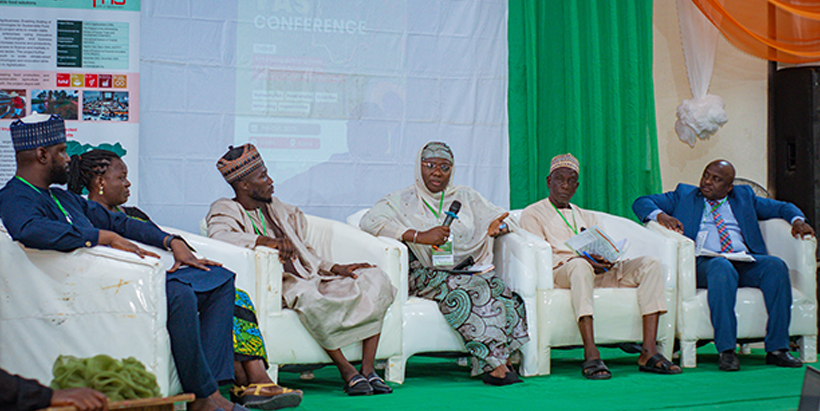
De gauche à droite : le responsable des ressources humaines de Nutri K, M. Bashir Yerima ; la coordinatrice zonale de l'Institut nigérian de recherche sur les produits stockés (NSPRI), le Dr Ajani Alice Olapade ; le PDG/directeur exécutif de SMART Agribus, M. Ridwan Adebisi ; la responsable de la réglementation de l'Agence nationale pour l'administration et le contrôle des aliments et des médicaments (NAFDAC) à Kano, Hajiya Halima Abdulkarim ; le directeur de l'irrigation au ministère de l'Agriculture de l'État de Kano, Mallam Ado Ibrahim ; et le directeur régional pour le Nord-Ouest de Fidelity Bank, M. Abdulazeez Suleiman, lors de la table ronde.
Le gouvernement de l'État de Kano a salué IITA–CGIAR Jeunesse dans l'agro-industrie : Favoriser la mise à l'échelle de technologies innovantes pour des solutions alimentaires durables, également connu sous le nom de projet YAS, pour sa contribution significative à la stimulation de l'engagement des jeunes dans l'agriculture, au renforcement des moyens de subsistance et à l'augmentation de la disponibilité alimentaire dans l'État.
La commissaire aux Femmes, aux Enfants et aux Personnes handicapées, représentée par la directrice des Affaires féminines au sein du ministère, Hajiya Nafisa Yakasi, a fait cette remarque lors de la conférence organisée récemment par le projet YAS dans l'État de Kano. Elle a félicité l'IITA-CGIAR pour son approche axée sur l'inclusion du genre et ses efforts délibérés pour autonomiser les femmes dans l'agriculture.
La conférence, qui avait pour thème ‘ Renforcer le partenariat public-privé pour pérenniser les capacités des jeunes dans l'agro-industrie ’, a réuni des participants au projet, des partenaires, des représentants du gouvernement, des leaders communautaires, des représentants d'agences de régulation et de certification alimentaire, des institutions financières et d'autres partenaires au développement. La conférence a offert une plateforme de mise en réseau pour les participants et les autres parties prenantes.
Le coordinateur du projet YAS, Adebayo Awotodunbo, a souligné que le projet, depuis sa création il y a trois ans, a renforcé la participation des jeunes à l'agriculture grâce à la formation, au mentorat et au soutien à l'entrepreneuriat. Selon lui, cela a facilité la création de plusieurs entreprises dirigées par des jeunes.
La directrice pays de BopInc, le partenaire de mise en œuvre de YAS, Mercy Mayaki, a souligné que les partenariats public-privé restent essentiels pour relever les défis critiques auxquels sont confrontés les jeunes agripreneurs, notamment l'accès au financement, aux opportunités de marché et aux technologies innovantes.
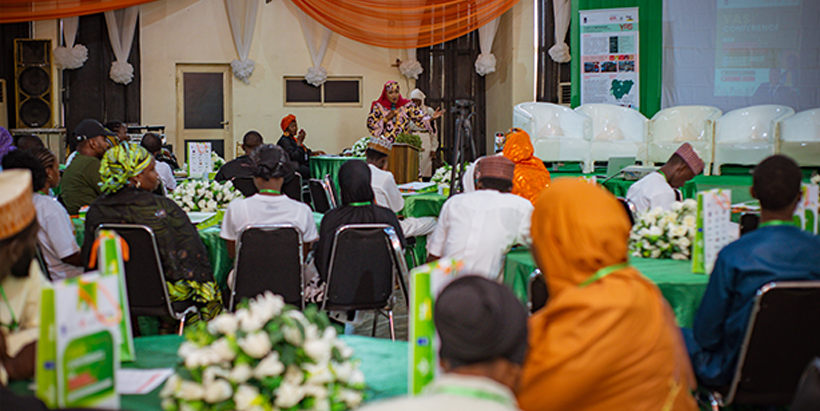
Un des intervenants s'adressant aux participants
L'un des temps forts de l'événement a été le concours de pitchs commerciaux présenté par d'anciens participants. Parmi les juges figuraient la directrice de la réglementation de l'Agence nationale pour l'administration et le contrôle des produits alimentaires et pharmaceutiques (NAFDAC) à Kano, Hajiya Halima Abdulkarim ; le responsable des ressources humaines de Nutri K, Bashir Yerima ; et le comptable de l'Institut international de recherche sur les cultures des zones tropicales semi-arides (ICRISAT) à Kano, Bashir Abdullahi.
À la fin du concours, Gambo Zakari, un pisciculteur spécialisé dans l'élevage de poissons-chats, a été déclaré vainqueur ; Hassana Abdulaziz a terminé première dauphine, et Fiddausi Galadima deuxième dauphine, tandis que Mohammad Suleiman Mahe et Safiya Mohammad se sont classés respectivement quatrième et cinquième.
Le gagnant recevrait pour 500 000 N d'intrants ; le deuxième recevrait pour 300 000 N d'intrants, le troisième pour 200 000 N d'intrants, tandis que les quatrième et cinquième recevraient des prix de consolation d'une valeur de 100 000 N d'intrants chacun. Impressionné par leur performance, l'un des partenaires du projet et PDG/directeur exécutif de SMART Agribus, Ridwan Adebisi, a promis de récompenser Mahe et Safiya avec 50 000 N supplémentaires chacun.
Au cours de la session plénière, Mallam Ado Ibrahim, directeur de l'irrigation au ministère de l'Agriculture de l'État de Kano, a indiqué que le ministère des Ressources en eau avait récemment attribué des terres au projet YAS pour la formation des participants. Il a ajouté que le gouvernement s'engageait à nouer des collaborations favorisant un écosystème propice aux jeunes entrepreneurs agricoles.
De même, le Dr Ajani Alice Olapade, coordinatrice zonale de l'Institut nigérian de recherche sur les produits stockés (NSPRI), a déclaré que l'institut avait récemment formé 40 participants au programme YAS à la transformation de tomates, de dattes et de maïs en divers produits. Elle a énuméré les innovations déployées par l'institut, notamment un séchoir solaire parabolique pour le séchage des produits agricoles, des fûts en acier hermétiques pour le stockage des produits séchés, des unités de stockage en vrac pour les grains et les semences, ainsi qu'une station agrométéorologique qui fournit des données sur l'humidité, la température, l'ensoleillement et la direction du vent.
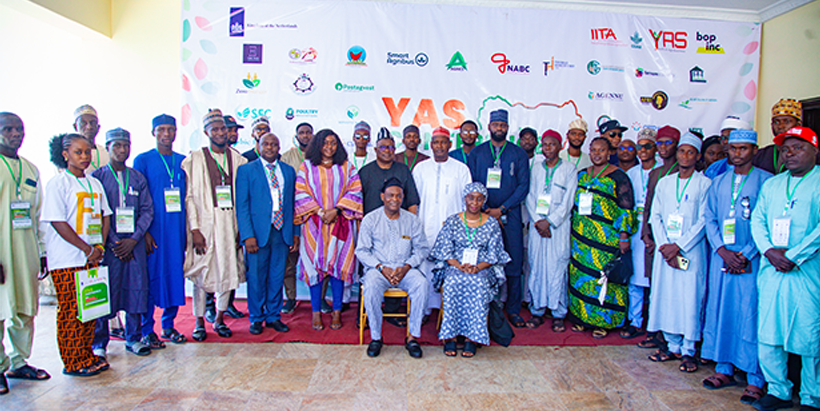
Le coordinateur du projet YAS, Adebayo Awotodunbo, la directrice pays de BopInc, Mercy Mayaki, et d'autres invités après l'événement.
S'exprimant sur la question de l'accès au financement, Abdulazeez Suleiman, directeur régional du Nord-Ouest de la Fidelity Bank, a déclaré que, même si les prêts à taux zéro tant souhaités par beaucoup ne sont peut-être pas disponibles, il existe des prêts à faible taux d'intérêt dont les jeunes agripreneurs peuvent bénéficier, qu'ils soient en phase de démarrage ou déjà propriétaires d'une entreprise.
De même, Yerima, de Nutri-K, a exhorté les jeunes à saisir les opportunités offertes par ce secteur, soulignant que son entreprise s'approvisionnait en arachides et autres matières premières auprès des agriculteurs afin de soutenir l'économie locale et les petits exploitants. Il a appelé les jeunes agriculteurs à postuler à des programmes offrant un financement et une visibilité, à rejoindre des pôles d’activité donnant accès à un accompagnement, à élaborer des business plans viables pour être éligibles à des programmes de crédit intégrés, et à s’investir dans l’éducation financière afin de naviguer efficacement au sein des systèmes financiers formels.
Évoquant les obstacles rencontrés lors de l’enregistrement des produits, Abdulkarim, de la NAFDAC, a souligné que les chefs d’entreprise devaient se conformer aux normes réglementaires avant de pouvoir obtenir une autorisation, précisant que l’image de marque et le conditionnement jouaient également un rôle clé dans l’acceptabilité des produits.
L’administrateur de la station de l’IITA à Kano, Shuaibu Rabo-Ado, qui a remercié l’ambassade des Pays-Bas pour son soutien au projet YAS, a exhorté les institutions financières à remplir leur rôle de catalyseurs essentiels de la croissance de l’agroalimentaire en améliorant l’accès au crédit et aux services de conseil financier. Il a appelé à la mise en place de produits destinés à soutenir les jeunes agripreneurs. ” Grâce au projet YAS, l’IITA a considérablement contribué au développement économique en autonomisant plus de 10 000 jeunes à travers le Nigeria. De telles interventions doivent compléter, et non se substituer, à la mission plus large du gouvernement en matière d’autonomisation des jeunes et des citoyens “, a-t-il ajouté.
Les participants ont également eu l’occasion de partager leurs réussites. Jibril Lawal a expliqué qu’il avait lancé sa pisciculture en se fiant à des approximations, ce qui lui avait valu d’énormes pertes. Cependant, il a précisé qu’après avoir suivi la formation YAS, son exploitation était devenue rentable et qu’il avait pu se développer de manière significative. Il a ajouté qu’il s’était assuré que les connaissances acquises aient été transmises à de nombreux jeunes de sa communauté de Madobi. ” Grâce aux bénéfices que j’ai réalisés, je cultive désormais du soja et du gombo sur trois hectares de terre, ce qui a considérablement augmenté mes revenus », a-t-il ajouté.
Proposé par Babatunde Ajaja
Olamide Deborah Nwanze est une chercheuse principale spécialisée dans la recherche sur l'approche "genre" afin d'éclairer les politiques de sélection participative et inclusive, de développement de variétés et de systèmes semenciers concernant les cultures de racines, tubercules et bananes (RTB) au siège de l'Institut International d'Agriculture Tropicale, à Ibadan, au Nigeria. Elle est candidate au doctorat à l'Université d'Ibadan et titulaire d'un master et d'un diplôme d'ingénieur agronome en vulgarisation agricole et développement rural. Olamide est membre du programme African Women in Agricultural Research and Development – Gender Responsive Agricultural Systems Policy (SAISIE DE RÉCOMPENSEet les Chercheuses Sensibles au Genre Équipées pour la Transformation Agricole (SUPER. Elle cherche à appliquer ses apprentissages en matière d’approche genre, recherche sensible au genre, et expertise en développement et examen de politiques pour faciliter l’accès et l’adoption par les femmes, les jeunes, les enfants et les groupes sociaux vulnérables aux innovations agricoles qui garantissent la sécurité alimentaire, nutritionnelle, des revenus et des moyens de subsistance en Afrique. Ses rôles actuels comprennent le mentorat de chercheurs stagiaires, le développement de guides et manuels de formation, la mise en œuvre et l'adaptation de cadres et d'outils genre, l'engagement des acteurs de la chaîne de valeur en tant que partenaires de la science citoyenne, l'examen et la refonte des politiques, la gestion et l'analyse des données. Ses recherches actuelles portent sur les méthodes mixtes ainsi que sur les approches participatives et interdisciplinaires pour saisir et mettre en évidence les dynamiques de genre, les besoins, les préférences et les défis rencontrés par les parties prenantes au sein de la chaîne de valeur des moyens de subsistance agricoles afin de prioriser des stratégies axées sur le genre dans les programmes de sélection, la conception et la mise en œuvre des politiques.
de Sousa, K., van Etten, J., Manners, R. Bello, A., Teeken, B., Olaosebikan, O., et al. 2024. L'approche tricot : un cadre agile pour les essais décentralisés à la ferme soutenus par la science citoyenne. Une rétrospective. Agron. Sustain. Dev. 44, 8. https://doi.org/10.1007/s13593-023-00937-1
Madu, T., Onwuka, S., Nwafor, S., Onyemauwa, N., Ejechi, M., Ofoeze, M., Ukeje, B., Eluagu, C., Olaosebikan, O., Okoye, B., 2024. Les études sur les consommateurs inclusifs en matière de genre améliorent l'amélioration du manioc au Nigeria dans : Frontiers in Sociology, volume 9, numéro : 1224504, doi : 10.3389/fsoc.2024.1224504
Olaosebikan, O. ; Bello, A. ; Utoblo, O. ; Okoye, B. ; Olutegbe, N. ; Garner, E. ; Teeken, B. ; Bryan, E. ; Forsythe, L. ; Cole, S. ; Madu, T. 2023. Facteurs de stress et résilience au sein de la chaîne de valeur du manioc au Nigeria : Caractéristiques préférées des variétés de manioc et stratégies de réponse des hommes et des femmes pour informer l'amélioration variétale. Sustainability 15, 7837. https://doi.org/10.3390/su15107837
Okoye, B., Ofoeze, M., Ejechi, M., Onwuka, S., Nwafor, S., Onyemauwa, N., Ukeje, B., Eluagu, C., Obidiegwu, J.*, Olaosebikan, O., Madu, T.* 2023. Priorisation des traits préférés dans la chaîne de valeur de l'igname au Nigeria : une analyse de la situation en matière de genre in: Frontiers in Sociology, volume 8, numéro : 1232626, pages 1 – 9, ISSN 2297-7775, 2023. https://www.frontiersin.org/articles/10.3389/fsoc.2023.1232626/full
Olaosebikan, O., Bello, A. A., de Sousa, K., Ndjouenkeu, R., Adesokan, M., Alamu, E. O., Agbona, A., van Etten, J., Kegah, F. N.*, Dufour, D., Bouniol, A., Teeken, B. 2023. Acceptabilité par les consommateurs des produits alimentaires à base de gari-eba de manioc dans des contextes culturels et environnementaux variés en utilisant l'approche triade de comparaison des technologies (tricot) dans : Journal of the Science of Food and Agriculture,
Teeken, B., Olaosebikan, O., Bello, A. A., Madu, T.*, Cole, S. M. 2023. Évaluation qualitative de la positionnalité et des préférences des dyades en relation avec les activités liées au manioc : travailler avec des scientifiques citoyens du procès tricot https://hdl.handle.net/10568/138326 Type : Manuel
Bouniol, A., Ceballos, H., Bello, A. A., Teeken, B., Olaosebikan, O., Owoade, D., Agbona, A., Fotso Kuate, A., Madu, T.*, Okoye, B.*, Ofoeze, M.*, Nwafor, S.*, Onyemauwa, N.*, Adinsi, L.*, Forsythe, L., Dufour, D. 2023. Impact variétal sur le travail des femmes, la charge de travail et la pénibilité associée dans le traitement des plantes à racines, tubercules et bananes : focus sur le manioc en Afrique subsaharienne dans : Journal of the Science of Food and Agriculture, pages 1 – 25, ISSN 0022-5142,
Bello, A. A., Agbona, A., Olaosebikan, O., Edughaen, G., Dufour, D., Bouniol, A., Iluebbey, P., Ndjouenkeu, R.*, Rabbi, I. Y., Teeken, B. 2023. Effets génétiques et environnementaux sur la productivité de la transformation et le rendement des produits alimentaires : la pénibilité du travail des femmes dans : Journal of the Science of Food and Agriculture, pages 1 – 32, ISSN 0022-5142, 5
Cavicchioli, M., Zimbiti, T., Teeken, B., Nwanze, D.O., Liani, M., Parkes, E. & Bello, A. 2023. Rapport sur la formation en sélection génétique sensible au genre à l'IITA. Genetic Resources Center, IITA-HQ, Ibadan, 21-23 septembre 2022. Ibadan, Nigéria : IITA, (34 p.).https://hdl.handle.net/10568/131368
Agbona, A. Peteti P., Teeken B., Olaosebikan O. Bello, A. A., Parkes, E., Rabbi, I. Y., Mueller, L., Egesi, C., Kulakow, P. 2022. Gestion des données dans les programmes d'amélioration des cultures RTB africaines multidisciplinaires. In : Williamson, H.F., Leonelli, S. (eds) Towards Responsible Plant Data Linkage: Data Challenges for Agricultural Research and Development. Springer, Cham. https://doi.org/10.1007/978-3-031-13276-6_5
Lora Forsythe, Pricilla Marimo, Sarah Mayanja, Olamide D. Olaosebikan, Esme Stuart, Bela Teeken, Benjamin Okoye, Tessy Madu, (2021). Analyse transversale du genre dans RTBfoods Étape 2 Cartographie des genres sur les produits RTB. Comprendre les moteurs des préférences en matière de traits et le développement de profils de produits RTB multi-utilisateurs, WP1. Londres, Royaume-Uni : Rapport scientifique de terrain RTBfoods, 30 p.
Teeken, B., Garner, E., Agbona, A., Balogun, I., Olaosebikan, O., Bello, A., Madu, T., Okoye, B., Egesi, C., Kulakow, P. et Tufan, H.A. 2021. Au-delà des “ traits des femmes ” : explorer comment le genre, les différences sociales et les caractéristiques des ménages influencent les préférences pour les traits. Frontiers Systèmes alimentaires durables 5:740926. https://doi.org/10.3389/fsufs.2021.740926
Teeken, B., Agbona, A., Bello, A., Olaosebikan, O., Alamu, E., Adesokan, M., Awoyale, W., Madu, T., Okoye, B., Chijioke, U., Owoade, D., Okoro, M., Bouniol, A., Dufour, D., Hershey, C., Rabbi, I., Maziya‐Dixon, B., Egesi, C., Tufan, H. et Kulakow, P. (020. Comprendre les préférences variétales du manioc par le classement par paires du gari-eba et du fufu préparés par des agriculteurs-transformateurs locaux. Int J Food Sci Technol.https://doi.org/10.1111/ijfs.14862
Bela Teeken, Olamide Olaosebikan, Ireti Balogun, Benjamin Okoye, Tessy Madu, Steven Cole, Abolore Bello, Elizabeth Parkes. (2020). Pilotage des outils de profil client et produit G+ pour l'amélioration sensible au genre du manioc au Nigeria. Nigeria : Institut international d'agriculture tropicale (IIAT). https://hdl.handle.net/20.500.11766/13000