
NOUVELLES DE L'IITA

Africa’s agricultural future hinges on scaling proven innovations, leaders say at AASW9
août 4, 2026
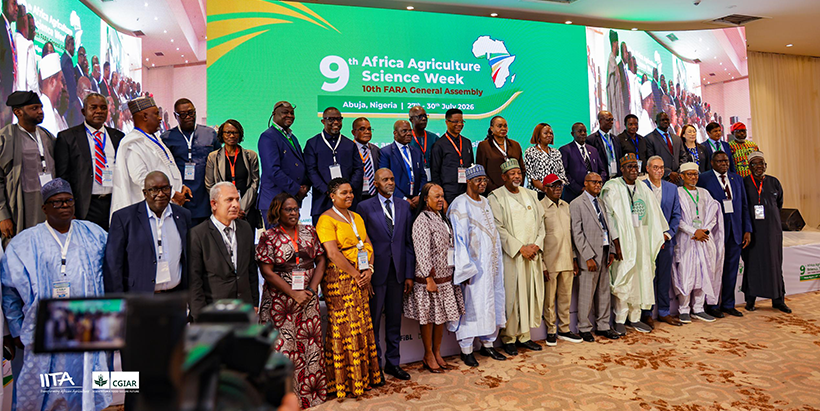
The Honorable Minister of Agriculture and Food Security, Senator Abubakar Kyari, the Honorable Minister of Livestock Development, Idi Mukhtar Maiha; FARA Board Chairperson Ms. Bongiwe Njobe, FARA Board members, and delegates from across Africa at the 9th Africa Agriculture Science Week (AASW9) and the 10th FARA General Assembly in Abuja, Nigeria. 

Africa is not short of agricultural innovations. From climate-smart technologies and improved crop varieties to digital advisory services and livestock innovations, the continent has developed solutions that can transform its food systems at scale. Yet millions of smallholder farmers remain beyond their reach.

Bridging this gap—moving these proven technologies from research to the last mile users— emerged as the defining theme on the opening and first day of the 9th Africa Agriculture Science Week (AASW9) and the 10th FARA General Assembly.

Bringing together heads of government, policymakers, scientists, development partners, private sector actors, and young innovators from across the continent, the event opened with a shared call to shift Africa’s agricultural agenda from developing new technologies to delivering greater impact through stronger partnerships, investment, and implementation.

As host nation, Nigeria set the tone for the week. President Bola Ahmed Tinubu, represented by the Honorable Minister of Livestock Development, Idi Mukhtar Maiha, said that the establishment of the Federal Ministry of Livestock Development demonstrates Nigeria’s commitment to unlocking the livestock sector’s potential to strengthen food security, create jobs, and drive economic growth.

The Honorable Minister of Agriculture and Food Security, Senator Abubakar Kyari welcomed delegated from across Africa, reaffirming Nigeria’s commitment to regional collaboration in advancing agricultural transformation. Senator Adams Oshiomhole also called for sustained political commitment and increased investment, stressing that agriculture must remain central to Africa’s long-term development agenda.

Speaking on behalf of the African Union Commissioner for Agriculture, Rural Development, Blue Economy and Sustainable Environment, Dr Janet Edeme emphasized that achieving the ambitions of Agenda 2063 and the Comprehensive Africa Agriculture Development Programme (CAADP) will require stronger institutions, enabling policies, and sustainable financing. She also highlighted the importance of empowering women and young people—not simply as beneficiaries of development programs, but as leaders driving Africa’s agricultural transformation.

At the opening, the keynote address reinforced the conference’s central message. IITA Directeur général et CGIAR Regional Director for Africa, Dr Siméon Ehui, argued that Africa already possesses the scientific expertise, biodiversity, research institutions, and farming communities needed to transform its agrifood systems. The continent’s greatest challenge, he noted, is ensuring that scientific breakthroughs are translated into solutions that are accessible, affordable, locally relevant, and adopted at scale.

He called for stronger connections between science, policy, investment, markets, and local knowledge, urging stakeholders to move beyond fragmented projects towards coordinated scaling and delivery systems that can generate measurable impact for farmers and food systems across Africa.

That call for action resonated throughout the opening ceremony. FARA Director General, Dr Aggrey Agumya, described science, innovation, and collaboration as the foundations of resilient agrifood systems, while urging governments, researchers, and development partners to deepen partnerships that accelerate the adoption of proven technologies on the continent.

Similarly, Dr Debisi Araba, Managing Director of, AKADEMIYA2063, reminded participants that Africa’s food sufficiency will ultimately be judged not by the quality of its strategies, but by how effectively they are implemented.

The conversations continued in a series of technical and side events that translated these high-level priorities into practical action. A session on Gender Equality in Food, Land and Water Systems highlighted the importance of evidence-based policies that expand women’s and young people’s access to innovation, finance, leadership opportunities, and productive resources, recognizing inclusion as a prerequisite for resilient and sustainable food systems.

Youth leadership also took center stage during the Youth4Nutrition: Inclusive Science and Innovation from Soil to Plate side event, where young scientists and agripreneurs displayed innovations designed to improve nutrition and strengthen food systems. The launch of the Youth4Nutrition Nigeria Chapter further signaled growing momentum to place young people at the forefront of Africa’s agricultural transformation.

Other discussions explored food safety and the Technologies pour la Transformation Agricole en Afrique (TAAT) program, demonstrating how strategic partnerships are helping move research beyond experimental trials into practical solutions benefiting millions of farmers. Across the exhibition halls, researchers, policymakers, investors, entrepreneurs, and development partners exchanged ideas, showcased innovations, and forged new collaborations aimed at accelerating agricultural transformation across the continent.

As the first day concluded, one message echoed consistently across plenary sessions, technical discussions, and exhibition spaces: Africa’s agricultural transformation will not be determined by the number of innovations it produces, but by how effectively existing solutions reach the farmers and communities they are designed to serve. Scaling what already works, participants agreed, is now the continent’s most urgent agricultural priority.


Retour en haut
Olaosebikan, Olamide

Olamide Deborah Nwanze est une chercheuse principale spécialisée dans la recherche sur l'approche "genre" afin d'éclairer les politiques de sélection participative et inclusive, de développement de variétés et de systèmes semenciers concernant les cultures de racines, tubercules et bananes (RTB) au siège de l'Institut International d'Agriculture Tropicale, à Ibadan, au Nigeria. Elle est candidate au doctorat à l'Université d'Ibadan et titulaire d'un master et d'un diplôme d'ingénieur agronome en vulgarisation agricole et développement rural. Olamide est membre du programme African Women in Agricultural Research and Development – Gender Responsive Agricultural Systems Policy (SAISIE DE RÉCOMPENSEet les Chercheuses Sensibles au Genre Équipées pour la Transformation Agricole (SUPER. Elle cherche à appliquer ses apprentissages en matière d’approche genre, recherche sensible au genre, et expertise en développement et examen de politiques pour faciliter l’accès et l’adoption par les femmes, les jeunes, les enfants et les groupes sociaux vulnérables aux innovations agricoles qui garantissent la sécurité alimentaire, nutritionnelle, des revenus et des moyens de subsistance en Afrique. Ses rôles actuels comprennent le mentorat de chercheurs stagiaires, le développement de guides et manuels de formation, la mise en œuvre et l'adaptation de cadres et d'outils genre, l'engagement des acteurs de la chaîne de valeur en tant que partenaires de la science citoyenne, l'examen et la refonte des politiques, la gestion et l'analyse des données. Ses recherches actuelles portent sur les méthodes mixtes ainsi que sur les approches participatives et interdisciplinaires pour saisir et mettre en évidence les dynamiques de genre, les besoins, les préférences et les défis rencontrés par les parties prenantes au sein de la chaîne de valeur des moyens de subsistance agricoles afin de prioriser des stratégies axées sur le genre dans les programmes de sélection, la conception et la mise en œuvre des politiques.

À l'IITA, elle contribue à la mise en œuvre du CGIAR Initiative d'Élevage Accéléré et Innovation génétique Programmes ; recherche participative et genre au sein des Prochaine Génération ManiocHarvestPlusRTBAliments, et Tricot-ClimMob 1000Fermes Projets ; et la communication des connaissances sur le genre via le Série de webinaires G-LENS, vidéo documentaire, notes de politiquepublications, et blogs.


Publications récentes

de Sousa, K., van Etten, J., Manners, R. Bello, A., Teeken, B., Olaosebikan, O., et al. 2024. L'approche tricot : un cadre agile pour les essais décentralisés à la ferme soutenus par la science citoyenne. Une rétrospective. Agron. Sustain. Dev. 44, 8. https://doi.org/10.1007/s13593-023-00937-1

Madu, T., Onwuka, S., Nwafor, S., Onyemauwa, N., Ejechi, M., Ofoeze, M., Ukeje, B., Eluagu, C., Olaosebikan, O., Okoye, B., 2024. Les études sur les consommateurs inclusifs en matière de genre améliorent l'amélioration du manioc au Nigeria dans : Frontiers in Sociology, volume 9, numéro : 1224504, doi : 10.3389/fsoc.2024.1224504

Olaosebikan, O. ; Bello, A. ; Utoblo, O. ; Okoye, B. ; Olutegbe, N. ; Garner, E. ; Teeken, B. ; Bryan, E. ; Forsythe, L. ; Cole, S. ; Madu, T. 2023. Facteurs de stress et résilience au sein de la chaîne de valeur du manioc au Nigeria : Caractéristiques préférées des variétés de manioc et stratégies de réponse des hommes et des femmes pour informer l'amélioration variétale. Sustainability 15, 7837. https://doi.org/10.3390/su15107837

Okoye, B., Ofoeze, M., Ejechi, M., Onwuka, S., Nwafor, S., Onyemauwa, N., Ukeje, B., Eluagu, C., Obidiegwu, J.*, Olaosebikan, O., Madu, T.* 2023. Priorisation des traits préférés dans la chaîne de valeur de l'igname au Nigeria : une analyse de la situation en matière de genre in: Frontiers in Sociology, volume 8, numéro : 1232626, pages 1 – 9, ISSN 2297-7775, 2023. https://www.frontiersin.org/articles/10.3389/fsoc.2023.1232626/full

Olaosebikan, O., Bello, A. A., de Sousa, K., Ndjouenkeu, R., Adesokan, M., Alamu, E. O., Agbona, A., van Etten, J., Kegah, F. N.*, Dufour, D., Bouniol, A., Teeken, B. 2023. Acceptabilité par les consommateurs des produits alimentaires à base de gari-eba de manioc dans des contextes culturels et environnementaux variés en utilisant l'approche triade de comparaison des technologies (tricot) dans : Journal of the Science of Food and Agriculture,

Teeken, B., Olaosebikan, O., Bello, A. A., Madu, T.*, Cole, S. M. 2023. Évaluation qualitative de la positionnalité et des préférences des dyades en relation avec les activités liées au manioc : travailler avec des scientifiques citoyens du procès tricot https://hdl.handle.net/10568/138326 Type : Manuel

Bouniol, A., Ceballos, H., Bello, A. A., Teeken, B., Olaosebikan, O., Owoade, D., Agbona, A., Fotso Kuate, A., Madu, T.*, Okoye, B.*, Ofoeze, M.*, Nwafor, S.*, Onyemauwa, N.*, Adinsi, L.*, Forsythe, L., Dufour, D. 2023. Impact variétal sur le travail des femmes, la charge de travail et la pénibilité associée dans le traitement des plantes à racines, tubercules et bananes : focus sur le manioc en Afrique subsaharienne dans : Journal of the Science of Food and Agriculture, pages 1 – 25, ISSN 0022-5142,

Bello, A. A., Agbona, A., Olaosebikan, O., Edughaen, G., Dufour, D., Bouniol, A., Iluebbey, P., Ndjouenkeu, R.*, Rabbi, I. Y., Teeken, B. 2023. Effets génétiques et environnementaux sur la productivité de la transformation et le rendement des produits alimentaires : la pénibilité du travail des femmes dans : Journal of the Science of Food and Agriculture, pages 1 – 32, ISSN 0022-5142, 5

Cavicchioli, M., Zimbiti, T., Teeken, B., Nwanze, D.O., Liani, M., Parkes, E. & Bello, A. 2023. Rapport sur la formation en sélection génétique sensible au genre à l'IITA. Genetic Resources Center, IITA-HQ, Ibadan, 21-23 septembre 2022. Ibadan, Nigéria : IITA, (34 p.).https://hdl.handle.net/10568/131368

Agbona, A. Peteti P., Teeken B., Olaosebikan O. Bello, A. A., Parkes, E., Rabbi, I. Y., Mueller, L., Egesi, C., Kulakow, P. 2022. Gestion des données dans les programmes d'amélioration des cultures RTB africaines multidisciplinaires. In : Williamson, H.F., Leonelli, S. (eds) Towards Responsible Plant Data Linkage: Data Challenges for Agricultural Research and Development. Springer, Cham. https://doi.org/10.1007/978-3-031-13276-6_5

Lora Forsythe, Pricilla Marimo, Sarah Mayanja, Olamide D. Olaosebikan, Esme Stuart, Bela Teeken, Benjamin Okoye, Tessy Madu, (2021). Analyse transversale du genre dans RTBfoods Étape 2 Cartographie des genres sur les produits RTB. Comprendre les moteurs des préférences en matière de traits et le développement de profils de produits RTB multi-utilisateurs, WP1. Londres, Royaume-Uni : Rapport scientifique de terrain RTBfoods, 30 p.

Teeken, B., Garner, E., Agbona, A., Balogun, I., Olaosebikan, O., Bello, A., Madu, T., Okoye, B., Egesi, C., Kulakow, P. et Tufan, H.A. 2021. Au-delà des “ traits des femmes ” : explorer comment le genre, les différences sociales et les caractéristiques des ménages influencent les préférences pour les traits. Frontiers Systèmes alimentaires durables 5:740926. https://doi.org/10.3389/fsufs.2021.740926

Teeken, B., Agbona, A., Bello, A., Olaosebikan, O., Alamu, E., Adesokan, M., Awoyale, W., Madu, T., Okoye, B., Chijioke, U., Owoade, D., Okoro, M., Bouniol, A., Dufour, D., Hershey, C., Rabbi, I., Maziya‐Dixon, B., Egesi, C., Tufan, H. et Kulakow, P. (020. Comprendre les préférences variétales du manioc par le classement par paires du gari-eba et du fufu préparés par des agriculteurs-transformateurs locaux. Int J Food Sci Technol. https://doi.org/10.1111/ijfs.14862

Bela Teeken, Olamide Olaosebikan, Ireti Balogun, Benjamin Okoye, Tessy Madu, Steven Cole, Abolore Bello, Elizabeth Parkes. (2020). Pilotage des outils de profil client et produit G+ pour l'amélioration sensible au genre du manioc au Nigeria. Nigeria : Institut international d'agriculture tropicale (IIAT). https://hdl.handle.net/20.500.11766/13000